
Olive Oil Health Benefits – 2025 Update
A closer look at the powerful,...

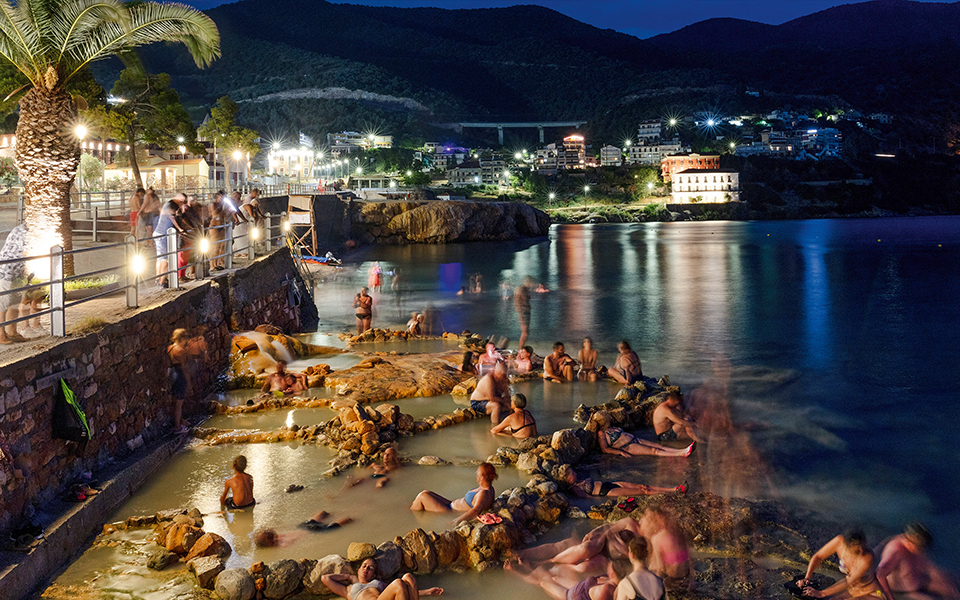
An evening dip in the little rock pools on Edipsos Beach.
© Perikles Merakos
Careful, don’t slip,” call the dockworkers to passengers boarding the ferry that links Arkitsa with the port of Edipsos. The vessel fills with vehicles, the wide doors close, and the 40-minute crossing to the famous spa town of northern Evia begins. “Come on, come on, let’s take a photo!” Just before the ship docks, families gather on deck, posing against a backdrop of green mountains, the hotels of Edipsos and a sea shimmering in the late afternoon light.
Many of the passengers have been here before. I talk with a family standing next to me, for whom Edipsos has become part of a long-standing tradition, and to a German couple in their sixties who first came here a decade ago and, feeling nostalgic this year, booked a studio months in advance for a return this summer.
Before setting foot in Edipsos, I was under the sway of ageist clichés. In my mind, this was a destination exclusively for the elderly. And now, a quick glance from a car window confirms that they do make up the majority the people we are passing, but stereotypes exist to be disproved.
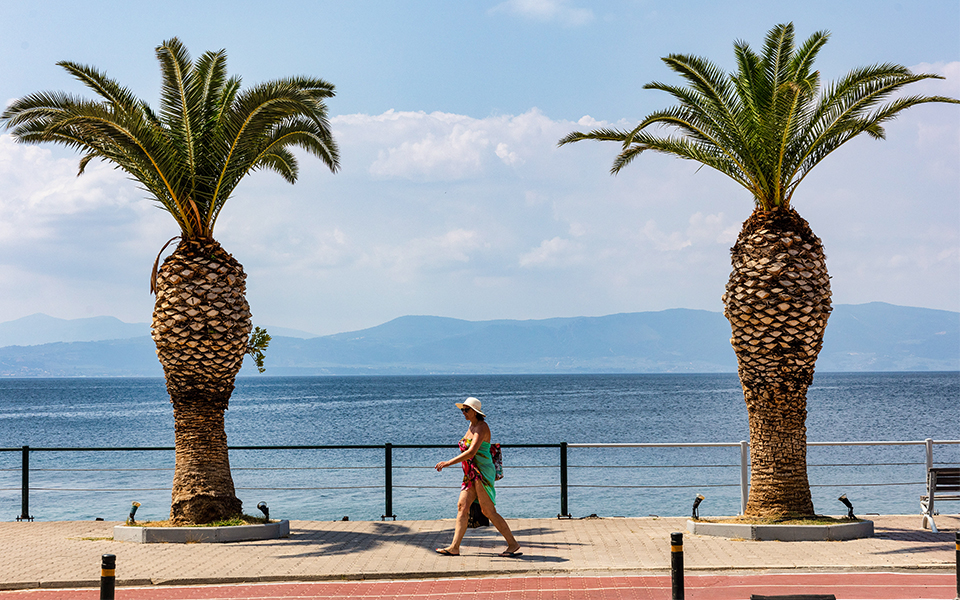
A stroll along the promenade before or after an afternoon swim.
© Perikles Merakos
Strictly speaking, Edipsos is a settlement that doesn’t actually touch the sea; it lies four kilometers inland from its coastal annex, Loutra Edipsou, a settlement that many long-time vacationers still refer to simply as “Loutra.” They head down to the beach wearing their sunhats and carrying beach bags, making their way toward the shore in front of the Thermae Sylla Hotel, instantly recognizable by a turret that lends the town the aura of a bygone era.
The hotel takes its name from the Roman general Sulla who, according to Plutarch’s Parallel Lives, sought relief for his ailments in the region’s hot springs. For centuries, the ruins of the Roman baths were a local landmark. In the mid-19th century, residents from neighboring villages (Edipsos, Yialtra and Lichada) would set up makeshift lodgings at the northern edge of the baths, beneath the plane trees whose branches shaded the thermal springs.
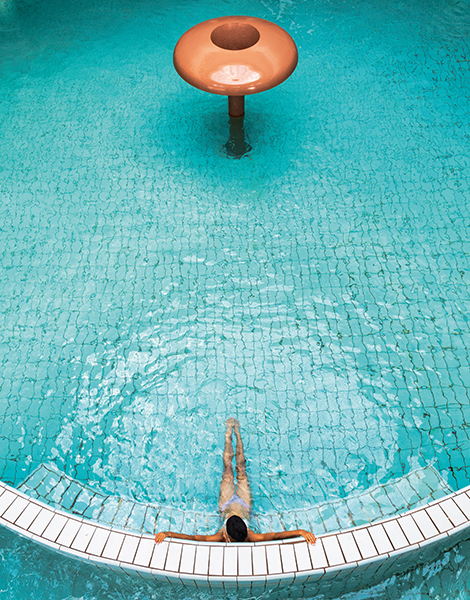
Hydrotherapy at the Thermae Sylla.
© Perikles Merakos
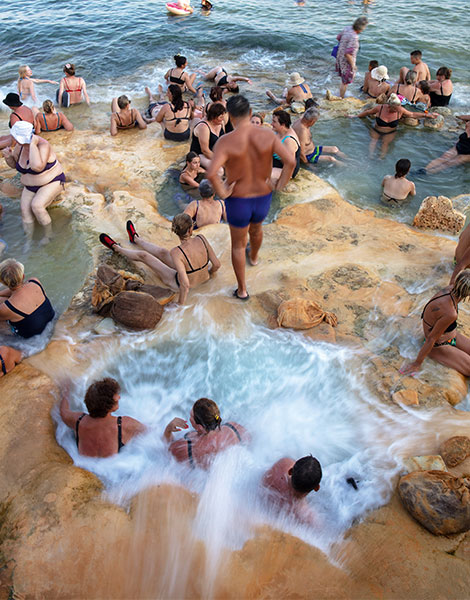
At the little rock pools, where seawater mingles with thermal springs, bathers start gathering from nine in the morning.
© Perikles Merakos
The property on which the hotel stands was originally granted to the Tombazi family, heroes of the 1821 Greek War of Independence, in recognition of their service to the nation. A descendant, Errikos Tombazis, founded the hotel in 1897, making it the region’s first luxury establishment boasting its own thermal springs. By the early 20th century, thermalism had become one of the first forms of tourism in the modern Greek state.
“Among the hotel’s keepsakes, we discovered letters from Austrian visitors inquiring about room rates with natural light or with candlelight, as electricity had yet to reach Edipsos,” says the hotel’s director, Yiannis Koutropoulos.
With electricity came tourism development. Along the seaside promenade rose the interwar hotels Avra, Istiaia and Aigli. At the height of the resort’s popularity, one could stand at the Thermae Sylla and take in the Kastalia Hotel, which served as a hydrotherapy center for war veterans, the Ai Pigai with its massive marquee, the Heraklion with its distinctive burgundy façade, and the Stadion with its white exterior. Of these, only the Avra, the Istiaia and the Thermae Sylla remain in operation today.
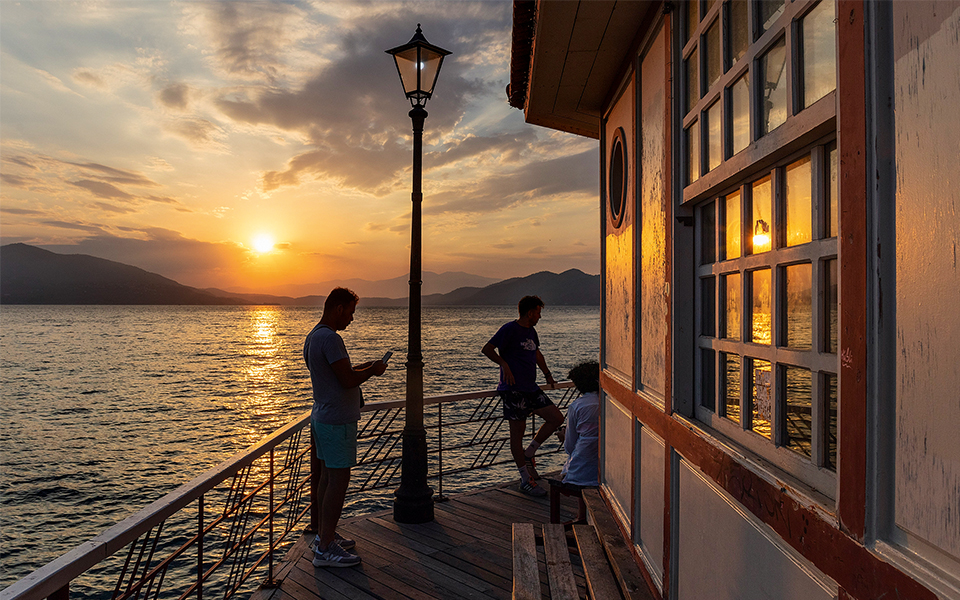
Sunset at the former Kyma Pavilion.
© Perikles Merakos
During the interwar period, Edipsos became the most important center of thermal tourism in Greece, attracting figures of note. At the Thermae Sylla, rooms once occupied by Eleftherios Venizelos, Maria Callas, Greta Garbo, and Winston Churchill look largely the same now as they did then. Throughout the building, the high ceilings are adorned with plaster decorations that evoke an era when such craftsmanship was a given. There’s a palpable sense of history in these spaces – not as if they were museum pieces, but as a living continuum.
From my window, I can see the outdoor pool, where elderly bathers perform exercises. The water is a blend of seawater and thermal spring water, with temperatures ranging between 28 and 30 degrees Celsius. I prefer to head to the hydrotherapy hall, once frequented, as co-owner Voula Karatziou-Anastasopoulou explains, “by cosmonauts from the Gagarin Institute and Russian ballet dancers with worn-out knees. The results were spectacular, thanks to the therapeutic action of the spring waters on the musculoskeletal system.”
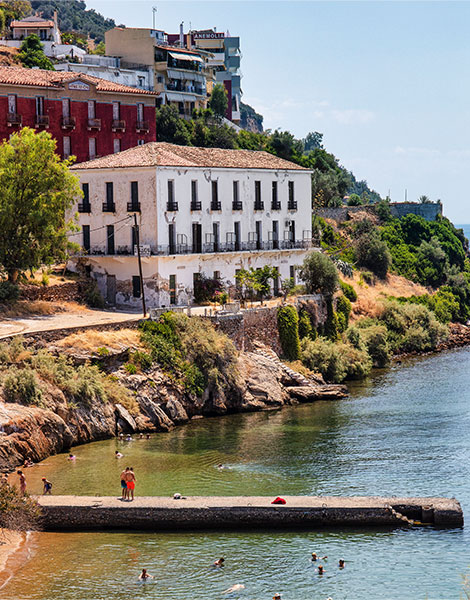
The Stadion Hotel in the foreground, with the Heraklion behind it. Neither operates today.
© Perikles Merakos
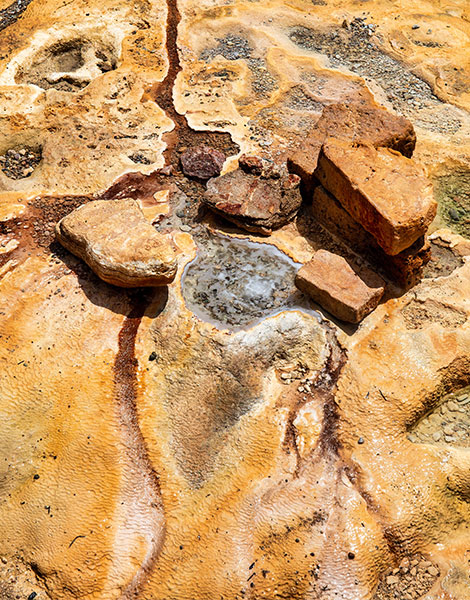
The little rock pools.
© Perikles Merakos
In the hall’s reception area, I come across photographs of a visit to the Thermae Sylla by a joint delegation of American and Russian astronauts and cosmonauts from the International Space Station. I recognize the broad smile of astronaut Peggy Whitson, who, I recall, holds the record as the oldest woman to complete a spacewalk. As I slip into the water, I notice only its temperature, hovering between 30 and 32 degrees Celsius. I sink slowly, feeling the warmth take over my muscles. I relax, and there is nothing more to do. I simply remain there. My heartbeat slows, my mind empties, and for a few minutes, nothing exists but the “now.”
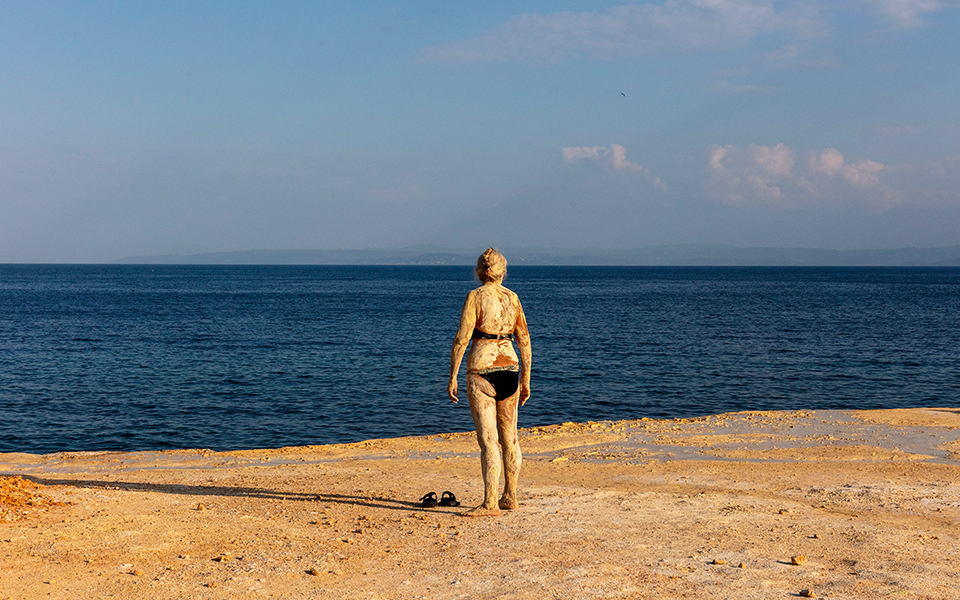
Many visitors try clay therapy at the hot springs, for a deep cleansing of the skin.
© Perikles Merakos
In front of the historic hotel, pipes carrying thermal water empty into the Evian Gulf, creating a unique mix of bathing and hydrotherapy; cool sea currants are suddenly interrupted by the higher temperature of spring water. The shoreline here is narrow and studded with rocks that have been eroded and turned yellow by the heavy deposits of limestone and trace minerals. Locals told us that during the pandemic, when movement was restricted, young people carved artificial hollows into one of these rocks, forming small pools that collected thermal water, where they could sit and soak in comfort.
Umbrellas are scarce, claimed only by those who stake their spot from nine in the morning. Most people arrive after ten and leave just before one. Upon arrival, bathers spread their towels on any available surface: some on the sand, others on the ledge beneath the wooden hooks where belongings and towels are hung, others still on the mineral-stained rocks themselves or farther along at the abandoned EOT pavilion, where the roof still provides shade for those who aren’t fond of sunbathing. Many wear special water shoes, both to avoid slipping on the rocks and to better manage the pebbly seabed. “Be careful on that rock, it’s no joke. And no running!” shouts a mother to her daughter, who scampers up and down the steps, collecting clay from the cliff face.
I step gingerly into the sea, like anyone unaccustomed to walking on pebbled shores, cooling off briefly before climbing out again to stand beneath the rocky ledge where thermal waters cascade like a waterfall. There’s a small line of people waiting. An unwritten rule seems to prevail; everyone respects the crowd and avoids lingering too long. I edge closer, unsure whether the water will be too hot, then stand beneath the yellowed rock. It is the very definition of relaxation.
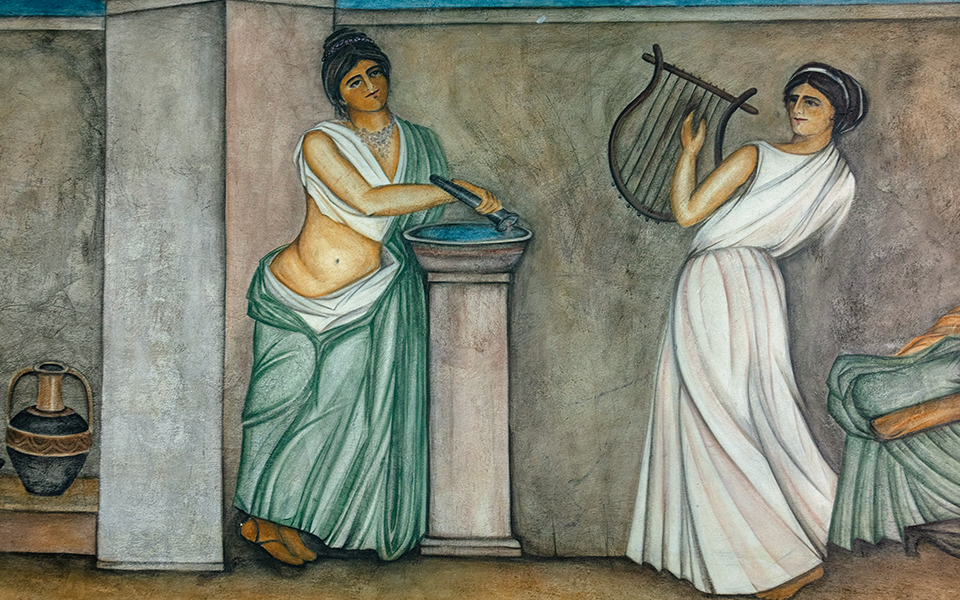
The word “spa” is said by some to have Latin roots and come from the phrase salus per aquam (“health through water”), a motto reflected in the murals of the Thermae Sylla hydrotherapy hall.
© Perikles Merakos
On the neighboring rock, three women from the Serbian city of Kruševac are sitting together. It feels unusual to see them this far south, as most Balkan visitors typically spend their summers along the coasts of Pieria, Halkidiki, or Kavala. “Travel agencies often advertise package deals for Edipsos. This year we decided to come for the first time, because it seemed cheaper than the prices we found in northern Greece, and also because we wanted something different,” Vesna explains.
Locals we spoke to note that tourist traffic has slowed this summer. “In the past, visitors would spend twenty days here. It’s still cheaper than other islands, but even so, in recent years everyone is cutting back. Greeks simply can’t afford it anymore,” says Elli Karatsiraki, who runs a small guesthouse with rental rooms in the Platania district, the area where Loutra Edipsou first developed. Yet there is a counterbalance. “Edipsos is a destination with visitors all year round. The high season now stretches into October, while the hot springs make it appealing even in winter. Imagine, we’re fully booked on October 28. And it’s not only older people – young couples are coming too, drawn to thermal tourism.”

The Aigli Hotel, built during the town’s boom years in the interwar period.
© Perikles Merakos
By half past twelve, the beaches are empty. It’s time to rest. Many people have lunch on the balconies of their rented accommodations, while others head to the tavernas beneath the plane trees at the northern edge of town or along the coastal road toward Aghios Nikolaos. “It’s still quiet now; wait until Saturday and Sunday, then you’ll see,” says the waiter at Maravelis Fish Taverna as he sets down a platter of fresh fish.
In the afternoon, the beach beckons once more. Around five-thirty in the afternoon, bathers return, leaving again by seven, just as the sun begins to set, its light bathing the old Kyma Pavilion in golden tones. Once a seaside refreshment stand, the venue now comes to life with periodic art exhibitions. In early summer, it’s a venue for screenings that form part of the Evia Film Project, organized by the Thessaloniki International Film Festival.
Before sunset, we drive to the nearby village of Yialtra to visit the Vryniotis Winery. Here, within the family vineyards, wine lovers can taste the local grape varieties that flourish in northern Evia – such as Vradianó and Mavrokountoura – while enjoying panoramic views of the North Evian Gulf.
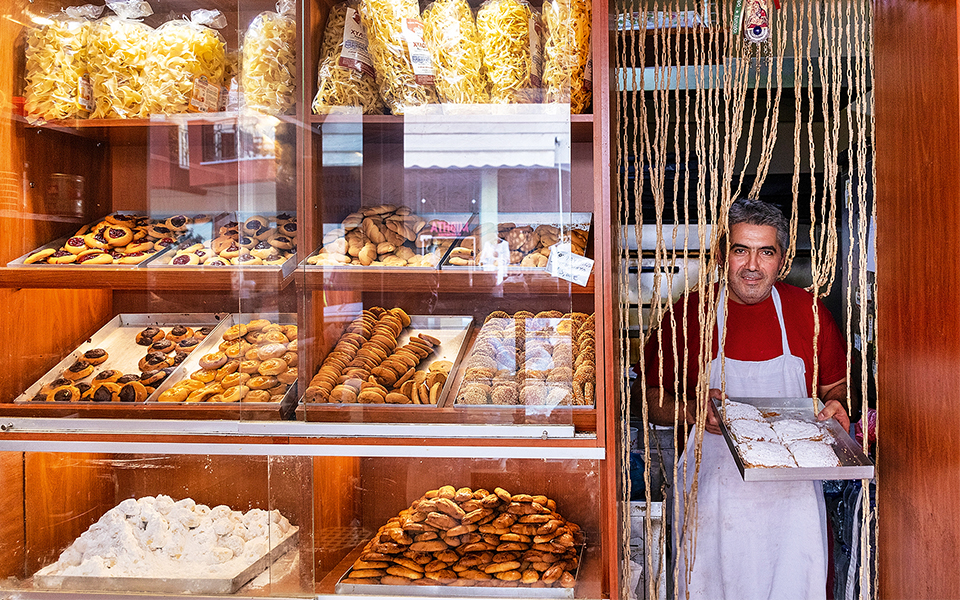
Thanasis Delbenderis steps out of his bakery with trays of fresh bougatsa.
© Perikles Merakos
Back in Edipsos, the promenade closes to traffic each evening, and the town comes alive. First stop for many is the Mahairas pâtisserie, a family-run business in operation for 110 years, famous for almond sweets, butter kourabiedes, and ergolavoi (macaroon-like cookies). In the back of the workshop, Yiannis Mahairas and his son Anargyros prepare confections that locals and visitors alike take home with them. “It was the first pastry shop in town, and all the area’s pastry chefs started here,” says Mahairas. “Something I remember from my grandfather’s old recipes is that he always said: ‘I add a little less sugar, for economy.’ At the time, sugar was imported and cost more than almonds, which are now much more expensive. That’s why they made them that way.”
At nine o’clock, the tourist train begins its rounds. Families and visitors of all ages climb aboard, snapping photos as traditional island songs sung by Yiannis Parios play through the speakers. We may not be in the Cyclades, but Evia, too, is an island. Locals and vacationers stroll up and down the promenade, ice creams or roasted corn in hand. Many pause at the open-air Apollo Cinema, the only one still operating in the wider area, to catch a few scenes from the evening’s free screening. In Edipsos, everything reminds you that summer is here, and in no hurry to leave. And nor, of course, are we.
A closer look at the powerful,...

City or mountain? Urban strolls or...

Swim in thermal springs, explore untouched...

Michiel Bakker, President of the Culinary...


