A Thread of Silk, a Story of Grace
Near the town of Serres, Anna…

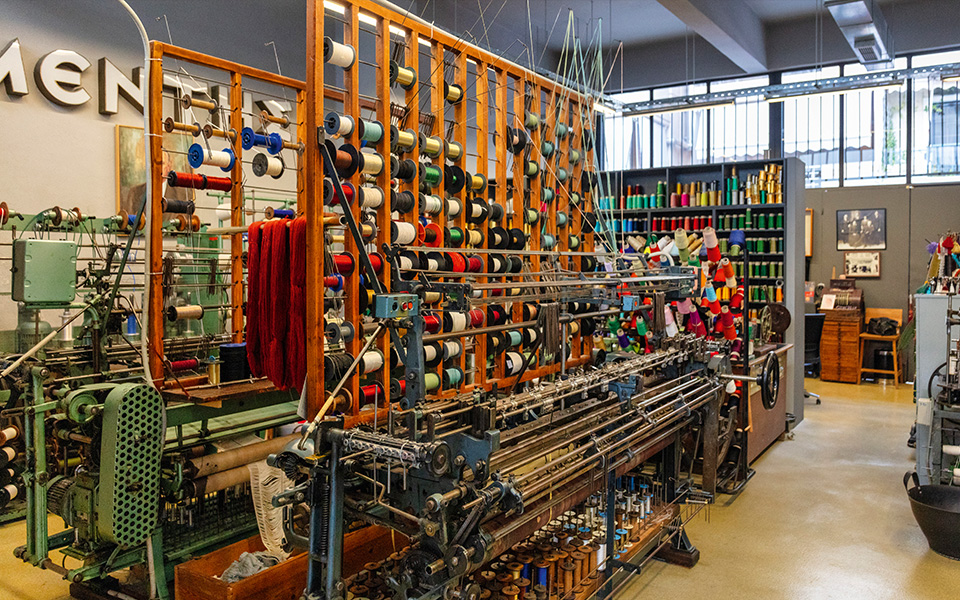
NEMA's main production space is located in what was once an old spinning mill.
© Perikles Merakos
Virginia Matseli was neither a collector nor a textile professional. A dedicated folklore researcher and ethnologist with a 35-year career in the Ministry of Culture’s Department of Modern Cultural Heritage, she joined the Mentis-Antonopoulos NEMA Passementerie initiative almost by chance; or perhaps by that fine thread that inevitably leads people to what will ultimately define them. Her Asia Minor roots, her grandparents’ stories of silk and silkworm eggs, and her growing fascination with handmade garments led her, at the height of the financial crisis in 2010, to begin documenting Athens’ disappearing traditional crafts. Milliners, embroiderers and artisans whose families had contributed to the country’s handmade production for generations were closing one by one.
Among the many captivating stories she uncovered, one stood out: the tale of the Mentis family and its long tradition of silk craftsmanship. “For decades, the Mentis workshop supplied Greece with silk tassels, trims, cords, fabrics and embroidered adornments from the heart of Athens – until the financial crisis threatened to end it all,” she recalls. For Matseli, the thought that this chapter of modern Greek cultural identity might vanish was unthinkable. “I started digging, speaking to everyone I knew, until one remarkable woman said to me: ‘What then? Will our Evzones wear tassels imported from Asia? Silk craftsmanship must be saved.’”
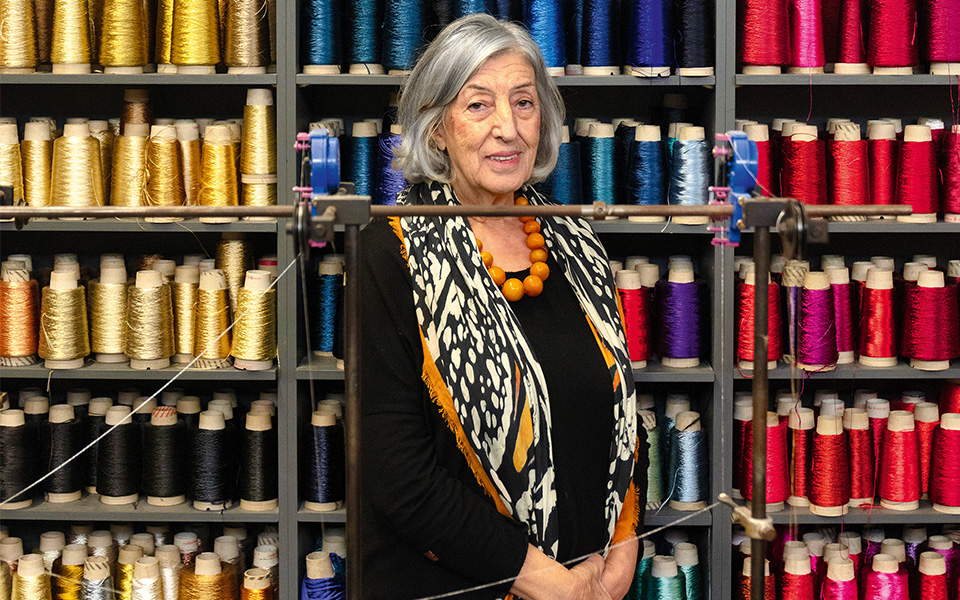
Εthnologist Virginia Matseli, head of NEMA.
© Perikles Merakos
That woman was Lia Martinou, who provided the financial support that allowed NEMA to take the form it has today: an active silk workshop in the neighborhood of Kato Petralona that, since 2012, has worked to revive Greece’s handmade textile arts under Matseli’s guidance, operating as a living museum. With the support of the Benaki Museum’s then-director, Angelos Delivorrias, the workshop came under the Museum’s auspices. The Antonopoulos family, renowned silk artisans, donated their stock and machinery, enabling the success of the project. Their historic machines were restored, craftsmen were rehired, and the art of silk weaving once again found a place in the heart of the city.
“The whole philosophy of this initiative is about bringing yesterday into today,” Matseli says. “We want young people to learn about the loom, about weaving, about silk – not out of nostalgia, but with a view to the future. I believe the time will come when we will focus on our hands again, instead of just pressing buttons.” Ask her what a loom truly represents, and she’ll tell you it is the ancestor of the computer. Nearby stand two iconic French Jacquard looms from 1832; technological objects, yes, but also monuments to human ingenuity. “Joseph-Marie Jacquard, the French weaver and merchant, used punched cards to determine the pattern of a textile, an innovation that later became foundational to computer science. It’s not a coincidence that Ada Lovelace, history’s first programmer, studied his system,” she says.
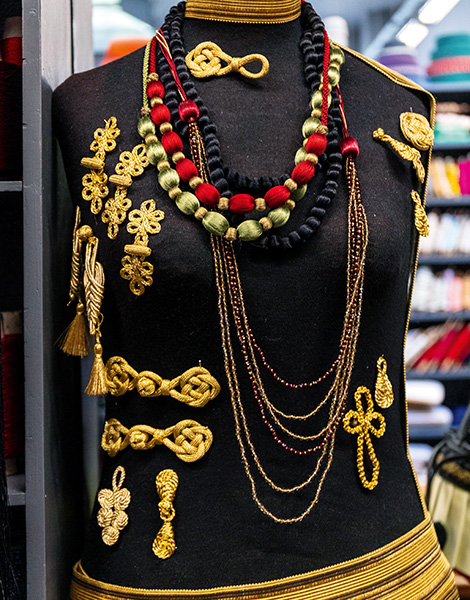
Handmade decorative pieces crafted from yarn.
© Perikles Merakos
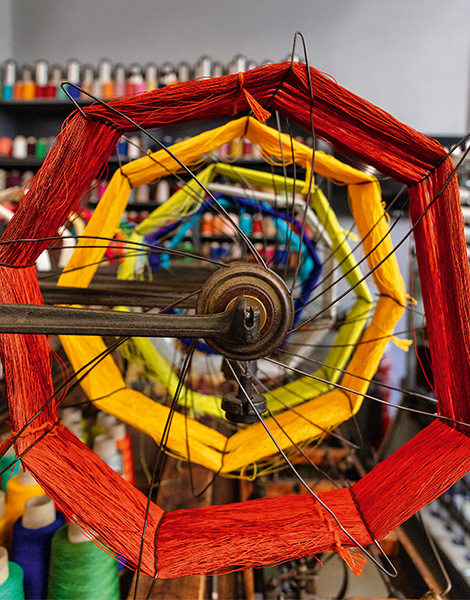
Vibrant silk threads on the machines.
© Perikles Merakos
As we speak, six silk artisans work quietly beside us, their hands producing objects that are the result of traditional know-how and contemporary aesthetics: trims, tassels, decorative straps, and even Christmas ornaments. Some pieces are custom orders for Greek brands such as Callista Crafts and Zeus+∆ione; others end up in the Benaki Museum shop, where visitors can support the initiative through their purchases. “From the very beginning, our aim was to preserve this handmade art,” Matseli explains. “Anyone who comes here can feel the threads, the cotton, the silk, the textured rugs – materials that retain the imprint of our touch. We used to write letters, taking time over them, touching the paper again and again and looking at our handwriting before we mailed them. Now everything happens through screens. Machines are beginning to leave humans behind. That’s why I believe we must not lose our roots – because if we do, we will lose ourselves.”
Visitors to NEMA are, in fact, encouraged to touch everything around them. Matseli and her team regularly host workshops and educational programs designed to reveal the expressive power of thread. Preschool groups learn about yarn and weaving. Adults with visual impairments explore materials through touch, discovering the world of textiles with their fingers. Refugees and young people with limited access to the arts come to experience the joy of making something by hand. “We recently had a wonderful collaboration with Harvard University. Students of Design and Sustainability came to discuss clothing and how the climate crisis affects textiles,” Matseli says. “Next, we’re planning a creative project with women in prison. We’ll provide them with thread, and they will tell their stories through embroidery, which will then be sold to support them financially.”
At its core, NEMA is a vibrant and outward-looking community that is “weaving” itself in the present with the intention of shaping the future. “It is the community of silk,” Matseli says. “Because the goal was never to save the machines or the threads, but the knowledge carried by the people who shaped modern Greek culture; their emotions, their loves, their joys and sorrows.”
Near the town of Serres, Anna…

From holiday decor to pieces that…

Explore these unique items by Greek…

We explore the delicious flavors of…