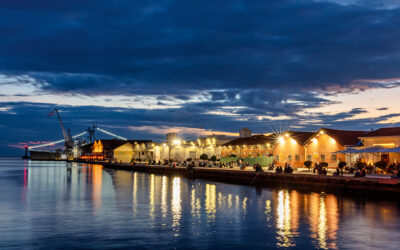
City Scenes: Thessaloniki Caught on Camera
Where dusk, movement, and memory meet,...

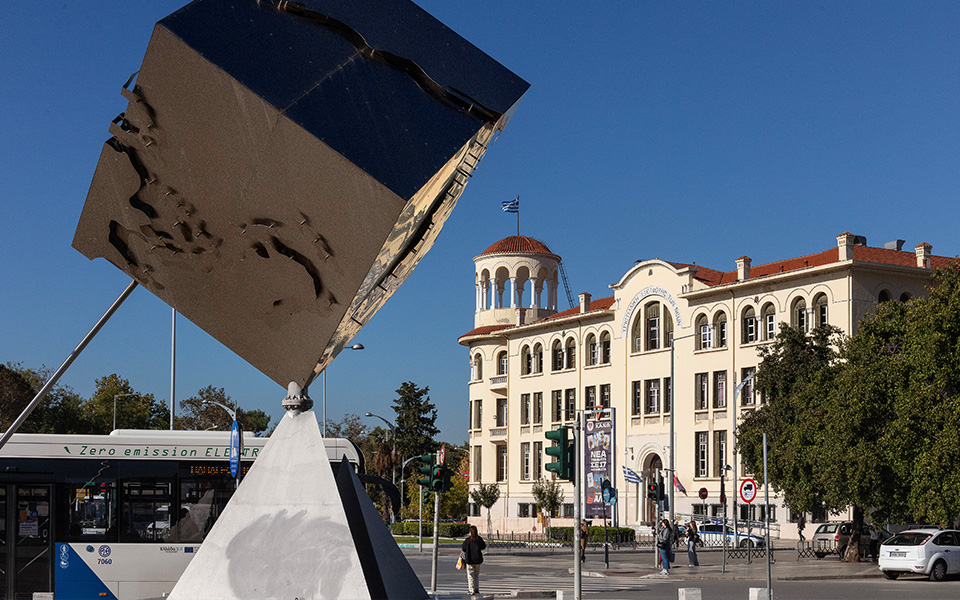
The YMCA Mansion as seen from the direction of the Thessaloniki International Trade Fair.
© Perikles Merakos
1934, 1 Nikolaou Germanou
In 1924, the foundation stone for one of Thessaloniki’s most iconic buildings was laid. Ten years later, the YMCA Mansion opened its doors to welcome hundreds of young men and women eager to engage in athletic and intellectual pursuits. Designed by architect Marinos Delladetsimas, the building consists of two three-story wings connected by an open circular balcony, crowned by an impressive dome that dominates the skyline and draws the eye. The influence of Ernest Hebrard’s vision for Aristotelous Square is unmistakable, and the Neo-Byzantine touches bring to mind the city’s rich medieval heritage.
Thessaloniki’s long and proud basketball tradition owes much to the YMCA, whose members first introduced the sport to the city. Within this very building was Thessaloniki’s first indoor basketball court, and even today it houses the only heated swimming pool in the city center. Generations of Thessalonians have trained in its pioneering facilities, gaining not only physical strength but also the values of fair play and discipline.
Today, the YMCA Mansion remains a vibrant institution: it hosts a wide range of athletic programs, maintains an excellent library and serves as a venue for exhibitions, concerts and other cultural events. Still open to all, it continues to inspire, true to its long legacy.
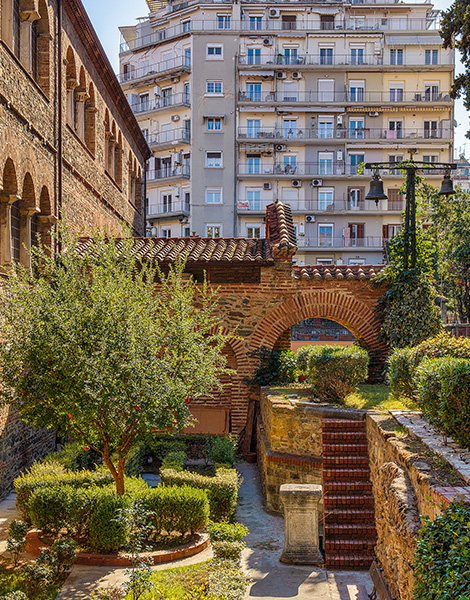
The Church of the Acheiropoietos
© Perikles Merakos
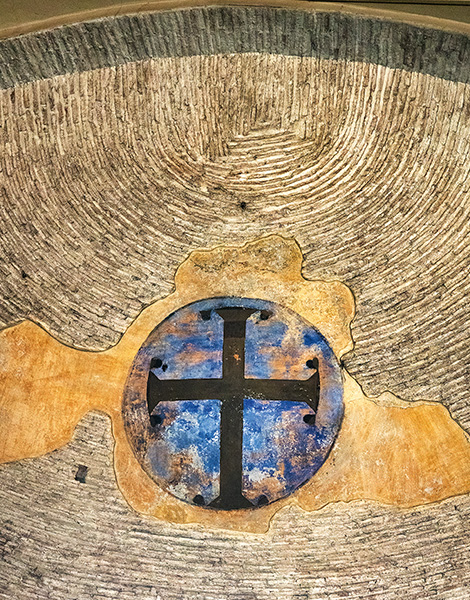
The Church of the Acheiropoietos
© Perikles Merakos
Late 5th c. AD, 54-56 Aghias Sofias
In the heart of the city beside the Aghia Sofia metro station stands the early Christian Church of the Acheiropoietos, the oldest church in Thessaloniki still in use today. A three-aisled basilica built in the late 5th century AD, it has endured for more than fifteen centuries. Its evocative name, Acheiropoietos (“Not made by human hands”), recalls a miracle that occurred during the Byzantine era; according to tradition, an icon of the Virgin and Child changed form by itself. Because this transformation occurred without human intervention, the icon – and, by extension, the church – came to be known as Acheiropoietos.
Inside the church, a sense of serenity prevails. The marble floor, the graceful columns crowned with exquisitely carved early Christian capitals, the galleries and the abundance of light streaming through dozens of windows give the ancient sanctuary a warm feeling. In the north aisle, Roman mosaics survive from an earlier structure, possibly a bathhouse. Only fragments of the original decorations remain, including some mosaic work on the arches of the arcades, where the name of Andreas, Bishop of Thessaloniki, is still visible. In the south aisle, a rare fragment of a 13th-century fresco depicts the Forty Martyrs of Sebaste.
When Thessaloniki fell to the Ottomans on March 29, 1430, Sultan Murad II, the city’s conqueror, converted the Church of the Acheiropoietos into a mosque. A succinct dedication, elegantly framed in a medallion, was carved onto the eighth column of the north aisle: “Sultan Murad Khan conquered Thessaloniki, year 833 of the Hegira.” After the city’s liberation in 1912, the church was once again used for Christian worship.
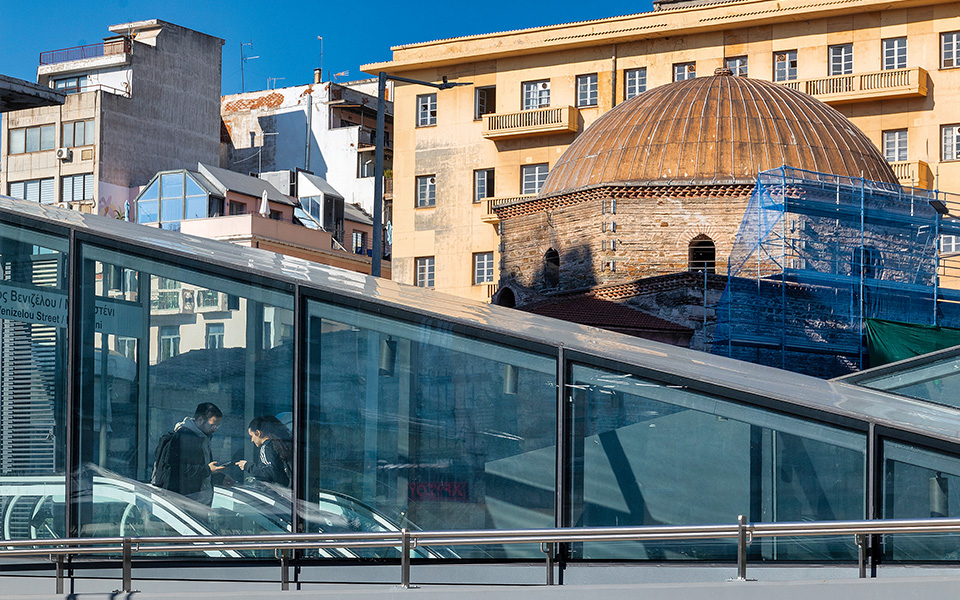
Hamza Bey Mosque
© Perikles Merakos
Alkazar, 1467-1468, 49 Egnatia
Every civilization leaves its mark on the ever-changing fabric of cities. The Ottoman period in Thessaloniki lasted nearly five centuries and gifted Thessaloniki a number of significant monuments. The Hamza Bey Mosque, the oldest mosque in the city, was built between 1467 and 1468 by Hafsa Hatun in honor of her father, the Ottoman official Hamza Bey. According to historical accounts, Hamza Bey met a gruesome fate in Romania, executed in public by either Vlad III Țepeș – the historical figure who inspired the character of Count Dracula – or by Stephen III the Great. The impressive mosque dominates the junction of Egnatia and Venizelou streets. Its core, almost square in shape, is crowned by a majestic dome. It features a spacious courtyard with imposing columns, many of which were repurposed from earlier Christian or Roman monuments.
Following the Greco-Turkish War and the subsequent population exchange between Greece and Turkey in 1923-1924, Thessaloniki’s Muslim inhabitants were forced to leave the city. The mosque soon fell into disuse; a few years later, it was converted into a cinema named “Alkazar,” a name still familiar to most Thessalonians today. In the 1980s and 1990s, the building suffered significant damage through unsympathetic renovations by private owners, who turned the interior into a series of shops selling imitation leather goods.
With the construction of the nearby Venizelou metro station, the mosque has been included in a restoration program. In the near future, it will reopen to the public as a cultural venue, reclaiming its rightful place as one of Thessaloniki’s architectural and historical landmarks.
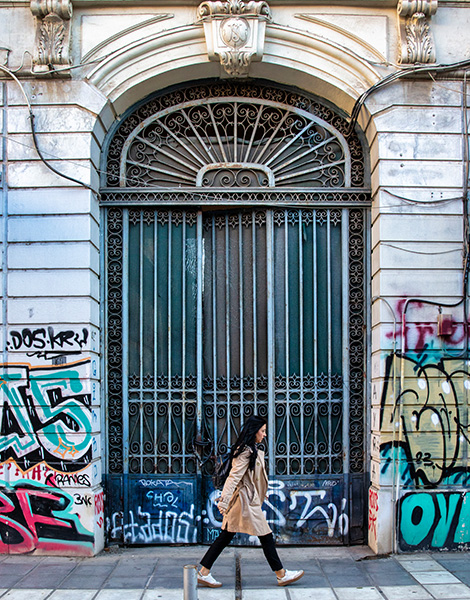
Saul Modiano Arcade
© Perikles Merakos
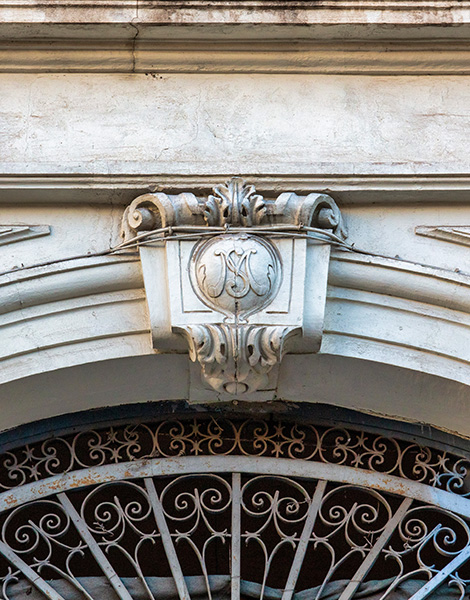
Saul Modiano Arcade
© Perikles Merakos
1881, 17 Eleftheriou Venizelou
The history of the Modiano family is synonymous with the cosmopolitan spirit of old Thessaloniki. Arriving from Livorno, Tuscany, in the 18th century, the Modianos became part of the city’s large Sephardic Jewish community and soon left a lasting mark on Thessaloniki’s urban and social life. The family patriarch, Saul, rose from humble beginnings as a poor orphan to become one of the wealthiest men not only in Thessaloniki but in the entire Ottoman Empire.
Among the architectural legacies left by the Modianos (including their family mansion, which now houses the Folklife and Ethnological Museum of Macedonia-Thrace, and the famous Modiano Market, recently restored at the junction of Ionos Dragoumi and Vasileos Irakleiou streets) is the remarkable Saul Modiano Arcade. Completed in 1881, it was a groundbreaking addition to the Ottoman city center. One of Thessaloniki’s first multipurpose commercial complexes, it combined shops, offices, and workshops, and even included a han, an early form of inn where merchants and tradesmen could stay overnight.
It was fittingly named Cité Saul, and its passageways pulsed with the same energy that animated the commercial heart of the city. The great fire of 1917 severely damaged the building, which once occupied an entire city block, but a portion of the original facade survives along Vasileos Irakleiou Street, where visitors can still see exquisite neo-Renaissance architectural details: elegant Corinthian capitals, ornate balconies with fine balustrades, and a heraldic emblem bearing the intertwined initials “S” and “M,” the monogram of Saul Modiano.
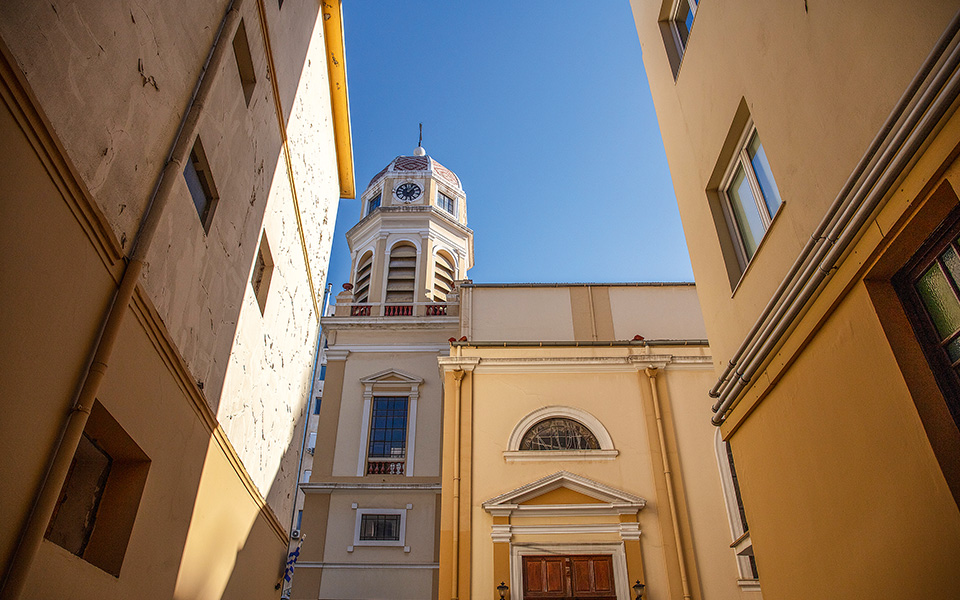
The Immaculate Conception Cathedral
© Perikles Merakos
1900, 19 Fragkon
The Levantines of Thessaloniki formed a distinctive community within the city’s old multicultural mosaic. Though relatively few, they played a significant role in the commercial, social, and cultural life of the great Balkan metropolis. Locally, they were referred to as Franks, a term broadly used to describe Western Europeans and, by extension, Roman Catholics. Among them were merchants, consuls, bankers, missionaries, doctors, and even a few adventurers.
Despite being subjects of various European states, they were united by their shared Catholic faith. The presence of an imposing church to serve their spiritual needs was essential to the prestige and cohesion of their community. In 1896, the renowned architect Vitaliano Poselli was commissioned to design Thessaloniki’s Catholic Cathedral. On the site of a smaller earlier chapel, Poselli built a grand basilica dedicated to the Immaculate Conception of the Virgin Mary.
According to local lore, when the final tile was placed on the roof, the Italian architect knelt in prayer and made the sign of the cross, thanking God that no worker had been injured or killed during construction. Even today, the three-aisled basilica on Fragkon Street impresses visitors with its exceptional acoustics and towering 40-meter-high bell tower. The flags of the Vatican fluttering in the courtyard welcome worshippers from around the world, while the same premises also house the offices of Thessaloniki’s Catholic community.
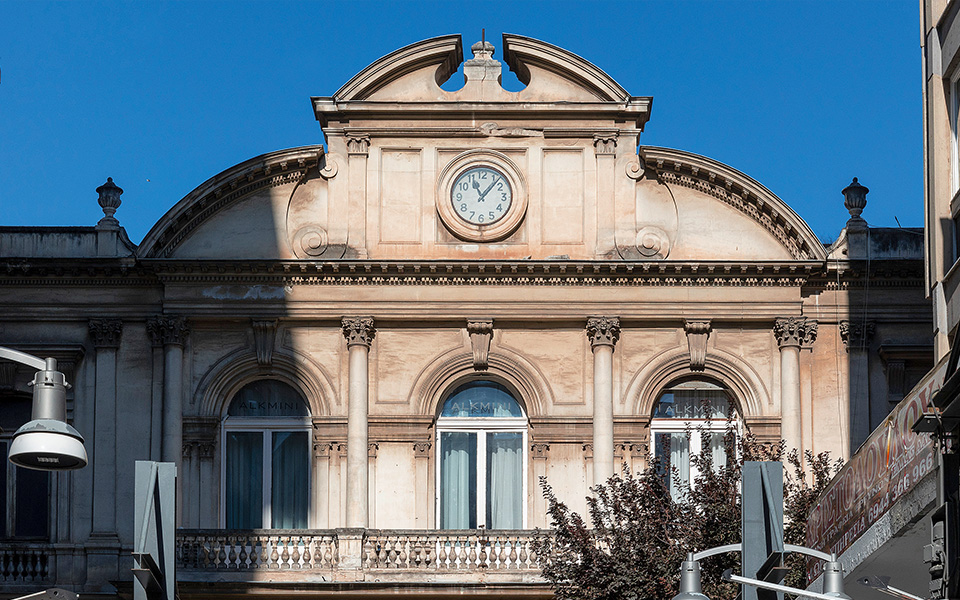
Malakopi Arcade
© Perikles Merakos
1907, 7 Syngrou
On historic Stock Exchange Square – today a lively hub of with bars, restaurants, shops and constant foot traffic – one building continues to command attention. Known today as the Malakopi Arcade, it was originally constructed in 1907 to house the headquarters of the Banque de Salonique, a powerful financial institution owned by the influential Allatini family.
The Allatinis, from Livorno, were in a sense the rivals of the Modiano family. Their industrial and social reach was vast; by 1900, their flour mills employed more than two hundred workers, and their grand villa in Thessaloniki famously hosted Sultan Abdul Hamid II, who lived there in exile for three years after being deposed by the Young Turks.
At the dawn of the 20th century, the Allatinis commissioned celebrated architect Vitaliano Poselli to design a new building that would house their bank. The result was a two-story rectangular structure with a Baroque-style curved pediment, organized around a central square atrium covered by a glass roof that allowed natural light to flood into the interior. Remarkably, the original vault of the Banque de Salonique still survives in the basement of what is now a commercial arcade.
On the building’s façade, an ornate circular clock indicates 11:07. It was at that moment on the night of June 20, 1978, when a powerful 6.5-magnitude earthquake shook Thessaloniki. The stopped clock stands today as a silent, melancholy memorial to that night.
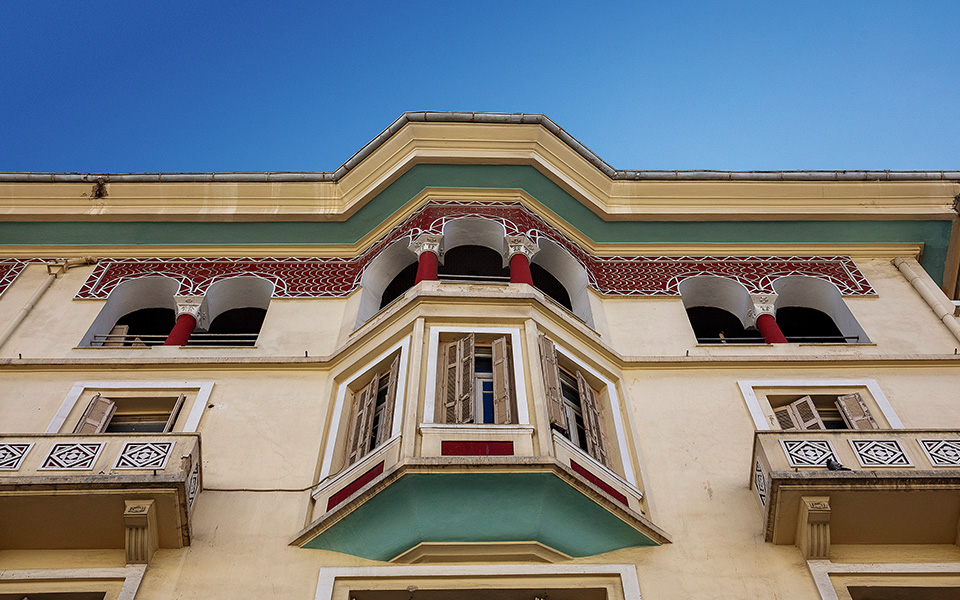
The Bosporion Mansion
© Perikles Merakos
1924, 8 Aristotelous
In 1917, Thessaloniki reached its all-time peak in population. To its residents were added hundreds of thousands of soldiers from the Entente forces, stationed in the region to fight – and perhaps die – on the Macedonian Front. Amid the turmoil of WWI, the city was struck by a devastating fire. Paradoxically, the blaze was not caused by a munitions explosion, bombardment, or other act of war, but – according to legend – by the carelessness of two Greek women frying eggplants, who inadvertently set much of the city ablaze.
The government of Eleftherios Venizelos reacted swiftly, appointing a committee of experts to redesign the burnt city. At its head was the French architect, urban planner and archaeologist Ernest Hebrard, who drafted an ambitious reconstruction plan. Though never fully realized, his plan gave Thessaloniki its most beautiful public space: Aristotelous Square. The square is distinguished by its unified architectural vision, as all buildings were required to conform to Hébrard’s design principles.
Among them stands the Bosporion Mansion, at number 8 Aristotelous. This twin four-story building was constructed as a residential property along the city’s new central axis. It’s notable for its Neo-Byzantine features, particularly the six biforate (or twin-arched) openings on the top floor that form elegant balconies. Another distinctive feature is its magnificent Art Nouveau entrance on the ground floor, one of the very few surviving examples in Thessaloniki. The Bosporion Mansion remains a vibrant fragment of the city’s past and one of the enduring jewels of Aristotelous Square.
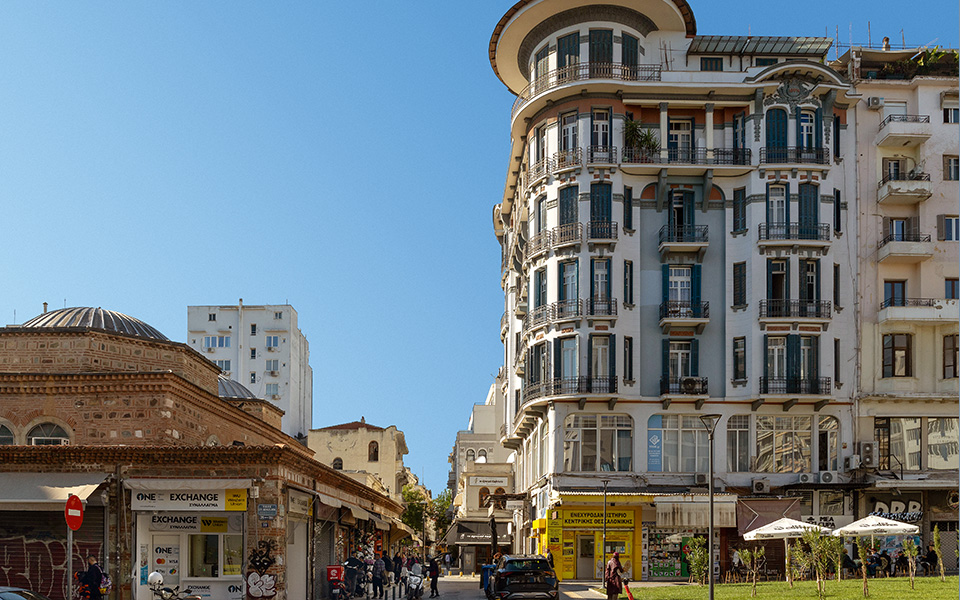
The Ergas Mansion
© Perikles Merakos
1925, 19 Dionysiou Solomou & 41 Eleftheriou Venizelou
It would fit in as easily in Paris or Vienna, yet the Ergas Mansion stands in the heart of Thessaloniki, drawing the gaze of even of the most indifferent passerby. Built in 1925 in the fire-ravaged zone of the city near the Ottoman Bezesteni and the Venizelou metro station, this six-story building was designed by two prominent interwar architects, S. Mylonas and E. Kotzambassoulis.
The construction of such grand edifices became common in Thessaloniki during the 1920s and 1930s, reflecting a broader urban trend to combine ground-floor retail spaces with offices on the lower levels and luxury apartments above. What sets the Ergas Mansion apart is its curved corner, crowned by an impressive dome punctuated with elegant circular skylights. The dome resembles a vast observatory overlooking the bustling streets and shops below, while the building’s eclectic decorative features lend it both grace and harmony.
The mansion was commissioned by the affluent Sephardic Jewish family of Alberto and Allegra Ergas. On the upper floor, within an oval medallion framed by ornate plaster garlands, one can still read the family’s name. Another subtle tribute survives at the main entrance on Dionysiou Solomou Street: the intertwined letters A and E – the initials of the original owners – can be seen on the wrought-iron door, silent relics of a cosmopolitan world long vanished.
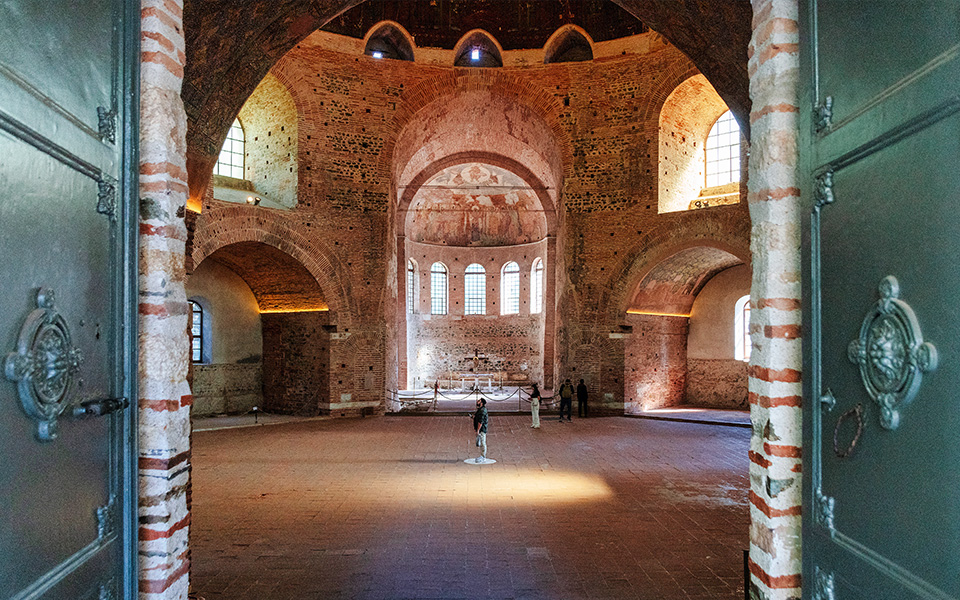
The Rotunda
© Perikles Merakos
Early 4th c. AD, 5 Aghiou Georgiou Square
Few monuments built 1,700 years ago still retain their original roof. What’s more, for the Rotunda in Thessaloniki, that roof is no ordinary structure; it’s a monumental crowning dome twenty-five meters wide. Yet it is not its architectural splendor, nor even its archaeological significance that is the most important aspect of the Rotunda. It has a deeper symbolic worth as one of the very few buildings to have served three of humanity’s great faiths: the ancient Greco-Roman pantheon, Christianity, and Islam.
The monument was commissioned by the Roman Emperor Galerius in the early 4th century AD as the crowning element of an ambitious architectural complex that also included a hippodrome, an octagonal throne hall, a Roman basilica, baths and, of course, the triumphal Arch of Galerius (Kamara), where the emperor is shown victorious over the Persians in distant Mesopotamia. Long thought to have been intended as Galerius’ mausoleum, the Rotunda is now believed by most scholars to have been built as a temple, perhaps dedicated to Zeus, Ares or perhaps all the gods of Olympus, much like the Pantheon in Rome.
A few decades later, at the end of the 4th or the beginning of the 5th century AD, the Roman Rotunda was converted into a Christian church and remained one for over a thousand years. Christianity was spreading throughout the Roman Empire, and ancient beliefs were slowly but steadily disappearing. The Rotunda’s magnificent mosaics, true masterpieces of early Byzantine art, date from this early Christian phase.
In 1591, when Thessaloniki was part of the Ottoman Empire, the Rotunda was transformed once again, this time into a mosque. Even today, a tall, slender minaret – the only one to have survived in the city – rises beside the original Roman building. The Rotunda stands as the living imprint of Thessaloniki’s timeless soul.
The OTE Tower
© Perikles Merakos
1970, 154 Egnatia
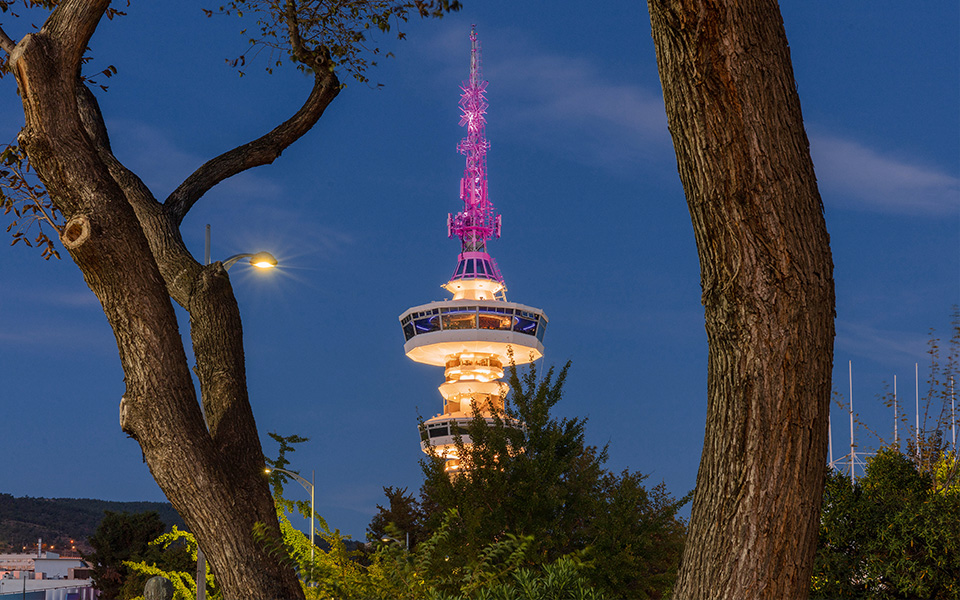
The Thessaloniki International Fair (TIF) was launched in 1926 with the mission of ushering in a “new era,” showcasing modern technologies and scientific innovations, and creating opportunities for commercial exchange between Greek and international entrepreneurs. After the Second World War, the need for technological modernization became even greater, leading to the construction of new modernist pavilions and buildings within the fairgrounds. The most emblematic of these – and still a defining feature of Thessaloniki’s skyline – is the OTE Tower.
Construction began in 1966 and was completed in 1970. Designed by architect Alexandros Anastasiadis, the tower was a bold experiment in the use of reinforced concrete, resulting in a fusion of function and futuristic design. It was named after the Hellenic Telecommunications Organization (OTE), to which it was leased.
Visitors can ascend its 166 steps or take the elevator to reach the tower’s restaurant and bar, which offer spectacular views over the city and the sea. The restaurant floor slowly rotates, completing a full 360° turn every hour and providing an ever-changing panoramic vista of Thessaloniki.
The OTE Tower also played a pioneering role in the history of Greek broadcasting; some of the very first Greek television programs were transmitted from here, introducing Thessaloniki’s residents tο the “small screen” in the early 1970s. Today, it remains both a technological landmark and a beloved symbol of the city’s modern identity.
The Masonic Mansion
© Perikles Merakos
1932, 44 Filikis Etaireias
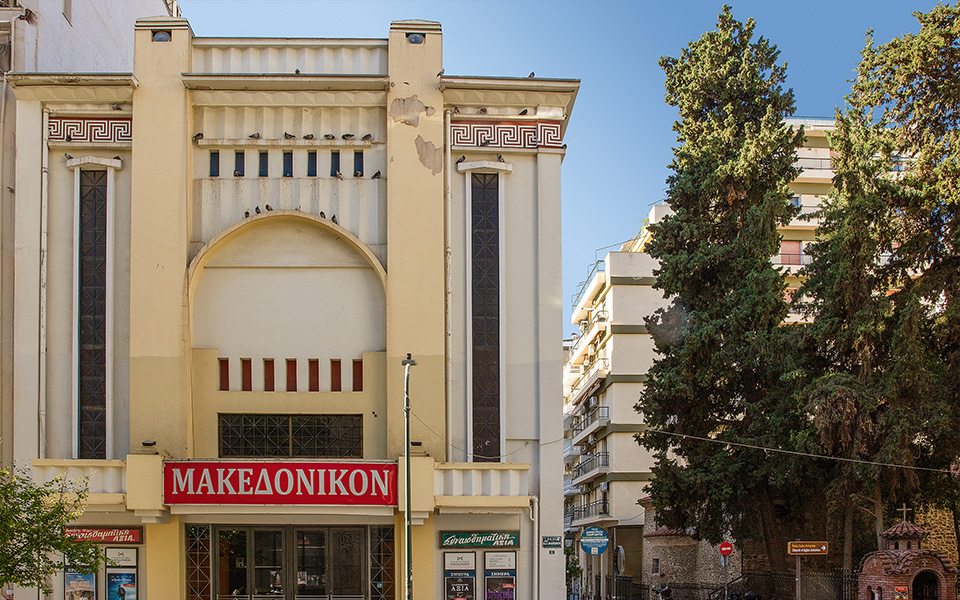
For many, Freemasonry is shrouded in mystery; for others, it represents a romantic remnant of the past. Whatever one’s view, it is a fact that Thessaloniki during the Belle Epoque was home to several Masonic lodges whose members included many prominent figures of local society. Today, the city’s impressive Masonic Mansion, constructed in 1932 by architects G. Manousos and S. Mylonas, still stands proudly on Filikis Etaireias Street.
The structure displays bold Art Deco influences and features various inventive elements, such as the vertical openings that frame its skylights, allowing abundant natural light to flood the interior. Few know that the entire Makedonikon Cinema, with its later modernist façade, was one of the mansion’s grand halls before being rented out as a movie theater.
Inside, a powerful sculpture by an unknown artist depicts the three stages of Masonic initiation through three male figures: the young Apprentice, the mature Fellow, and the elderly Master. The high-ceilinged halls, embossed symbols, carved wooden doors and ceremonial chamber all reflect the dignity and prestige of the lodge.
During the Nazi occupation, the building was requisitioned and the invaders destroyed or looted much of its prized library and other valuable treasures. Despite these losses, the Masonic Mansion endures as a living monument of Thessaloniki’s history and architecture, and a reminder of the city’s lesser known mysteries.
Where dusk, movement, and memory meet,...

The Goethe Institute's exhibition explores Athens'...

Major infrastructure projects, a significant urban...
From major infrastructure projects to a...