
In the Footsteps of St. Paul: A Pilgrimage...
Trace St. Paul the Apostle’s journey...

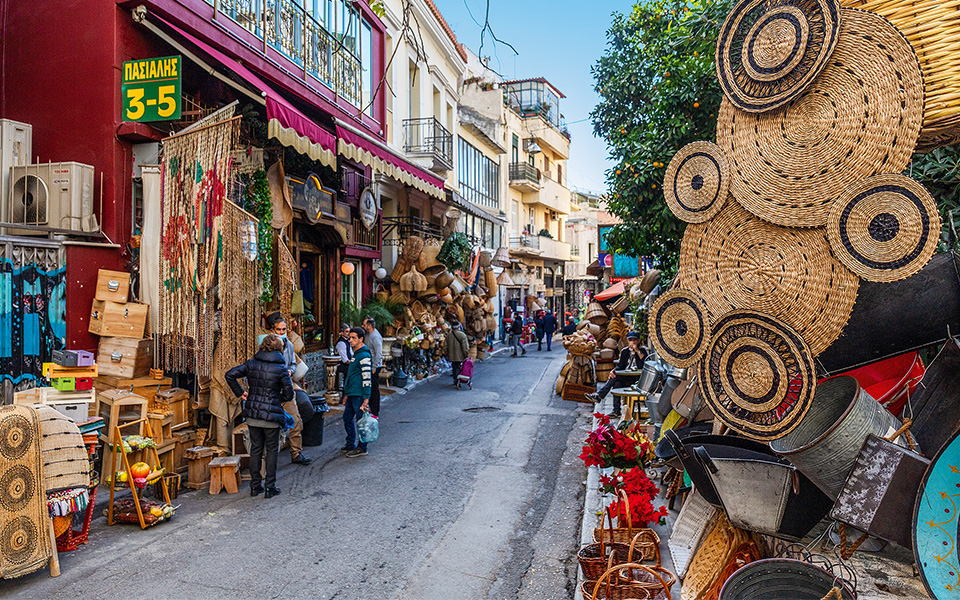
Pallados Street in Psyrri, full of pleasant surprises.
© Perikles Merakos
The city wanderer – the flâneur, as the French named him – is a figure that recalls the dandies of the 19th century: singular characters who drifted through the great crowds of the streets without ever losing their individuality. In much the same way, choosing to walk through Athens becomes a decision that will lead you – almost inevitably – to a series of revelations you could never experience otherwise. Speaking with the writer, architect and urban planner Alexandros Papageorgiou-Venetas, you sense (even vicariously) the narration of the capital through the eyes of a keen and persistent pedestrian. His book “Vimatismoi: Walks in the City” (published in Greek by Agra) captures impressions gathered over more than eight decades of tireless walking.
It is a text interwoven with passages from Greek and international literature, combined with the author’s own reflections. The result is polyphonic – and unmistakably peripatetic. Through Papageorgiou-Venetas’ personal recollections (many of which were born mid-stride) and through borrowed fragments from writers such as Walter Benjamin, Goethe, Poe, Andreas Embirikos, Robert Walser and others, we understand that wandering the city is not merely a form of physical activity; it’s a contemplative dialogue between the body and the urban landscape.
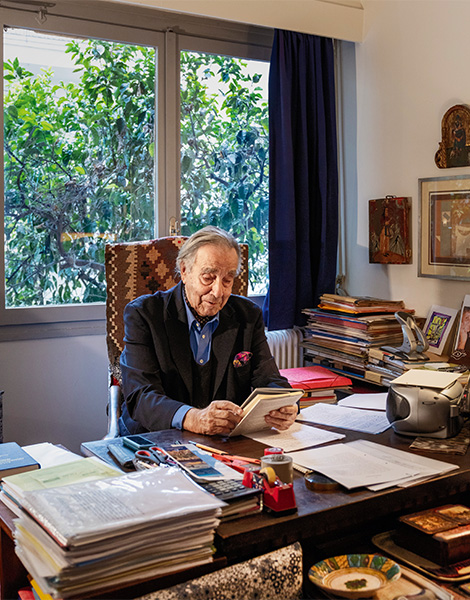
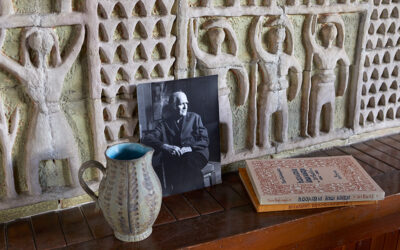
Alexandros Venetas-Papageorgiou at his desk.
© Perikles Merakos
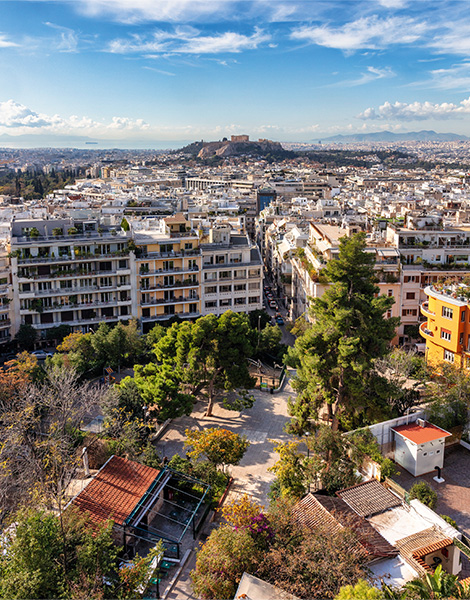
Dexameni Square in Kolonaki, a local landmark.
© Perikles Merakos
As the author tells us: “I began walking around 1940, when I followed my father to the then-unbuilt area of Pangrati, and more specifically to the Church of Profitis Ilias, which at the time was still under construction. I remember flying my kite there. The entire area, all the way to where Truman’s statue now stands opposite 42 Vasileos Konstantinou, was nothing but fields, at most, ten houses in total. Nothing like the Pangrati of today.”
Papageorgiou-Venetas describes himself as an “lover of Athens” in the truest sense, someone who seeks out the city’s hidden qualities, discovering them step by step, through walking and through reading. Yet he notes: “Athens has become quite challenging for the pedestrian. The city is tolerable now mostly when it is empty, but a city is meant to be lived in when people are around. On the other hand, despite the density of its built environment – something that cannot change – Athens remains a calm city compared with others where buildings rise eight or ten storeys high.”
His advice for aspiring urban wanderers is clear. There are still pristine corners of Athens worth exploring. Take Plaka, for instance – perhaps the most historic urban core in Greece. “It was significantly improved, thanks to the extraordinary efforts of Professor Dionysis Zivas and his team some 20-30 years ago, under the auspices of the then responsible minister, Stefanos Manos. The area was restored impeccably.”
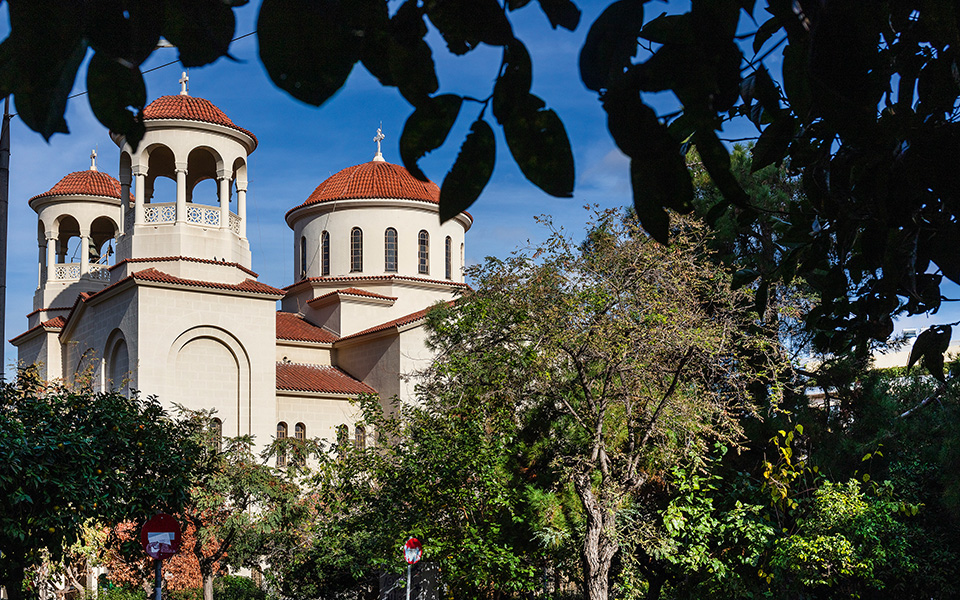
The Church of Profitis Ilias in Pangrati has long been a neighborhood meeting point.
© Perikles Merakos
If your path leads you near Psyrri – a historic craftsmen’s district turned bohemian enclave – Papageorgiou-Venetas recommends wandering its narrow lanes. “Although it risks becoming a place of dubious entertainment, the human scale has been preserved.”
For him, however, the most compelling district for a stroll is Petralona, a leafy, quietly residential pocket on the slopes below Filopappou Hill. “In order to protect the historic landscape and the archaeological site [the Acropolis and the surrounding hills], the buildings – miraculously – have remained low. Even though one encounters many new houses, Petralona remains a pleasant neighborhood.”
Another area worth walking, the author adds, is Kypseli – a vibrant, multicultural district that still carries strong interwar echoes. “It has retained many elements of that period – its squares, its market and, of course, Fokionos Negri pedestrian street.”
Discovering a city is rarely something you can do by car. Papageorgiou-Venetas insists that: “You can only truly experience a city on foot. When you’re seated in a vehicle, what you see is entirely different – interesting perhaps, even a little spectacular. But walking allows you to admire the architecture and connect with the people, the conditions, the events that once unfolded in the very spot where you’re standing. Walking gives you the time for inner processes, the time to pause … and understand where you are, to notice details that would otherwise pass you by.” Despite Athens’ challenges – those facing any major city – the overall impression it leaves is, Papageorgiou-Venetas says, positive. “The ratio of greenery has improved in recent years. We’ve finally come to understand just how essential it is. And seedlings manage to sprout from even the tiniest cracks. Perhaps no one waters them, but Athens has a high water table and that’s why they survive. Attica’s earth nourishes them! And there are still streets and neighborhoods where small shops thrive – places where you know the owner’s name and he knows yours. Step back outside and you see a green canopy arching above you. All of this is reassuring, and you can only truly see it if you walk.”
Another reassuring aspect of the capital is that it contains many identities – layers worth discovering one by one. “At present, Athens consists of 55 different municipalities, each with substantial and well-developed urban infrastructure. Taken together, across the entire [Attica] basin, they create a rich diversity thanks to the city’s polycentric structure. Walking through Psyrri is one thing; walking through Halandri – a district in the midst of change that still preserves an older core – is quite another. All of this lends a particular charm to a great metropolis.”
Papageorgiou-Venetas has reasons to be optimistic about the city’s future. “A portion of the younger generation cares deeply about the place where they live and walk. They educate themselves and know how to explore as ‘internal tourists,’ as I call them, in the best sense of the term. There’s also hope in the Greek spirit which, despite its occasional self-destructive streak, has a unique connection with place. This is why every decade we see revitalizing movements emerge. As Dimitris Pikionis said, a true wanderer must be motivated by a sense of pilgrimage – meaning an awareness of the character and history of a place.”
Now in the later years of my life, I descend almost daily on foot from the slopes of Lycabettus, past Hadrian’s Reservoir, towards the city center. A city burnished and dressed up, a place for visitors to admire – yet also loud, congested and weighed down by an almost unbearable density of buildings, cars and people.This short downward route (no more than 500-800 meters) could, under different circumstances, offer an active elder a small walking ritual: a measure of physical exercise, yes, but also a contemplative view of a familiar and beloved setting that still has the power to delight. A joy in reclaiming the native city once more, in noting what remains interesting, in stirring old memories. But the stroll that so often becomes a gentle ramble is now almost impossible. The relentless traffic breaks the walker’s rhythm, demands caution with every step, and steals the luxury of looking around. You no longer lift your gaze; you watch your feet and the treacherous ground beneath them.
The pavements are deceptive – often cracked, always narrow. You’re forced to devise a personal method of walking, simply to secure a bearable passage. You map out in your mind any pedestrianized streets you can weave into your route. It brings a small, fleeting relief. And if you happen to walk “with” someone, conversation is out of the question. The pavement is so narrow that one must follow in single file. A peace-time skirmish line; true companionship impossible.
So instead of a leisurely walk, you find yourself merely shifting your body through space – wanting it or not, you become a passerby, moving forward almost self-consciously. If you wish to observe something carefully – a facade, a tree, a person – you must stop, lean against a wall, steady yourself and then take in the scene. And yet I repeat this route regularly. I am a peculiar kind of passerby, one who does not always head to work (a professional duty) but instead to his various errands: everyday engagements (meetings, purchases, visits) that keep me in contact with the social world around me, though without the pleasures of the flâneur, pleasures denied to me in the present conditions. Still, I continue my steps through the city: a spark of life, an endless apprenticeship, a quiet and enduring joy.
Trace St. Paul the Apostle’s journey...
The workshop of famed tile painter...

From Christmas markets to New Year’s...

A major restoration project is bringing...


