Macedonia: 4 Distinctive Guesthouses for a Nature Getaway
Four guesthouses set in unique landscapes,...

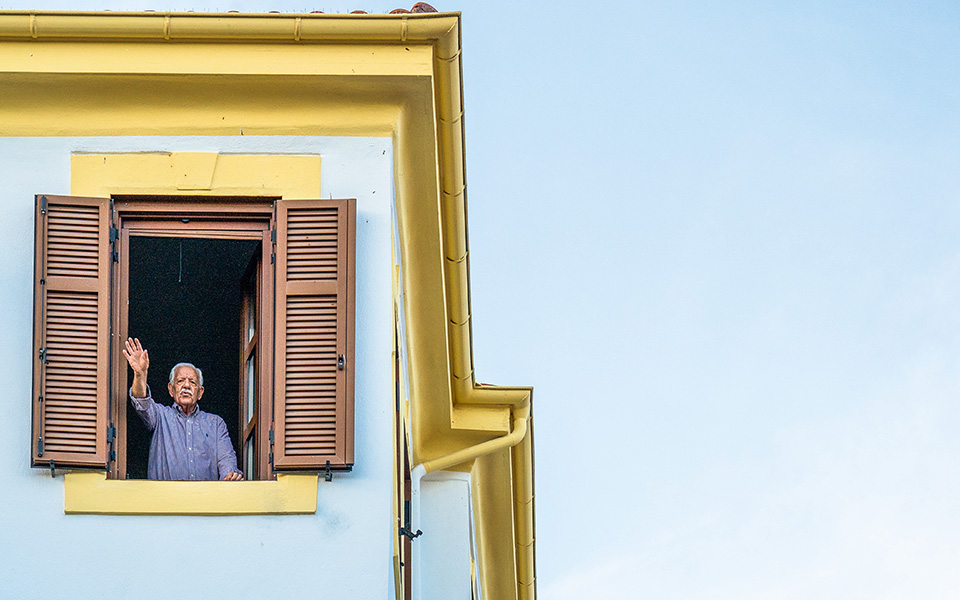
The pharmacist Petros Petrou welcomes us to Xanthi from his home on Pygmalion Christidis Street.
© Perikles Merakos
They say he first saw her riding a white horse and was instantly enchanted. He fell in love and married her soon after. He was the son of a tobacco merchant named Christidis, educated at the Great School of the Nation in Constantinople. She was a Catholic woman of French-English descent from Adana. The couple lived in the Christidis family home in Xanthi, a two-story neoclassical mansion with Russian influences on Orfeos Street. He often travelled for business. She spent her mornings on the balcony of the second floor, her view partly obstructed by the small shops clustered below.
Upon returning from one of his journeys, Christos Christidis decided to surprise his beloved Julie: he paid a thousand gold pounds to buy every one of those shops and expand the courtyard of their house. He then planted a hundred rose bushes in the garden, which remains to this day one of the largest and most fragrant in the Old Town.
Here, aristocratic gardens border small, whitewashed courtyards adorned with tin flowerpots; the grand mansions of former tobacco barons coexist with low-ceilinged folk homes; mosques stand beside churches; eclecticism meets traditional architecture; and grandeur lives in harmony with humility.
It is a multicultural, resilient, deeply symbolic city that enchants not only through its preserved architectural heritage but also through the stories that linger in every corner.
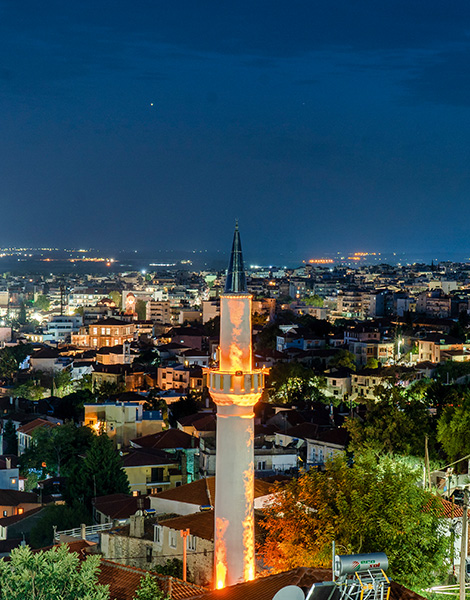
The nighttime view of Xanthi from above. Dominating the scene is the minaret of the Ahrian Mosque.
© Perikles Merakos
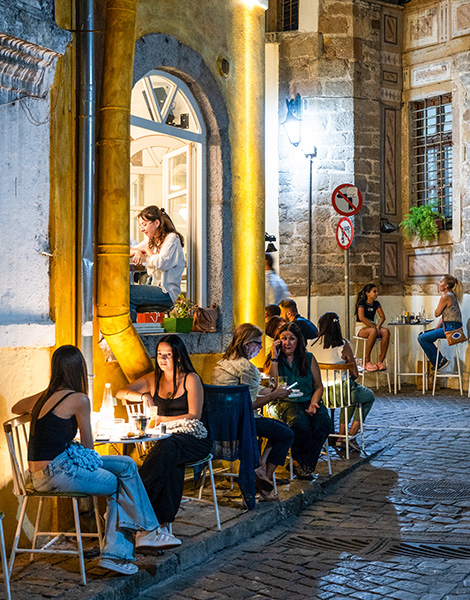
Orfeos Street stands out as one of the most vibrant streets in the historic settlement.
© Perikles Merakos
“The people beside us often have the most extraordinary stories, but we don’t know them because they’ve never come to light,” says Triantafyllos Vaitsis, an internationally acclaimed shadow artist who arrived in Xanthi in 1994 to study environmental engineering and never left.
In 2014, he founded The House of Shadow in the heart of the Old Town, a unique gallery where sculptures made from humble materials project their haunting shadows on the walls. Today, Vaitsis is working on a series of works inspired by the city’s modern history: the earthquakes that devastated Xanthi in 1829, its reconstruction by stone masons from Epirus, the Belle Époque era, the arrival of the railway, the birth of Manos Hadjidakis in 1925, the second wave of reconstruction with apartment buildings, and the founding of the Polytechnic School.
“At the center of it all stands a man from Xanthi, an ordinary person who, in truth, is anything but ordinary,” Vaitsis explains. “I chose my wife’s grandfather, who escaped death three times: in Bulgaria, at Dachau, and during the Greek Civil War. As a war veteran, he was later given a small kiosk to run.”
Orfeos Street stands out as one of the most vibrant streets in the historic settlement.
© Perikles Merakos
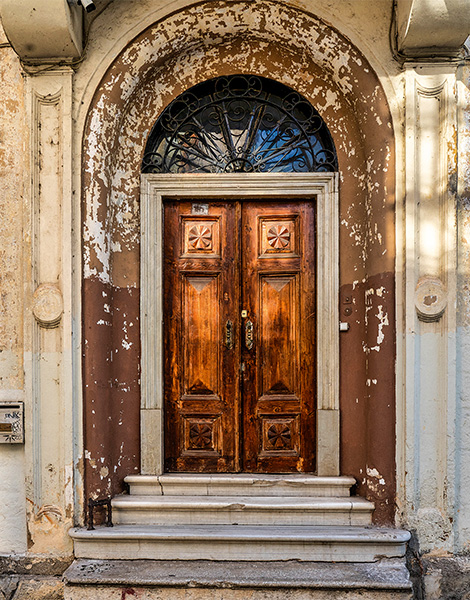
The arched entrance of the Stalios mansion, built in 1880.
© Perikles Merakos
Just five minutes away, on Aristeidou Street, another remarkable story lies hidden beneath the surface – quite literally. In the basement of a two-story house now owned by the Fysekiadis family lies a fragment of a 16th- or 17th-century hamam, believed to be one of the oldest surviving Ottoman monuments in Xanthi.
“My father bought the house in 1958 for 20,000 drachmas from the Kougioumtzoglou family, who were distillers,” explains current owner Dimitris Fysekiadis. “At the time, the city was in decline, and wealthy Xanthiots were leaving for Thessaloniki. That’s how we discovered the two domes. We use the lower part as storage for our winter firewood, and the upper part has been integrated into our living room.”
The residence on Aristeidou Street is one of 593 listed buildings in the Old Town, declared preserved under a Presidential Decree in 1995, though the area had already been under cultural protection since 1976. “The irony,” notes Fysekiadis, “is that while we were responsible for restoring it, once the restoration was complete, the Archaeological Service gained the right to oversee its management, according to heritage law.”
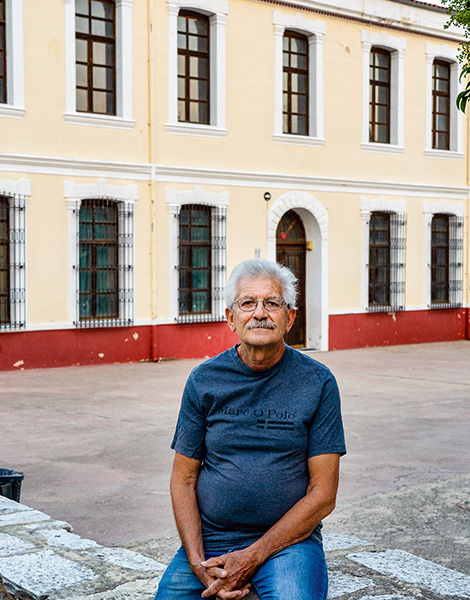
Civil engineer Triantafyllos Sfyris in the courtyard of the 1st Primary School of Xanthi, where he was a student.
© Perikles Merakos
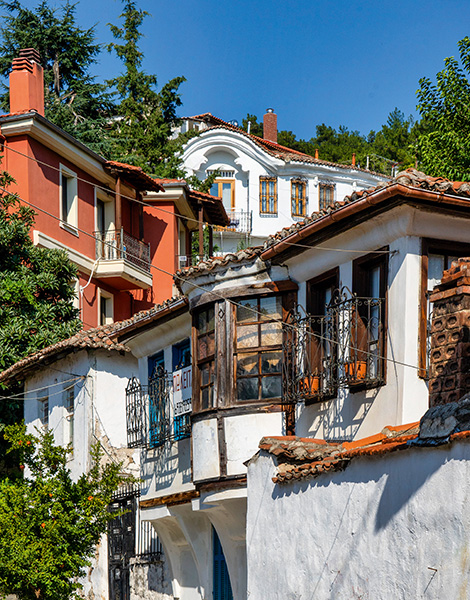
A residence from 1897, in the Mitropolis neighborhood, featuring a distinctive semicircular sachnisi (bay window), the only one of its kind in Xanthi.
© Perikles Merakos
Maintaining the historic homes of Xanthi’s Old Town has become an increasingly heavy burden for residents, largely due to the strict preservation requirements imposed by the Ministry of Culture. The cost of necessary restoration work is often prohibitive, leaving many owners with no choice but to let their properties fall into disrepair.
“The number one issue is abandoned houses,” says Katerina Mavroudi, president of the Old Town Residents’ Association, founded in 1992 to revive and protect the area. Today the association counts around 150 member families, both Christian and Muslim. “There are countless old buildings with multiple co-owners. It’s extremely difficult to maintain them, not only because of the restrictions imposed by the Archaeological Service but also because of the high cost of restoration,” she explains.
Civil engineer Triantafyllos Sfyris, who has restored numerous buildings in the historic district in recent years, agrees. “The cost of repairing and restoring a listed building with traditional materials is many times higher than constructing a modern one from scratch. The state should subsidize that difference. You can’t build culture on someone else’s wallet. Otherwise, the Old Town will end up full of ruins,” he warns.
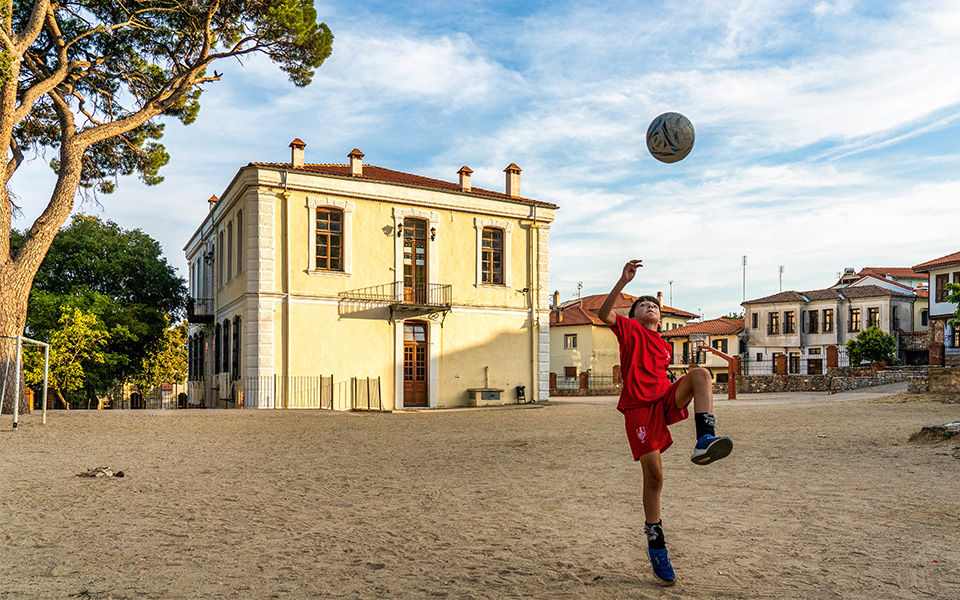
Playtime in the courtyard of the 1st Primary School.
© Perikles Merakos
That frustration is shared by Bachriye Kehagia, who lives with her husband, children, and parents in the house where she was born, near the Achrian Mosque. “Here it’s like a neighborhood; a different world,” she says. “We’re not like those who live in apartment buildings, stacked one on top of another without knowing each other.”
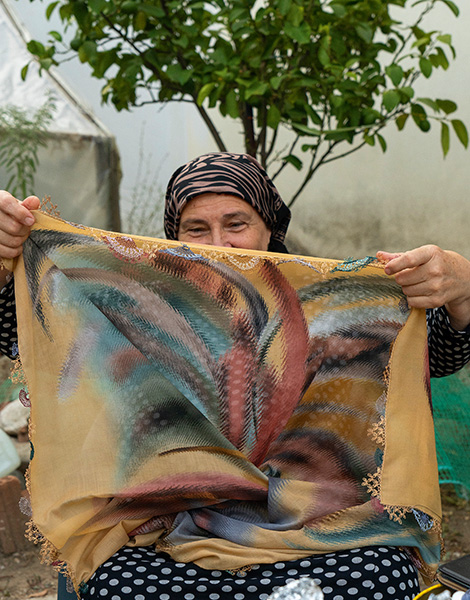
And that is precisely the feeling the Old Town leaves on its visitors: residents greeting passers-by with warmth, children playing in the streets or in schoolyards, neighbors exchanging the day’s news from balcony to balcony or sitting together to embroider. A beautiful “village” untouched by noise and concrete.
Yet every September, the picture changes dramatically. During the Old Town Festival, the cobbled lanes overflow with visitors. The event began in 1991, initiated by the then mayor Philippos Amoiridis, with the aim of bringing together residents from all communities to rediscover their city. Today, however, complaints about noise, litter, and vandalism have become common.
“When the festival takes place, things are very difficult,” says Servili Ersin, a resident of Pindarou Street and third-generation owner of the historic Servili coffee roastery. “It’s not just the noise – it’s that, for an entire week, our courtyards turn into public toilets.”
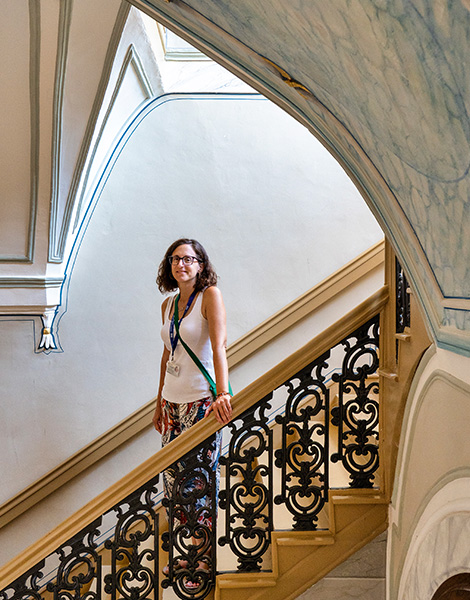
The museologist and tour guide Natassa Michailidou at the Moisis Mansion (Old Town Hall).
© Perikles Merakos
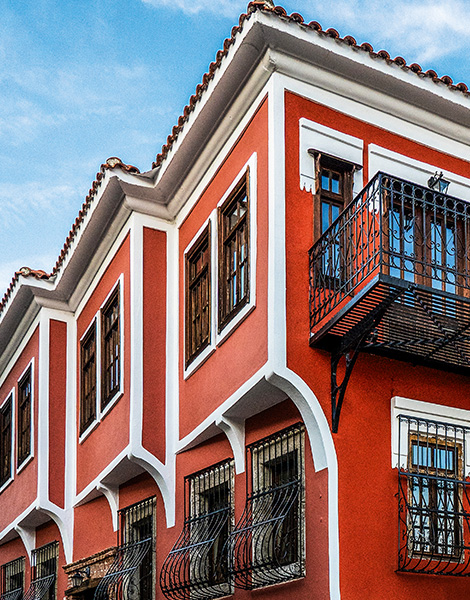
Neoclassical, eclectic, or of traditional architecture, the houses in the Old Town are usually single-story, two-story, and rarely three-story.
© Perikles Merakos
For many, the guided tours organized by the Municipality of Xanthi are a perfect way to see their city with fresh eyes. “If someone can afford to get lost in these alleys, it’s the best gift they can give themselves,” says museologist and tour guide Natassa Michailidou, who leads school groups and visitors from across Greece and abroad during the Old Town Festival. Her favorite spot is a traditional house dating back to 1849 – the oldest dated private residence in the settlement – at the corner of Orfeos and Silivrias streets. “It’s neither large nor grand,” she explains. “But its sachnisia (bay windows) have survived, as has its beveled corner – intentionally cut by the craftsmen so passing carts wouldn’t damage it – along with their ‘signatures’: a rosette and a woman’s breast, carved as a blessing for the owners’ good fortune.”
Another distinctive example of local architecture, featuring a sachnisi and a nearly semicircular courtyard, stands at the junction of Pygmalion Christidis and Philippos streets. Here once lived folklorist and poet Katina Veikou-Serameti, who came to Xanthi as a schoolteacher from Neoi Epivates in Eastern Thrace. She wrote, among other works, the Xanthiotika, short rhyming quatrains in the local dialect, meant to preserve the language for future generations.
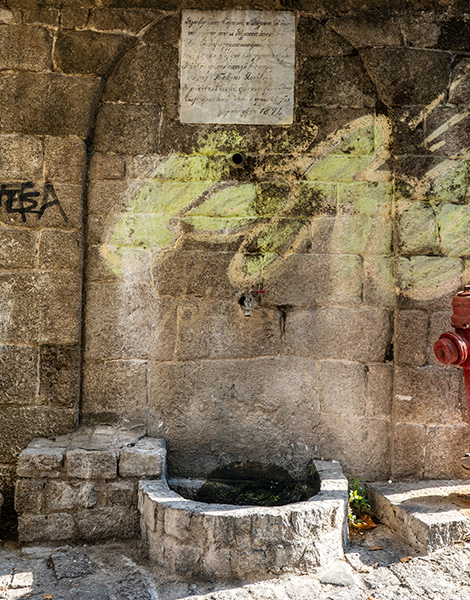
© Perikles Merakos
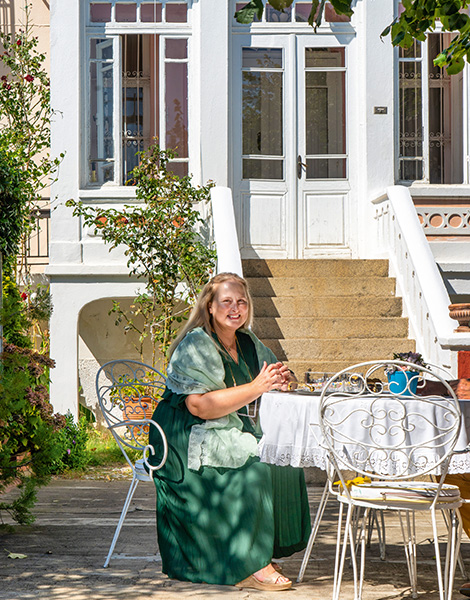
Aliki Michalopoulou, great-granddaughter of Zoulí Christidi, at the family mansion with a hundred rosebushes where she grew up.
© Perikles Merakos
Veikou-Serameti was one of the reasons why philologist, author and poet Thanasis Mousopoulos decided to move to the Old Town. “Two dear friends who are no longer with us lived here, two pillars of Xanthi’s cultural life: Katina Veikou-Serameti and another remarkable man, poet and writer Stefanos Ioannidis,” says Mousopoulos. In the 1990s, he left his family apartment in the new city for the house that used to belong to the mother of his painter friend Theodoros Mousmoulidis, within the protected historic district.
“One of the neighborhood’s greatest blessings is coexistence,” he emphasizes. “People of different cultures, languages, and faiths live together. The problems arise only when politics interfere – from either side. In the Old Town, we have no need for saviors. As long as they stay away, ordinary people, no matter where they come from, live together in harmony.”
Four guesthouses set in unique landscapes,...
How Metsovo thrives against the odds...
The charming port city of Volos...

The imposing mountain range of Agrafa...