A beloved Thessalian treat, halva sapouné tells the story of Kalambaka, family resilience, and sweet tradition – carried on through generations by the hands that still shape it today.
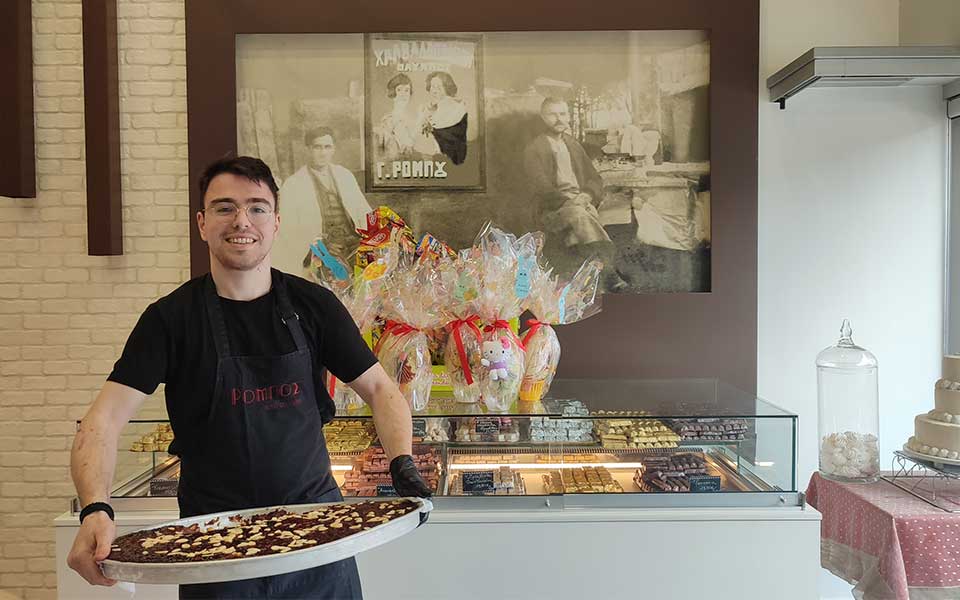
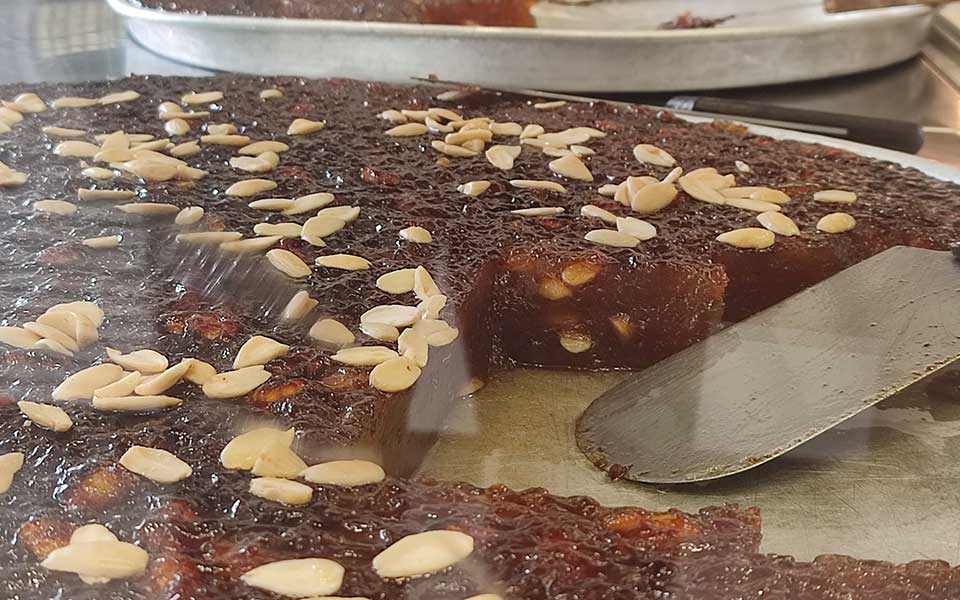
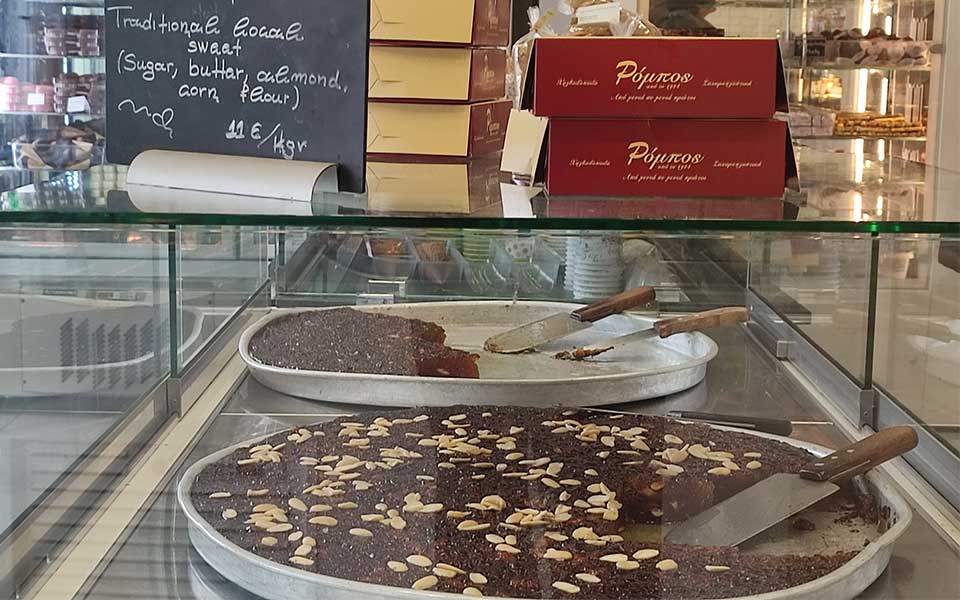
Kalambaka is an extraordinary place. A stick-strait main street runs through the flat town while the rocks of Meteora, lit dramatically up at night, rise sharply above it just a few hundred meters away. The day is shaped by faith, geology, hiking, a hearty basic meal, and something sweet, in that order. For the last, several patisseries sell all the usual favorites. But the town’s signature treat – halva sapouné – is the most basic thing you can imagine, made with just sugar, butter and water bound together with cornstarch, and some almonds. Except, a perfect halva sapouné is anything but basic: the perfect slice is wobbly to the touch and silky on the tongue, with a mouth-flooding hit of butter, bronzy caramelized sugar, and toasty almonds. Morning to night, there’s a steady stream of people lining up at the halva case at Patisserie Rombos, pointing to the section they want – some like the smooth center, while others prefer the crustier pieces from the edges of the pan.
The story of halva sapouné is inseparable from the story of the Rombos family, and by extension, the story of modern Greece. Georgia Rombou shares her family’s journey.
From Kalambaka to cosmopolitan Smyrne
Georgia Rombou’s grandfather, Giorgos, was born into a very different world. Barely a generation had passed since Kalambaka had become part of Greece, along with nearly the rest of Thessaly and the southern part of Epirus, in 1881. On the heels of the Balkan Wars, and amid the internal turmoil that resulted in the National Schism that divided the nation, Greece entered WWI. Meanwhile, the Megáli Idéa, the “Great Idea” to unite all the lands where Greeks live, including those in Asia Minor, had been taking shape. That’s where the story of halva and the Rombos family begins, in Asia Minor: “My grandfather left the family farm to join a unit from Trikala, headed for Smyrne,” Georgia begins. The Greek cause was moving forward; with the signing of the Treaty of Sèvres, Smyrne (today Izmir) fell to Greek administration, becoming the Zone of Smyrne. “He was stationed for years in Smyrne,” Georgia continues. “He grew to love the cosmopolitan culture of the city. And he was always interested in learning new things, especially things related to business; my grandfather was an industrious man. While he was there, he met a local couple, street vendors who made traditional sweets. They had things he had never seen or tasted in Kalambaka: sámali (a dense, syrupy cake of coarse semolina), red candy apples on a stick, and, best of all, halva sapouné. Soon, he was making these things too, helping the couple and learning their trade.”
The letter tied with a black ribbon
The life of Smyrne as he had grown to know it would soon come to an end. The Greco-Turkish war brought about a reversal of fortune for Greece; the Turkish forces took Smyrne. As ethnic violence escalated, a fire broke out, consuming much of the city. It was a catastrophe of tremendous magnitude. Georgia describes the events that followed: “Amid the chaos, my grandfather was separated from his unit and lost contact with them altogether. They could not find him, so they finally wrote to his family. When a letter from the army arrived, it was tied with a black ribbon. His parents’ hearts sank when they saw it. They did not need to open it to know that the news wasn’t good: their son was missing, presumed dead. They held a memorial service and mourned him. It was a sad time for the family, and with the catastrophe of Smyrna it was also a sad time for all of Greece.”
A sweet reunion
“But of course, he had managed to survive. My grandfather was strong and resourceful, and very determined. Eventually, he made his way back to Kalambaka, so thin he was barely recognizable. And why would they recognize him, since they thought that they would never see him again? And so it was that when he walked into the village cafe, not even his own father knew who he was; it was a joyous reunion.
“The first surprise was that he was alive. Then came a second surprise: instead of raising animals on the family farm, he would be making halva sapouné.”
“This was a shock: not only would he not be joining the family business, as was traditional, but he would be selling sweets in the street! And what is halva sapouné, they wondered? Back then, it was known in the larger cosmopolitan towns like Larissa, where many Turkish people still lived before the population exchange. But it certainly was not known in Kalambaka, a town without even proper shops, let alone patisseries. But my grandfather was determined. Every day, he filled a great wooden “tava” with individual portions of halva he had made fresh that morning and carried it around town.” It did not take long for the people of Kalambaka to develop a taste for the new treat.

A (lucky) romance
“On a summer morning in 1928, as my grandfather was setting off with a tray full of fresh halva, a pretty young neighbor leaned out of her window and wished him good sales. He sold every single piece. He thought she was good luck and vowed to marry her. That was my grandmother, Eleni.
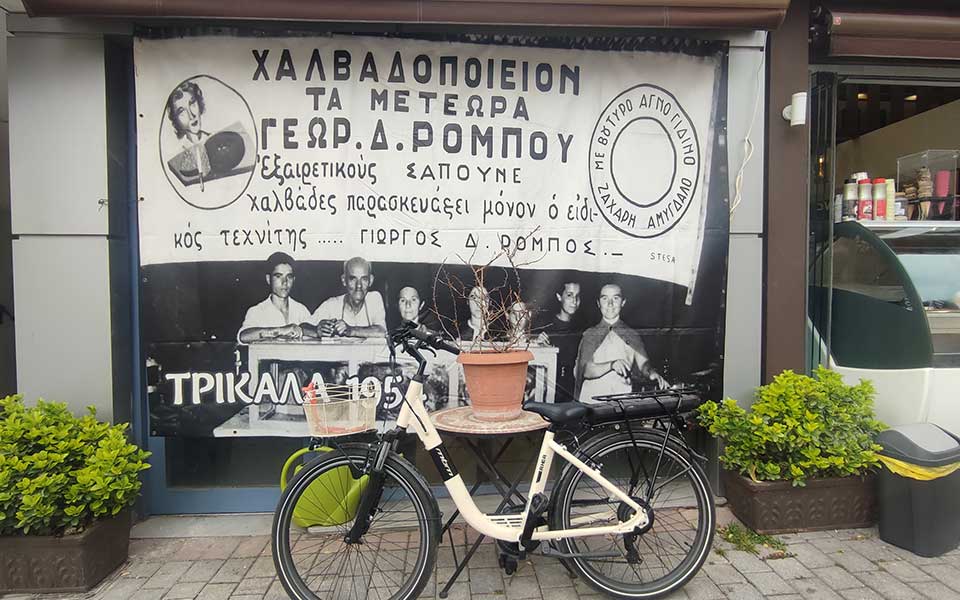
“As his fame grew, he started selling at festivals throughout the summer. Then my father, Dimitris, learned how to make it too, and eventually our family opened our first shop. Everyone throughout the region knew about our family’s halva sapouné. Halva had become more than just our business; it was our identity.
A very sad time
Dimitris was getting older and was not well. He was getting ready to eventually pass on the business to his son Giorgos, Georgia’s brother, (both were named after their grandfather). Georgia, meanwhile, had married Dionysios Gandalis, who owned the town bookshop.
Then Giorgos was killed in an accident. “We were heartbroken. Losing my brother was terrible, and it also meant that there was no Rombos man left to make halva. Making halva is such a large part of who we are as a family, so somehow that made it even harder for us. And besides being a tradition, it’s also physically demanding. We needed a man, a man from the family.”
…and another love story
“So Dionysios stepped up. He rolled up his sleeves and he learned, making halva for the family and running his bookstore at the same time. However, my father was not getting stronger, so Dionysios eventually gave up the bookstore to make halva. What Dionysios did meant the world to us. He made it possible for us to keep our family’s tradition alive.
But also, he got really good at it! He attended pastry school and even went to Paris to take special seminars. He started making all kinds of things. In 1994, we opened a regular “zacharoplasteio,” a pastry shop selling all kinds of sweets and cakes, like we have now. Halva is still our main thing though, what we’re best known for.”
(Indeed, while Georgia has been talking, the huge piece of halva left in the tray has been getting smaller and smaller. The store is really busy, but one woman is standing right next to the case, guarding that last piece – “everyone in our group got some and said I have to try it!” she said.)
A strong pair of arms
Today, Thanos Gandalis, the son of Dionysios and Georgia, represents the fourth generation. His father has taught him well, and now he makes most of their halva sapouné in the early hours of the morning before the shop opens. Making halva takes more than skill and experience – you need the strength of an athlete. Fortunately, Thanos inherited his father’s powerful arms, though like any kitchen apprentice, he’s earned a few burn marks along the way.
A single pan of halva sapouné at Rombos weighs 13 kilos – nealy 29 pounds. To get that delicious, caramelized crust – an essential counterpoint to the silky inside – you first need to determine the perfect moment, when the halva has developed a bottom crust that is evenly bronzed and just the right thickness. Then, while it’s still really hot (120 to 130 degrees Celsius), you have to toss the whole mass up into the air with perfect control, in order for it to flip over 180 degrees and slip back into the pan in one piece. “Lots of people think you use a blowtorch to get the crust on a halva, like on a crème brûlée,” he explains, “but you can only get a good crust like that from the bottom of the pan.”
Halva ‘sapouné’ (…not Farsalon)
There are several types of halva in Greece. Sesame halva is the best known abroad. There’s also halva from coarse semolina, a popular and simple to make homestyle treat. Then there’s sapouné – ‘soapy’ in Greek, like the halva’s slippery texture. The old highway connecting Athens to Thessaloniki used to pass through Farsala, another Thessalian town. Roadside shops sold halva sapouné to motorists. It became so customary to stop off for a box when passing through that this type of halva came to be associated with the town, and the name, for many, has stuck. A visit to Rombos in Kalambaka will clear up the confusion.
A true taste of Thessaly
“Halva sapouné is, in a way, the sweet expression of the abundant lands of Thessaly. Everything that you need to make a good halva sapouné, we have it right here. The cornstarch we use is from local corn. We have goats here too, and you really need goat butter to make a good halva; it has such a full flavor yet it’s still light on the tongue. We have orchards full of almond trees, so beautiful in the springtime. And we even have sugar beets. People think that plain granulated sugar is all the same, but it isn’t. Greek sugar is particularly good for halva. Not only does it have a delicious taste, it also works very well in the recipe. We wouldn’t get the same result working with imported sugar.
There are not as many farmers producing goat butter these days as when our family first started making halva. Today, it would not necessarily be easy to source the amount of goat butter that we need. Happily, we have a very close relationship with our supplier, who’s also a local cheesemaker. He knows that he has a customer for all his butter, and we know that we have a secure supply. Sometimes, if there’s not quite enough, we might add a small amount of sheep butter to make up the difference. But never cow butter, because its flavor is not rich enough. And we never use oil, unless we make “nistisimo” halva for fasting. We’ve never used anything but local ingredients in our halva. It’s essential for the quality of course, but it’s also more than that; preserving our local agriculture and our heritage is very important to us. Perhaps most of all though, making halva is about being part of our community; we still sell our halva at local festivals, just like my grandparents did.”
INFO
Patisserie Rombos
16 Trikalon, Kalambaka
Tel. (+30) 24320.222.69
Open daily 08:00-22:00