Kalamata: Maria Callas Becomes the Face of the…
A vivid mural of Maria Callas…

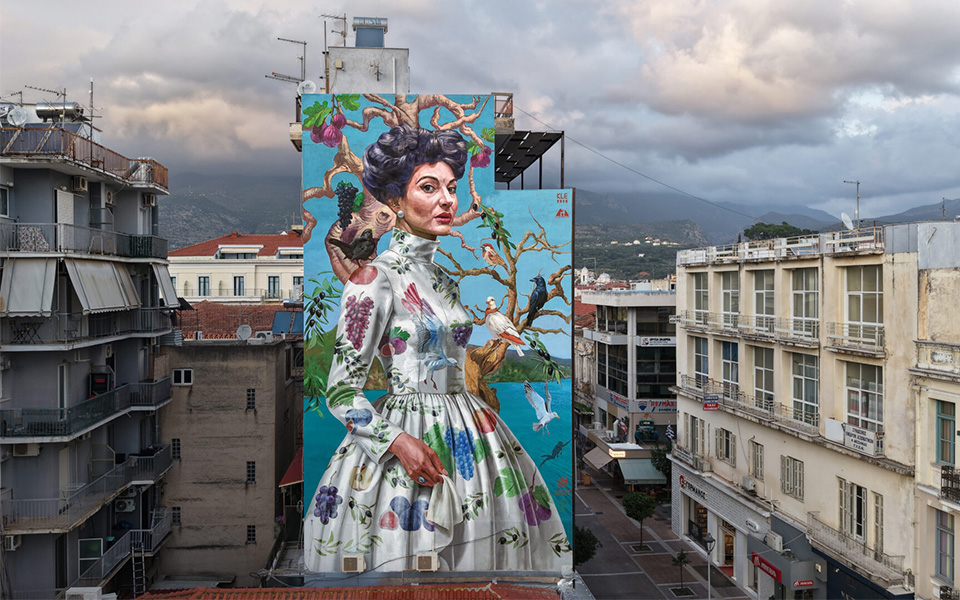
The mural “Kalamata,” nineteen meters high and seven meters wide, adorns a seven-story building in the center of the Messinian capital.
A towering mural of Maria Callas in the heart of Kalamata has won major international recognition, earning a place among the world’s most celebrated works of street art. The artwork, created by Greek artist Kleomenis Kostopoulos – known professionally as KLE – has been shortlisted by the global platform Street Art Cities as one of the top murals worldwide for 2025.
The 19m-high, 7m-wide mural was voted Best Street Artwork of the Month for November by the platform’s international audience and is now competing for the top spot among 12 standout works from cities across the globe. Street Art Cities is widely regarded as the world’s largest online platform dedicated to public art, featuring works from more than 2,000 cities.
For Kostopoulos, the distinction marks a significant moment not only for his own career, but also for the city that commissioned the work. “With this project, we made a first attempt to step onto the international stage of public art,” he said in a recent interview with Kathimerini.gr describing the recognition as an honor for both the artist and Kalamata itself.
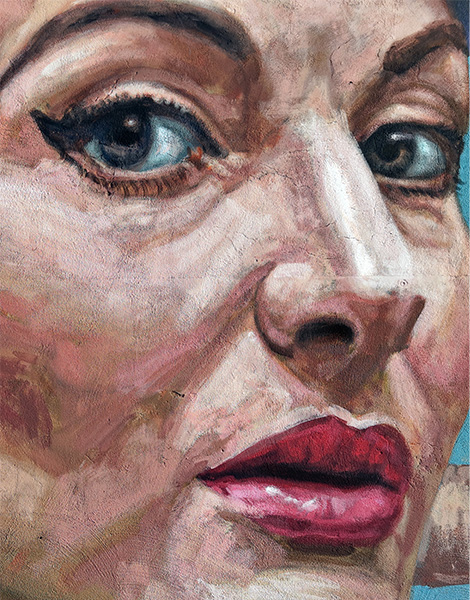
The work by Kleomenis Kostopoulos does not merely aspire to beautify the public space, but to revive discussion in Greece about the role of contemporary art in everyday life.
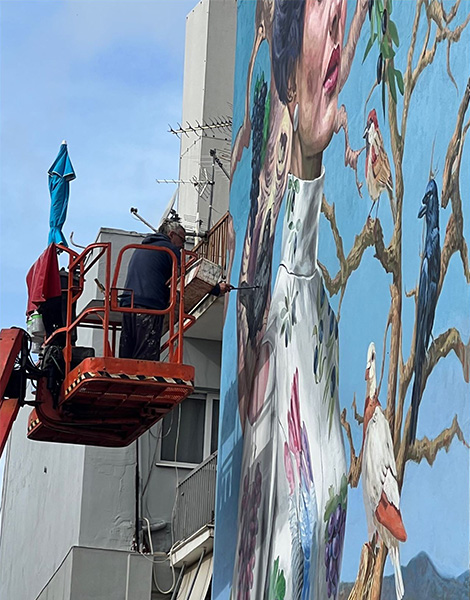
The creator of the mural at work. It took two weeks to complete.
Although the mural takes as its starting point one of the most iconic figures of 20th-century opera, the work is not intended as a straightforward portrait. Instead, Kostopoulos conceived the image as an allegorical representation of the city itself. Callas was chosen not only for her global cultural stature, but also because of her personal connection to the region: her father was of Messinian origin.
“Honoring the invitation from the Municipality of Kalamata, I wanted to create the city itself,” the artist explained. In the mural, Kalamata is rendered as a female figure whose face belongs to Callas, forming a symbolic bridge between local identity and international culture. The result is a composition that speaks simultaneously to place, memory, and artistic legacy.
Painted on a central building façade, the mural incorporates a rich array of symbolic elements drawn from the natural and cultural landscape of Messinia. The figure’s dress is filled with references to local flora and agricultural produce, while the surrounding imagery includes birds, trees, and natural forms evoking sound, movement, and fertility. In the background, the Taygetos mountain range and a recognizable view of Kalamata’s seafront anchor the work firmly in its geographic setting.
Among the more discreet details is a small diver placed in the lower corner of the composition – “a silent reference to the family to which the building belonged and to a young person who was lost prematurely. He loved diving and so I wanted to have this connection,” Kostopoulos notes. The inclusion reflects that artist’s belief that public art is inseparable from the histories of the places and people it inhabits.
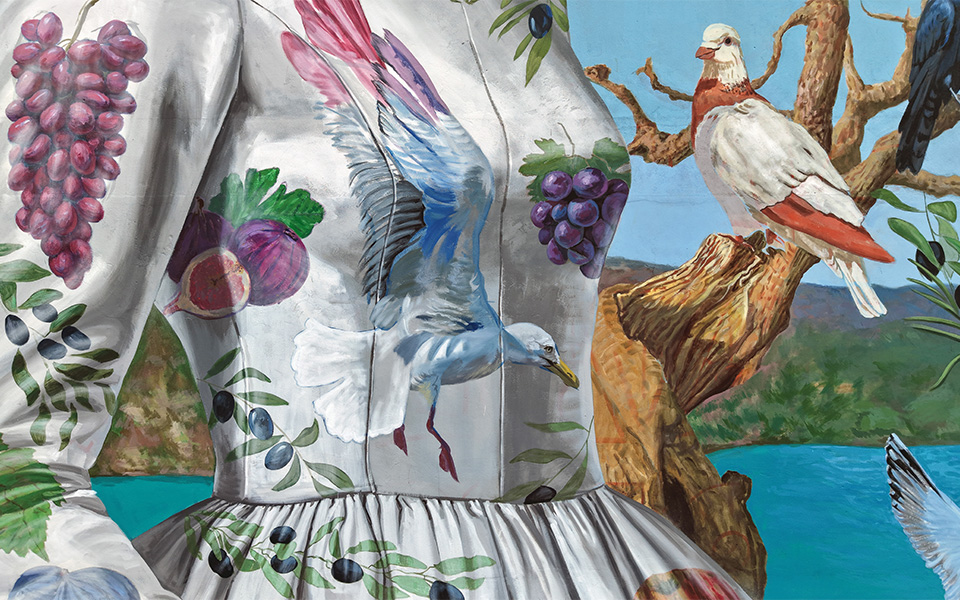
Callas’s dress is rich in symbolism and carries the natural world of Kalamata within it.
The mural was completed in November and entered automatically into Street Art Cities’ monthly public vote, where it rose to first place from the opening day and remained there until voting closed. While detailed demographic data is not available, Kostopoulos estimates that much of the support came from outside Greece, highlighting both the international reach of the platform and the growing global appetite for large-scale public art. “I want to believe that they recognized a good painting,” he says.
Kostopoulos, who also serves as artistic director of the Artwalk Street Art Festival in Patras, has long advocated for street art as a democratic and accessible form of cultural expression. In recent years, he argues, the medium has moved decisively into the cultural mainstream, shaping public debate and appearing in high-profile global events.
“I believe that street art is the future of art,” he says. “And how could it not be? We are talking about the most democratic, inclusive and influential art that can exist.”
In Kalamata, the mural has already begun to reshape how the city sees itself. Initial reservations about the scale of the project have given way to enthusiasm, with many residents now embracing the artwork as a new visual emblem of the city. With its international shortlist placing Kalamata alongside some of the world’s leading urban art destinations, the mural appears to be doing precisely what its creator hoped: introducing the city to the world in a whole new way.
A vivid mural of Maria Callas…

A fashion show inspired by legendary…
Pick up a copy of our…

A museum dedicated to the legendary…


