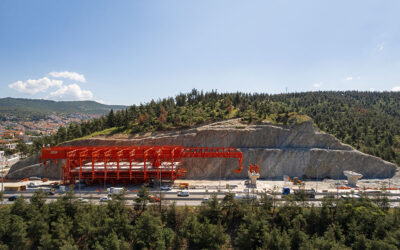
Thessaloniki’s Long-Awaited Transformation Takes Shape
From major infrastructure projects to a...


Local women display what was once customary wear in their district.
© Konstantinos Tsakalidis
On the eastern side of Thessaloniki, past the district of Ηarilaou and stretching up to the ring road, lies a neighborhood whose story reaches deep into the centuries. Many of its residents even claim descent from the Byzantines. This is Pylaia, once known as Kapoutzida.
Around 1430, as Sultan Murad II prepared to capture Thessaloniki after a protracted siege that had begun in 1422, he encountered fierce resistance from a group of Byzantine soldiers defending the city’s eastern gate. Their bravery and determination impressed the Sultan, who sent them a personal message urging them to surrender. When they refused and continued to hold their ground, the Ottoman commander agreed to their own terms of capitulation. The gatekeepers – known in Turkish as kapoutzides, or “keepers of the gate” – were granted the right to continue guarding the gate and to retain the lands outside the city walls, southeast of Thessaloniki.
Their first settlement, Kapoutzida, was located in what is today the area of Triandria-Ano Toumba, the closest village to Thessaloniki from the east. According to local tradition, the community relocated to its present site at the end of the 18th century, after a plague of poisonous snakes made the original area uninhabitable.
Their fields, where they cultivated grains, sesame plants and vineyards, stretched from today’s American Farm School to the university campus. Their vegetable gardens were concentrated in the area of Kalamaria. The black wine of Kapoutzida, made from their own vines, was once famous throughout the region. Over time, new settlers arrived from villages and towns in Halkidiki and Macedonia, including Kilkis; after 1922, refugees from Asia Minor made Pylaia their home, too. Gradually, farmland gave way to houses and, after 1990, as the district expanded, entirely new neighborhoods began to emerge, reshaping Pylaia into one of Thessaloniki’s most dynamic residential areas.
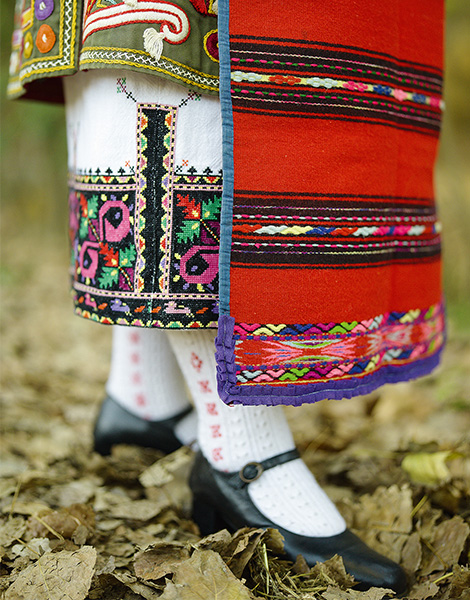
A close-up of a traditional Pylaia garment.
© Konstantinos Tsakalidis

© Konstantinos Tsakalidis
“During the Ottoman period there were no official street names; each neighborhood was known by the name of its Turkish landlord. That’s how locations were recorded in old property deeds. For example, our family had half an acre in the area known as Avli-Efendi,” explains Maria Tziaferi, a lifelong resident of Pylaia and president of the Women’s Cultural Association of Pylaia Kapoutzida. I meet her at the association’s headquarters in their neighborhood, along with two other members, Anastasia Spyroudi and Ourania Mengisoglou-Spyroudi. Just as the original Kapoutzides once guarded Thessaloniki from its besiegers, the women of this association now fight to keep the town’s traditions alive.
Founded in 2007 by a small group of 21 people, the association today counts more than 600 members, all women. “We couldn’t quite get the men to agree with us, so we decided to take the lead ourselves,” Ourania says with a laugh. Anastasia adds: “Our goal is to preserve and promote Pylaia’s cultural heritage: its dances, dialect, customs and local traditions. Since no folklorist has ever systematically recorded them, we rely on the research of Alexandra Parafentidou and Fenia Tsouka-Fountoukidou.”
As she speaks, I notice behind them a small wardrobe filled with traditional garb: the association’s modest costume collection. Beyond its archival work, the group also runs a folk dance troupe that participates in festivals and parades, a traditional music choir, and a variety of educational and community programs that keep the spirit of Pylaia alive and thriving.
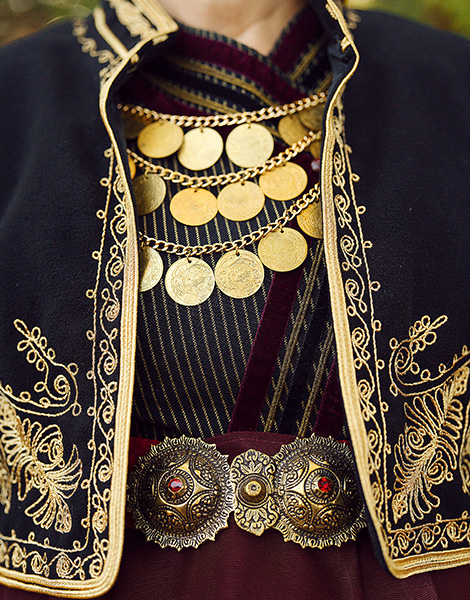
Coins form part of the traditional necklace worn by the women of Pylaia on formal occasions.
© Konstantinos Tsakalidis
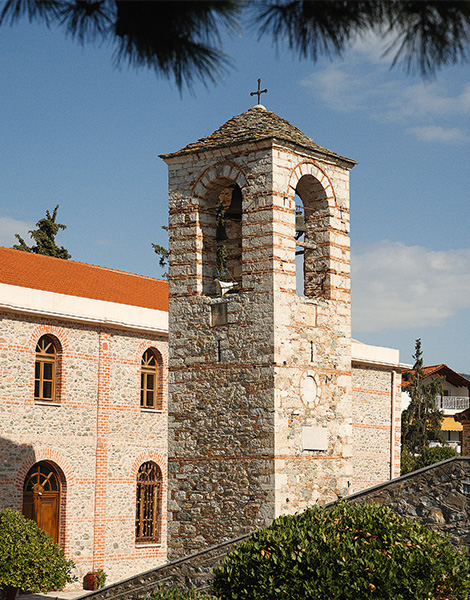
The bell tower of the Prophet Elias Church, erected in 1863.
© Konstantinos Tsakalidis
“Traditional dances are a fascinating chapter in Pylaia’s folklore and history,” says Vicky Kanellou, former Deputy Mayor of Culture and a friend of the association, who joins our conversation. “Born during the difficult years of Ottoman rule, they, like folk songs, expressed every aspect of life, from birth to death, from friendship to marriage.” “Our dances are mostly slow, circular and stately, with a distinctive local flair,” adds Maria Tziaferi. “There’s even a unique version of the syrtos called ‘Kato sta Alonia’ (‘Down at the Threshing Floor’), which is now taught in physical education academies.”
A little later, Anastasia brings out a sagias, the traditional women’s costume of Pylaia. Like most folk garments of the Balkan Peninsula, it has its roots in Byzantine tradition; the word “sagias” is derived from “sagion,” the war cloak worn by the ancient Gauls. “The last wedding in Pylaia where the bride wore a sagias took place in 1905,” Anastasia explains. “After that, attire gradually became more contemporary in style.” Today, authentic Pylaia costumes are preserved and exhibited in the Folklore Museums of Thessaloniki and Kalamata, as well as in the Benaki Museum in Athens.
Only a handful of the original garments remain, although a few seamstresses in Pylaia still make faithful reproductions. Smiling, Ourania interjects: “Don’t be fooled by how elegant these outfits look – back in the day, we city folk in Thessaloniki used to think of the people from Pylaia as villagers!” She laughs, recalling the image of Pylaia’s farmers bringing grapes and vegetables into town on donkeys, and milkmen delivering fresh milk door to door.
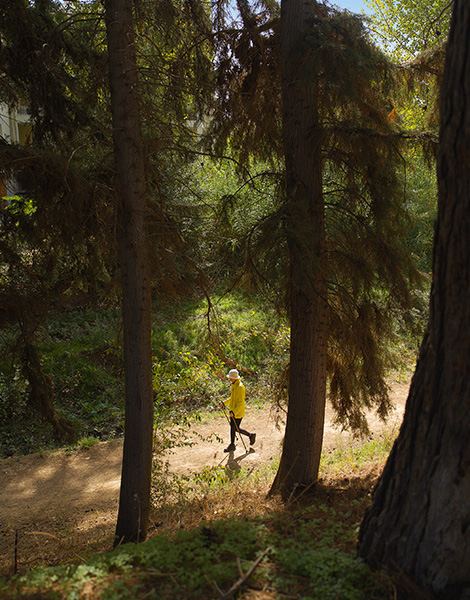
Elaiorema Park in Pylaia provides city residents with a green escape.
© Konstantinos Tsakalidis
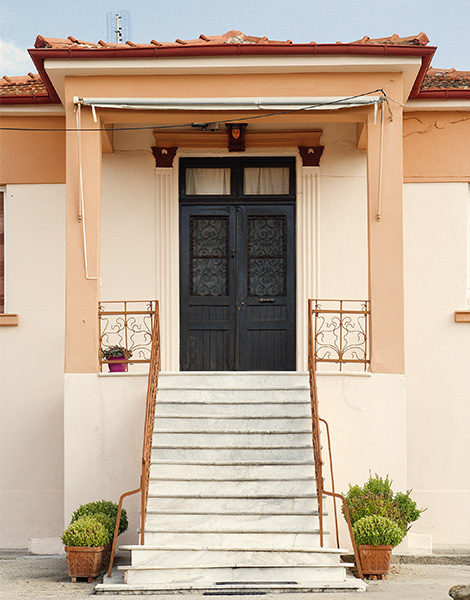
Older residences in the neighborhood are being respectfully restored.
© Konstantinos Tsakalidis
For decades, before merging with the municipalities of Panorama and Hortiatis, Pylaia was a remote suburb with little to no transport connection to Thessaloniki.
Today, with a population of over 35,000 residents according to the latest census, Pylaia is fully integrated into Thessaloniki’s urban fabric, with only a few plots of land left for development. Besides the efforts by the local women’s association, however, little remains to tell the story of its rich past.
Our tour with the members of the association begins at the church of Prophet Elias, the patron saint of the area, whose courtyard houses a stone bell tower dating back to 1863. Around it, along the street of the same name, several local landmarks reveal Pylaia’s contemporary side: the Winehouse cellar, which hosts tastings of Greek wines; the Italian restaurant Da Leonardo; and the beloved seafood eatery O Glykanisos.
From here, we climb the hill to the half-ruined Prasakakis Tower, once the residence of Dr. Ioannis Prasakakis. Built in the early 1850s and now listed as a historic monument, it is one of the oldest surviving houses in Pylaia. Like the Benouzilio silk factory, another listed monument, it remains abandoned yet full of stories. Built around 1886, the complex took its name from Levi Benouzilio, a Jewish entrepreneur who bought it in 1919 and transformed it from a brickworks into a workshop producing locks and buttons, and employing many refugees. In 1952, the building was converted into a silk factory, which operated for nearly two decades before closing its doors. Today, a proposal is pending to restore and transform it into an open-air folklore museum with educational workshops.
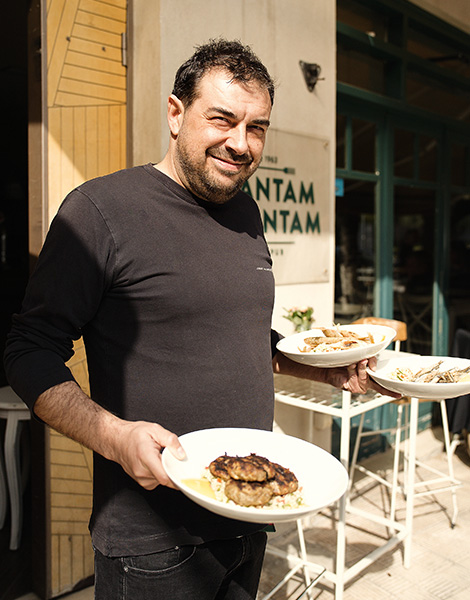
Dimitris Tziaferis, owner of the eatery Anantam Papantam.
© Konstantinos Tsakalidis
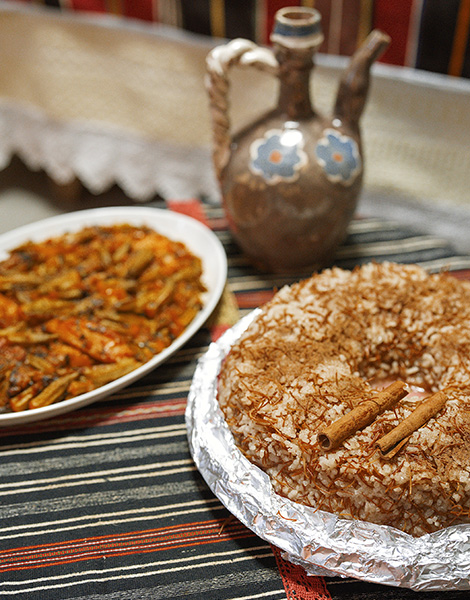
Local treats include okra and a rice dish called atzem pilafi.
© Konstantinos Tsakalidis
Our walk through historic Pylaia ends at Anantam Papantam, the neighborhood’s oldest family-run restaurant. In 1963, the grandfather of current owner Dimitris Tziaferis opened To Makedoniko, a modest ouzeri serving small plates and local delicacies. Among them was tsirnouchia, a freshwater fish cooked with leeks, once a signature dish of the area’s home-style cuisine.
“Back then, fish came from Lake Koroneia, from Aghios Vasileios, and from our own coast,” Dimitris recalls. “Pylaia used to have many fishermen who moored their boats where the new marina for leisure boats is now planned, near the airport.” The menu still honors those roots with a beautifully prepared fish-and-leek dish.
“And don’t forget our legendary okra!” adds Maria with a smile. “Okra began to be cultivated after the Asia Minor refugees arrived in 1922, although I’m not sure how many people still grow it today.” As she speaks, she remembers the old local dialect. “My parents didn’t use articles, and their language was full of borrowings from Bulgarian and Ottoman Turkish. For instance, they called Stella ‘Stoino,’” she laughs, raising her glass in a toast.
We promise to meet again in the summer, when Pylaia celebrates the Pyliotika, a three-day festival held around July 20th and honoring the Prophet Elias with music, dance, and the spirit of a community that still cherishes its roots.
From major infrastructure projects to a...

From temples and festivals to front...

A major restoration project is bringing...

Discoveries along Amalias Avenue, from the...


