
Five Historic Athenian Souvlaki Joints
Souvlaki joints started appearing in earnest...

When British archaeologist Hugh Thomas, who teaches at the University of Sydney, visited the Kotsanas Museum of Ancient Greek Technology last October, he was openly impressed by what he found inside the Art Nouveau building in central Athens. Though. Though far less known than the Acropolis Museum or the National Archaeological Museum, the institution left a lasting impression.
“Smart people exist today. Smart people also existed hundreds/thousands of years ago. These devices are simple, but ingenious. If you happen to visit Athens, I wholeheartedly recommend the Kotsanas Museum of Ancient Technology,” he wrote in one of his social media posts.
According to the museum’s director, Eleni Papastergiou, such reactions are far from rare. Last summer, Jeff Dean, head researcher of Google’s artificial intelligence program, also expressed his admiration for the technological ingenuity of ancient Greece and the application of fundamental principles of physics in its inventions.
“If you ever find yourself in Athens, I wholeheartedly recommend the Museum of Ancient Greek Technology,” he too noted in a similar post.
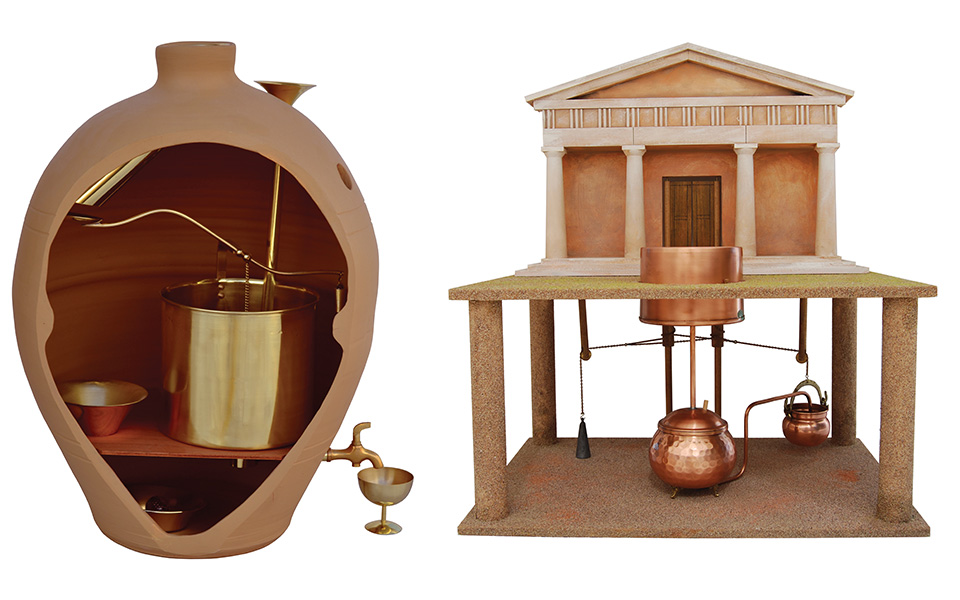
The first vending machine in history (left) and the automatic opening of temple doors at the Museum of Ancient Greek Technology by Kostas Kotsanas.
“Our visitors are often struck by the realization that technologies such as robotics and computing, steam power, self-propulsion and automatic navigation, automation and programming, cartography, telecommunications, and cryptography were already conceived in ancient Greece,” Papastergiou explains. “This understanding challenges the widespread belief that technological civilization follows a steady upward trajectory, revealing instead a history marked by advances and setbacks over the centuries.”
These achievements are presented through more than 250 interactive exhibits, ranging from screws, gears, and pistons to programmable mechanisms and automatic navigators – components that echo those found in modern engines – allowing visitors to examine the machines up close and understand how they operate.
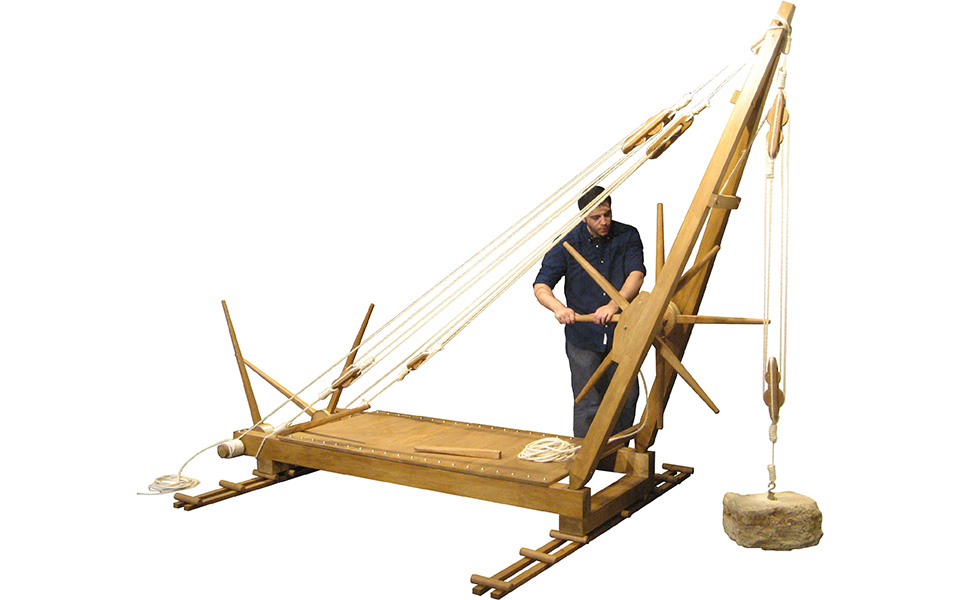
The twin-mast lifting machine used to build the Parthenon – Kotsanas Museum.
“Among the most popular exhibits are Plato’s alarm clock with its sharp, birdlike sound, the automatic opening of a temple’s doors, a coin-operated libation vessel, and a stone-lifting crane,” Papastergiou notes. “Particularly emblematic is Hero’s aeolipile, the world’s first steam engine, which has become the symbol of our museum due to its pioneering design.”
The exhibits of the Kotsanas Museum have toured major technological and archaeological museums, as well as academic and cultural institutions worldwide, bringing to light technological achievements that were forgotten for more than a millennium.
“Exploring an era in which cutting-edge technology was not patented reveals just how much modern technological civilization owes to ancient Greece,” Papastergiou concludes, noting that a new exhibition dedicated to the Seven Wonders of the ancient world is expected to open in the near future.
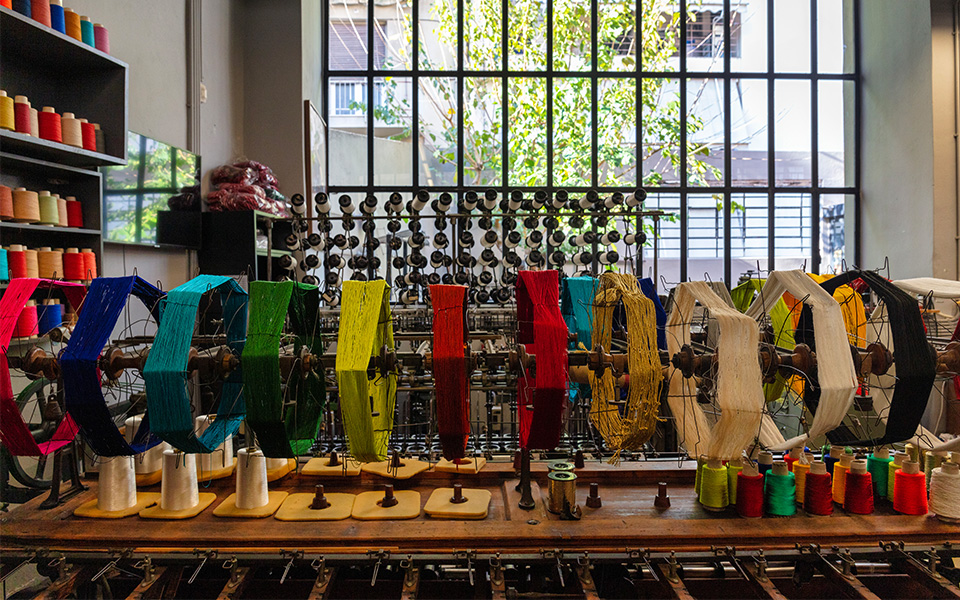
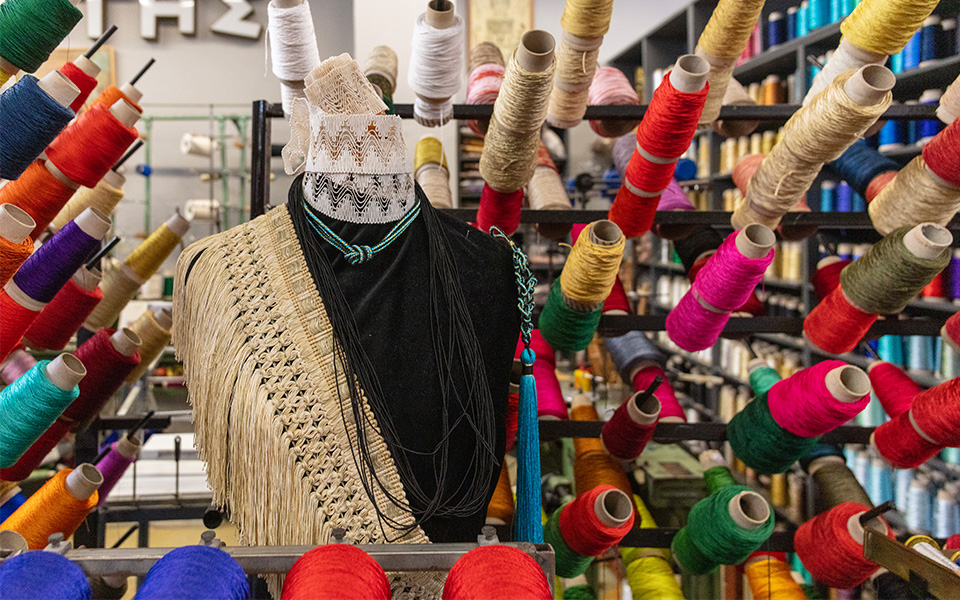
A space filled with inspiration and creativity opens its doors daily at the Mendis-Antonopoulos Silk Weaving Museum in Petralona.
© Perikles Merakos
Tucked away in a narrow alley behind Piraeus Street, in the Petralona district, the Mentis-Antonopoulos Textile Mill operates as a living repository of intangible cultural heritage. Within its walls functions the only workshop in Greece that continues to produce silk using traditional methods.
Founded 13 years ago through the determination of Virginia Matseli, the small museum later joined the Benaki Museum network. Despite its cultural significance, it remains largely unknown to the wider public. Visitors who reach its sturdy entrance on Polyfimou Street are often welcomed by Matseli herself, the museum’s founder and tireless guide.
“Here, you will see threads of silk, cotton, or rayon, as well as works made from elaborate yarns,” explains Ms. Matseli as we walk among spinning machines and the people operating them.
“The challenge was to ensure that the knowledge of silk production would not be lost – to pass it on to future generations. And we succeeded. This is a sustainable museum.”
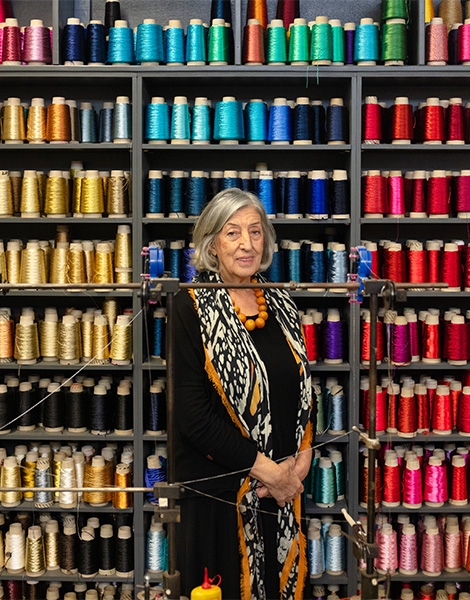
The museum’s inspirer and founder, Virginia Matseli, set herself the challenge of preserving traditional silk-weaving know-how, and she succeeded.
© Perikles Merakos
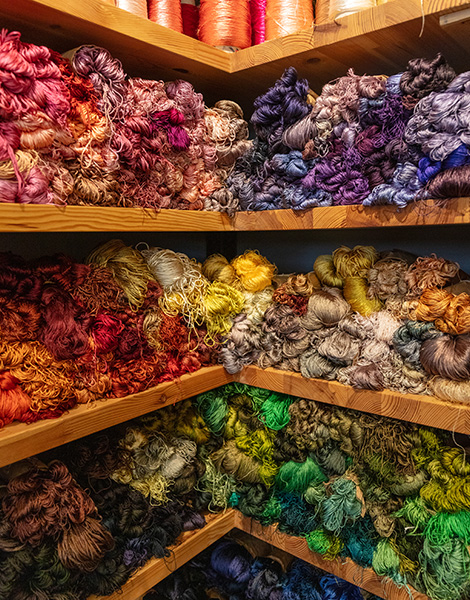
A space full of inspiration and creativity opens its doors every day at the Mendis-Antonopoulos Silk Weaving Museum in Petralona.
© Perikles Merakos
The museum’s story is closely linked to the economic crisis that gripped Athens in the early 2010s. At the time, Matseli was serving as director of the Department of Modern Cultural Heritage at the Ministry of Culture, witnessing the gradual disappearance of traditional crafts from the historic center.
Distressed by the situation and facing institutional inaction, she began independently documenting endangered professions, recording interviews with silversmiths, milliners, dressmakers, and other craftsmen. It was during this effort that she encountered the last remaining silk workshop of Mentis and Antonopoulos on Romvis Street, on the brink of closure.
“The shutters were down and their belongings had been packed into boxes. They had gone bankrupt and were preparing to close. I asked them to wait a little so I could see what I might do and I sought support from Lia Martinou. who immediately agreed to sponsor the rescue of the workshop.
The mill was eventually relocated to its current premises – then a derelict building with no windows – and opened to the public on December 13, 2012. It has operated continuously ever since.
Today, the museum attracts international interest. Shortly before our visit, students from Harvard toured the space, while major fashion houses – including Dior, Christian Louboutin, and Dolce & Gabbana – have commissioned its work. The museum also collaborates with leading Greek sculptors and produces pieces for major international exhibitions, including Documenta in Kassel.
Asked what she considers the museum’s most distinctive element, Matseli does not hesitate.
“The human capital,” she says. “The people who were once laid off and later rehired to continue practicing this beautiful craft.”
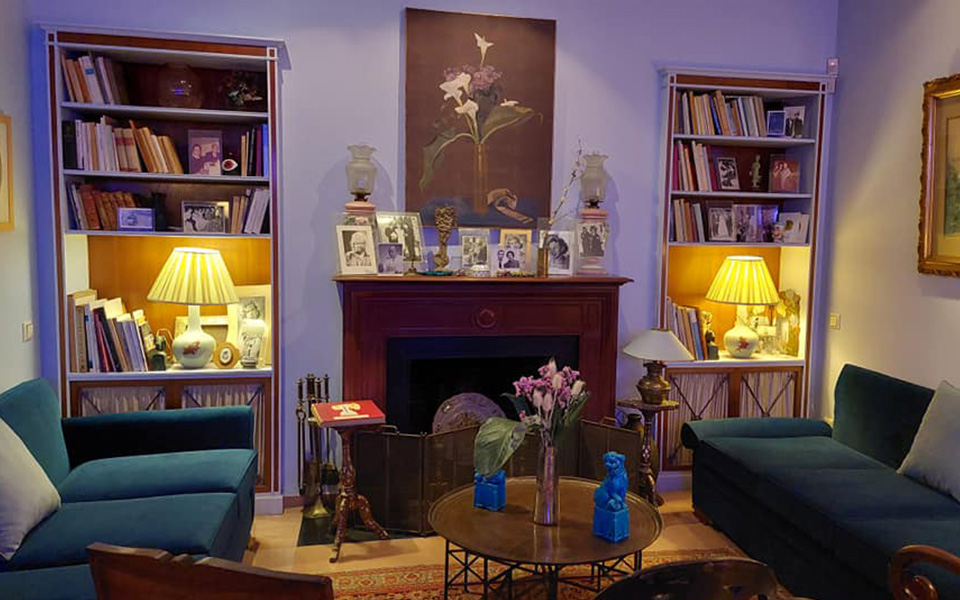
In the living room of the Katakouzinos House, on Amalias Avenue.
Seventeen years after opening its doors to the public, the Katakouzenos House on Amalias Avenue continues to function not merely as a museum, but as a living cultural monument, preserving the atmosphere of the Athenian intellectual elite of the Generation of the ’30s.
This discreet “urban salon” in the heart of Athens once hosted poets, painters, musicians, and thinkers who gathered to exchange ideas and visions for the future of Greek culture. Over time, the house has retained its character, offering visitors an intimate encounter with a defining period of modern Greek intellectual life.
“The Katakouzenos House is a living house-museum of Athenian bourgeois life in the 20th century,” explains Sofia Peloponnisiou, museologist and curator of the Katakouzenos House. “It has been preserved almost unchanged, as Angelos and Leto Katakouzenos experienced it. Through its authentic furnishings, artworks, books, and personal objects, it captures the values, aesthetics, and everyday life of the urban class of the period.”
“The study of the Katakouzinos House, which hosted the Athenian intellectual elite of the Generation of the 1930s. [Katakouzinos House Archive]
She emphasizes that it is not a typical museum space, but rather an experiential environment that allows visitors to fully grasp the Katakouzenoi’s contribution to the artistic and intellectual life of Athens.
“The Katakouzenos House has been transformed into a valuable testimony to the history and identity of Greek urban society of the past century. What moves visitors most is the sense of intimacy and the living presence of the people who once lived there, as well as of those who in recent years have visited the house or left their own imprint,” she adds.
According to the curator, the emotional core of the house lies in the couple’s story of love and devotion, their intellectual cultivation, and their generosity toward artists and friends. Personal items such as letters, photographs, and manuscripts bear witness to the relationships, joys, and hardships of a life dedicated to art and humanity.
“Equally moving are the works of art gifted by their friends, such as Yiannis Tsarouchis, Nikos Hadjikyriakos-Ghikas, Spyros Vassiliou, and Giorgos Gounaropoulos, which convey the spirit of an unforgettable era. What touches visitors most, however, is the sense that the house remains alive; that it continues to carry the spirit, sensitivity, and humanity of its owners, serving as a bridge between past and present.”
Peloponnisiou often observes the sense of surprise, particularly among younger visitors, when they encounter a residence that so seamlessly unites history, art, and lived memory. She recalls one visit in particular.
“A man of about seventy rang the bell one day,” she says. “After the tour, he told me that as a child he used to walk along the opposite sidewalk and wonder what life inside this apartment might have been like. When he finally stepped inside, he said he had fulfilled the greatest dream of his life.”
Children, she adds, respond differently but no less vividly. They move from room to room with curiosity and care, sometimes twirling playfully, instinctively engaging with a space that continues to breathe with memory.
Originally published in Greek at kathimerini.gr