From Zeus and Prometheus to Medusa, the Minotaur, and Oedipus, discover the Greek myths that continue to shape literature, language, and popular culture.
For thousands of years, the stories of Greek mythology have captivated the human imagination. Filled with powerful gods, cunning heroes, terrifying monsters, and epic adventures, they have inspired countless works of art, literature, and popular culture. In the ancient world, these tales would have been told and retold countless times – in bustling agoras, at religious festivals, and around the warmth of the household hearth on long winter evenings. Yet for the Greeks, they were far more than simple entertainment. They served a deeper purpose.
These myths were the great foundation stories of the ancient Greek world. They helped people make sense of everything from the changing seasons and celestial phenomena to the origins of cities, customs, and religious traditions. At the same time, they explored timeless aspects of the human experience: love and jealousy, courage and cowardice, ambition and hubris, fate and free will.
Their influence extends far beyond antiquity. For more than two millennia, Greek myths have inspired artists, poets, playwrights, composers, and, more recently, filmmakers, while their characters and symbols continue to shape everyday language and popular culture. Most people recognize expressions such as “Achilles’ heel,” “Pandora’s box,” “a Herculean task,” or the warning not to “fly too close to the sun,” yet many are less familiar with the stories behind them. And for newcomers, the sheer number of gods, heroes, monsters, and magical creatures can seem a little daunting.
To help you get started, we’ve selected ten of the most famous and influential stories from Greek mythology. Naturally, any such list is subjective – and by no means exhaustive – but it offers a lively introduction to the myths that have captivated imaginations for nearly three thousand years.
Ready? Fasten your winged sandals – we’re heading into the world of gods, heroes, and monsters!

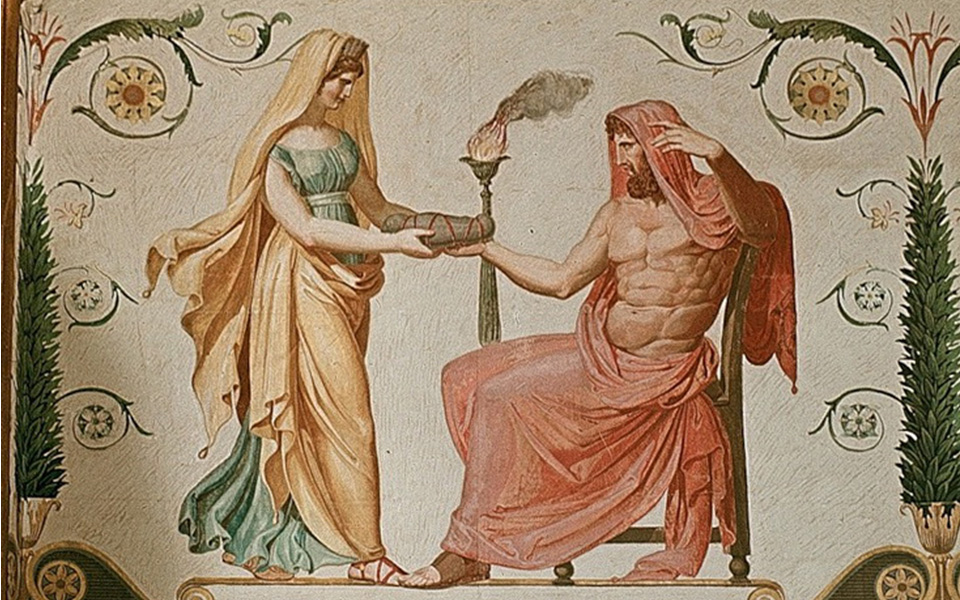
Rhea giving the rock to Cronus, 19th-century painted frieze by Karl Friedrich Schinkel.
The Titanomachy: Zeus and the Rise of the Olympians
Every great mythology begins with a battle, and in Greek mythology none is more important than the Titanomachy – the epic war that determined who would rule the universe.
The story begins with Cronus, king of the Titans, who had seized power from his father, Uranus (Ouranos), the primordial sky god, only to receive a chilling prophecy: one of his own children would overthrow him in turn. Determined to avoid this fate, Cronus swallowed each of his newborn children as soon as they were born. But when his youngest son, Zeus, arrived, his mother Rhea hid the infant away in a cave on Crete – traditionally said to be on Mount Ida – and tricked Cronus into swallowing a stone wrapped in swaddling clothes instead.
Years later, Zeus returned, freed his swallowed siblings – including Poseidon, Hades, Hera, Demeter, and Hestia – and led them in a ten-year war against the Titans. When the dust settled, the Olympian gods emerged victorious.
With the Titans imprisoned in Tartarus, Zeus became ruler of the cosmos. The age of the Olympians had begun, setting the stage for almost every myth that followed.
Much of this story comes from Hesiod’s “Theogony” (c. late 8th century BC), one of the earliest surviving works of Greek literature.
Prometheus tortured by the eagle (black-figure kylix, 560-550 BC, Vatican Museums)
Prometheus and the Gift of Fire
If Zeus was the ruler of the gods, Prometheus was humanity’s greatest champion.
A Titan famed for his intelligence, Prometheus took pity on mortal humans, who struggled without the knowledge and tools needed to thrive. Determined to help them, he stole fire from the gods and secretly delivered it to humanity, concealing the divine flame inside a hollow fennel stalk.
Fire changed everything. It provided warmth, protection, and light, but is also symbolized knowledge, technology, and civilization itself.
Zeus was furious. As punishment, Prometheus was chained to a remote mountainside, where an eagle devoured his liver each day, only for it to regenerate overnight. His torment continued until he was eventually freed by Heracles.
The myth appears in several ancient sources, including Hesiod’s “Theogony” and “Works and Days,” where it is closely linked to the story of Pandora – the first woman and the bearer of a very famous jar (mistranslated in the Middle Ages as a “box”).
The story of Prometheus endures because it asks a timeless question: is the pursuit of knowledge worth the price that sometimes comes with it?
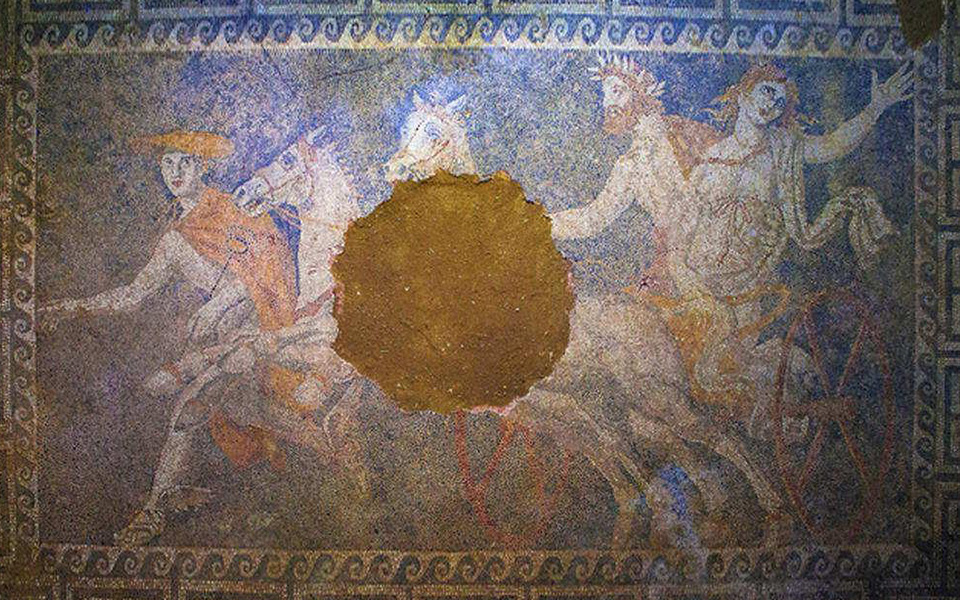
A mosaic of the Kasta Tomb in Amphipolis depicting the abduction of Persephone by Hades, 4th century BC.
Demeter and Persephone
Why do the seasons change? Today we turn to science for the answer. The ancient Greeks turned to one of the most poignant stories in their mythology.
Demeter, goddess of agriculture and the harvest, adored her daughter Persephone. One day, while Persephone was gathering flowers in a meadow, the earth suddenly opened beneath her feet. Hades, god of the Underworld, emerged in his chariot and carried her away to become his queen.
Heartbroken, Demeter searched the world for her missing daughter. As her grief deepened, she neglected her divine duties. Crops failed, fields lay barren, and famine threatened humanity itself. Eventually, Zeus intervened and ordered that Persephone be returned. Yet there was a complication: Persephone had eaten pomegranate seeds in the Underworld, binding her to that realm.
A compromise was reached. For part of each year, she would remain with Hades, and for part she would return to her mother. When they were reunited, spring and summer flourished. When Persephone departed, autumn and winter followed.
The myth not only explained the seasons but also formed the foundation of the famous Eleusinian Mysteries.
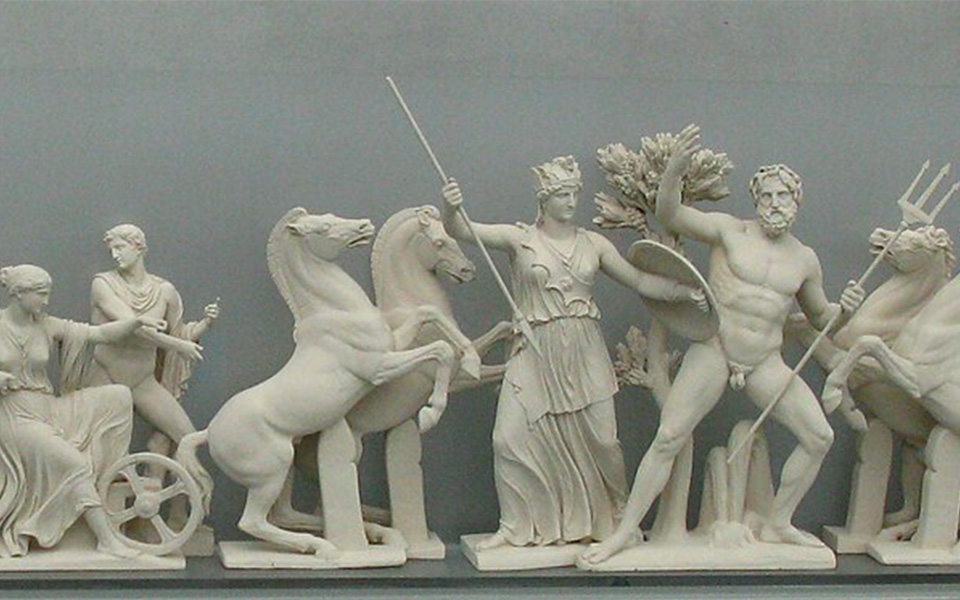
The contest between Athena and Poseidon for Athens and Attica, and the victory of the Virgin Goddess. Proposed reconstruction of the west pediment at the Acropolis Museum, Athens.
Athena and Poseidon: The Contest for Athens
Long before Athens became famous for democracy and philosophy, its people faced a crucial decision: which god would become their protector?
According to the myth, both Athena, goddess of wisdom and strategy, and Poseidon, god of the sea, desired patronage over the growing city. To settle the dispute, the gods agreed that each would offer a gift to its inhabitants. The citizens would then choose the gift they valued most.
Poseidon struck the ground with his mighty trident, causing a spring of saltwater to burst forth – the so-called “Sea of Erechtheus.” In some later traditions, he also created the first horse, a symbol of strength, speed, and power. Athena responded by planting an olive tree. Unlike Poseidon’s dramatic gift, hers was practical and enduring. The olive tree provided food, oil, wood, and a source of wealth for generations.
The people chose Athena’s gift, and the city was named Athens in her honor.
The story reveals something important about how the Athenians saw themselves. While they certainly admired strength and military prowess, they also valued wisdom, foresight, and civic prosperity. Even today, visitors to the Acropolis can see the sacred olive tree that commemorates this ancient contest – a reminder of the mythological origins of one of the world’s most influential cities.
Perseus with the Head of Medusa, Benvenuto Cellini, Loggia dei Lanzi, Florence.
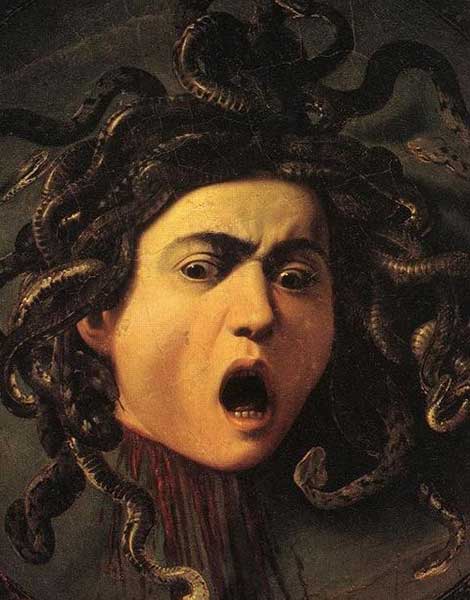
“Medusa,” by Caravaggio (c. 1597)
Perseus and Medusa
Every hero needs an impossible challenge, and few seemed more impossible than the task given to Perseus.
The young hero was ordered to retrieve the head of Medusa, one of the dreaded Gorgons. Unlike her immortal sisters, Medusa could be killed, but there was a catch: anyone who looked directly at her was instantly turned to stone. It was the sort of mission from which no one was expected to return.
Fortunately, Perseus had help. The gods equipped him with a collection of magical gifts, including winged sandals from Hermes, a mirrored shield from Athena, and Hades’ cap of invisibility. Guided by Athena, he approached the sleeping Medusa and carefully used the shield’s reflection to avoid her deadly gaze. With a single stroke, he severed her head.
The adventure did not end there. On his journey home, Perseus famously rescued the princess Andromeda from a fearsome sea monster (not the Kraken!) before eventually returning to Greece in triumph.
Medusa’s snaky hair and petrifying stare have become some of the most recognizable images in Greek mythology, but the story’s enduring appeal lies in something deeper Perseus succeeds not through brute strength alone, but through courage, ingenuity, and a little divine assistance – qualities that would define many of Greece’s greatest heroes, perhaps most famously our old friend Odysseus.
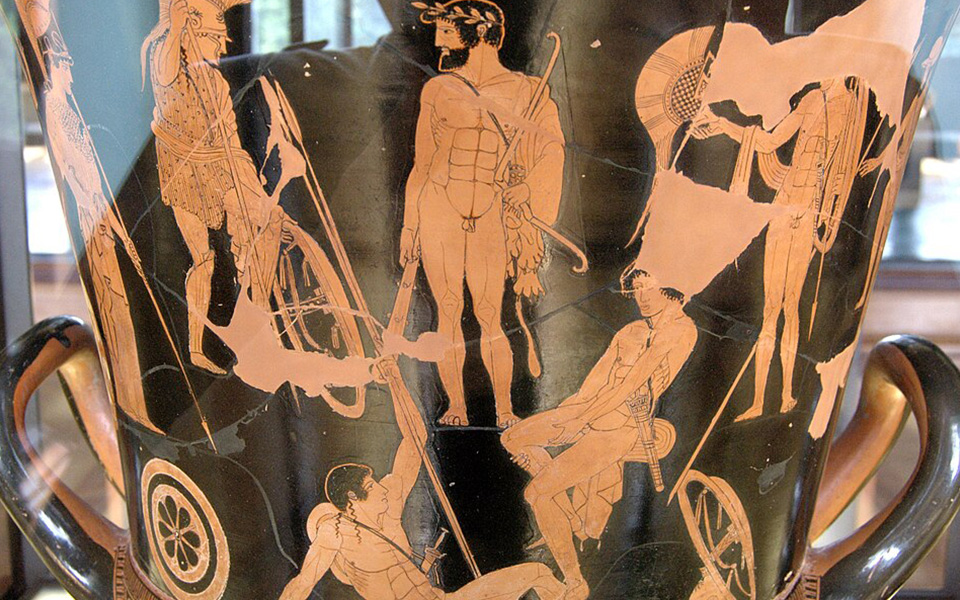
Gathering of the Argonauts, Attic red-figure krater, 460–450 BC (Louvre G 341).
Jason and the Argonauts
If Perseus gave Greek mythology one of its greatest adventures, Jason and the Argonauts gave it one of its greatest quests.
The story begins when Jason sets out to reclaim the throne that rightfully belongs to him. To do so, he must obtain the legendary Golden Fleece, a miraculous treasure kept in the distant kingdom of Colchis on the far shores of the Black Sea.
Recognizing that he cannot succeed alone, Jason assembles a remarkable crew of heroes known as the Argonauts, named after their ship, the Argo. Among their ranks are some of mythology’s most famous figures: Heracles, Orpheus, Telamon, Peleus (the future father of Achilles), Castor and Pollux, and many others. It was, in effect, the closest thing Greek mythology had to an all-star team.
Together they sail across dangerous seas, encountering harpies, navigating the deadly Clashing Rocks, confronting hostile kings, and overcoming a host of other supernatural challenges.
When Jason finally reaches Colchis, he faces a series of seemingly impossible tasks, including taming fire-breathing bulls and sowing a field with dragon’s teeth, from which armed warriors spring from the earth. His success ultimately depends upon the help of the sorceress Medea, whose knowledge of magic enables him to secure the Golden Fleece and make his escape.
Part adventure story, part coming-of-age tale, the voyage of the Argo established a template that countless stories would follow. A band of companions, a perilous journey, a distant prize, and trials at every turn – the ingredients of the modern quest narrative were all there more than two thousand years ago!
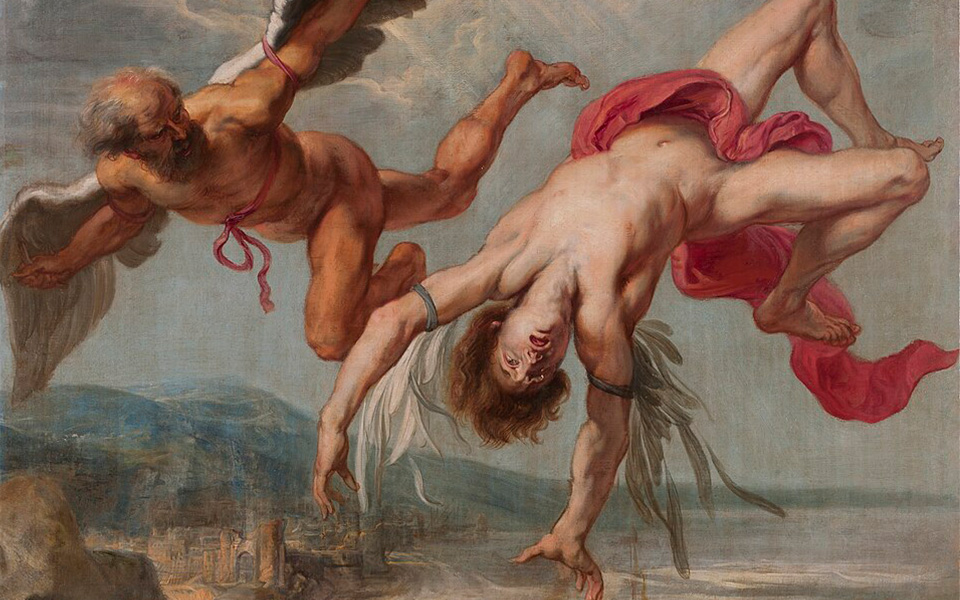
Jacob Peter Gowy’s “The Fall of Icarus” (1635-1637)
Daedalus and Icarus: Flying Too Close to the Sun
While most myths celebrate epic triumphs. Others serve as dire warnings.
Daedalus, the master craftsman who built the Labyrinth, found himself trapped on Crete with his son Icarus. Determined to escape, Daedalus devised an ingenious solution. Gathering feathers and fastening them together with wax, he fashioned two pairs of wings.
Before taking flight, he gave Icarus a simple but important warning: do not fly too low, where the sea’s moisture could weigh down the wings, and do not fly too high, where the sun’s heat might melt the wax.
At first, father and son soared successfully above the waves. But exhilarated by the experience, Icarus ignored his father’s advice and climbed ever higher into the sky. The wax softened, the feathers scattered, and he plunged into the sea below.
The moral of the story captures a timeless truth: ambition and innovation can achieve extraordinary things, but wisdom lies in recognizing limits. For the Greeks, the fate of Icarus was a powerful reminder that success often depends as much on restraint as on daring.
Even today, the story continues to inspire artists, writers, and musicians – including Iron Maiden’s classic song “Flight of Icarus,” which reimagines the tale with a darker twist, casting doubt on Daedalus’ motives and transforming the story into a meditation on ambition, freedom, and betrayal.
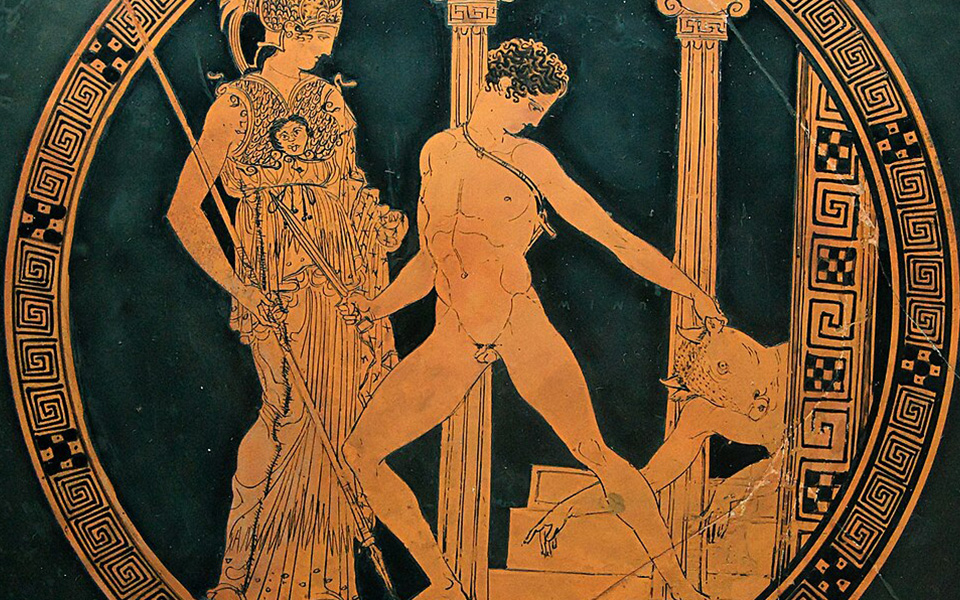
Theseus slaying the Minotaur, with Athena nearby, tondo of a kylix by Aison, late 5th century BC.
Theseus and the Minotaur
Every city needs a founding hero. For Athens, that hero was Theseus.
His most famous adventure began with a terrible injustice. Each year, Athens was forced to send fourteen youths – seven young men and seven young women – to Crete as tribute to king Minos. There they were cast into the Labyrinth, a vast maze inhabited by the Minotaur, a terrifying creature with the body of a man and the head of a bull.
Determined to end this humiliation, Theseus volunteered to join the doomed expedition. Upon arriving in Crete, he won the affection of Minos’ daughter Ariadne, who secretly provided him with a ball of thread – according to some versions, on the advice of Daedalus. As Theseus entered the Labyrinth, he unwound the thread behind him, ensuring that he could find his way out again.
Deep within the maze, he confronted the Minotaur and slew the beast. Following the thread back to safety, he escaped Crete and freed Athens from its obligation to provide further sacrifices.
Over time, he became Athens’ national hero, credited not only with great deeds but also with uniting the communities of Attica into a single political entity.
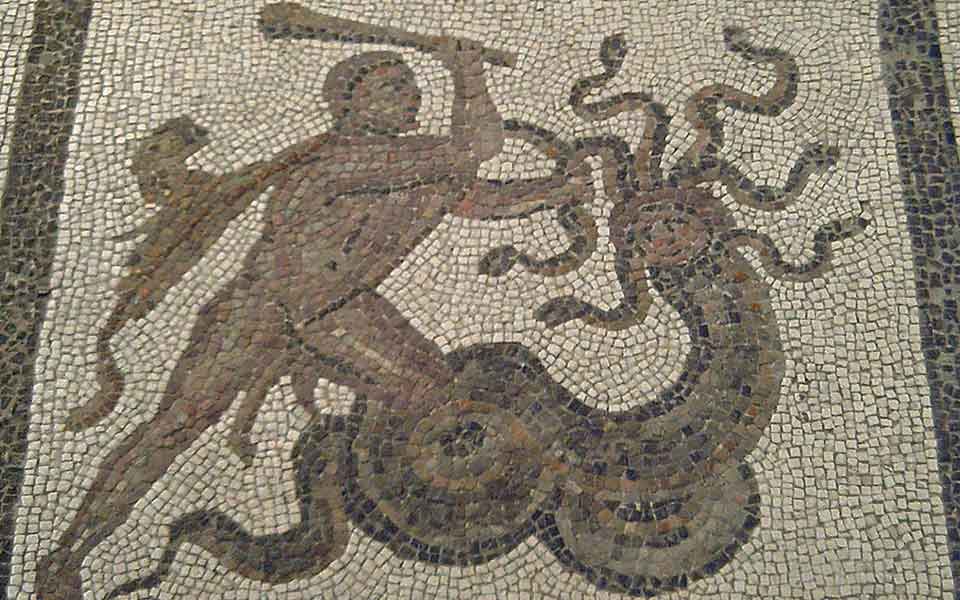
A Caeretan black-figure hydria (c. 346 BC), depicting Heracles and his nephew Iolaus slaying the nine-headed Lernaean Hydra.
The Twelve Labors of Heracles
No hero looms larger in Greek mythology than Heracles.
The son of Zeus, Heracles possessed immense strength, but his life was marked by tragedy as well as glory. Driven mad by Hera, he committed a terrible crime and sought purification for his actions. As part of his penance, he was ordered to serve king Eurystheus and perform a series of seemingly impossible tasks.
These became known as the Twelve Labors. Over the course of his adventures, Heracles slew and skinned the invulnerable Nemean Lion, defeated the multi-headed Hydra, captured the Ceryneian Hind, subdued the ferocious Erymanthian Boar, and cleaned the filthy Augean Stables in a single day by diverting two rivers. His final labors carried him to the edges of the known world and even into the Underworld itself.
For the ancient Greeks, Heracles represented the ideal hero – not because he was perfect, but because he continually struggled, suffered, and ultimately overcame. Little wonder that his exploits appear throughout Greek literature and art, from the poems of Homer and Hesiod to the tragedies of Sophocles and Euripides. More than any other mythological figure, Heracles came to embody the heroic spirit itself.
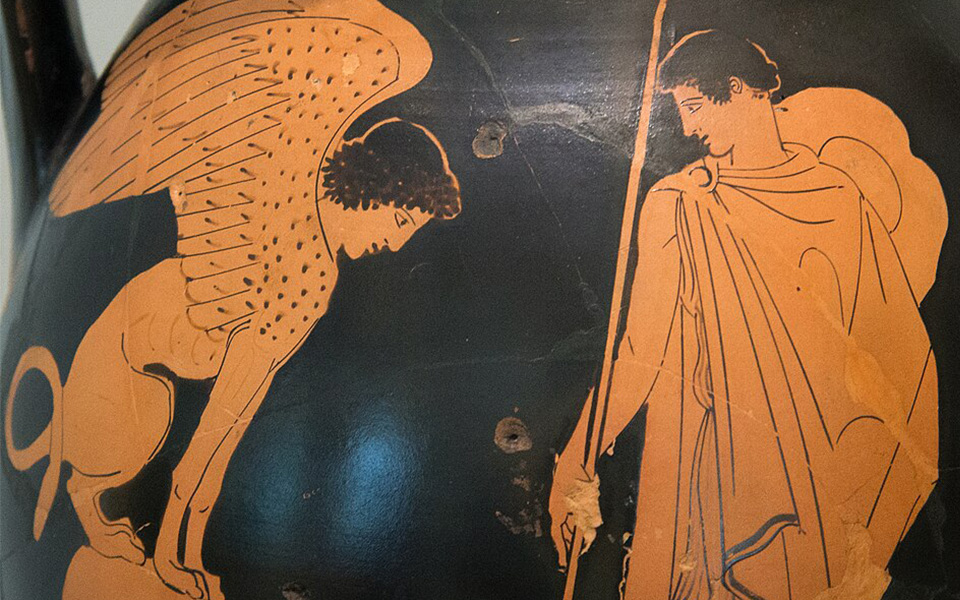
Attic red-figure pelike, 450-440 BC. Achilleus Painter. Oedipus solves the riddle of the Sphinx and frees Thebes. Antikensammlung Berlin, Altes Museum, F 2355.
Oedipus and the Sphinx: The Riddle That Could Not Save a King
Many Greek heroes defeated monsters with swords and spears. Oedipus – whose name means “swollen foot” – defeated his with his mind.
According to the myth, the city of Thebes was terrorized by the Sphinx, a fearsome creature with the body of a lion, the wings of an eagle, and the head of a woman. Perched outside the city, she challenged all travelers with a riddle. Those who failed to answer correctly met a grisly end.
When Oedipus arrived, the Sphinx posed her famous question: “What walks on four legs in the morning, two legs at noon, and three legs in the evening?”
After a moment’s thought, Oedipus gave the correct answer: a human being. As an infant, a person crawls on all fours; as an adult, walks on two legs; and in old age, relies upon a staff as a third. Defeated, the Sphinx destroyed herself, and Oedipus was hailed as a hero. He became king of Thebes and appeared destined for a life of success and happiness.
Yet this triumph was only the beginning of a far darker story. Before his birth, a prophecy had foretold that he would kill his father, king Laius, and marry his mother, queen Jocasta. Despite every effort to avoid this fate, the prediction came true. When the truth emerged, Jocasta took her own life and Oedipus blinded himself in despair.
The myth achieved immortality through the tragedies of Sophocles, whose Theban plays of the late 5th century BC – “Oedipus Rex,” “Oedipus at Colonus,” and “Antigone” – remain among the most celebrated works of world literature.
It is a dark way to end our list, but also an appropriate one. More than two thousand years later, the story still raises profound questions about fate, free will, and human responsibility. The ancient Greeks never settled the debate – and perhaps that is precisely why the myth continues to fascinate us today.