As the Gennadius Library marks its centennial, rare books, maps, letters and young scholars show how Greek history keeps opening new lines of inquiry.
At the foot of Lycabettus Hill, the Gennadius Library has stood with quiet authority for a century. Designed by the American architects John Van Pelt and W. Stuart Thompson, its neoclassical building, with clear echoes of the Erechtheion on the Acropolis, still draws the eye of passersby. Far fewer step through its gates to discover the treasures held within: the first printed edition of Homer’s works, published in Florence in 1488; Flora Graeca, the monumental ten-volume botanical survey of Greek flora; 16th-century maps; the revolutionary map drawn up by Rigas Feraios; the correspondence of Ali Pasha, the powerful Ottoman ruler of Ioannina; the announcement of Lord Byron’s death in Ellinika Chronika, the newspaper published in besieged Messolonghi during the Greek War of Independence; and the archives of poet Takis Sinopoulos and archaeologist Heinrich Schliemann, among many others.
The main entrance of the Gennadius Library.
© Vangelis Zavos
A luxurious binding created by the renowned London bookbindery Morrell for the 1496 edition of Lucian of Samosata’s Dialogues.
© Vangelis Zavos
A Director with a Host’s Instinct
In the late 1980s, when Maria Georgopoulou was a doctoral student in the United States, she would spend her summers at the Gennadius Library gathering material on Venetian Crete – first for her dissertation and later for her book. She could hardly have imagined then that her name would one day become so closely associated with this celebrated institution.
“At the time, the library was one of the most accessible places of knowledge for people of my generation,” says Dr Georgopoulou, who took over as director of the Gennadius in 2004, leaving behind a promising career at Yale. “My Greek husband and I had reached the point where we had to make a definitive decision about where we would live, as our children were growing up. When you work for an organization this interesting, you feel that you grow along with it, while also having the chance to contribute to changes both small and large.”
I ask her whether she misses teaching. “Certainly not grading papers,” she says, laughing. “What I do miss is the look in the eyes of 20-year-olds when they hear something from you for the first time – those eyes opening wide, and then a question that comes out of nowhere, one that forces you to rearrange everything you know in your mind in order to answer it.”
The main entrance of the Gennadius Library.
© Vangelis Zavos
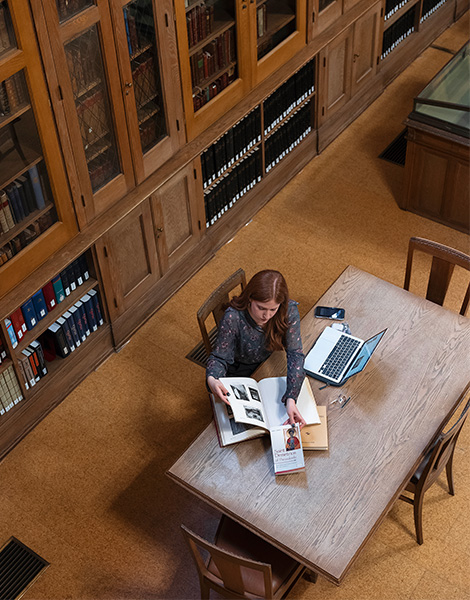
Alison Grenda, a doctoral student in Byzantine art and fellow of the American School, spends long hours in the library’s reading room.
© Vangelis Zavos
That thirst for dialogue with the next generation of scholars is what drives her to approach every new or regular visitor to the Gennadius, to learn about their research interests and personal goals. As director, she’s also something of a host: she knows which corridor leads to each collection, where every small labyrinth in the building ends, and the name of every researcher and staff member, all of whom she always greets quietly, but by their first name.
The library owes its existence to the diplomat Joannes Gennadius, who assembled in London one of the most comprehensive private libraries on the history of Hellenism. His later donation of 30,000 volumes to the American School of Classical Studies at Athens led to the creation of an international center for the study of Greek civilization across time: the Gennadius Library.
Two wings were added in the late 1960s. Further modernization and new spaces followed in successive phases, in 1999, 2005 and 2017; the East Wing was inaugurated in 2005 and renovated in 2018.
Sofia Pitouli, a doctoral student in Byzantine art.
© Vangelis Zavos
150,000 Items
By 10:00, every seat in the reading room of the main building is already taken. In complete silence, five researchers are absorbed in their books.
“The Gennadius is not a lending library,” explains Irini Solomonidi, the head librarian. “Readers obtain a library card using official identification and may use the collections during opening hours, from 9:00 to 17:00. They can locate non-rare books themselves and, depending on their needs, scan sections of them. Rare books and manuscripts, however, are subject to different rules. In essence, we are many libraries in one. We began as the collection of Joannes Gennadius and, over time, evolved into a hybrid collection. In its early years, the decision was made that the library should not remain static but should continue to grow along the lines of the subjects Gennadius himself had chosen.”
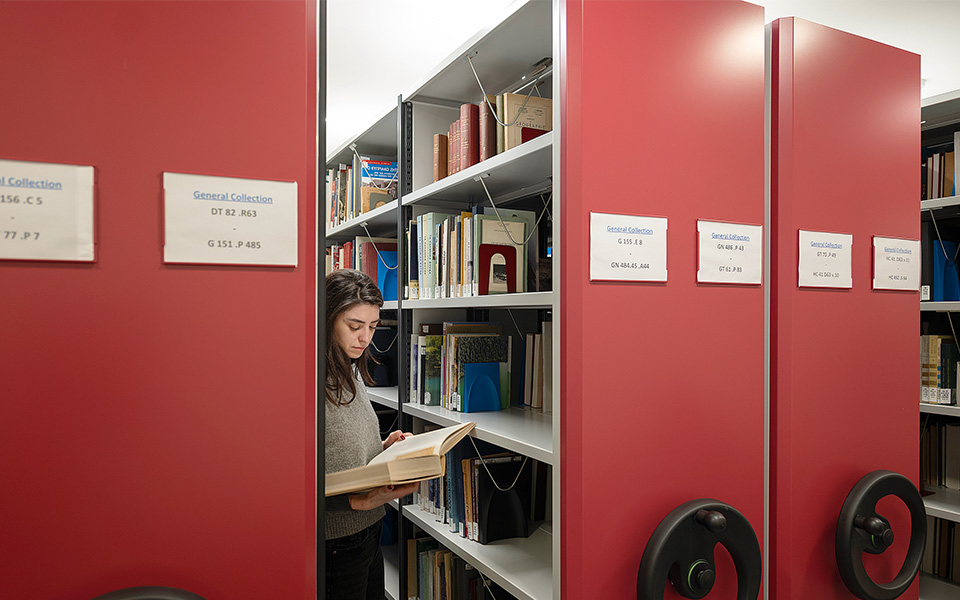
The library continues to receive book donations to this day. “Georgios Veloudis, who was professor of Modern Greek Literature at the University of Ioannina, left us 5,000 books in his will, while the Byzantinist Efthalia Konstantinidi donated 8,000,” Dr Georgopoulou notes. For the library’s staff, 2015 was a landmark year. “We carried out an inventory of all the books and archival material – 150,000 items in total. It was a monumental task, and we’re all very proud of it,” says Solomonidi. The books were divided into rare and non-rare categories. “The rare books were moved to special closed-access stacks. Visitors may consult them by request, through the library staff. The non-rare books – 100,000 volumes – were reclassified according to the Library of Congress system in order to make them compatible with the American academic community.”
The Gennadius remains a non-lending library, which makes its librarians especially valuable. And since part of the collection has now been digitized, researchers from around the world often turn to them remotely for help with their work.
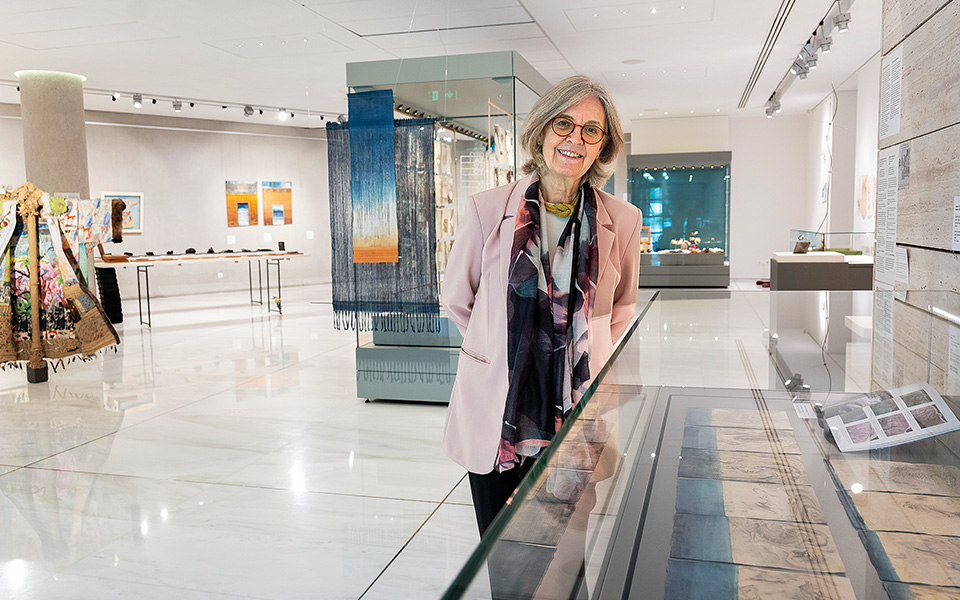
Maria Georgopoulou, Director of the Gennadius Library.
© Vangelis Zavos
Ali Pasha’s Letters
The archives, housed alongside the rare books, belong to the American School of Classical Studies at Athens. “Our department was created in 1994 to manage the growing number of archival collections,” explains Dr Natalia Vogeikoff-Brogan, director of the archives.
“Here we hold the personal papers of American archaeologists connected with the School, whether through excavation work or as members. We also hold the personal archives of prominent Greeks that have been donated to the Gennadius, as well as the archive of Heinrich Schliemann, the German archaeologist who spent the final years of his life in Athens and is buried in the city’s First Cemetery.”
In a sense, the Gennadius itself – which belongs to the American School – was born from an archive. “When the School decided to accept Joannes Gennadius’ donation, it effectively made a major change to its mission, which until then had been devoted exclusively to the study of antiquity.”
In the same spirit, the archives of George Seferis and Odysseas Elytis, both Nobel Prize-winning Greek poets, were accepted, along with those of many other leading figures of modern Greek letters and intellectual life. Most archives are acquired through private agreements. “An archive may contain much more than books,” Dr Vogeikoff-Brogan explains, as she shows me a painting by Panayiotis Tetsis depicting Seferis.
The handwritten letters received by Ali Pasha soon draw my attention. “The Ali Pasha archive consists essentially of the correspondence he received, since it was not possible to preserve copies of his own letters,” she says. “It was bequeathed to the Gennadius by Damianos Kyriazis in 1953.”
The collection is a priceless trove of some 1,500 private and public documents, studied, transcribed and annotated by Vasilis Panagiotopoulos in five volumes. “An associate of Lord Elgin, the painter Giovanni Battista Lusieri, had gone to Ioannina to paint the city. Shortly before the work was completed, however, Ali Pasha is said to have objected. In a letter from 1809, the British officer and traveler William Martin Leake reassured him about the character of the artist – and of the British mission more broadly.”
Such valuable documents, however, are not there simply to be admired.
“We are not a museum. Someone cannot simply come out of curiosity to see, say, Elytis’ handwriting with their own eyes,” Dr Vogeikoff-Brogan clarifies. “They must have a specific research purpose and make an appointment.” Due to limited space and staff, up to four visiting researchers are admitted per day.
“We are interested in being kept informed about the progress of their work. We are an institution that produces knowledge; we want to know whether we are contributing to scholarly articles or books,” she adds.

A lock of Lord Byron’s hair, preserved in an album dedicated to the poet.
© Vangelis Zavos
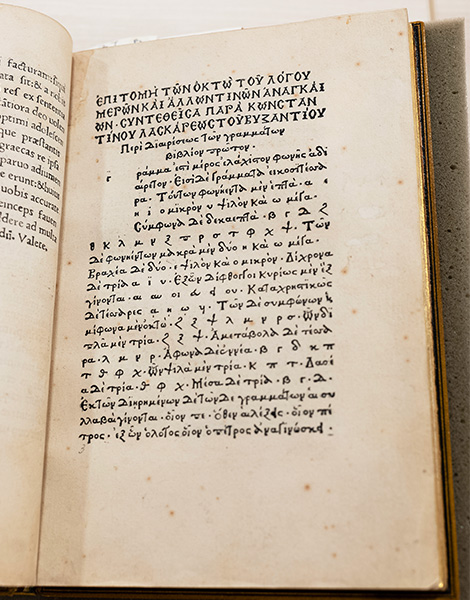
Constantine Lascaris’ Epitome of the Eight Parts of Speech is the first dated printed book in Greek.
© Vangelis Zavos
The Next 100 Years
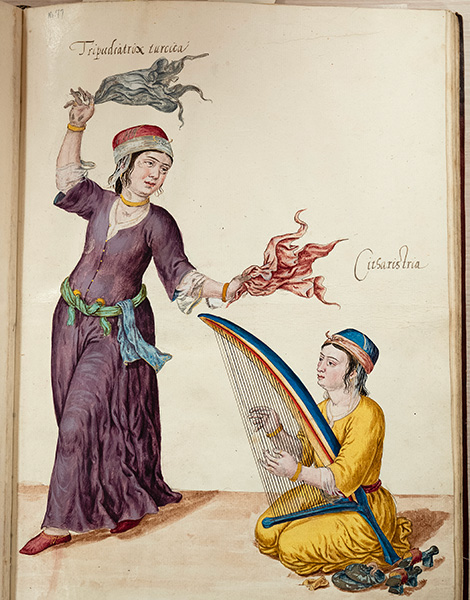
As the library’s centennial approaches, preparations for the anniversary are in full swing. In April, an exhibition will open featuring 100 exceptional items from its rich collections: books, manuscripts, works of art, maps, costumes, photographs and more. Among them will be the first edition of Aristotle printed by Aldus Manutius in Venice between 1495 and 1498, as well as watercolors by the English artist Edward Lear from the mid-19th century.
Later that month, the international conference “Libraries and Collectors” is scheduled to take place. A student competition is also already underway. “We are reaching out to middle-school and high-school students in Greece and the Greek diaspora, asking them to speak to us – through any medium they choose – about place, using digitized material from the Gennadius,” the director explains.
“For us, 100 years is not simply an anniversary. It’s a challenge. We must decide how we move forward from here,” she says. “How do we pay due respect to the treasure we hold, and how do we present it in the best possible way to the next generations?”
The people of the Gennadius are working along three main lines. “We are seeking resources to acquire new rare material, to expand the fellowship program and to become even more outward-looking, through events and the further digitization of our collections,” Dr Georgopoulou explains.
Hilal Cemile Tümer, top, a doctoral student from Berkeley, and Dimitris Prokos.
© Vangelis Zavos
A Scholarly Home in Kolonaki
Hilal, Alexandra and Dimitris, three of this year’s Gennadius Library fellows, share an office on the second floor. Their fields differ – history, architecture and folk song – but all three have come here to work with the library’s extraordinary holdings, which span the period from late antiquity to the present day.
“We receive around 100 applications each year,” says Dr Maria Georgopoulou. “From these, we now select six researchers, evaluating, among other things, how closely their work relates to the material held here.” The fellows are at the start of their academic careers: some are completing their dissertations; others have begun postdoctoral work. During their nine-month stay, each pursues a distinct research project.
Dimitris Prokos, a scholar of Modern Greek literature at the National and Kapodistrian University of Athens, is writing his doctoral dissertation on Greek folk songs. At the Gennadius, he is studying the archives of James Notopoulos, a Greek American scholar and former Gennadius fellow in the 1952-53 academic year.
“My interest in Notopoulos began during a short stay at Harvard, where his collection of recordings is held,” says the 33-year-old researcher. “Although Notopoulos was a Homerist, he worked extensively on folk song and was the first to record it in the field. Before him, recordings had been made indoors.” Notopoulos left behind some 900 recordings. Prokos is now studying Notopoulos’ notes, including the setbacks that marked his fieldwork – beginning with the customs authorities’ confiscation of his equipment, which delayed his efforts by more than two months. The fellowship, Prokos says, gives him the financial independence to focus fully on his research. “In the humanities, especially in Greece, full fellowships are extremely rare.”
A scholar of Modern Greek philology, are two of this year’s Gennadius Library fellows.
© Vangelis Zavos
Hilal Cemile Tümer, a Turkish doctoral student at the University of California, Berkeley, is studying a little-known chapter of the Greek Revolution of 1821: the displacement of Greek-speaking Muslims from the Peloponnese and the rest of southern Greece, who left by ship for Asia Minor and rebuilt their lives there.
“I gather information from the writings of European travelers, reports by officials and ambassadors, and the memoirs of Greek revolutionaries themselves,” she says. Her research languages include Ottoman Turkish, modern Turkish, English, French and Greek.
As Dr Georgopoulou notes, interest among researchers from Turkey is strong. “The philosophy of Byzantine and Ottoman studies has changed. In my time, everyone focused on Constantinople. Now, increasingly, scholars are studying other corners of the former empires.”
The fellows live at Loring Hall, part of the same complex as the Gennadius Library and the American School of Classical Studies at Athens. The impressive neoclassical building hardly resembles a typical student residence: fellows are provided with their own rooms, daily meals and the practical support needed to focus on their research. “The aim is to free them from everyday concerns,” Dr Georgopoulou says. This year, for the first time, the program also includes a fellowship for an associate professor, who conducts his or her own research while mentoring the younger scholars. The role is both academic and practical: helping a small group of researchers working on very different subjects develop a sense of community, while also guiding them on matters such as job applications and submitting articles to scholarly journals.
The fellowships are privately funded by supporters of the Gennadius, including the library’s trustees. “That’s why each fellowship bears a name,” Dr Georgopoulou says.
Asked whether changes in research and higher education across the Atlantic affect the Gennadius, she is measured. “We receive a negligible amount of federal funding, so nothing changes radically in terms of our own operation. But the broader uncertainty and the interruption of funding for research programs at universities in the United States affect us indirectly.” Some international students in the US, she notes, have declined fellowships abroad for fear that they might not be able to return afterward. As a result, the Gennadius may well see more fellows from European universities in the near future.