When Gods Were Tourists: Greece’s Sacred Travel Hubs
Before passports and package tours, pilgrims...


Wild and unspoiled, the island of Agistri is a popular destination for tourists seeking an alternative weekend retreat from Athens.
© Stelios Papardelas
Agistri has four settlements and covers an area of roughly twelve square kilometers. Skala and Metohi are located on one side, while Megalohori and the ancient settlement of Limenaria, which was founded centuries ago in an effort to fend off pirate raids, are located on the other, towards the west. Cycling around the island only takes a few minutes; once you’re on the island, it’s easy to find a bike to rent.
Agistri was once a well-liked spot for wild camping, but that practice is now forbidden. This altered the island’s personality, and the aggressive surge of visitors in recent years appears to be changing the island’s appearance as well. Agistri is still in the shadow of Aegina, but it’s no longer the same. Apart from the odd peaceful, “alternative” tourist, families from Athens now come here looking for a more affordable alternative to Andros, Syros, or Tzia. Tourists or even digital nomads search for apartments so they can spend a few months enjoying a simpler, but still appealing, version of the Greek summer.
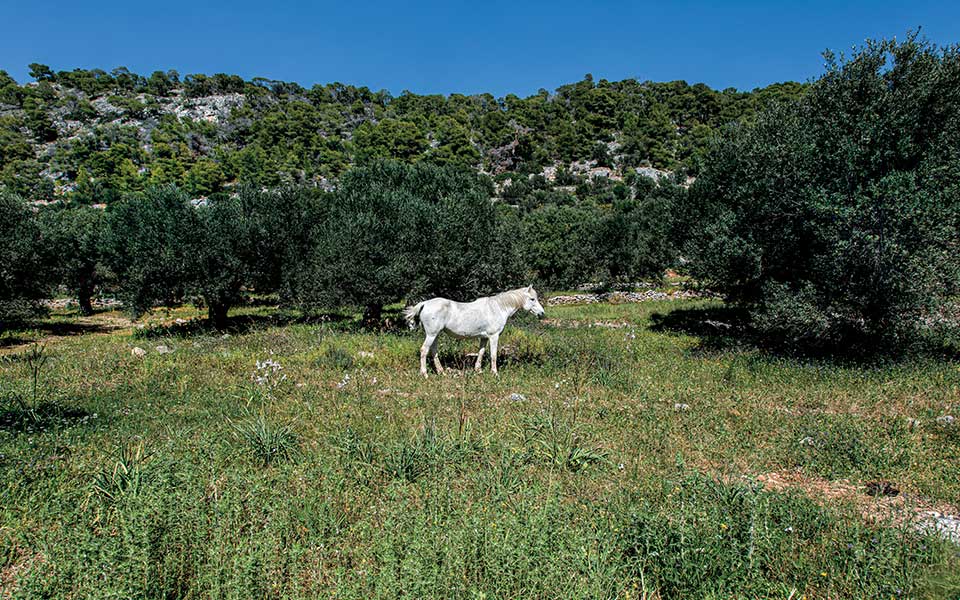
Traveling westward towards the village of Aponisos, passing verdant forests en route, visitors encounter grazing horses belonging to the local riding club.
© Stelios Papardelas
I remember being impressed by the peacocks on my first visit to Agistri many years ago. After being introduced to the island, they multiplied and are now mostly found around Metohi. Throughout the day, you could hear them squawking at random times. Occasionally, they would sneak into the courtyards to eat the food that the residents had left for the cats, and if you approached them, they would flee in fear. Their stunning turquoise feathers, however, more than made up for this behavior.
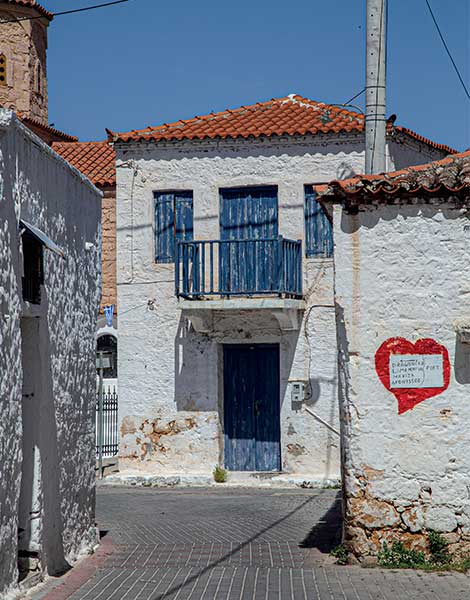
In the settlemement of Megalohori, descending towards the port, established in 2006, visitors encounter some older buildings around the church of Zoodohos Pigi.
© Stelios Papardelas

Where time stands still: Explore the cobbled walkways In the old settlement of Limenaria.
© Stelios Papardelas
We decided to look for them later, so we left Skala to go to the famous Alkyoni taverna. Nikos, its young owner, welcomes us with fresh mousmoula (loquat). In addition to running the taverna, he also lets out rooms. “It was bound to happen,” he says about the increase in visitor numbers in recent years. “Some 15-20 years ago, the island had nothing; just ten shops, nature, and no infrastructure.” He explains that Agistri is currently at a breaking point, with its identity uncertain as hotels and restaurants sprout up everywhere. “Now everyone works in tourism. The island has far more people than it can accommodate. Fortunately, its natural environment remains intact, which is the most important thing to me,” he says. The peak season has also changed. “In the past, Agistri was a ghost island in mid-September.” It is now well-known among foreigners, and the season is extending. Foreigners stay for longer periods of time, while Greeks consider it a weekend island. Even though it’s small, it’s worth staying longer.”
On a small beach just past Alkyoni, a group of young Spaniards who live in Athens relax in the sun while listening to music. They recommend that we take the path to Halikada, a popular beach with turquoise waters that is also popular among nudists. Within a few minutes, the shore appears through the pine trees. Only a few people at a time can relax beneath the steep cliffs and swim comfortably in the cool sea.
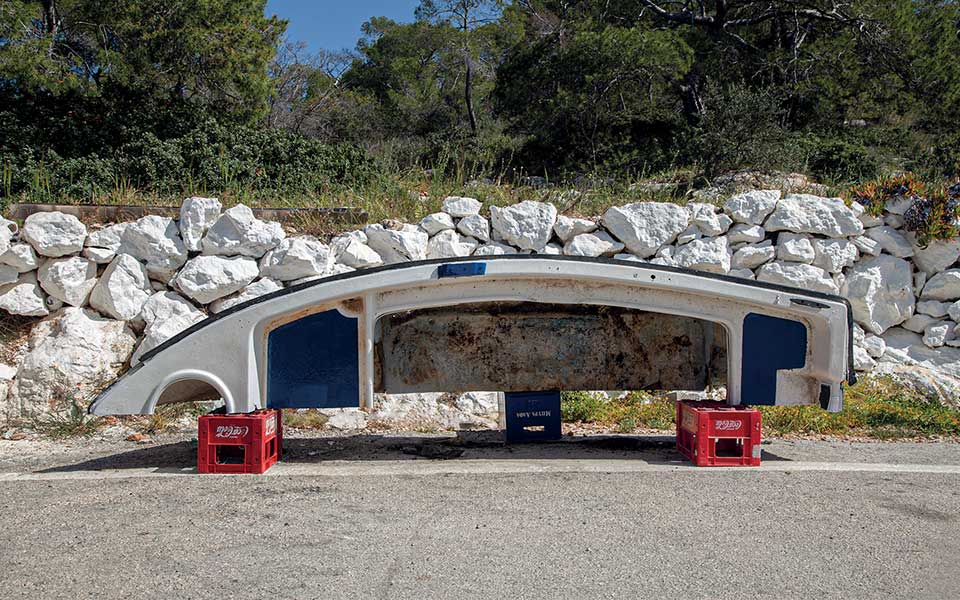
Boat repairs before the busy summer months.
© Stelios Papardelas
We stop at Kyr Giorgis taverna, whose owner is one of the island’s permanent residents. He welcomes us with frappé coffee, cigarettes, and Greek art rock playing on the radio. His real name is Christos Logothetis, but for the past twenty years customers have been calling him by his father-in-law’s name, who opened the place in 1980. “Here, you don’t need watches or cellphones,” he says. “This island is a paradise, although it has its difficulties.” Permanent residents still depend on Aegina for many things. “You have to go there even if you need to go to the bank,” he explains. He, too, mentions the increase in tourist traffic. He claims that there are an increasing number of them each year.
We cross the island and take a coastal road to Megalohori. Along the way, we see people at work: some are repairing furniture for the rooms they let out, others are cleaning chicken coops, and still others are painting boats before letting them dry in the sun. The port of Megalohori was built in 2006 to relieve traffic congestion at the port of Skala. Today, flying dolphin ferries making the 50′ trip from Piraeus to Agistri stop at Megalochori and local villagers moor their boats there. Babis is currently painting his own boat in preparation to welcome the diving enthusiasts who visit the island.

Two-wheelers are a popular way of getting around the island.
© Stelios Papardelas
Andriana Kotzia’s taverna is located on the outskirts of Megalochori. Originally from Piraeus, Andriana now resides here permanently and manages the establishment with her family. A few patrons are enjoying fish in the sun as we arrive. Andriana claims that in the past 30 years the island has undergone significant development. “We are making progress. Additionally, businesses have been modernized.” She has very high hopes for this year. “We make every effort to buy items from the island.
“The prices of products are at least 30-40% higher compared to Athens, but we support the local businesses in any way we can.” She also mentions something we didn’t expect to hear: the island has a traffic problem. “For an island only seven kilometers across, there are too many cars. To reduce them, public transportation needs to be developed. There are only two taxis and one bus.”

At the edge of Megalochori is the tavern of Andriana Kotzia, a Piraeus woman who is now a permanent resident on the island.
© Stelios Papardelas
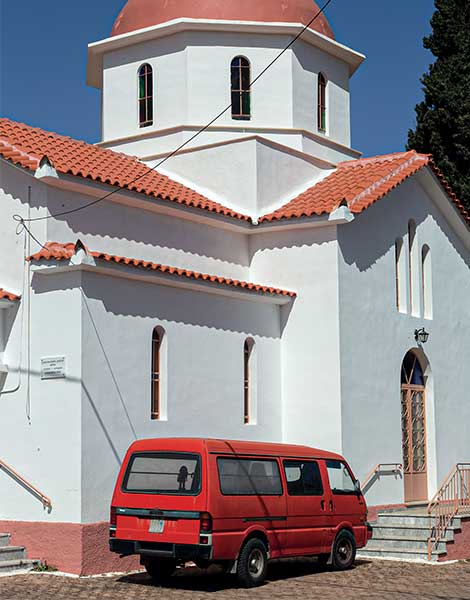
The church of Aghia Kyriaki, in the ancient settlement of Limenaria.
© Stelios Papardelas
Agistri lacks the natural beauty of the Cyclades, as well as any unique traditions or customs. However, it has its own charm and a movie-like, wild beauty, especially on the island’s west side. The clumps of bushes thicken on the rugged, rocky terrain, and horses stare at you in amazement. A tourist walking with a backpack in the sun, or a resident riding a motorbike or bicycle to run errands or go fishing, will occasionally call out a greeting.
As we approach Dragonera, the most famous beach on the west side, we notice that the few hidden spots behind the rocks have already been taken. The bicycles left among the trees indicate that there are others. Continuing our journey, we reach Limenaria, a village of 60 residents with beautiful, time-worn old houses.

The island's picturesque beaches are a popular draw in the summertime.
© Stelios Papardelas
The church of Aghia Kyriaki is one of the area’s two landmarks, the other being Mr. Nikos’ taverna. Here you will find primarily beef, goat, and pork stews, as well as ladera (vegetable casseroles cooked in olive oil). Limenaria receives few visitors because there are no hotels or direct access to the sea, with the exception of Mariza, a diving pier. A photo of the restaurant from 40 years ago hangs on the wall of the taverna, which has yet to open for the season.
Finally, we arrive at Aponisos, the azure gem that awaits visitors at the end of Agistri. It is a small private island connected to the mainland by a bridge, which forms a small harbor with clear waters surrounded by rocks. It also houses the area’s only fish taverna. We’re right in front of it when we hear a splash of water: someone has just dived into the sea. Time is the only thing that keeps us from diving in ourselves. The last ferry leaves in a few minutes, and if we miss it, we’ll have no choice but to spend the night here. People board the ferry at the port of Skala. Most of them had ridden the morning ferry with us; others have stayed behind, perhaps laying on a beach somewhere, conveniently forgetting that there would be no more ferry rides tonight. We return to our daily lives with our cheeks slightly reddened from the sun after a lovely day on the island, even though we forgot to look for the peacocks.
Before passports and package tours, pilgrims...
A compact archaeological guide to the...
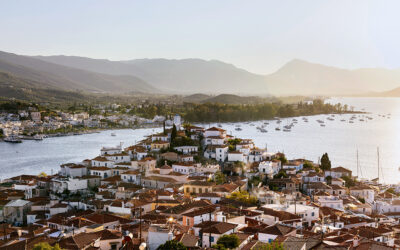
A weekend on the Saronic Gulf’s...
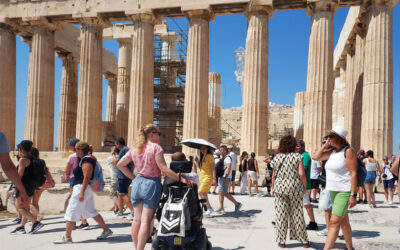
Tourists share the highs and lows...