10 Great Reasons to Visit Messolonghi
On the occasion of the 200th...

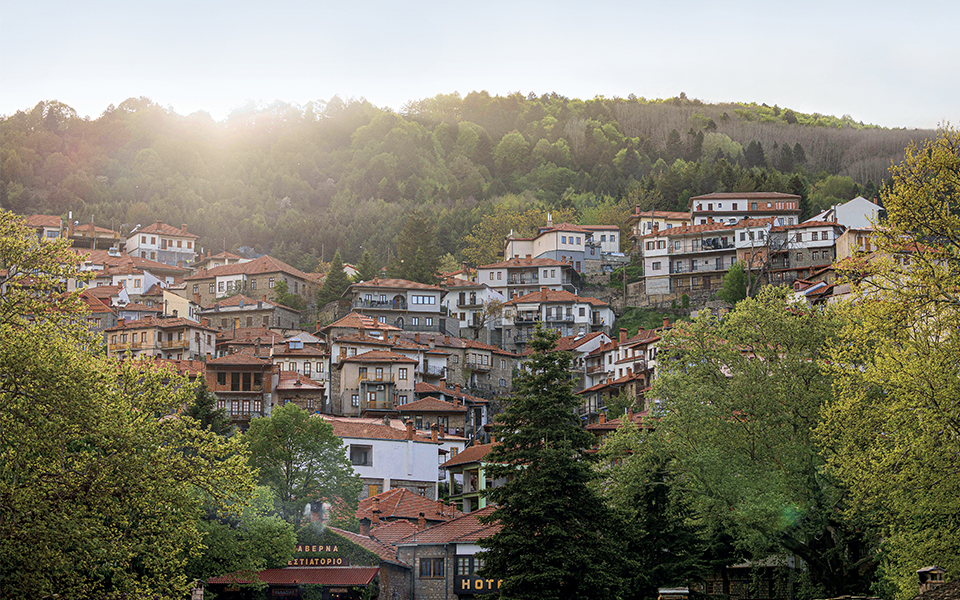
View of Metsovo, showcasing its characteristic local architecture, nestled within dense vegetation.
© Dimitris Tosidis
The locals simply don’t believe us when we say that few mountain communities in Greece have such a large population. All they continue to see is families leaving the villages and public services closing. And yet, with 1,200 permanent residents and at an altitude of 1,150 meters, Metsovo has been rich, populous and, perhaps, lucky throughout its history, as various circumstances seem to have contributed to its prosperity.
It goes back to its Vlach (Aromanian) settlers, really, a people known for their resourcefulness and diplomacy, but also for their hard work and love for the land. Famous livestock breeders, muleteers and merchants, they established Metsovo as an important town in the heart of the Pindus Mountains in northwestern Greece, turning it into an essential stopover between Ioannina and Trikala, which is why it had so many inns. The town was isolated enough to be safe and had a lot of pasture land, making it an ideal place for settlement.

Thanks to the dense forests, timber has always been a main occupation for the locals.
© Dimitris Tosidis

At the alpine Lake Kosmeou, on Mikri Tsouka Rossa of Metsovo.
© Dimitris Tosidis
Many argue that Metsovo has not been abandoned like many other Greek mountain communities because the Egnatia Highway was built nearby, ensuring continuity. For Dimitris Kaliampakos, a professor of environmental protection and reclamation in mining and quarrying at the National Technical University of Athens, however, a road alone is not enough to account for Metsovo’s survival, and if it remains populated, while the greater part of mountainous Greece has been deserted, it is for other reasons.
“Metsovo could serve as a model. Its success stems from the balanced development of the primary, secondary and tertiary sectors,” he says, as our conversation turns to the contribution of the town’s benefactors. “The most important parameter is the influence of the benefactors. They didn’t just endow girls with dowries and schools with funding, but also supported productive activities. It’s a great model of development.” Kaliampakos was referring, of course, to local-born businessman and philanthropist Michael Tositsas and conservative politician Evangelos Averoff, who, using the former’s money, along with determination, management and insight, laid the foundation for Metsovo’s development and survival. With the establishment of the Baron Michael Tositsas Foundation in 1947, countless charitable works were carried out in Metsovo and in other parts of the country too, and many continue to benefit society today.
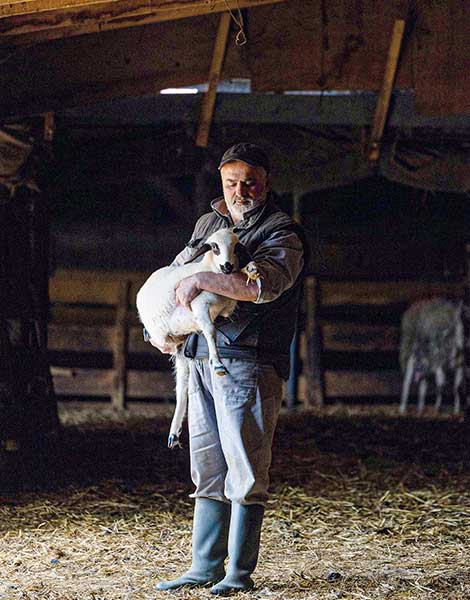
Kostas Boumpas at his livestock farm on the Politsies plateau.
© Dimitris Tosidis
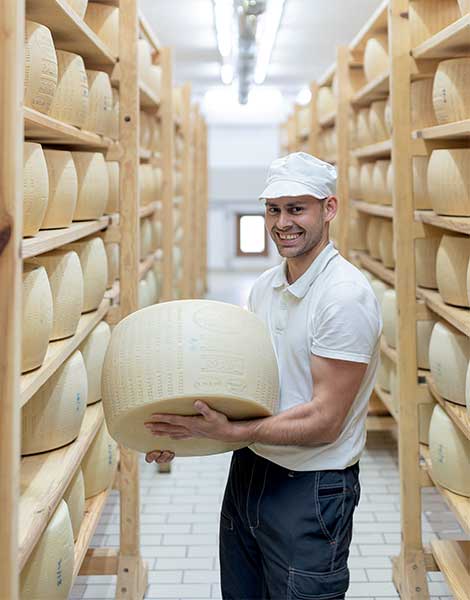
Lambros Papasis, employee at the Tositsa Foundation dairy.
© Dimitris Tosidis
In 1953, the foundation inaugurated a carpentry factory, facilitating the lives of the people running 22 workshops in town, which until then operated near the rivers with band saws, to make the famous Metsovian wood carvings, barrels and beehives. A cheese factory was founded in 1959 and, with an already thriving livestock economy, the foundation introduced cattle farming, even giving animals to the farmers. It sent two young Metsovites to Italy to learn the art of Italian cheesemaking so they could adapt it locally. Since then, with much effort, time and love, the Tositsas Foundation’s cheeses have been awarded prizes and are on tables all over the world. At the same time, it finances the studies of young Metsovites from livestock farming families.
One of the many people to benefit from the program is the cheese factory’s current director, Giorgos Tsompikos, who was selected at the age of 15, studied in Italy with a foundation scholarship, and was additionally trained by his predecessor, Apostolis Bissa. Speaking to Kathimerini, he says the cheese factory uses almost all the milk from the local producers, estimated to be around 80 – though, with livestock farming declining, the quantities of milk are small – and even buys it at a much better price than that in the wider market, as well as supporting farmers in case of losses. Twenty people work at the factory and 42 at the foundation, where many locals have been employed over the years as electricians, plumbers, carpenters etc. It is no coincidence that many young people in town choose to study at the Dairy School of Ioannina or the American Farm School of Thessaloniki, hoping to work at or with the foundation later on.
Jobs are not the only way the Tositsas Foundation supports the local community. Its ideals, which promote staying and producing locally, along with its reputation, and the tangible support of the Katogi Averoff Winery, the restoration of monuments and buildings, the creation of a ski resort, of medical centers in remote villages and several cultural spaces testify to a multifaceted project – all with the same goal. Like a vigilant protector, it is ready to intervene and assist wherever the need arises.
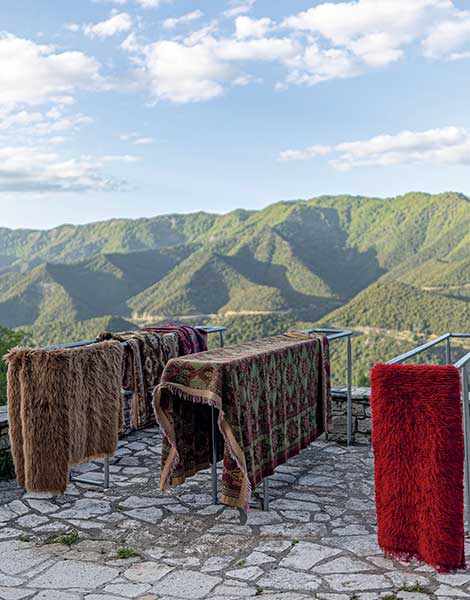
Velentzes textiles and carpets being processed at the water-powered fulling mill in Mandania of Anthochori.
© Dimitris Tosidis
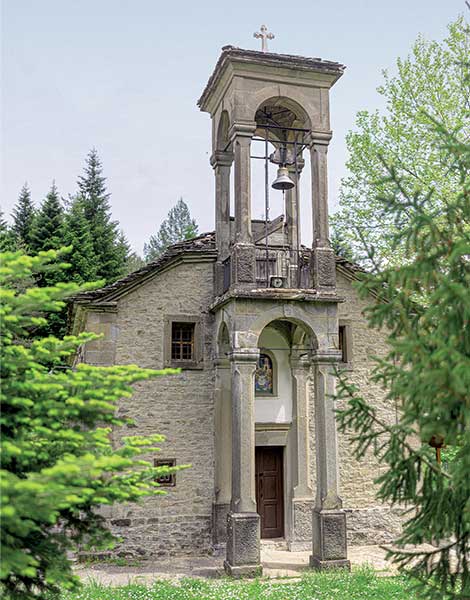
The Church of the Holy Trinity in Metsovo.
© Dimitris Tosidis
Every morning, I look at the spectacular view of the mountaintops and breathe in the fresh air. I also smell meat cooking on spits, of course, since Metsovo is one of the most popular tourist destination in Epirus, with 1,200 beds, seven tavernas and several shops selling local products. In its cobblestone streets with its beautiful stone houses, women water their gardens, working mothers rush to their jobs, children run around playing. How beautiful it is to see so much vitality and how lucky residents are to live in such an environment. The wider area of Metsovo is unimaginably rich in natural beauty: It is adjacent to Aoos Lake, the Pindus National Park (also known as Valia Calda, meaning the Warm Valley in the Vlach dialect) and the “Dragon Lakes” of Flegga, one of the mountain range’s five peaks, although this is not widely known.
It also has active schools of all levels: 60 children attend nursery, daycare and kindergarten, with around 80 in elementary school and around 200 in middle and high school. The Metsovion Interdisciplinary Research Center (MIRC), a branch of the National Technical University of Athens, is also located here, offering the perfectly suited postgraduate degree in Environment and Development of Mountain Regions. In fact, it is compulsory for students to spend one year in Metsovo, essentially “forcing” them into an experiential education.
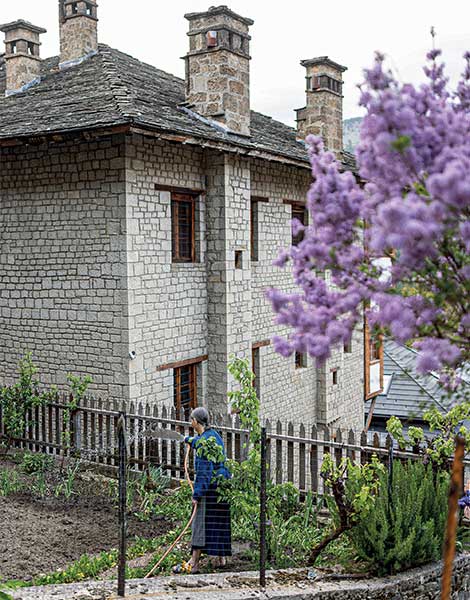
Everyday moments in the neighborhoods of Metsovo.
© Dimitris Tosidis
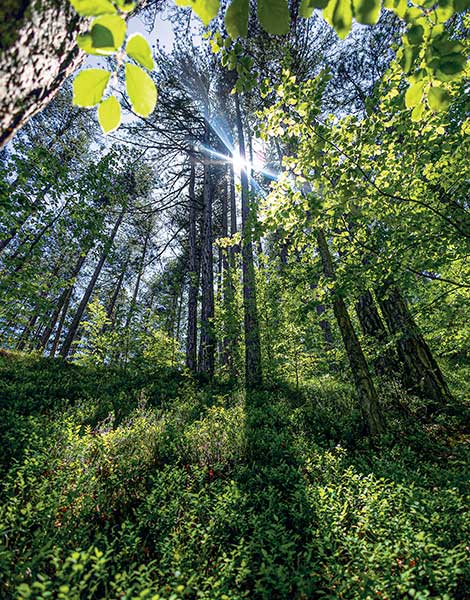
Dense black pine forests also cover the area of Milia, on the outskirts of Valia Calda.
© Dimitris Tosidis
Fourteen postgraduate students from all over Greece (the program can take up to 20, but the local hostel can only sleep 11) live free of charge in MIRC’s modern, beautiful building, mingling with the locals, experiencing daily life in Metsovo and, in addition to attending classes, carrying out various projects by “adopting” specific mountain districts. This year it was the region of Agrafa in central Greece. The teachers come to Metsovo on a rotating basis for a week, while the interdisciplinary nature of the program “constitutes a breakthrough for universities,” says Kaliampakos, who is also the program’s coordinator. “In mountainous communities it is impossible to separate one problem from the next, everything is interconnected,” he adds.
We met Athenians, Thessalonians, islanders and locals from the fields of biology, journalism, philosophy and business administration who came here to see if they could live in the mountains or to find out how they could utilize their knowledge for the benefit of mountain communities. Their work and research are valuable to the local community. MIRC and the municipality also launched a cooperation initiative just recently. “We have the same goal: the survival of Metsovo as a mountain community,” says Mayor Maria Christina Averoff. Amid a whirlwind of bureaucracy and a central government that applies the same laws to all municipalities in Greece without accounting for their particular needs and situations, she strives for Metsovo to remain healthy and alive, she tells us.
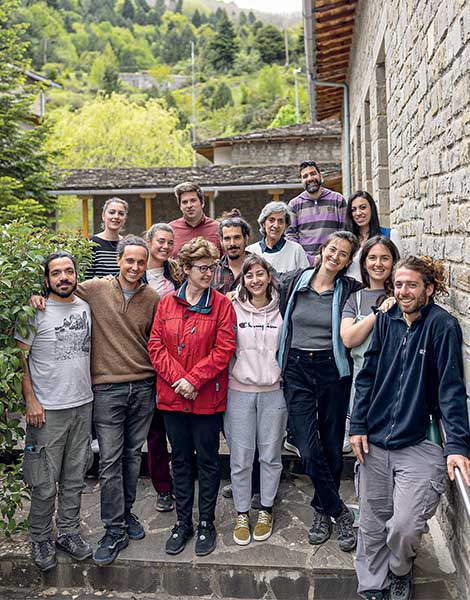
The postgraduate students of MEKDE, together with their professor Anastasia Strategea.
© Dimitris Tosidis
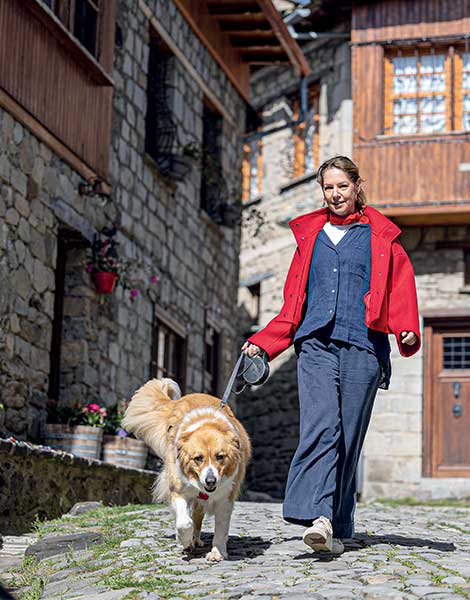
The mayor of Metsovo, Maria-Christina Averoff, with her beloved Lisa.
© Dimitris Tosidis
Growing up in the town, she decided to get involved in public affairs out of love for the region where she had always dreamed of living. “Instead of complaining, I wanted to do something. There were 4,000 residents in Metsovo when I was growing up. Now, according to the census, we number 2,400. The decrease is huge,” she says. “I want Metsovo to be sustainable, to attract new families and to give the existing ones a reason to stay. It is rich in nature and has a brand name, tourism and production. If it cannot survive with all of this, then no other place can. But tourism is not enough – the primary sector needs to be stimulated and it needs state aid.
“Incentives and benefits must be given to those who choose the mountains; and [politicians] must decide whether they really want people [living] in the mountains. For example, they established the Mountain Areas Committee in Parliament and this gave us a boost, until we suddenly found ourselves fighting against wind farms or the abolition of community presidents,” the mayor explains.
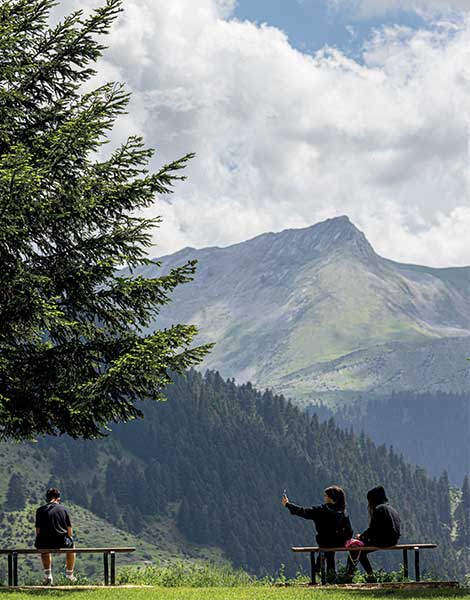
View of the square with the stunning vista of Mount Lakmos.
© Dimitris Tosidis
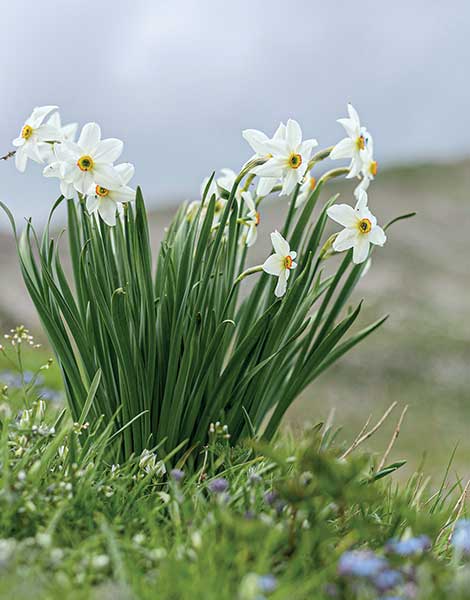
The “gkougkoutsia,” as the people of Metsovo call the manousakia or daffodils, which they gather in bouquets every spring.
© Dimitris Tosidis
Katerina Goula, a teacher and postgraduate student of MIRC, stayed in town after completing her master’s degree, setting down roots with her husband, photographer Dimitris Tosidis, even though neither is from the area. They are about to have a baby now and are determined to try raising it in Metsovo, influenced perhaps by the results of Goula’s interesting study in which she recorded the opinions of high school pupils of Metsovo and Chrysovitsa. She found that 43% of the pupils said they are satisfied with life here and 64% believe the natural environment to be the region’s greatest advantage. However, they did point to the lack of activities as a serious disadvantage. This is a mainly optimistic message for the region since, although all the respondents said that they would be leaving for tertiary studies, 45% would like to return (47% for their family, 27% for the lifestyle and 13% to help the town).
Parents feel the same way. Stamatia Todi, mother of two, said the children “are growing up very well and that is why we instill in them the values of the town, the concept of community, tradition, nature.” Some decided not to leave, like forester Stergios Tambekis, who chose his studies based not solely on his love for the forests, but on his work prospects in Metsovo. Others returned because they could not stand being away from the mountains, like firefighter Nikos Kalofyris, a top mountain runner, who is involved in opening trails and organizes the Ursa Trail race, one of the most beautiful in Greece. Lefteris Fafalis, the distinguished skier who participated in four Olympic cross-country skiing competitions, was born in Germany, grew up in Metsovo and, after studying in Germany and enjoying a successful career in the Alps, returned with his German wife, Olympic gold medalist Viola Bauer, and founded the region’s first tourist office specializing in outdoor activities.
There are other lovers of nature who promote the region in a different way, like 86-year-old Kalliopi (Opo) Giannouka, who is famous for her Metsovite pies and the Vlach velentza (woolen bedding) that she weaves on her loom, or the livestock farmer Kostas Boubas, who vows never to leave the area and his animals – his 25-year-old son studied at the Department of Agriculture in Ioannina precisely for this reason. Then, there are “love” immigrants like Nena Semertzidou, who married a local, or visitors, professors and students at MIRC who fell in love with Metsovites or Metsovo itself.
Perhaps Babis Tsourekas, who returned with his wife Anna Barbayanni to take over the family tourism businesses, was right when he said that “even if people leave, others come – Metsovo has always been like this.” Kaliampakos admitted that “the town meets all the requirements to be saved.” “Whether it evolves in the right direction is up to us,” he says, as the mayor adds, with determination, “It’s now or never.”
On the occasion of the 200th...
Exploring Tzoumerka on foot, where architecture,...
Without noise or concrete, the Old...
At 1,160m, Metsovo blends preserved mountain...