Eating Our Way Through Petralona
Exploring the eateries, stories, and shifting...

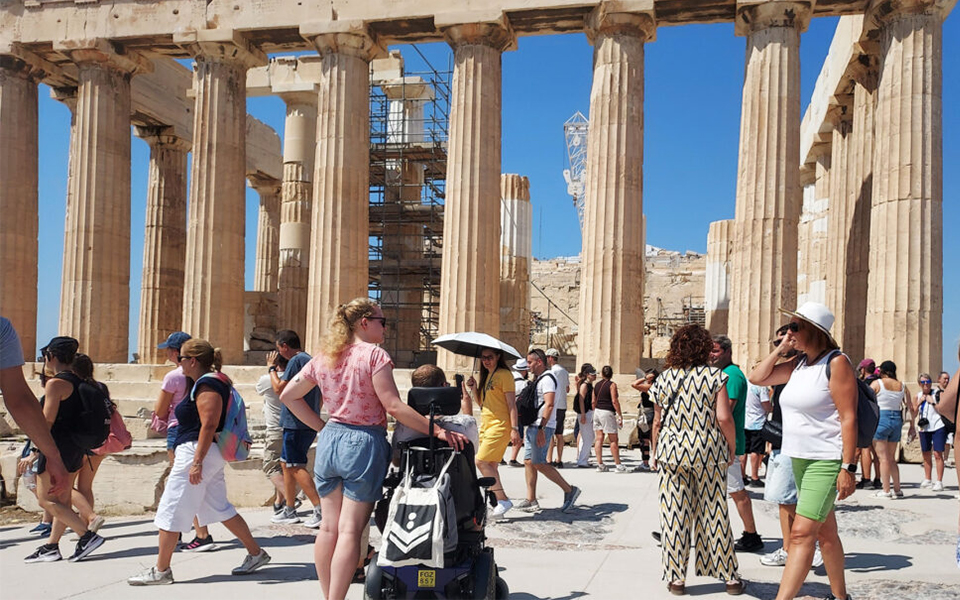
Together with thousands of other visitors, we climbed the Sacred Rock and spoke with tourists who often travel from the other side of the world to see Athens’ monuments up close.
© Nikos Kokkalias
Acropolis, 11 a.m., on a hot, languid August morning. At the southern entrance, the queue is relatively short, stretching only as far as Thrasylou Street. Those near the front stand gratefully beneath a large white awning – its origins unclear but its shade undeniably welcome. Beyond its reach, fluttering fans and portable mini-fans hint at the intensity of the sun.
One can’t help but wonder: could a similar awning be installed at the upper entrance, by the Propylaea? There, the line at the ticket booths evokes the days before timed entry slots were introduced to manage visitor numbers. Even so, delays are minimal; perhaps aided by the fact that most cruise ships are currently docking at other Greek ports.
In any case, should anyone need assistance, a private ambulance is standing by just beyond the gates, while a Hellenic Red Cross team is also stationed on site.
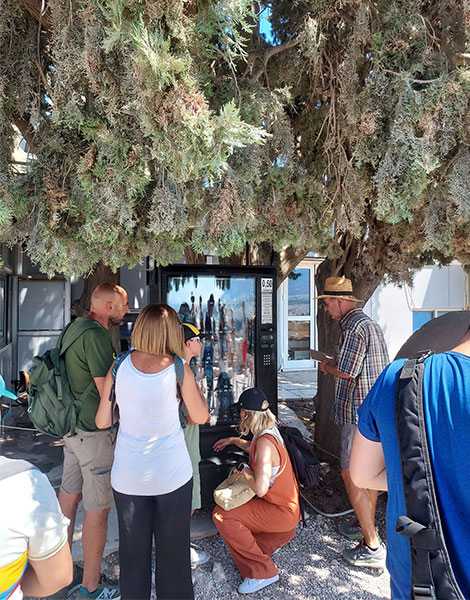
The water vending machine is in high demand among visitors, especially on the hot days of August.
© Nikos Kokkalias
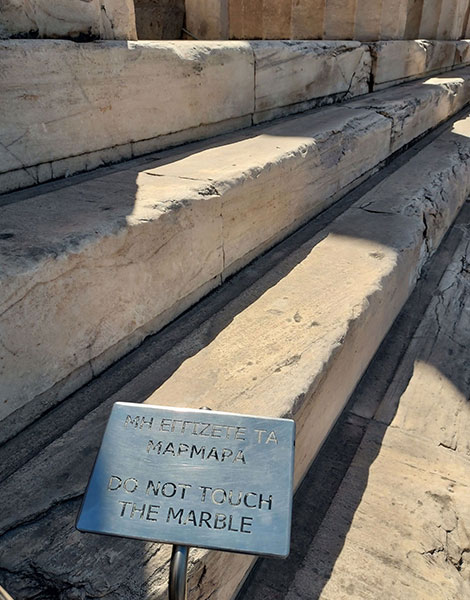
Despite reminders, Acropolis staff occasionally need to call visitors to order.
© Nikos Kokkalias
The brown information board now reads “Admission €30,” matching the ticket we hand over before ascending the Sacred Rock. Crowds are sparse, except where people pause to admire the Odeon of Herodes Atticus or to snap a photo of an unsuspecting turtle. A bottleneck predictably forms at the Propylaea; restoration of the worn Roman staircase has long been under discussion.
It’s here we meet Rajesh (44) and Neha (42) Canadian visitors of Asian heritage taking a family selfie. “Yes, there’s a line at the ticket booths,” Rajesh says, “but if people checked the website, they’d know how to book more easily.” Neha nods, pointing out another issue: the slippery rock surface that made the climb a bit tricky for her. “I think that could be improved,” she says politely.
At the summit, no one appears to be struggling. A young man in a wheelchair moves comfortably along the well-trodden accessibility paths. Only a jammed vending machine creates a temporary hiccup. But Antonio (44) from Chile, brings the conversation back to ticketing. “It’s easy to get in – if you already have a ticket. But the lack of clear information on-site is frustrating; it’s not obvious where to find it,” he notes.
The issue, he explains, began online. Search results turned up numerous dubious third-party vendors, pushing the official site (hhticket.gr) far down the list. “The authorities, not Google, should control that,” he insists. Mei (43) from Hong Kong, who is traveling with him, raises another concern: the absence of restrooms at the top of the Acropolis. Antonio agrees: “I understand archaeologists have their reservations, but surely they could find a convenient solution.”
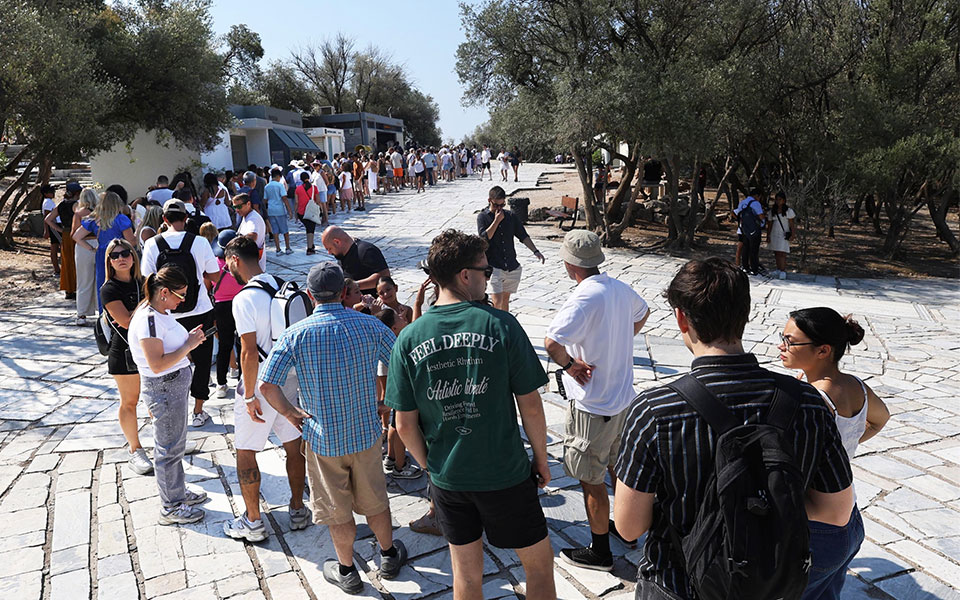
Queue at the ticket office located at the Propylaea.
© Nikos Kokkalias
Some visitors linger before the Erechtheion, pointing out to friends that these Caryatids are replicas. Others pause to read the panels about the Parthenon’s history or the ongoing restoration works. Mélissa and Alicia (both 22, from France) are thrilled with their free entry as young EU citizens. “It’s really cool that young Europeans can see something like this for free,” they say, calling the monument “incredible.” They had no issues with queues or information, and as for adding more facilities? “It would spoil the site’s charm.” They do, however, offer one critique: “The visitor pathways are helpful, especially for accessibility – but they’re not very attractive.”
Maria (27) from Colombia, says that she would welcome a shaded area or even a restroom. Christina (24) from the US and Carlotta (23) from Germany agree, taking refuge in the shadow of the eastern Belvedere bastion. Their main concern is the lack of clarity around free admission. Although both live in Germany, it wasn’t clear to them whether all EU residents were entitled to free admission. “We also couldn’t book other categories of free tickets online, so we had to queue and show ID in person,” they add.
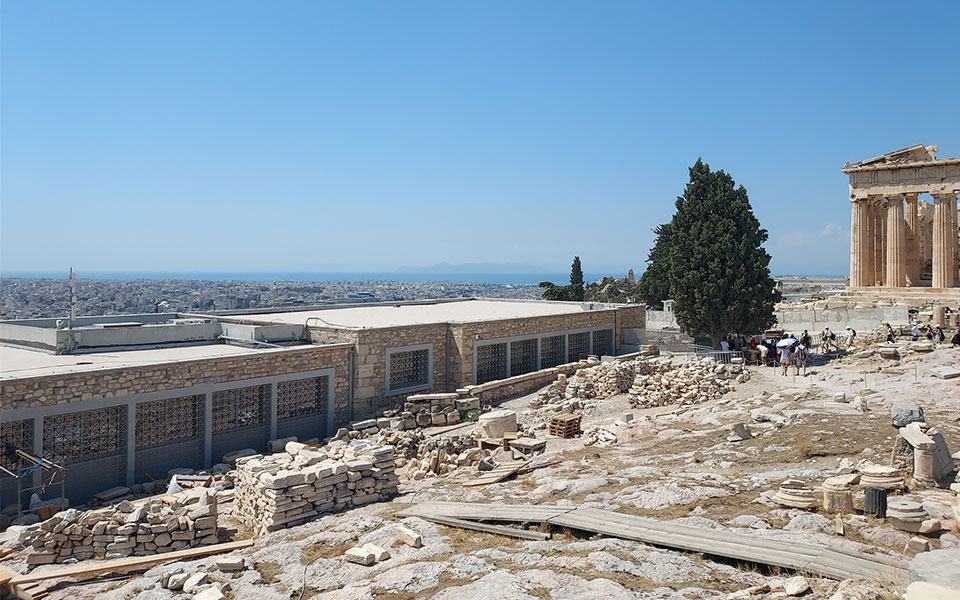
The old Acropolis Museum will reopen with new uses, such as temporary exhibitions and the storage of archaeological material.
© Nikos Kokkalias
Southwest of the bastion, the Old Acropolis Museum remains closed to the public. A sign on the fencing reminds visitors that work is underway. Funded by the “Attica 2021-2027” Regional Operational Program and supported by private donors like NEON and MUEVO, it is being revamped to host temporary exhibitions and preserve archaeological finds.
Another improvement may be on the horizon: a second lift. Culture Minister Lina Mendoni recently mentioned this as a serious possibility in talks with the Onassis Foundation, which sponsored the first lift. A breakdown in May exposed the system’s limits. Though intended for disabled visitors, the lift is often used by those with temporary mobility issues. On this day, the lift operates smoothly. A sign reminds visitors it’s reserved for wheelchair users and their companions, but enforcement proves tricky; it is not easy to refuse access to a young woman with her leg in a brace and an older lady with a cane.
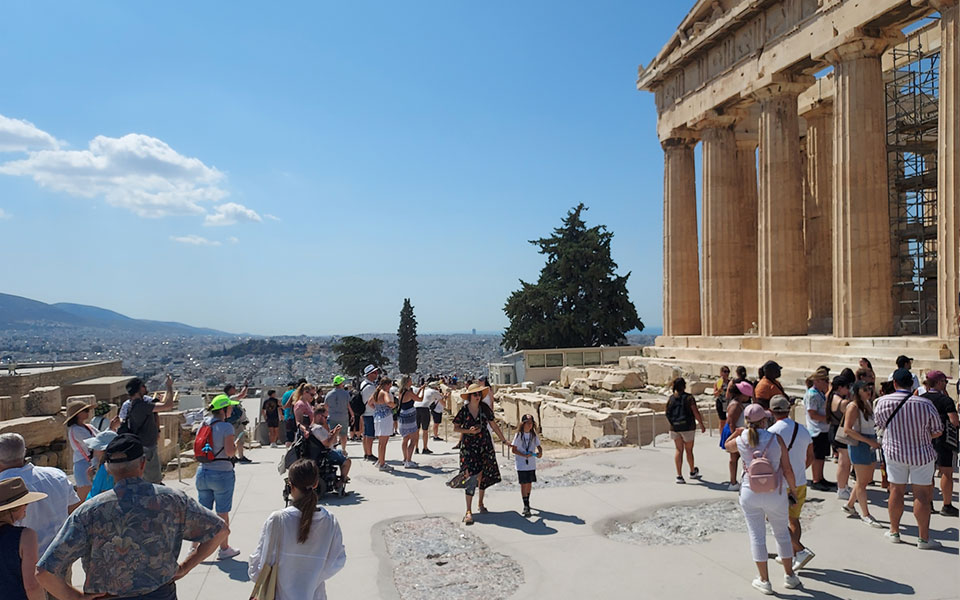
Along the visitors’ routes around the monument, everyone moves quite comfortably, including people using wheelchairs.
© Nikos Kokkalias
Staff remain vigilant in protecting the monument. No one dares pick up a stray marble fragment. One visitor, however, attempts to pose with a corporate flag in front of the Parthenon. “No flags – we are here to see and admire,” two staff members firmly remind him.
The rope barriers have been reinforced in recent years, notes Antonis, a 52-year-old Greek-American visiting the Acropolis for the first time since 1989. As we head toward the exit, he observes that protection of the monument is better than he remembers, as is access to different vantage points. “I would only wish there were more staff providing information, like pointing out where a certain temple once stood,” he says, “and maybe a few more water dispensers.”
For souvenirs, a new Acropolis gift shop has opened nearby, drawing a steady stream of visitors, along with the adjacent restrooms, which, while welcome, give off a rather unwelcome scent under the August heat.
Still, placing modern infrastructure within an ancient monument is no easy feat. Christina (24) from the United States, is keenly aware of this. “I appreciate the minimalist facilities,” she said, adding: “Other monuments, like some national parks in the US, have so many amenities – even shops – that they end up being overwhelming.”
This article was previously published in Greek at kathimerini.gr.
Exploring the eateries, stories, and shifting...
Souvlaki joints started appearing in earnest...
Discover five of Athens’ latest openings,...

The Kerameikos archaeological site provides a...