Hania, an Open-Air Film Set
The island of Crete is attracting...

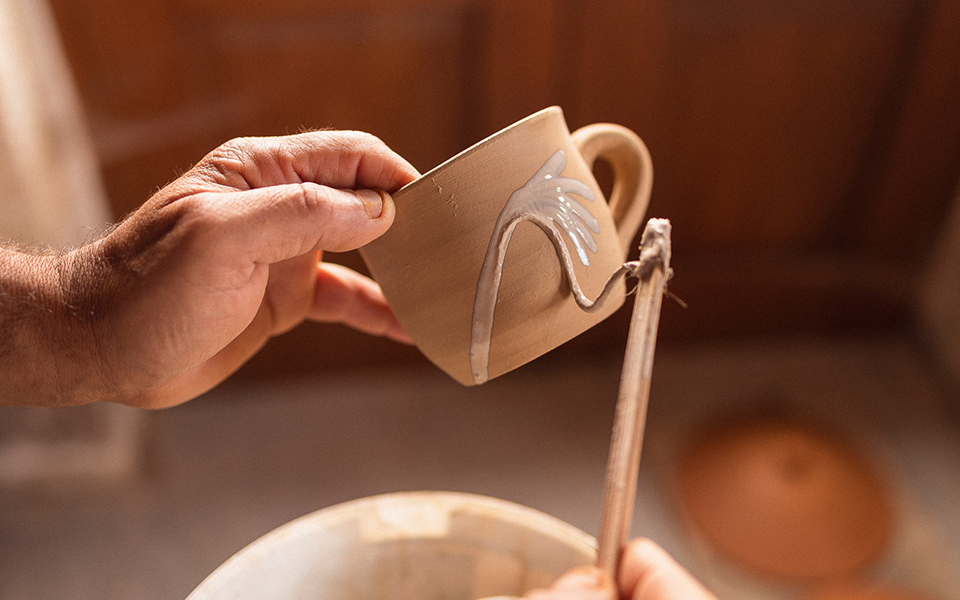
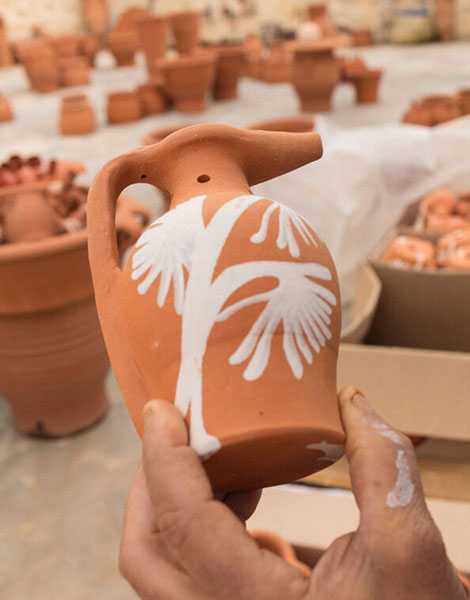
“The ‘little leaf’ is the characteristic Minoan motif on the pottery of Margarites. From the depths of the centuries also comes the ‘brush’ used for painting: a reed stick with a small tuft of sheep’s wool tied to its tip.
© Christina Georgiadou
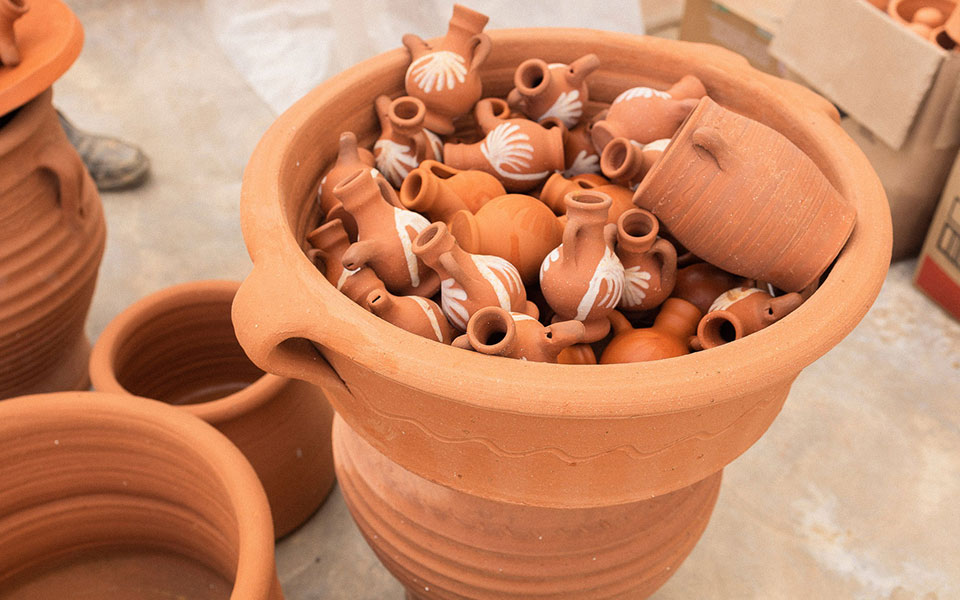
Stepping into the courtyard of Markos Dandolos’s workshop reveals a sea of terracotta vessels in their natural hues: amphorae, urns, jugs, and colossal storage jars reminiscent of Minoan-era designs.
Markos is a pitharas (maker of the large storage jars known as pitharia) in Margarites, a semi-mountainous settlement in Mylopotamos. The village’s pottery tradition is so esteemed that it is recognized as part of UNESCO’s List of Intangible Cultural Heritage. Both young and old potters, locals and foreigners alike, maintain their workshops here, which are known as tsikalaria. No one knows when exactly Margarites became the pottery center of Rethymno. Some say the name “Margarites” derives from the Byzantine word magara, meaning utilitarian ceramic objects. And tsikalario means a workshop where clay cooking pots (tsikalia) are made.
Margarites, Tel. (+30) 697.389.6269
Orders can be placed from anywhere in Greece, both for Markos’ own creations as well as other designs and ceramic pieces.
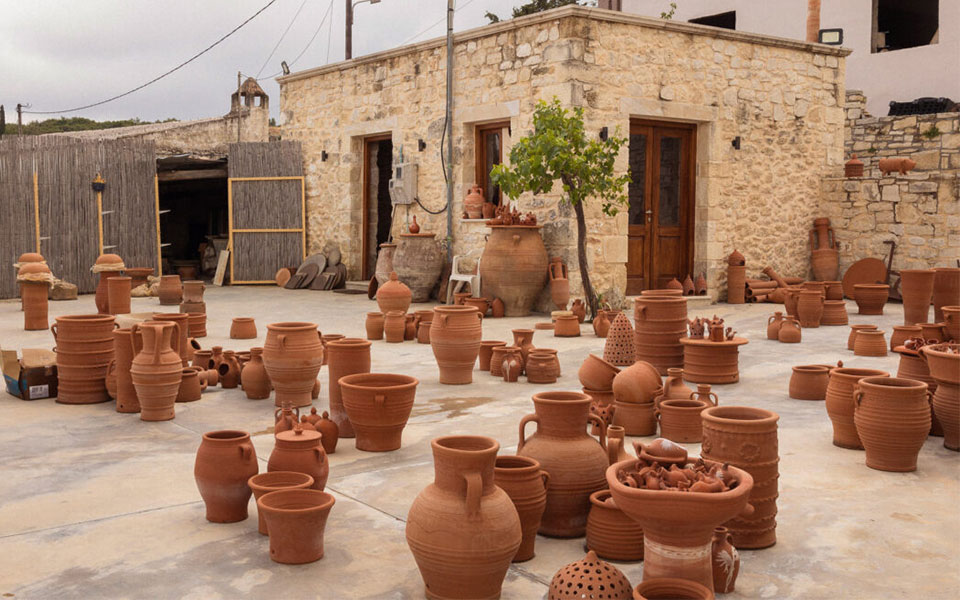
The courtyard of the pottery workshop of the potter Markos Dandolos
© Christina Georgiadou
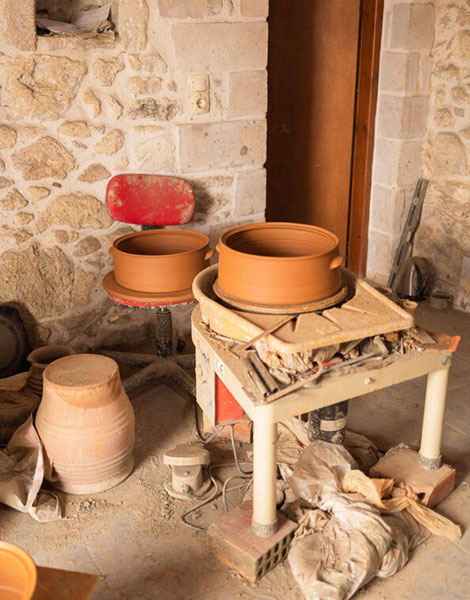
Of the roughly 19 tsikalaria in Margarites today, only three still double as pitharadika, producing massive pitharia, huge vessels of the type used since ancient times to store goods.
One of these is Markos’ workshop. A fourth-generation pitharas, he comes from a long line of potters on both his mother’s and father’s side. “We are eleven siblings, and six of us learned this craft from our father,” Markos says. “I work on the large jars together with one of my brothers, while the others focus on the smaller pieces. I learned the craft right here as a little boy.”
From childhood until the age of twenty, Markos prepared the clay for his father, later mastering the craft himself and eventually opening his own workshop.
“A pitharas never worked alone – he always had at least three or four assistants. One carried the clay from the clay pit; another brought the firewood. Many farmers, when clearing their fields, would gather bundles of pruned branches and take them to the potter to sell. That way, they earned a little money and the pitharas had wood for the kiln,” Markos recalls.
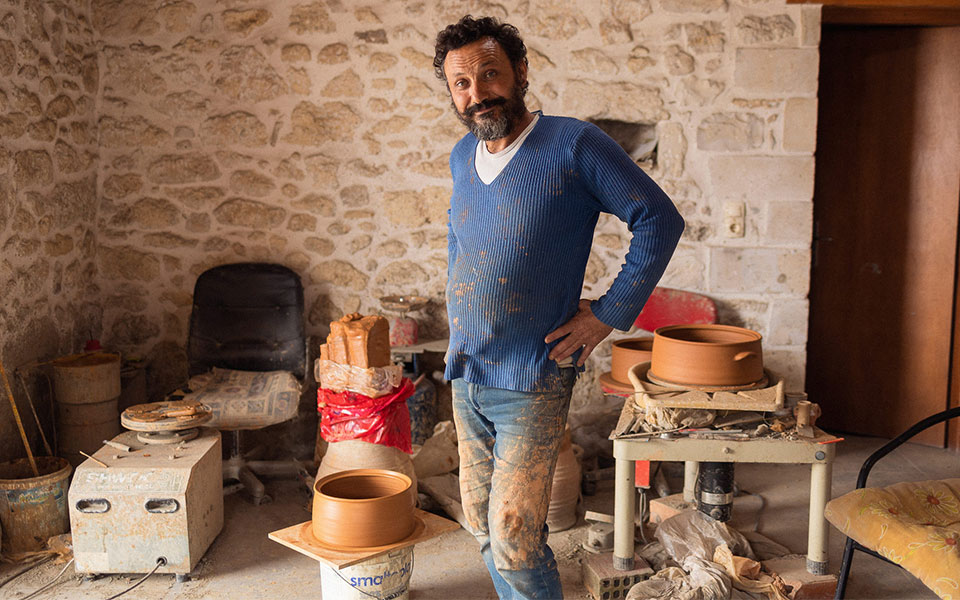
Markos Dandolos, from a long line of jar makers, in his pottery workshop in Margarites.
© Christina Georgiadou
Margarites is blessed not only with good clay soil, but also with something more special: a dark gray earth called lepida. “It comes from up there, in the highlands,” explains Markos. “Lepida makes the big jar durable – it won’t crack in the fire, it won’t split under the sun or while drying. In the old days, people even used it on rooftops. When crushed, lepida formed a greasy, glass-like crust that acted as insulation. If I’m not mistaken, they sometimes mixed it with salt too.” It was an excellent waterproofing material that helped households endure the winter, keeping the damp out.
In pottery, one-third lepida is mixed into the clay, after a long process of breaking, grinding, sifting, draining, and letting the soil set. “But if you add too much,” Markos warns, “the mix becomes sandy, harsh, difficult to work with. It loses its smoothness – it’s like a barley rusk. The vessels don’t hold up well, especially bowls; they can’t keep their shape while being worked.”
Markos is one of the few craftsmen who still know how to shape Minoan-style jars with their distinctive three handles, making them with his own clay gathered from the mountainside. These large vessels were traditionally intended for the storage of olive oil, but also for carobs, flour, or whatever crop each household produced, sealed at the top with a ceramic stopper (pouma).
© Christina Georgiadou
For smaller wares, he uses Italian or Marousi clay. He also knows how to recycle spasidia, the unfired offcuts from other workshops. He grinds them into powder, mixes them with fresh clay, and reuses them in specific vessels. Always curious, he studies ancient Minoan and Cycladic pottery, observes ceramics recovered from shipwrecks, experiments with his own blends, then sits at the wheel and shapes them anew.
Most of Markos’ ceramics are utilitarian. Basins and smaller bowls for kneading dough, water jugs, pointed amphorae, clay pots for cooking, and ammotsikala – vessels with the distinctive Minoan spout and handle, once used to roast chickpeas.
Another vessel he makes is the nistata, once used to separate olive oil. It was filled with olive paste and left until the dregs (katsigeros) settled at the bottom, leaving the pure oil at the top. At its base, there was a small hole sealed with a cork. Once removed, the sediment drained out; when the oil began to flow, the cork was put back in.
He also makes tomedes (stands for resting large jars), old-style ladomprika (ceramic oil cruets for serving olive oil at the table), and wide-bottomed varkostamna (jugs designed for boat transport so they would not tip over in rough seas). Other items include armeous for milking, small jars (kouroupakia) for olives, cheese, or cured meats, lainia and little wine and raki jars complete with thimble-sized cups.
© Christina Georgiadou
© Christina Georgiadou
Remarkably, he even makes the ancient round ceramic beehives – a Cycladic and eastern Cretan design – which were built horizontally into walls or stone terraces, to collect honey. The local equivalent, known as margaritones, are similar but placed upright, with a small opening at the base for the bees to enter and exit. Markos even crafts ceramic smokers for beekeepers, once fueled with smoldering dung to produce smoke. He has also tried to recreate a Cycladic smoker he saw in Sifnos (his wife, herself a potter, is from there), but the excavated examples are broken, and their unusual, perforated design with a lid has not yet allowed him to make a fully functional replica.
Many of his vessels are decorated with the fyllaraki motif, a simple design characteristic of Margarites, found in workshops throughout the village. The pattern is applied with a special tool: a thin reed, like a writing pencil, tipped with a long wick of sheep’s wool. Dipped into diluted white clay slip, the wool brush creates quick strokes of little leaves across the reddish surface of the pot. After firing, the white motif retains its brightness, standing out against the darker clay.
Markos is not interested in the modern designs found in most other studios. Like his great-grandfather Antonis Vavoudakis and his grandfather Georgios Skordalos, he makes only what has been passed down to him. In this way, he perpetuates a tradition with roots deep in time; one that connects his craft to the wider arts of his land, perhaps even to the art of food itself and to the inherited wisdom of household economy. V.K.
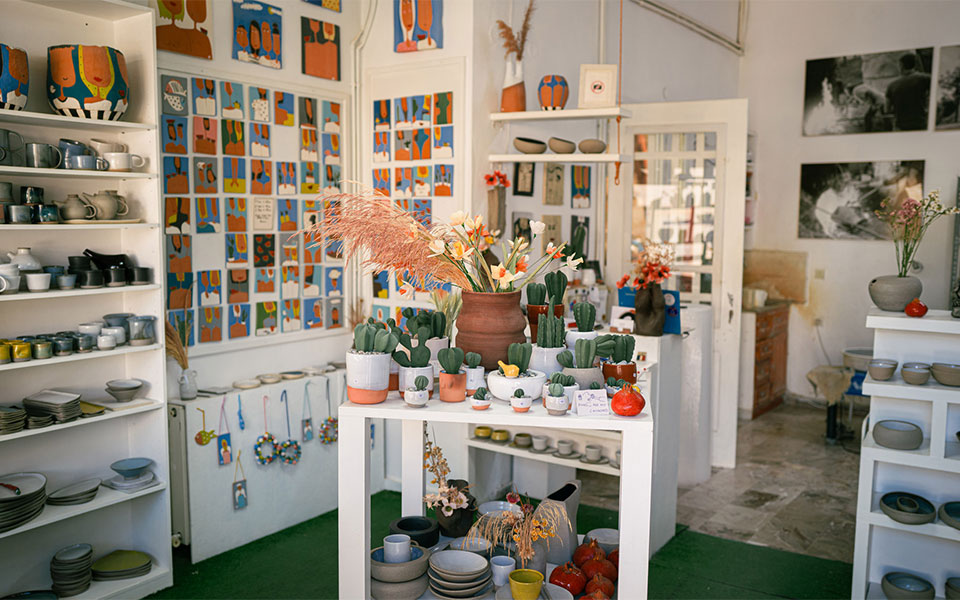
The ‘ea Ceramic Studio’ of Ema and Aris creates signature ceramics – modern pieces inspired by small Minoan bottles for essential oils.
© Christina Georgiadou
Lithuanian-born Ema Ramanskaite and Rethymno native Aris Tabatsikos founded their workshop in Margarites in 2012. Ema has lived in Crete for the past 20 years, working as a tour guide, while Aris, a metal craftsman, was based in Athens. Their collaboration came about when both had decided – independently – to change the course of their lives.
“We took a trip together to Margarites, had some wine, and decided that this was where we needed to set up our workshop. We had come to the source, and we had chosen to come here deliberately, to do what we truly love,” Ema recalls.
Working both on the wheel and by hand, they use high-fired clay (stoneware) to create glazed utilitarian objects inspired by ancient forms but adapted to their own distinct aesthetic; pieces that are modern, functional, and unmistakably theirs.
“Everything we make tells a story,” they explain, pointing to their bottles and some of their mugs, which feature distinctive double walls. “We were inspired by the small Minoan flasks that once held precious essential oils. But we adapted the idea, enlarging them. Our bottles have a hollow cylindrical space at their core, making them ideal for serving oil, wine, or raki.”
Elegant and restrained, their pieces are characterized by clean lines and a white-gray palette. Their creations draw inspiration from a wide spectrum of influences, ranging from historical forms to comics, striking a balance between sculpture and functionality. Today, their works and utilitarian ceramics can be found in luxury hotels such as Grecotel, Costa Navarino, and Boheme Mykonos. N.M.
This article originally appeared in Gastronomos.
Margarites, Tel. (+30) 698.323.2787
Their creations are also available online at eaceramicstudio.com
and at Aumorfia, 17 Praxitelous, Athens, Tel. (+30) 211.412.9067.
The island of Crete is attracting...

One of the most rewarding road...
The goddess Artemis, the Virgin Mary,...
In Crete, xerotigana are the quintessential...