Sacred Solitude: Inside the World of Greek Orthodox...
Keepers of stillness and prayer in...

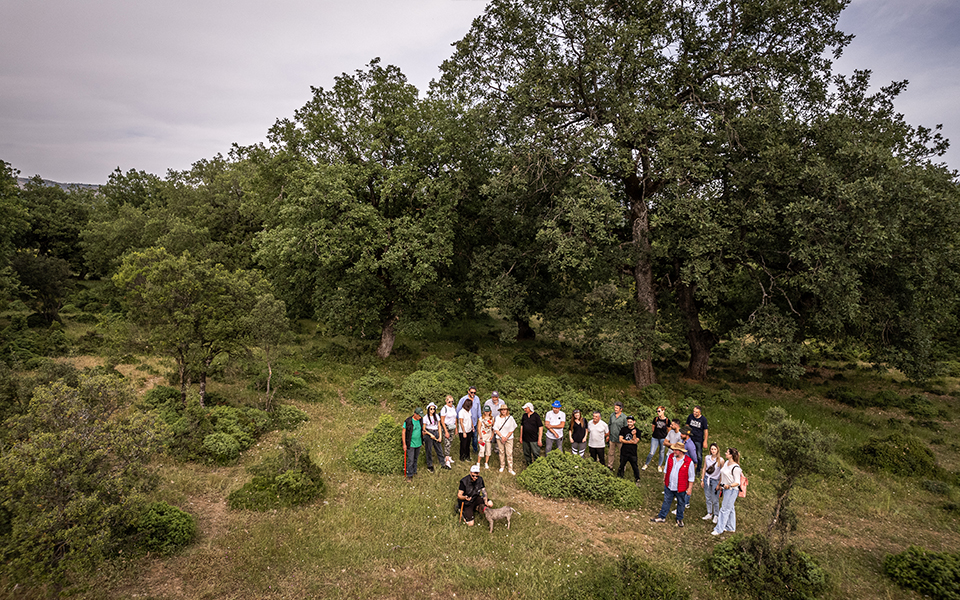
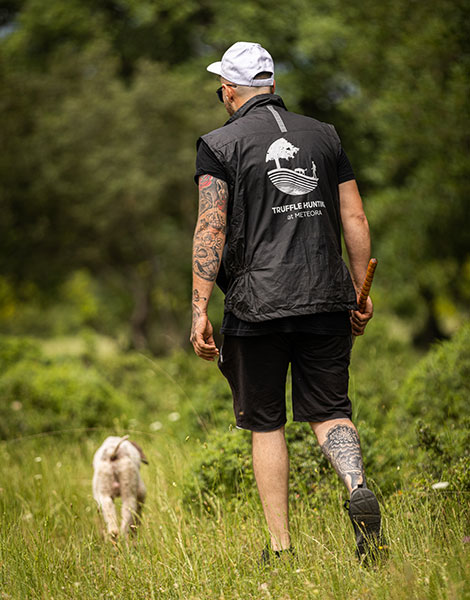
The most capable guide in Greece is Benfra. Today, this adorable 3-year old Lagotto Romagnolo with her curly golden fleece is leading us surely through the woods, nose to the earth, with her trainer, Alexandros Ziogas. Reaching a copse of low shrubs, she can’t contain her excitement. After a dig of just seconds, she emerges with a black truffle held gingerly in her mouth. She drops it into Alexandros’ hand and in return gets a treat: “Dogs by nature don’t have a taste for truffles,” he says, “and we don’t want to give them a chance to develop one. It’s all about the hunt for Benfra – she really loves it.”
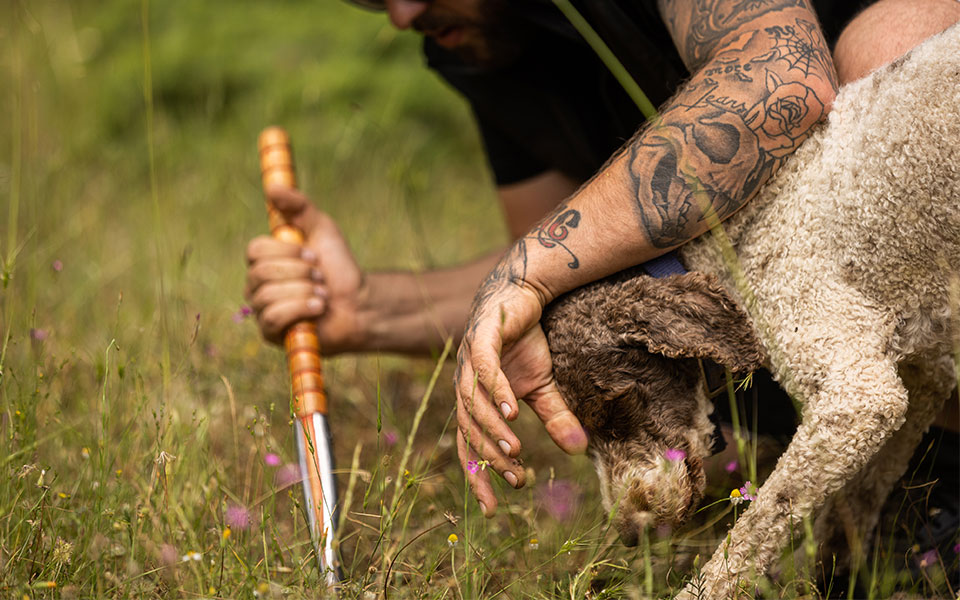
Training begins when the pups are just a couple of months old; they start by playing “fetch” with truffles, carrying them gently in their mouths so as not to crush them. Benfra belongs to an Italian breed prized for its excellence in truffle hunting. She doesn’t miss a single ripe truffle, and she’s very precise in her work, not over-digging. That precision is very important; truffles regenerate very quickly so, as long as the root with its spores remains undisturbed, there will be a new truffle in the same spot in five days’ time. Alexandros delicately replaces the soil around the root in order to protect it for their next hunt.
Pigs were once the truffle-hunting companions of choice; they’re really good at finding them. Unfortunately, they’re a lot less good at handing them over (pigs have a taste for truffles). Their woodland counterparts are worse: “Wild boars are our biggest enemies,” says Alexandros. “They love truffles, but they can destroy the spores and root system when they dig them up.” Truffles are also a favorite treat for badgers, mice and squirrels.
It was the Italians who pioneered the training of dogs for truffle hunting, with great results. French truffle hunters, too, now generally have canine hunting companions.
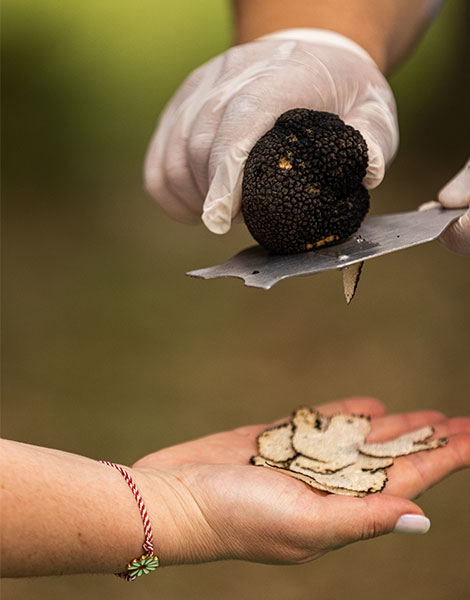
Truffles are associated with Perigord in France and with Piedmont (especially for the white truffle), Umbria, Tuscany and the Marche in Italy. On the international culinary scene, people aren’t really talking about Greek truffles. This is largely because most Greek truffles go to Italy, and are then sold as Italian truffles. “It’s too bad, though,” says Alexandros’ brother Argyris, who is accompanying us, “because the quality of Greek truffles is excellent. It’s just that people don’t really know them yet. Hopefully this will change.”
Until quite recently, no one was talking about truffles much in Greece, either. Although ten species of truffles had been recorded by naturalists in generations past, systematic research of truffles has only been going on in Greece since 2007. Until then, truffle discoveries were purely incidental, something that would occasionally happen during a hunt for terrestrial mushrooms.
The profile of the truffle has risen sharply in recent years. One of the decisive factors is Benfra and the truffle dogs that came before her. In 2001, George Setkos, president of Western Macedonia Mycophiles, brought the first specially trained truffle dog to Greece from Italy. Now there are many trained truffle-hunting dogs, and around 100 truffle hunters in Greece who are supported by the research and educational activities of societies of mycophiles, or fungi fans. Training dogs for truffle hunting was the topic of one of the seminars at last year’s truffle festival. Kalambaka’s Panhellenic Truffle Festival, organized by the Natural History Museum of Meteora and the Mushroom Museum in cooperation with the Municipality of Meteora and with support from the region of Thessaly, was held in the fall of 2024 for the second time. “Greece is good for truffles, “ says Alexandros. “They need a certain altitude and temperature range, some rainfall, a non-acidic soil (pH 7.5-8.3), and trees, pine and oak trees in particular. There are plenty of areas like this throughout Greece, and we go hunting all over, traveling throughout the country with our dogs.”
The Tuber magnatum, the white truffle, deserves its grandiose name. From the Latin magnatum (“great person”), this shockingly pricy food item regularly ranks in the top five most expensive foods, along with saffron, Beluga caviar and edible gold. The fact that it’s as elusive as it is delicious earns it an almost a cult-like status; the Tuber magnatum is the undisputed diva of the truffle world.
The hunt, not surprisingly, is quite challenging. “They need much colder weather,” says Agryris, “and they also need a high pH soil, but they’re really picky about it, too; the soil has to be precisely right, and it’s not possible to replicate the ideal conditions. Basically, all the conditions need to be absolutely perfect, but perfect by nature; white truffles can’t be cultivated. Compared with black truffles, which grow very close to the surface, white truffles are much, much harder to get at. And when you do find them, extracting them is difficult because they can be very deep, even up to a meter. On top of all this, they’re super-fragile; the dogs locate them for us, then we finish retrieving them by hand. We have to be very careful; if the surface of the truffle gets scratched, its price is cut in half.” It’s an exciting hunt. And often, an exceptionally gratifying one. “While the Tuber uncinatum – the black summer truffle we hunted – might sell for €250-€300/kilo, the price of the rare white truffle fluctuates depending on the market, going from €1000 to up to €4000 per kilo. On a good day during a peak year, two hunters and their dogs might find two or even two and a half kilos of white truffles in a day, a very rewarding haul. Some years though, they might be finding just 100 gr a day.”
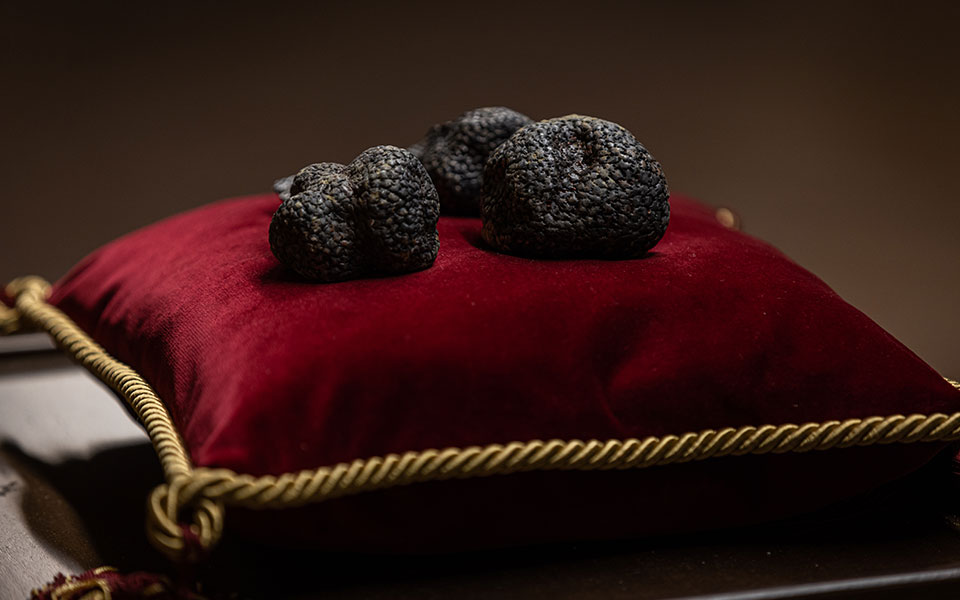
So how do these elusive, dizzyingly-expensive treasures of the soil taste? “They’re intense; they take over everything in your refrigerator!” Argyris says. “Their scent is 30 times stronger than that of the black truffle.” Given their cost, this can be a good thing. They can be eaten on their own; packed with their rich aromas, even paper-thin slivers go a long way. And in the meantime, they can be stored with eggs, which will absorb their aroma so you can make delicious omelettes. Or they can be stored in raw rice for a risotto that is thick with their flavor. “They’re also very garlicky,” Argyris adds. Fans of earthy, savory umami flavors will love them, as, indeed, do those who forage them. The Tuber magnatum fetches a high price, but even so the truffle hunters will not usually sell all of them; they find them just as irresistible as everyone else does.
The Tuber melanosporum can be cultivated. But the Ziogas family and their dogs hunt only for wild truffles – it’s more exciting that way. Between the black Tuber istinum of summer, the Tuber uncinatum of fall, and the Tuber magnatum of fall and winter, it’s nearly always truffle season. Hunting is a year-round pursuit.
The Truffle and Mushroom Festival of Kalambaka, organized by the Museum of Natural History and Mushroom Museum, actually takes place at the end of the truffle season. These are the “worst” truffles: the black truffle of autumn is rather soft, and they should be firm. “Worst” is a relative term though; even a mediocre truffle is a delight for the layperson. There were certainly no complaints. The truffles of spring and summer – the peak season in Kalambaka – are, however, even better.
Throughout truffle-hunting season, the museum offers a very special experience, the same one that we are taking part in now. Everyone drives to a wooded spot some 20 minutes from town. Benfra, Lara, or one or more of their other canine colleagues, accompanied by Alexandros or Argyris, leads the way. Sturdy shoes and long pants are a good idea, because you’ll be tramping through the shrubland behind them at a good pace.
Our own hunt ends in success. After several truffles have been unearthed and Benfra seems satisfied that she has found everything viable in the vicinity, everyone heads to a clearing in the woods. Alexandros cleans the fungi under flowing water with a toothbrush as Benfra looks on, then makes her way through our group, getting lots of much-deserved attention from everyone. Meanwhile, Alexandra Niavi, chef of the Natural History Museum of Meteora and Mushroom Museum, starts to cook. We are having pasta with fresh and dried mushrooms – the museum shop’s own products – cooked in the stock from the mushrooms and finished with shavings of the fresh truffles. People take turns stirring. When the pasta is done, Niavi adds a whole bottle of white truffle oil. Even in the wide open space, a heady odor fills the air. Then she shaves the truffles that Benfra has just found over the dish for another earthy burst of aroma. The team serves it up in biodegradable dishes of dried leaves, and we dig in with wooden forks.
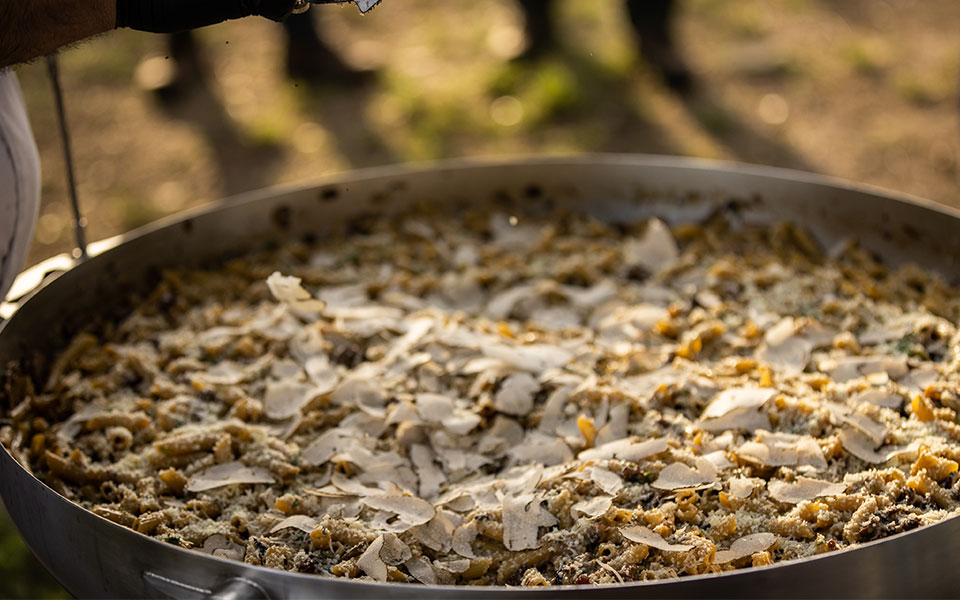
Melt the butter and sauté the garlic until it starts to soften (don’t let it take on any color). Add the sliced mushrooms and sauté until they release their liquid and start to darken. Add the pasta, then the white wine and slowly tip in pitchers full of the stock from the reconstituted mushrooms, together with the mushrooms themselves, stirring all the while. Taste for salt. Reduce the heat and cover while the pasta continues to absorb the broth. Check every few minutes. When the pasta is tender but not too soft, add the white truffle oil and the truffle shavings. Serve with the grated cheese and freshly ground pepper.
For dessert, we have a traditional Greek sweet with a twist; a “glyko tou koutaliou,’ or preserve, is usually made of fruits cooked in a sugar syrup. Naturally, the museum offers a mushroom version, which is actually quite tasty.
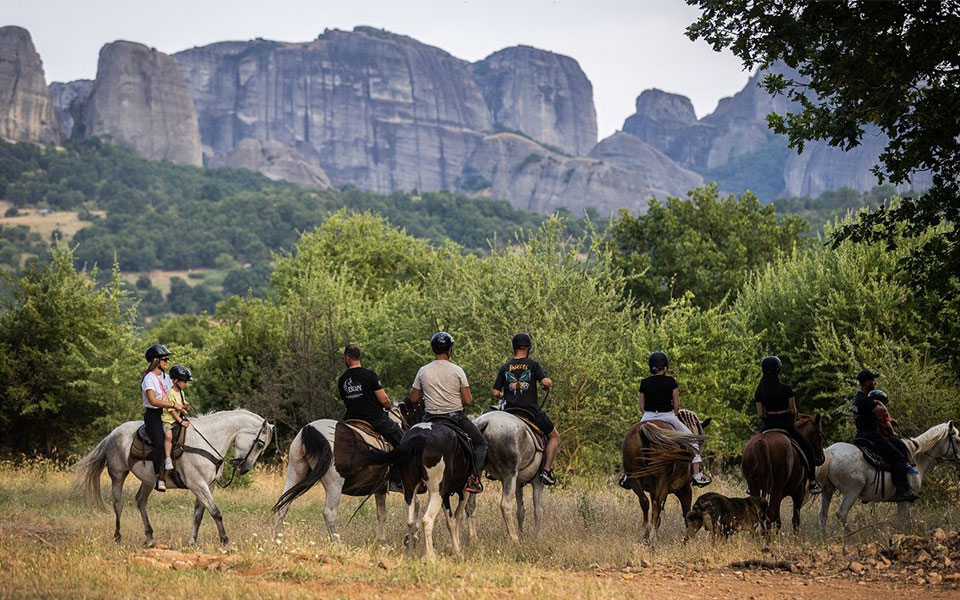
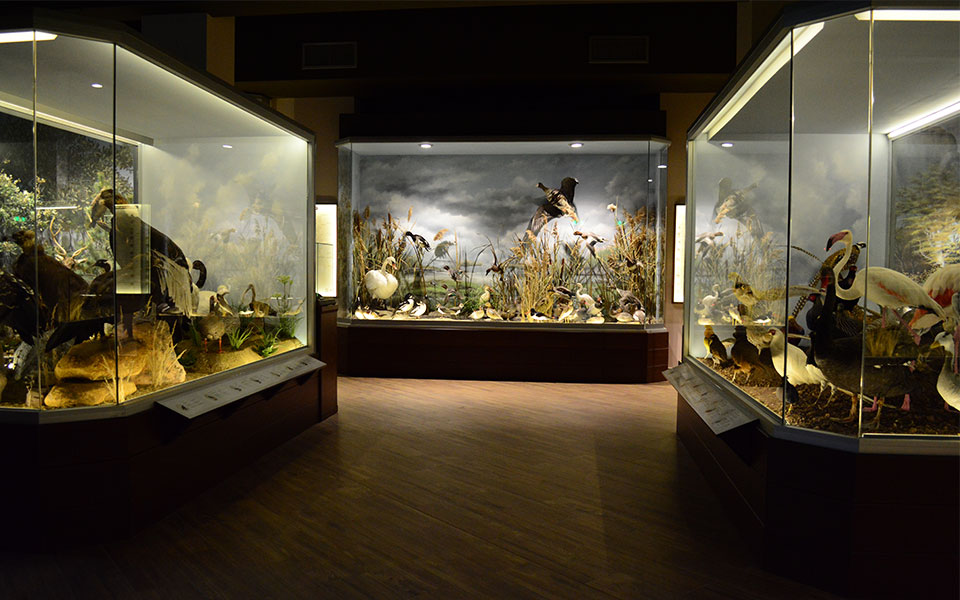
Now, the Natural History Museum of Meteora and Mushroom Museum have added something really special to the experience: truffle hunting on horseback. This complete experience unites culture, nature, and gastronomy. The experience begins with a guided exploration of the forest trails on horseback, along paths suitable for beginners and for riders of all ages. A truffle hunt follows, along with a mushroom tasting and a lunch of truffle pasta in the woods. The experience concludes with a tour of the Natural History Museum of Meteora and Mushroom Museum. For more information and dates, please see the information below.
More information about truffle hunting can be found at trufflehunting.net.
The truffle-hunting experience is offered exclusively in collaboration with the Natural History Museum of Meteora and Mushroom Museum and takes place on many weekends from spring through autumn. Find dates and prices for the organized group experiences at meteoramuseum.gr/truffle-hunting or by calling Tel. (+30) 24320.249.59.
Private truffle-hunting excursions can also be arranged.
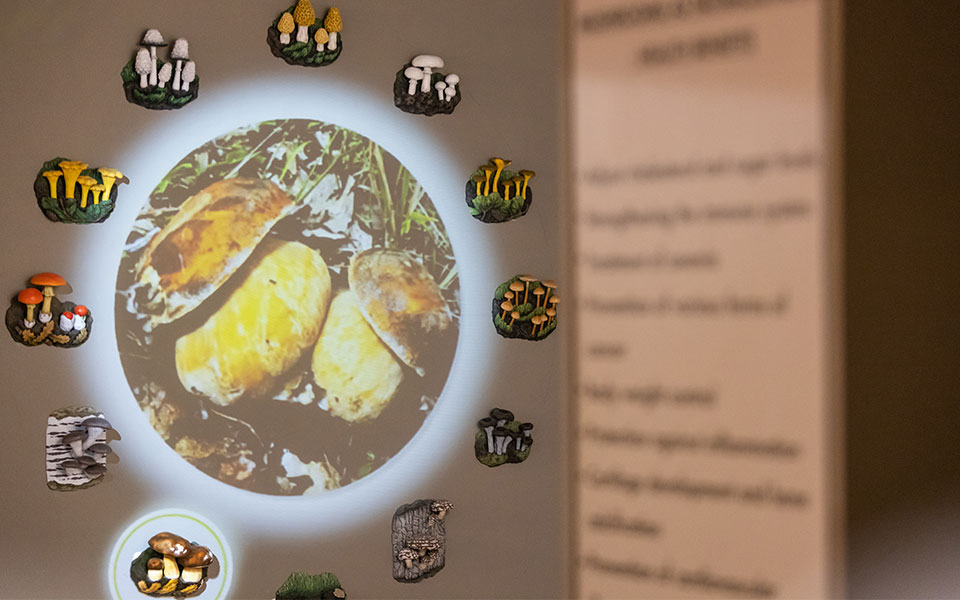
A wide range of dried mushrooms and mushroom powders of many varieties, as well as truffle shavings packed in oil, truffle salt, truffle oil and other related products are available at the museum’s shop and online, too. There’s a complete catalogue on the museum’s website at: meteoramuseum.gr.
Keepers of stillness and prayer in...
When the summer crowds depart, Greece’s...
The goddess Artemis, the Virgin Mary,...

Ten must-do experiences in Athens, from...