Discover Timeless Tranquility at Patmos Aktis, Resort &...
Patmos Aktis, Resort & Spa combines...

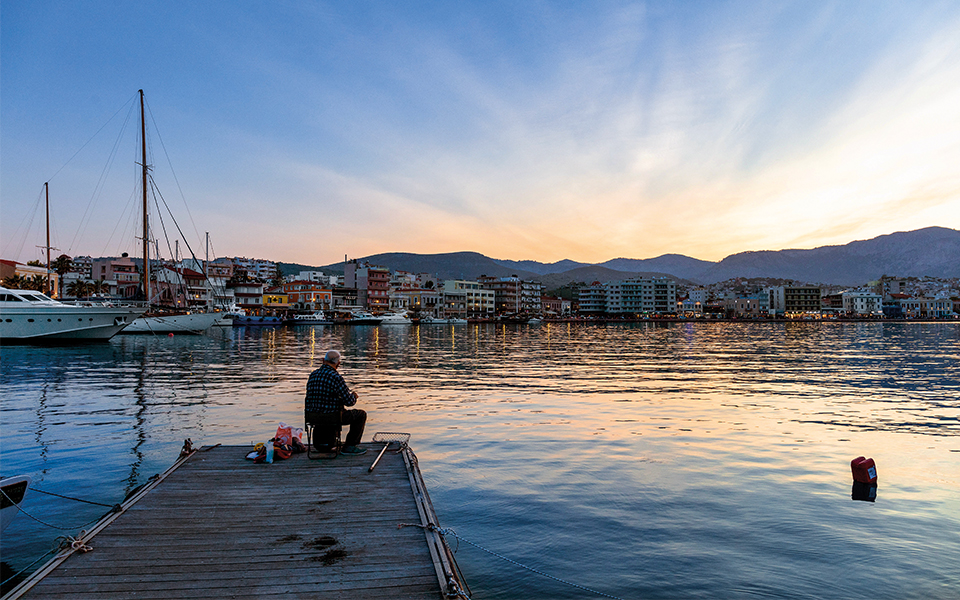
View of Chios port.
© Perikles Merakos
It’s early June, around eleven in the morning, and we’re sitting with Isabelle Tzoris, a 70-year-old Greek-French retiree, at the only kafeneio in the small village of Flatsia, in southeastern Chios. At a nearby table, a few locals are taking a break from their farm work, enjoying ouzo and meze in the shade. Isabelle chats easily with them in Greek.
Originally from the village but raised in France, she recently bought a two-story stone house built in 1920, about 80 square meters in size. “I wanted to reconnect with my roots,” she says, “but mostly I bought it because I love Chios.” Her children have followed suit, buying a home nearby. And they’re far from the only ones.
In Flatsia, now home to barely forty permanent residents, ten houses already belong to foreigners. “Chios still feels authentic,” Isabelle says. “The people are welcoming, the nature is magical, and life is simple and pleasant. Of course, it’s at a crossroads when it comes to tourism, but we hope it won’t lose its character.”
She currently lives in Burgundy and visits the island two or three times a year, often joined by a friend who recently bought a home further south in Gridia. One newcomer brings another, and what began nearly twenty years ago as a quiet trickle of foreign homebuyers has slowly turned into a small yet steady wave, helping revive the island’s villages and sustain their rhythms of everyday life.
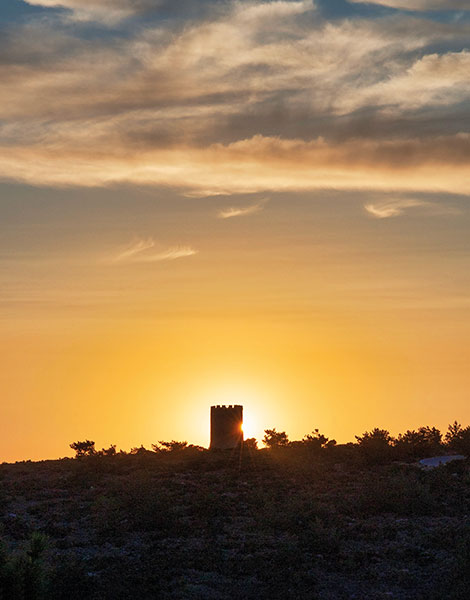
The Pachi watchtower is one of the dozens built during the Genoese rule, to provide early warning in case of a seaborne raid.
© Perikles Merakos
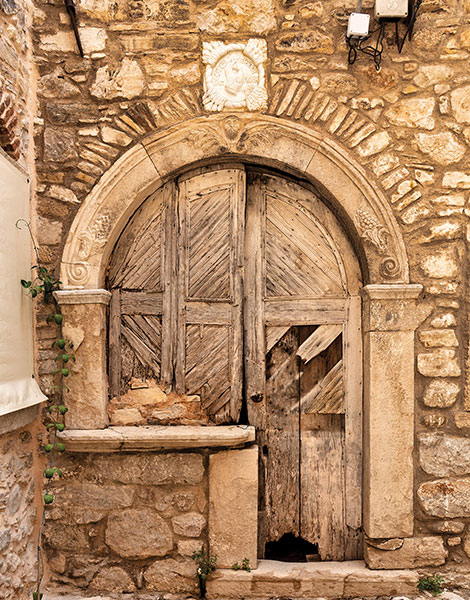
Remnants of the past in the medieval, preserved settlement of Kalamoti, in southern Chios.
© Perikles Merakos
“People left,” says Marina Tzori, owner of the village kafeneio and head of the local community. “Their grandchildren and great-grandchildren don’t come back. They sell off their properties. So the foreign retirees who dream of living in Chios buy these old, inexpensive houses and invest much more to restore them. They’ve brought life back to the village and to our traditions, too, since they take part in the local festivals.”
Beyond the welcome boost in population, there’s also a clear benefit to the local economy. “We get French, Italian, Dutch and Belgian customers, especially outside the tourist season,” says Giorgos Orfanos, owner of the seafood restaurant Molos in Kataraktis. “They’re regulars, and they spend generously, especially when it comes to fresh fish.”
Kataraktis, a seaside settlement founded by refugees from Asia Minor, lies just ten minutes north of Flatsia and tells a slightly different story. Here, the newcomers don’t renovate old houses — they build modern villas with pools. On the edges of the village, two small neighborhoods of luxury homes have sprung up, all with sea views. “Right now, about fifteen foreign families own homes here, and sales continue,” says Giannis Christakis, the village president, as fishing boats bob gently in the harbor behind him. “That’s mostly because plots of land are still affordable — though prices are now starting to rise.”
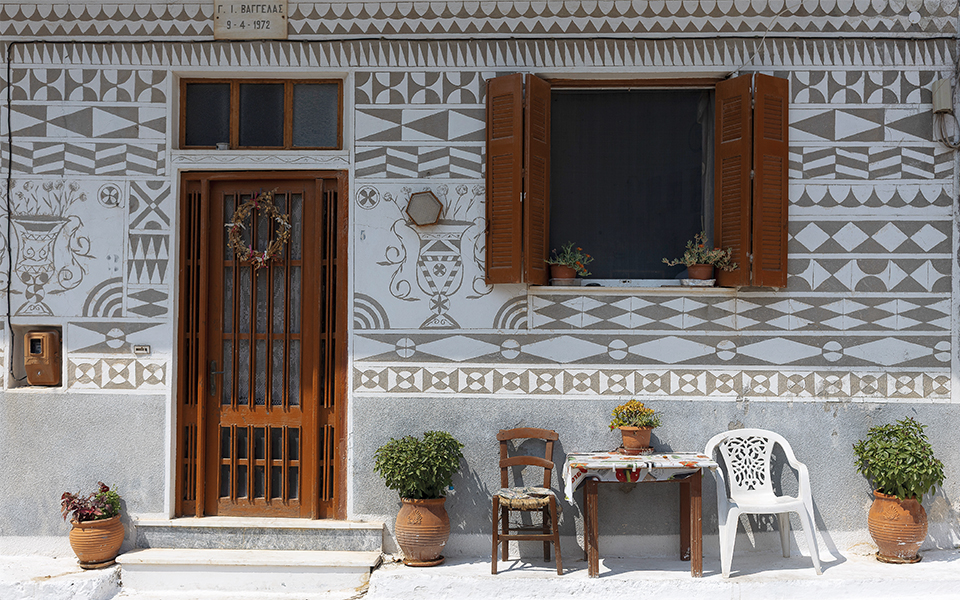
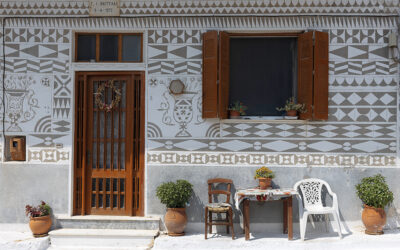
One of the many houses decorated with intricate xysta in the medieval settlement of Pyrgi.
© Dimitris Tosidis
Driving across Chios, from north to south, you notice the pattern repeating itself. In nearly every village, there are foreign residents of retirement age who’ve made the island their second home. Many first discovered Chios decades ago, as travelers in their youth, and the dream of living here never faded.
One of them is Patrick Jauffret, a 70-year-old wine merchant from Bordeaux, who has been visiting since 1993. Over time, he and his wife made close friends on the island and eventually decided to build their own house near Chora, the main town. Like most early buyers, they found their plot through local connections rather than real-estate agencies. That was the norm until about 2021, when demand began to surge.
Sensing the growing demand, Ioulia Moniouka, who has worked in commerce on Chios for over forty years, decided in 2021 to open a real-estate agency. “The interest kept rising,” she says, “as more and more visitors approached me looking for a house.” According to her, foreign buyers are spread all over the island — she even receives requests for Kampos, known for its elegant and often expensive stone mansions.
“Today there’s demand everywhere, from the Mastichochoria in the south to Volissos in the northwest,” she explains. “The average budget is around €150,000 for a purchase, and then they usually invest further in restoration. This year, I sold a 90-square-meter mansion with three acres of land — plus another 800 square meters of buildable space — for €270,000.” She also collaborates with international property websites, mainly to promote high-end villas.
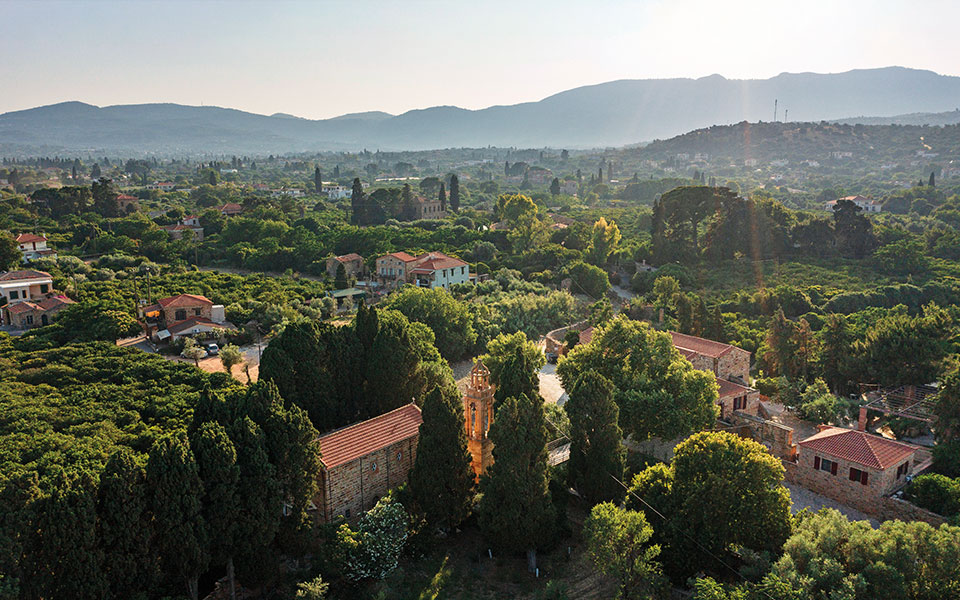
View of Kambos.
© Konstantinos Tsakalidis
The relatively low property prices and the affordable cost of renovation are key reasons foreigners choose Chios over other Aegean islands. As one of Greece’s larger islands, Chios has a well-developed supply chain for construction materials, keeping costs far below those of the Cyclades or smaller, more remote destinations.
According to Nikos Kladeas, owner of ecoHouses, who has been restoring homes for the past 25 years, “The average cost of renovation on Chios is about €1,200 per square meter, while on nearby smaller islands it exceeds €2,000.” His own story reflects how Chios gradually evolved into a home base for foreign retirees.
Years ago, Kladeas owned nightlife businesses and had set up a small construction team — with a carpenter and a plasterer — mainly for maintenance and minor repairs. Then, by chance in 2003, everything changed. “I was at a taverna when the owner introduced me to some Belgian visitors,” he recalls. “I ended up renovating a house for them in Kampos, in the area of Fragovouni. After that came more Belgians, then word spread, and soon I was approached by Dutch and French buyers. Many villages like Kallimasia, Lagkada, and Kardamyla have an abundance of old stone houses. You can still find properties for €35,000–40,000.”
Patmos Aktis, Resort & Spa combines...
On the Cycladic island of Tinos,...

This spring, five majestic peaks across...
Discover Pyrgi in Chios, a medieval...