Run a Half-Marathon on Santorini
"Santorini Experience" is to once again…

© Dimitris Mitsakos/Intime News
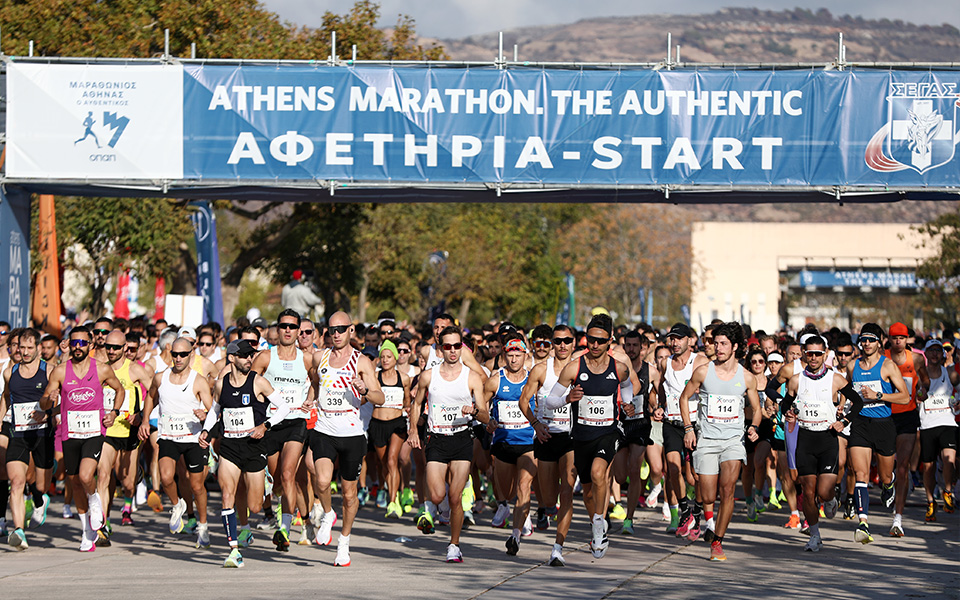
The Athens Marathon – The Authentic – returns this weekend, November 8-9, with a record-breaking 72,800 participants, confirming its place as one of the world’s great running events. Athletes from 126 countries, including Greece, Japan, South Africa, Chile, New Zealand, and Canada, will take to the legendary route from the town of Marathon to the Panathenaic Stadium in central Athens, where the very first modern Olympic Games were held in 1896.
Established in its current format in 1972, this year’s edition marks the highest participation in the event’s history, surpassing the previous record set in 2019. Among the entrants are 10,574 international runners, compared to 9,081 in 2024, underscoring the global appeal of the Greek capital’s signature sporting spectacle.
In addition to the full 42.195-km marathon on Sunday, November 9, thousands more will take part in the 10-km and 5-km OPAP races, the 5-km Universities Night Run, the 1.2-km kids race, alongside a series of parallel events celebrating fitness, culture, and community.
In the 10-km race alone, 2,502 runners will participate, compared to 2,324 in 2024 and 2,099 in 2019. Since 2019, the number of foreign participants has increased by an impressive 19%.
Yet the true power of the Athens Marathon lies not in numbers alone, but in the history it retraces. The route commemorates one of the most decisive moments in Western civilization: the Battle of Marathon in 490 BC, when a vastly outnumbered Athenian army, aided by a small force of Plataean allies, defeated the invading Persians on the coastal plain northeast of Athens. The victory safeguarded the fledgling democracy and inspired the legendary run of Pheidippides, who is said to have raced from Marathon to Athens to announce the triumph before collapsing and dying from exhaustion.
Today, runners pass by the two ancient burial mounds of the fallen warriors at the start of the race – the Athenian tumulus (“Soros”), where the 192 fallen Athenian hoplites were laid to rest, and the smaller Plataean mound. Along the way, they also encounter a modern bronze statue of Pheidippides, standing sentinel on the outskirts of Rafina.
But it’s not all ancient history. The marathon holds a special place in modern Greek identity, too. When the Olympic Games were revived in Athens in 1896, the marathon was chosen as the centerpiece event, symbolizing the bridge between the ancient and the modern. That inaugural race was won by a humble water carrier from Maroussi in northern Athens, Spyridon Louis, whose victory remains a source of enduring national pride.
For Athenians, Marathon weekend is more than a sporting event – it’s a citywide celebration. Crowds line the streets from Marathon to the city center, cheering on athletes as they make their final, emotional descent into the marble horseshoe of the Panathenaic Stadium.
If you’re in the Greek capital this weekend, even if you’re not running, it’s well worth being part of the experience. Visitors can explore the Marathon Expo at the Faliro Indoor Hall (November 6-8), attend “Authentic Talks” on sport and culture, or simply join the spectators who transform Athens into one of the world’s most inspiring outdoor arenas.
For more information, click here.
"Santorini Experience" is to once again…

Animal lovers around the world will…
Coming in at 2:16:49, Costas Gelaouzos…

30,000 runners will take part in…