Traditional Cretan Food: From Farm to Table at...
Experience Crete’s slow food philosophy where...

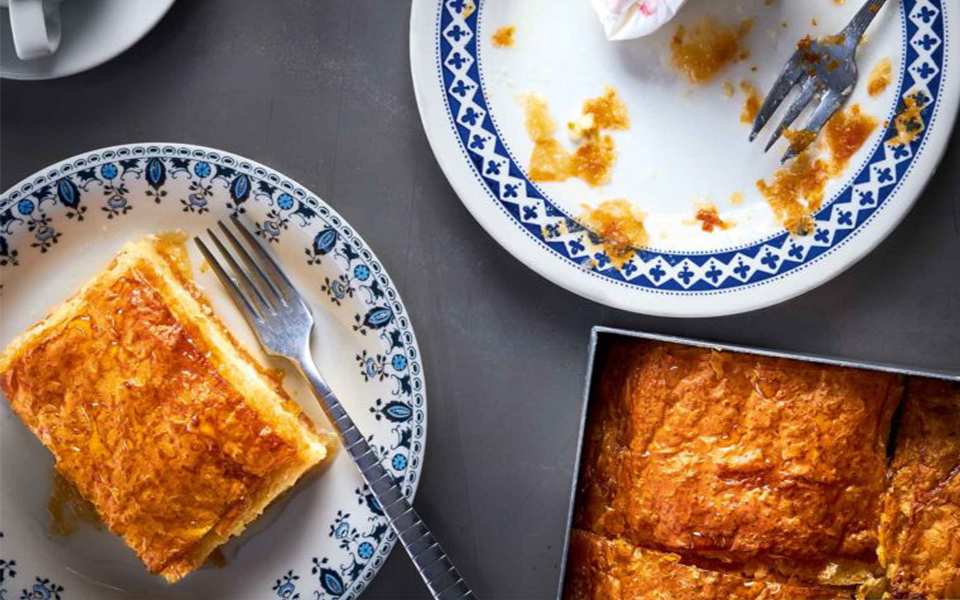
© Theodosis Georgiadis, Food styling: Stavroula Foutsa

Chef: Nikoleta Delatola-Foskolou

Preparation & Cooking time: Prep time: 40 minutes Baking time: 45 minutes Resting time: 2 hours
A dessert of urban origins and aristocratic sensibility, galaktoboureko is intricate and demanding to make. It was first created in professional pastry shops and only later found its way into home kitchens. Even though ready-made filo is readily available today, when galaktoboureko first appeared, such shortcuts simply did not exist.
The filo traditionally used for galaktoboureko is kroustas filo: thin, flexible sheets that can be folded without tearing. Each layer must be generously buttered so that, after a long bake, the filo becomes crisp, delicate, and beautifully golden. Kroustas filo has a unique ability to absorb syrup without becoming soggy, making it the ideal choice for all syrup-soaked desserts. Naturally, the syrup itself must be cooked to the correct consistency – rich and dense, but not excessive – so it is absorbed gradually and evenly.
Classic galaktoboureko is filled with semolina custard, although other approaches exist. Some prefer to use a light crème patissière, which thickens with cornstarch rather than semolina, resulting in a silkier, resistance-free texture. Both versions can be exceptional when well executed; the choice is purely a matter of preference.
More than any other ingredient, flavor is shaped by the type of milk used. Full-fat cow’s milk yields a mild, delicate finish. For a richer, more rustic character, sheep’s milk or a blend of sheep’s and cow’s milk can be used. One of the finest galaktobourekos we have ever tasted, in fact, was made with buffalo milk.
Besides the traditional versions, there are several creative variations. Kataifi can replace kroustas filo entirely, offering a completely different texture and flavor. For extra crunch, the kataifi base may be sprinkled with finely chopped pistachios. Another option is to add a thin layer of kataifi over the bottom filo sheets before pouring in the custard, enhancing contrast and structure.
The custard is usually scented with vanilla to soften the smell of the eggs. The finest versions use real vanilla pod, whose fragrance far surpasses synthetic vanilla powder. More economical but equally natural alternatives include lemon or orange zest, a splash of liqueur, or even coffee.
For a chocolate galaktoboureko, add 160 g of finely chopped couverture chocolate into the custard as soon as you remove it from the heat.
Galaktoboureko syrup contains more sugar than water. This higher density slows absorption and keeps the filo crisp. Reducing the sugar and increasing the water will result in softer filo.
Although technically a refrigerator dessert because of its custard, in winter galaktoboureko is best stored in a cool place outside the fridge, to prevent the filo from softening.
Never store galaktoboureko in an airtight plastic container: it will become soggy. Leave it in the baking tray and simply cover with a clean kitchen towel. This will keep the filo crisp for at least two days.
Galaktoboureko is delicious both cold and warm. You can reheat individual portions in the oven just before serving.
Originally published in Greek at gastronomos.gr.
Quantity: one 30 × 40 cm baking pan
For the syrup
Experience Crete’s slow food philosophy where...
A detailed guide to preparing homemade...
A traditional honey-and-cheese pie from Mykonos,...

Michiel Bakker, President of the Culinary...