A Day in Nemea: Good Wine and Ancient...
Why not try a brief getaway...

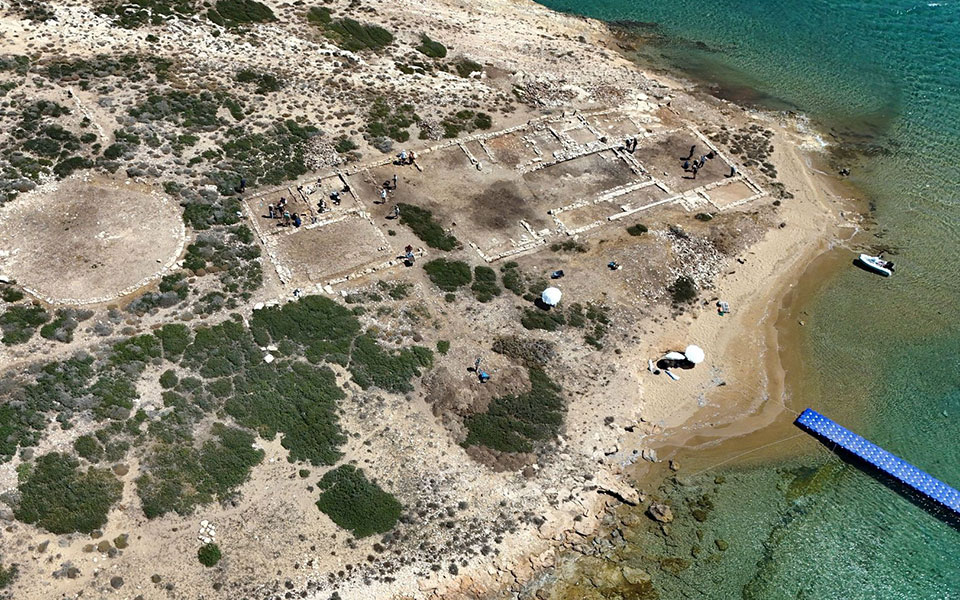
Aerial view of the eastern part of Tsimintiri, highlighting the close spatial and functional relationship between this small islet and the main sanctuary on Despotiko.
© Hellenic Ministry of Culture
Approaching Despotiko by boat, it’s hard to shake the feeling that you’re heading somewhere deliberately set apart. The low, rocky island lies just 700 meters southwest of Antiparos, close enough to feel within touching distance yet removed enough to demand intention. There’s no settlement here and no harbor in the conventional sense; only stone, scrub, and the piercing Cycladic light. The first thing you notice is how quiet it is – as if silence itself were part of the landscape.
That sense of separation is no accident. In antiquity, islands like Despotiko were often chosen for sanctuaries precisely because they stood on the margins of the inhabited world: places where land meets sea, where movement, arrival, and transition were built into the ritual experience itself. New findings from the Greek Ministry of Culture’s latest excavation season on Despotiko underline just how significant such remote sanctuaries once were – and why they continue to captivate visitors today.
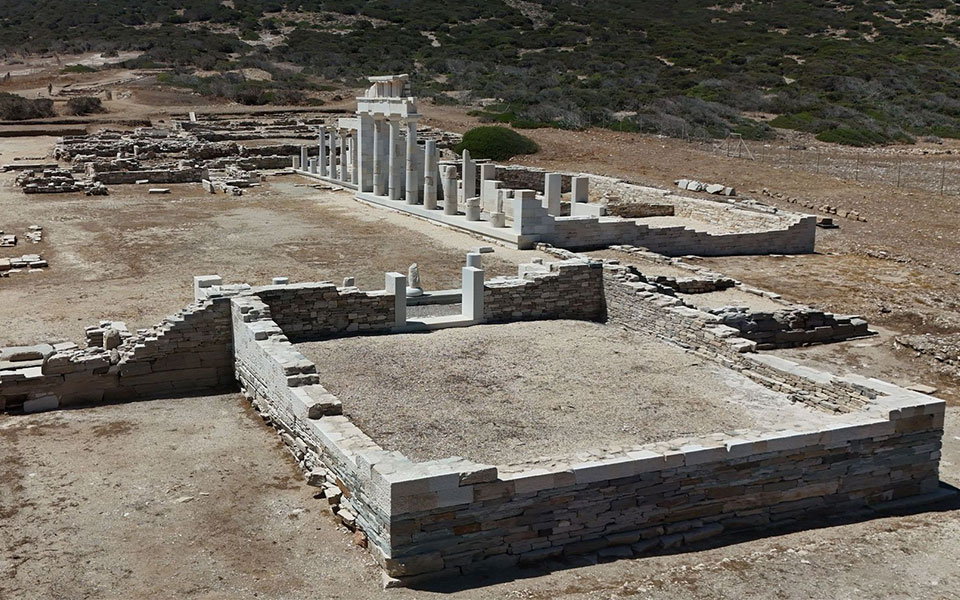
A view of the restored ritual buildings within the sanctuary precinct, revealing the scale and coherence of the Archaic complex as it would have appeared to ancient visitors arriving by sea.
© Hellenic Ministry of Culture
Although uninhabited today, Despotiko was anything but marginal in antiquity. Archaeological evidence shows that the island emerged as a major sanctuary during the late 6th century BC, dedicated to Apollo, and closely linked to the powerful nearby island of Paros. At its height, the sanctuary included a substantial temple, a large ceremonial dining hall (“hestiatorion”), stoas, courtyards, and a dense cluster of auxiliary buildings, suggesting a site capable of hosting large gatherings of pilgrims.
Excavations over the past two decades, led by archaeologist Yiannis Kourayos, have steadily revealed the scale and ambition of the sanctuary. So extensive are its remains that scholars have suggested Despotiko may have rivalled Delos itself in size during the Archaic period. Far from being a minor outpost, it appears to have played a central role in the religious and political landscape of the central Cyclades.
Its position was strategic. Sitting astride key maritime routes and controlling sheltered anchorages, Despotiko likely functioned not only as a cult center but also as a naval and logistical hub, tied to Parian influence in the Aegean. Water management systems, storage facilities, and robust architecture point to long-term planning rather than episodic use.
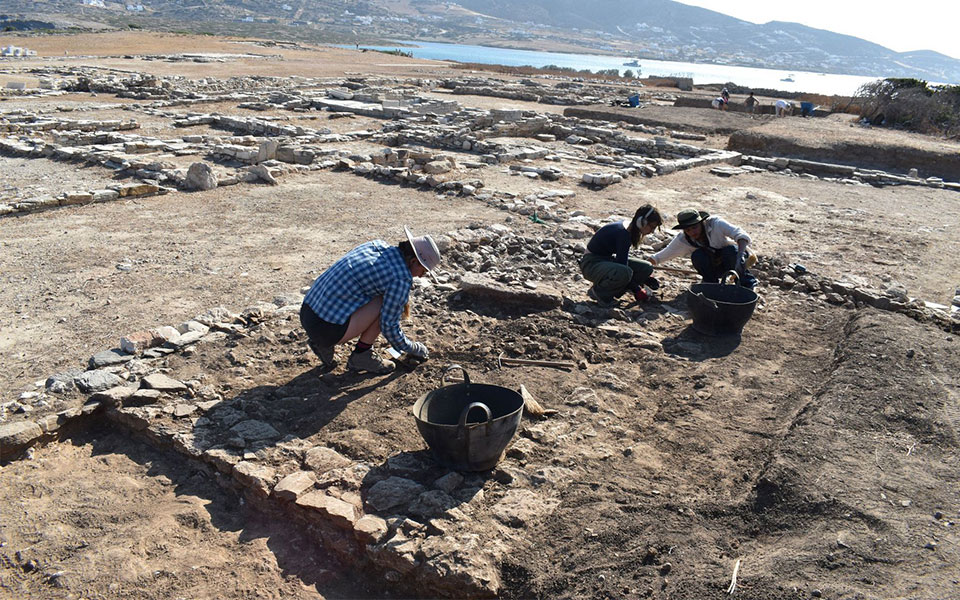
Excavation in the South Complex on Despotiko, where successive building phases point to long-term use and adaptation of the sanctuary beyond its initial Archaic peak.
© Hellenic Ministry of Culture
Systematic excavations on Despotiko and the neighboring islet of Tsimintiri continued in 2025 under the direction of the Ephorate of Antiquities of the Cyclades, led by Kourayos, with a long-standing team of archaeologists, conservators, and marble specialists. Over four weeks of fieldwork, research focused not only on the heart of the Archaic sanctuary but also on the wider built environment that supported it.
Beyond the limits of the main sacred precinct (“temenos”), work continued at a structure known as “Construction Ω,” where earlier seasons had revealed fragments of at least three Archaic “kouroi” (freestanding statues of youths) reused in later masonry, along with the torso of a statue dating to the first half of the 5th century BC. Their secondary use offers a reminder that ancient sanctuaries were living places, reshaped and adapted over generations rather than frozen at a single moment in time.
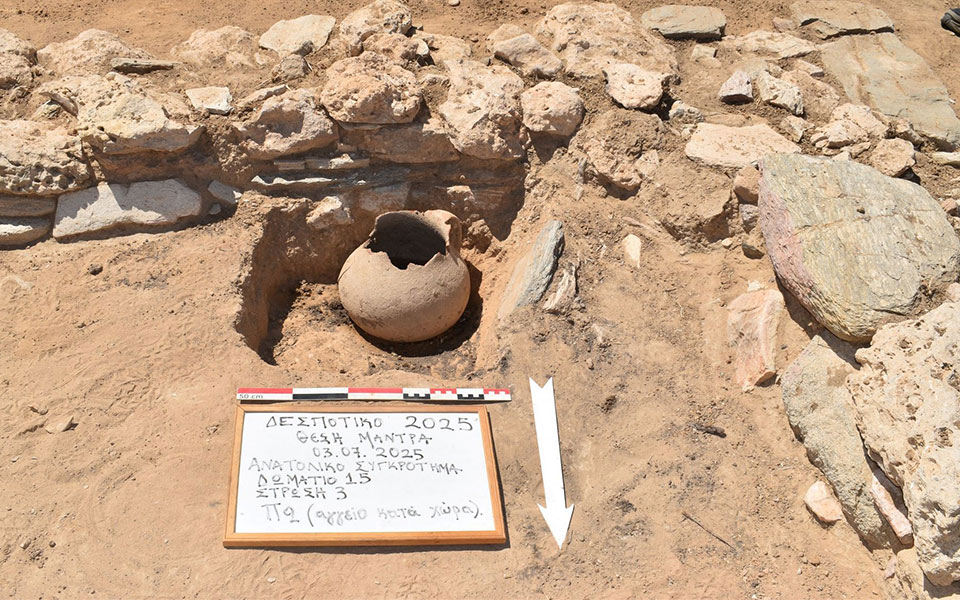
An intact cooking vessel uncovered in situ in a room of the Eastern Complex, likely placed as a foundation offering during construction.
© Hellenic Ministry of Culture
Nearby, excavation resumed at “Building MN,” a substantial rectangular structure with at least eight rooms and multiple architectural phases, the earliest dating to the 6th century BC. Elsewhere within the sanctuary core, the south-westernmost room of the Eastern Complex was explored in depth, yielding one of the season’s most evocative finds: an intact cooking vessel discovered in situ in the corner of the room. The vessel was likely placed there deliberately during construction, a foundation offering marking the inauguration of the space.
To the south-west of the sanctuary enclosure, a newly identified cluster of rooms built in a later period hints at continued activity well beyond the sanctuary’s initial Archaic flourishing. Together, these discoveries reinforce a picture that has been steadily emerging at Despotiko over the past two decades: this was not a modest island shrine, but a large, organized religious center with complex and extensive infrastructure.
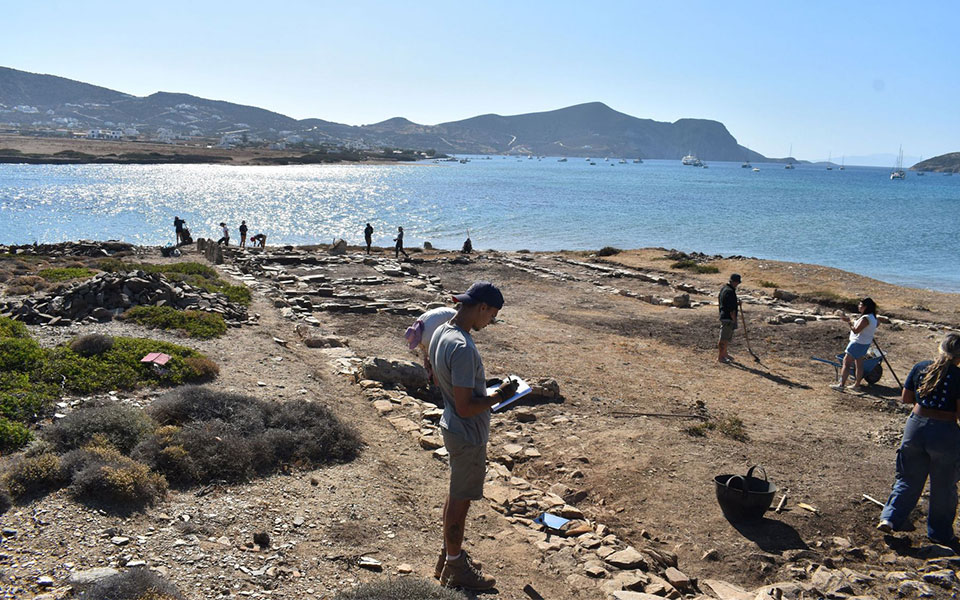
Building Bt on the neighboring islet of Tsimintiri, part of a large auxiliary complex that supported storage, preparation, and communal activity linked to the sanctuary on Despotiko.
© Hellenic Ministry of Culture
The picture becomes clearer when the nearby islet of Tsimintiri is taken into account. Excavation there focused on the northern sections of “Buildings Bt and Et,” which, together with “Building Gt,” form a unified complex covering at least 900 square meters. The complex comprises ten rectangular rooms arranged in sequence, opening onto a large open space to the south.
Within several rooms, archaeologists identified built stone features interpreted as storage installations, as well as stone benches. Finds were sparse – a consequence of heavy erosion and the absence of deep deposits – but included fragments of “pithoi” (large storage containers), commercial amphorae, fine drinking vessels, and loom weights. These traces suggest storage, preparation, and communal activity, pointing to the logistical backbone that sustained ritual life on Despotiko.
Taken together, Despotiko and Tsimintiri read less as isolated dots and more as parts of an integrated sacred islandscape – a reminder that sanctuaries were not only places of worship, but also centers of organization, hospitality, and exchange.
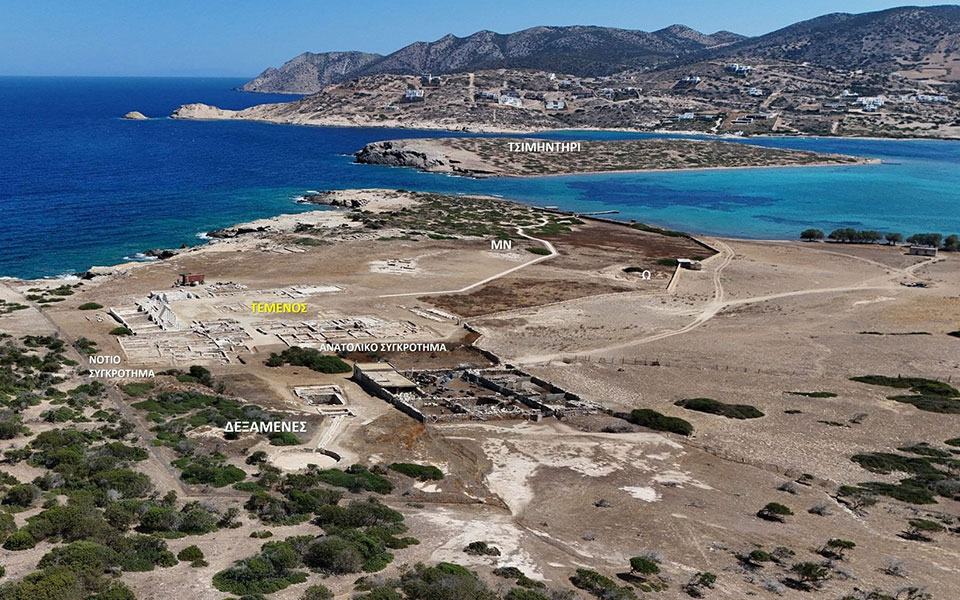
Aerial view of the sanctuary at Mandra on Despotiko, a low, windswept island just off Antiparos that once hosted one of the Cyclades’ most important Archaic cult centers.
© Hellenic Ministry of Culture
Alongside the excavations, 2025 marked the completion of the final phase of restoration on “Building D,” an Archaic structure within the sanctuary whose reconstruction began in 2022. With its restoration now complete, Building D joins the already restored temple and hestiatorion, dominating the archaeological site and offering visitors a rare sense of architectural volume and coherence.
The visual impact is immediate. Instead of scattered foundations alone, the restored structures offer a more legible impression of the sanctuary’s original form, capturing something of the presence and authority the site once projected to those arriving by sea. The project’s stated goal – to deliver an organized, accessible archaeological site to the public – now appears within reach. Despotiko is gradually shifting from a site known primarily through excavation reports into one that can be experienced on the ground.
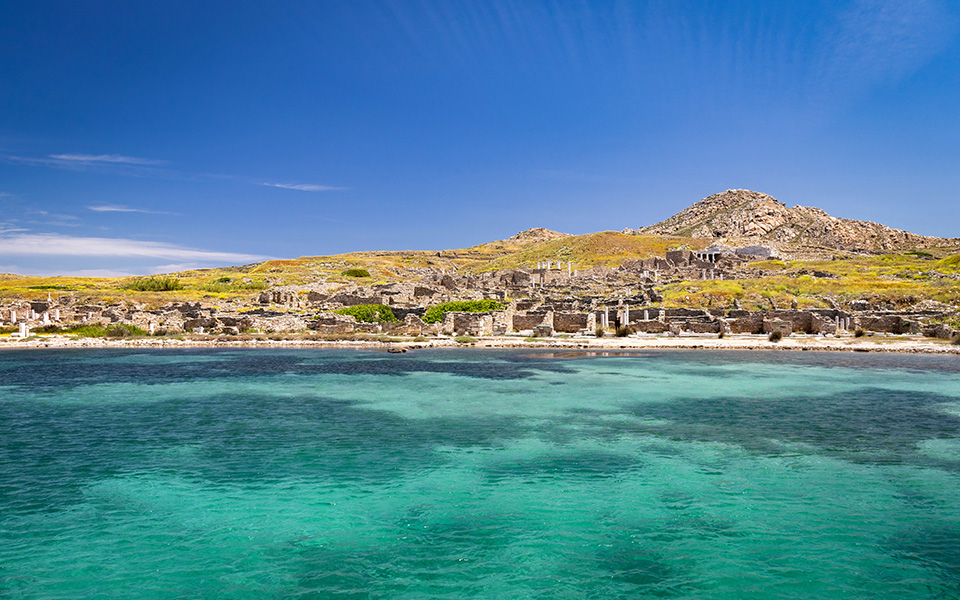
Reachable only by boat from nearby Mykonos, the sacred island of Delos, a UNESCO World Heritage Site, remains one of Greece’s most evocative archaeological destinations today.
© Shutterstock
Any discussion of sacred islands in the Cyclades inevitably leads to Delos. Located between Mykonos and Rineia, Delos was the most important sanctuary of Apollo in the ancient Greek world and a major religious, political, and commercial center from the Archaic period onward. According to myth, it was the birthplace of Apollo and Artemis; historically, it functioned as a panhellenic sanctuary and, later, a thriving port city under Hellenistic and Roman rule. Today, it is a UNESCO World Heritage site and one of Greece’s most visited archaeological islands.
Yet discoveries on Despotiko increasingly complicate a Delos-centric picture of Cycladic religion. Rather than a single dominant center, the evidence points to a network of sacred islands, each fulfilling different roles within a shared religious geography. Apollo was a unifying figure, worshipped on both Delos and Despotiko, but local traditions, architectural choices, and ritual practices varied considerably.
Beyond the Cyclades, other island sanctuaries underline the same pattern. On Samothrace, in the northern Aegean, a remote island sanctuary dedicated to the Great Gods drew pilgrims from across the Greek world, including kings and statesmen, who sought initiation into its mystery cults. Much earlier still, the uninhabited Cycladic island of Keros functioned as a ritual center during the Early Bronze Age, long before formal temples, through the deliberate deposition of broken figurines and marble vessels.
Seen in this broader context, Despotiko emerges not as a satellite of Delos, but as part of a long Aegean tradition of sacred islands – places where remoteness was not a drawback, but a defining feature.
For modern travelers, visiting places like Despotiko or Delos still involves effort – which is part of their appeal. Access is by boat, weather matters, and facilities remain limited. These are not sites designed for rapid consumption, but places that reward patience and attention. Archaeology, in turn, becomes more than an academic exercise – it becomes a form of travel through time, rooted in landscape and movement.
At Despotiko, standing among restored walls with the sea glittering sea just beyond, it is easy to understand why the ancient Greeks chose islands for their sanctuaries. Islands offered separation, visibility, and controlled access – qualities that shaped religious experience as much as architecture did.
As excavation continues and restoration progresses, Despotiko is emerging not only as a major archaeological site, but as a compelling destination in its own right. In the Cyclades, where beaches and whitewashed villages often dominate the imagination, these sacred islands offer a different kind of journey – quieter, grounded in deep history, and all the more memorable for it.
Why not try a brief getaway...

More and more Europeans retire to...
Discover Pyrgi in Chios, a medieval...

A once-mighty city-state overlooking Souda Bay,...