4 Summer Festivals Celebrating Greek Tradition
From Lefkada and Anogeia to Paros...


Shuttles from Mrs. Aristea’s workshop.
© Stelios Papardelas
Geometric motifs, floral patterns, horses, princes and Minoan suns. If Anogeia could be captured in a single image, it would be the woven textiles hanging from the village balconies: rows of vivid colors and intricate patterns displayed beside the women who created them – proud, welcoming and always ready to explain the stories woven into every thread. Their hands bear the marks of years of labor and craftsmanship, though they rarely speak about either. What matters to them is the quality of the work itself. And once conversations with visitors come to an end, they return to their looms – the few that still remain.
The men sit at the village kafeneio. Around them, children ride past on bicycles, while a truck slowly makes its way through the streets announcing the evening’s event through a loudspeaker: “Today, May 8, at 5:30 p.m., the opening of the ‘Anogeia Weaving House’ will take place in Perachori. The space is dedicated to the cultural heritage of our village and to the preservation of the art of weaving, thanks to a donation by Costantza Sbokou.”
The message fades as the vehicle continues deeper into the village.
Excitement is palpable among both residents and visitors. The women of the village hurry toward the House carrying everything needed for the opening ceremony. All are elegantly dressed, even though the event is still hours away. A few children run after them – and I follow along as well.

Mrs. Ermioni, one of the village’s last remaining weavers, shows us one of her rugs.
© Stelios Papardelas
Together, we walk from the home of musician Nikos Xylouris toward Michalis Skoulas Street. Rows of chairs arranged in the middle of the road signal that we have arrived. Through the large glass windows, woven textiles in every color come into view. Red, yellow and blue threads cover the bright white walls and black metal frames of the building. At the center stands an old loom. The atmosphere is striking. The space feels less like a museum and more like a café, library or creative studio. That, as UNESCO Goodwill Ambassador Costantza Sbokou-Konstantakopoulou later explains, was precisely the intention.
“When we agreed with the mayor, Sokratis Kefalogiannis, to move forward with a major project centered around the weaving tradition of Anogeia as part of the region’s intangible cultural heritage, it was very important to me that the final result would become part of the village’s identity while also expressing a contemporary aesthetic,” she explains. “This way, visitors can discover the richness of the material heritage found in the area while also using the House as a meeting place. ‘Does it have Wi-Fi? I’ll go there to work, write or read.’ That was our thinking, and my daughter Carmen played a major role in shaping the concept.”

Detail of a weaving in progress.
© Stelios Papardelas
Yet the story began much earlier, with her grandmother, Agapi Sbokou. “Like all the women in the village, she learned weaving from a very young age. When Anogeia was burned by the Germans in 1944, she walked all the way to Heraklion carrying two children in her arms and another in her womb. She settled there and almost immediately opened her own weaving workshop. I remember her saying that at one point she employed as many as 40 women weavers. Especially during the tourism boom of the 1980s, she began exporting woven textiles as far away as Australia. Her house was overflowing with them. You entered through a long corridor lined with stacks of folded textiles, and the looms stood in the adjacent room. I don’t think I ever saw them in operation, but the stories created such vivid images that I feel as though I experienced them myself.”
She goes on to explain that grandmother Agapi wove nearly everything needed to furnish the rooms in the first hotels established by her father, Giannis Sbokos. “For the women of that generation, weaving was an incredibly important source of income that allowed them to educate their children and support their families. At one point, my grandmother even returned to the village and created another workshop to provide employment for the women there as well.” That space is today’s “Anogeia Weaving House.”

The 17-year-old Carmen standing in front of one of the Center’s woven textiles.
© Stelios Papardelas

A patania dating from the period 1934-1945.
© Stelios Papardelas
I ask her which of the woven pieces displayed in the space is her favorite, and she points to a small textile hanging beside the entrance. “It’s one of the oldest woven pieces I have from my grandmother,” she says. “It’s made from wool using a technique called alyssida (chain). What makes it especially important is that it was a wedding textile, traditionally placed over the groom’s horse by his brother when they went to collect the bride’s dowry. While putting together this first exhibition – composed largely of textiles woven by women from Anogeia – I discovered traditions from my own homeland that I had never known before. It’s remarkable how such a small woven object can carry so many stories and customs within it.”
Later, her 17-year-old daughter Carmen gives me almost the same answer when I ask her the same question. I find her in the middle of the preparations, carefully organizing the library collection, which she curated herself. “I had never actually visited Anogeia before, even though I grew up hearing stories about it,” she says. “So, when I learned that my mother was creating the House, I immediately knew I wanted to be part of it. What fascinated me most were all the stories we heard from the local women when we visited their homes and they opened their wooden chests to show us their woven textiles. I had always seen the woven cushions my mother brought out onto the veranda every summer, but I had never really understood what they represented. Suddenly, everything started connecting and making sense.” She pauses for a moment before admitting that her goal for this summer is to learn how to weave.

Mrs. Aristea, the creator, at work.
© Stelios Papardelas
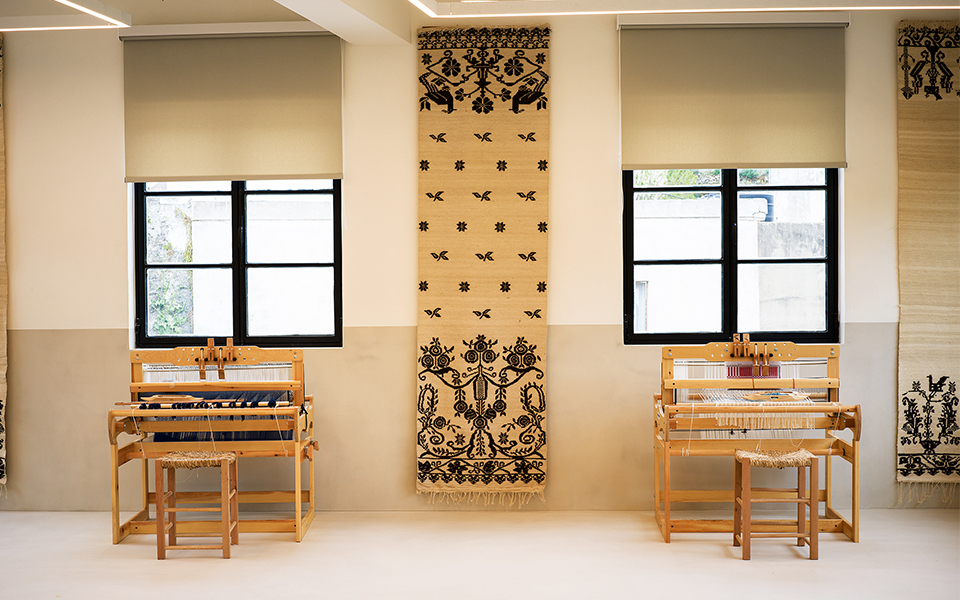
The looms from the Center’s workshop.
© Stelios Papardelas
By now, visitors have begun filling the space. Someone asks whether they are allowed to touch the textiles, while Zoe patiently explains the weaving techniques and intricate patterns. “As the wooden chests opened, so did our memories,” one village resident says upon seeing woven pieces made by her relatives. Younger visitors look curious, remarking that everything somehow already feels familiar.
At the back of the building, in the small courtyard with the old well, I meet architect Magdalini Sgouridi, who worked on the project together with Mare Studio, responsible for the artistic and creative direction. She speaks about the architecture she discovered in Anogeia. “The greatest lesson throughout this process was the return to simplicity and necessity,” she explains. “The building you see today was constructed after the destruction of 1944, during the reconstruction period, as a simple concrete structure. It appears to have functioned both as a workshop and a home. Right here, in the center of the courtyard, there used to be a large mound of rubble that sparked our curiosity. When we removed the walls on the northern side, we discovered the well, which is still full of water today.
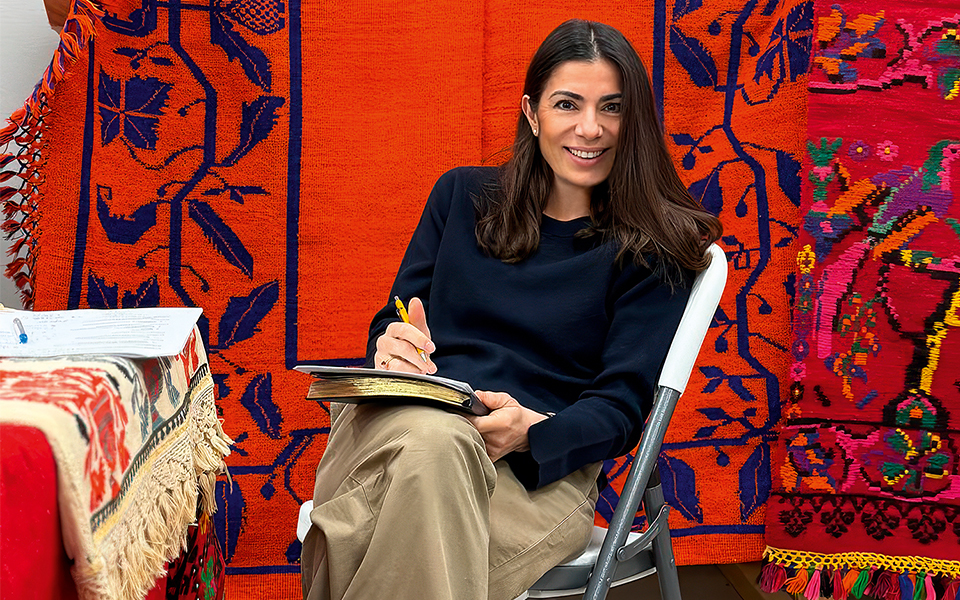
Costantza Sbokou-Konstantakopoulou
© Stelios Papardelas
“The essential thing was to create a welcoming space that would blend naturally into the character of the village as though it had always been here, while still feeling contemporary. The fact that the design and construction came after many visits to the village helped us truly understand both the spirit of the place and the needs of Anogeia. Architecture, after all, should give form to the function of life and not the other way around, as Aris Konstantinidis used to say.” She notes that the renowned Greek architect Aris Konstantinidis and the Xenia hotels he designed across Greece served as a major source of inspiration for the building’s design.
I look up at the woven iron structure on the upper floor, designed to shield the interior from the harsh midday sun. Jasmine blooms in the neighboring houses on either side of the House. Through the large openings, the older buildings of the village come into view, visible remains of the original character of Anogeia. The thin metal strips embedded in the floor and the cement coating rising halfway up the walls seem to ground the colorful, richly decorated textiles into a single unified narrative. Everything in the space appears to tell its own story. From the ground floor, the mountains surrounding the village are visible. On one side stretches the Psiloritis UNESCO Global Geopark; on the other, snow-covered peaks still marked by the recent wave of African dust. A place of encounters and contrasts, I write in my notebook along with my observations on the woven textiles.
From Lefkada and Anogeia to Paros...
Four Grecotel properties stand out in...
Emma Maidment and Tyson Venables left...

Breathtaking landscapes, unforgettable swims, outstanding food,...