Why Volos is Perfect in Autumn
The charming port city of Volos...

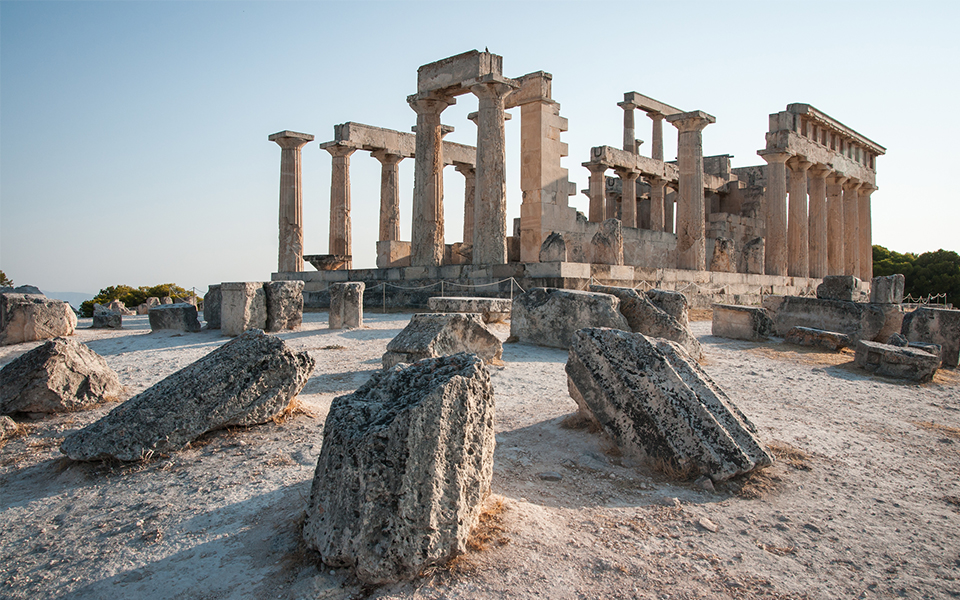
The temple of Aphaia on Aegina.
© Shutterstock
Only an hour’s ferry ride from Athens, Aegina has long been the capital’s favorite quick escape – close enough for a spontaneous hop across the water, yet rich enough in history to fill a relaxed weekend. Tradition links its name to the nymph Aegina, mother of the hero Aiakos – grandfather of Achilles, but the island’s story is anchored in its remarkable past: in the 7th and 6th centuries BC, Aegina was a maritime powerhouse and a formidable rival of Athens, minting some of the earliest Greek coinage (with its famous sea turtles), and controlling key trade routes in the Aegean and eastern Mediterranean.
Today, visitors know it for delicious pistachios, horse-drawn carts along the harborfront, pine-scented hills, and relaxed Saronic sunsets. But woven between the tavernas and holiday homes is an island dense with archaeology – from the ancient acropolis at Kolona to the striking Temple of Aphaia, Byzantine ruins at Palaiochora, and Venetian fortifications.
Compact, friendly, and easy to explore, Aegina is a perfect all-rounder for first-time travelers and archaeology lovers alike.
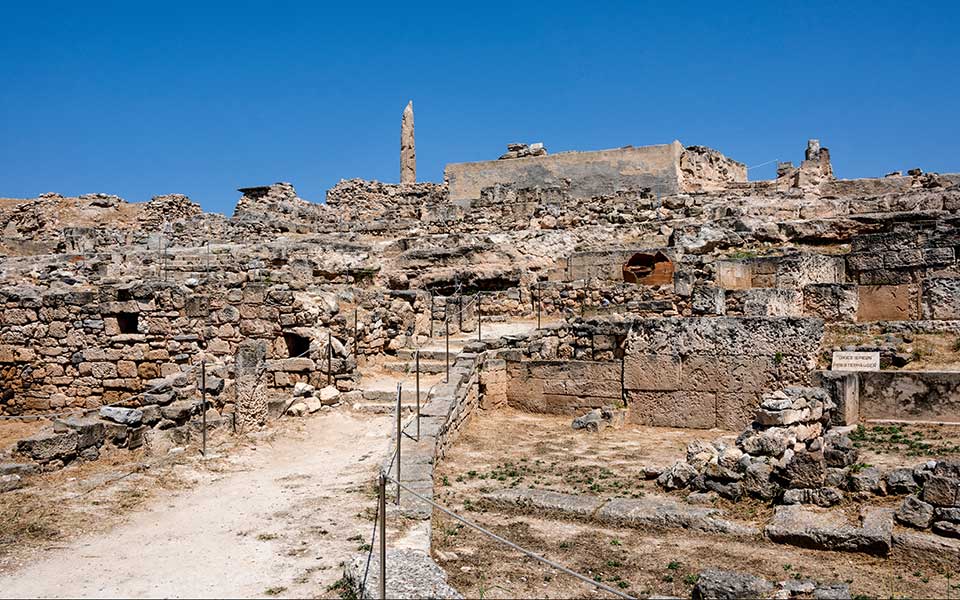
The lone column of the Temple of Apollo on Kolona Hill.
© Shutterstock
Just a few minutes’ walk from the ferry port, Kolona is the ideal place to begin your archaeological circuit. This low coastal hill, crowned by a single surviving column of the Archaic Temple of Apollo (6th century BC), served as Aegina’s acropolis and religious–political center for thousands of years.
Excavations here have revealed an extraordinary sequence: Early and Middle Helladic settlements from around 3000 BC, Mycenaean structures, extensive fortifications, and later Classical and Hellenistic public buildings, including the “Bouleuterion” (assembly house). Archaeologists have also unearthed Byzantine remains, evidence of the site’s long life.
Writing in the second century AD, Greek traveler and geographer Pausanias describes the “Aiakeion” – Aiakos’ monumental tomb – along with a grand theater said to rival Epidaurus, and shrines dedicated to Demeter, Artemis, Dionysus, and Hecate. Numerous elite Archaic burials have been found here too, including examples of fine gold jewelry. Offshore lie the remains of Aegina’s commercial, military, and “kryptos” (“hidden”) harbors, from which the island launched its warships. Much later, in Venetian times, Kolona’s lone column even served sailors as a navigational marker.
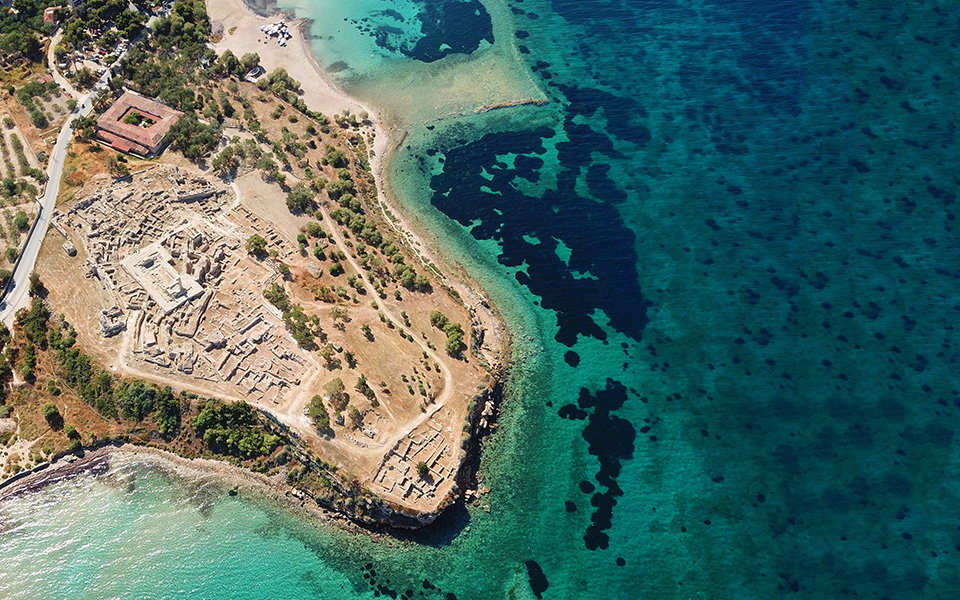
Kolona Hill and the Temple of Apollo, with the museum nestled discreetly beside the site, in the top left.
© Shutterstock
Right next to Kolona stands the Archaeological Museum of Aegina – founded in 1829 by Greece’s first governor, Ioannis Kapodistrias, and the country’s first national museum. Modest in size but impressively rich, its three halls display finds from prehistoric to Roman times: pottery, figurines, bronze and alabaster vessels, coins, weapons, jewelry, inscriptions, and sculpture from Kolona, the Temple of Aphaia, and other sanctuaries.
Highlights include a reconstructed Proto-Helladic two-storey residence known as the “White House,” a Bronze Age copper foundry, and even an etched Harappan carnelian bead, evidence of long-distance trade with the Indus Valley. The museum’s star piece is a 5th-century BC marble Sphinx dedicated to Apollo – a superb example of the distinctive Archaic style for which Aegina was once famous.
A visit here naturally sets the stage for the island’s showpiece site: the Temple of Aphaia. (And if the weather’s warm, Kolona Beach – just a short walk away – is perfect for a quick dip afterwards).
16 Spyrou Rodi, Aegina Town
Open: Mon-Sun 10:00-17:00 (Closed Tuesdays)
Tel. (+30) 22970.222.48 / 291.13
01/11-31/03: €5 | 01/04-30/10: €10 (includes Kolona site)
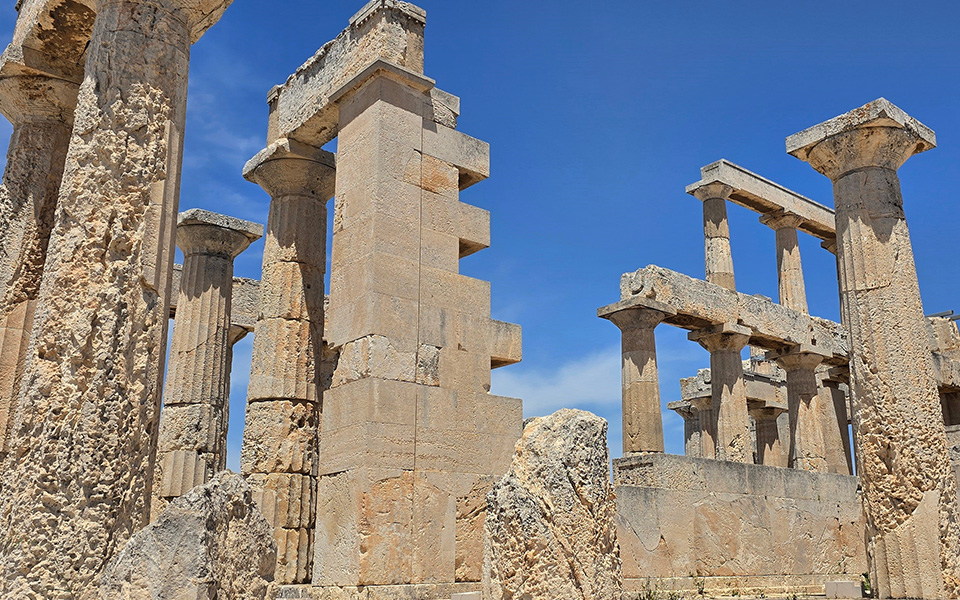
The Temple of Aphaia, the jewel of Aegina and a masterpiece of Late Archaic architecture.
© Shutterstock
Perched 160m above the pine-covered hills, just 2km east of the village of Mesagros, the Temple of Aphaia is Aegina’s most striking archaeological site – and a must-see. Dedicated to the local goddess Aphaia (later linked with Athena and Artemis during the Athenian hegemony), the sanctuary flourished during the Archaic period, though the hill was sacred long before then. The temple seen today, built between 500-490 BC after an earlier structure was destroyed by fire, showcases the refined craftsmanship of the so-called “Aeginean School.”
A classic Doric “peripteros,” it was built from local limestone with 12 fluted columns along each long side (instead of the usual 15) and six along the short sides. The corner columns are thicker and incline slightly inwards – a subtle optical adjustment also employed later in the building of the Athenian Parthenon. The original pediments, carved in Parian marble and vividly painted, depicted scenes from the Trojan War, celebrating the Aiakid dynasty (ancestors of Achilles and Ajax). Sadly, many of these sculptures were plundered in the early 19th century and now reside in Munich’s Glyptothek.
The temple’s location offers more than architectural history: legend and geometry intertwine here, as the temple forms one point of an imaginary isosceles triangle with the Parthenon and the Temple of Poseidon at Sounion – an alignment that has long sparked scholarly debate about ancient ideas of sacred space and communication across the Saronic Gulf.
Take your time exploring the pin-fringed paths, enjoy sweeping views, and soak in the temple’s enduring energy. After dark, the temple’s recently installed lighting casts a magical glow over the hill.
Open daily 08:00-20:00
01/11-31/03: €5 | 01/04-30/10: €10
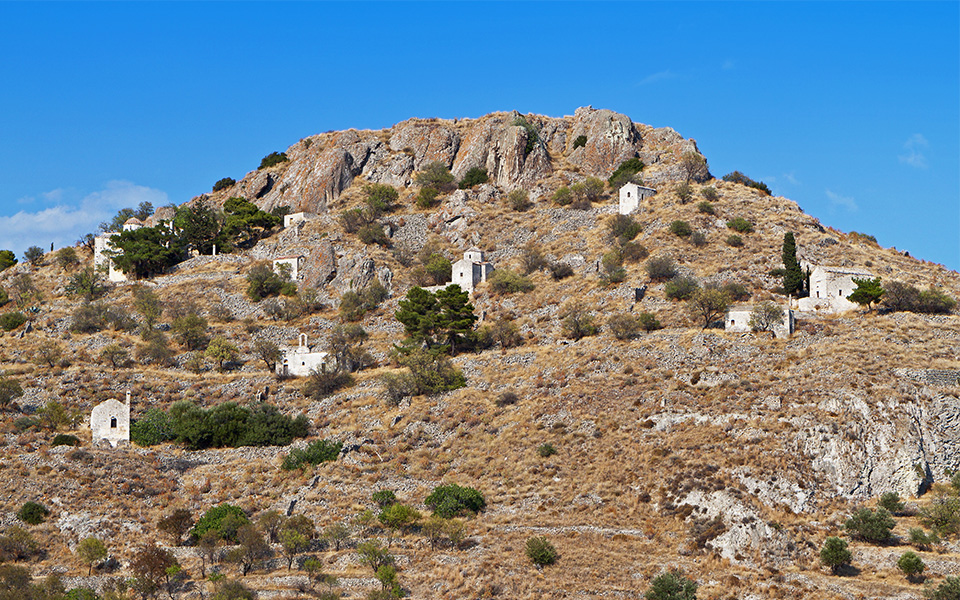
The atmospheric hilltop ruins of Palaiochora, Aegina’s abandoned medieval capital.
© Shutterstock
About 7km inland from Aegina Town lies Palaiochora (or Paleochora), the island’s abandoned medieval capital, perched above the famous Aghios Nektarios monastery. Founded in the 9th century to protect residents from the near constant threat of Saracen pirate raids, the settlement grew into Aegina’s primary town until 1826. It once boasted around 800 houses and an astonishing 366 churches – one for every day of the year, as locals like to say!
Today, roughly 38 churches remain, many with evocative frescoes. Look out for Aghios Georgios, Metamorphosis, and Aghia Kyriaki, where traces of Byzantine artistry cling to the stone walls. As you wander along cobbled paths, you’ll encounter remnants of fortifications, cisterns, and water reservoirs, as well as the ruins of a hilltop Venetian castle built in the mid-17th century.
Overgrown with wildflowers and wrapped in eerie silence, the village has earned the nickname the “Mystras of Aegina” for its Byzantine echoes and peaceful charm. Entry is free; bring sturdy shoes, water, and take your time. If you manage the climb to the castle, the views across the island are superb.
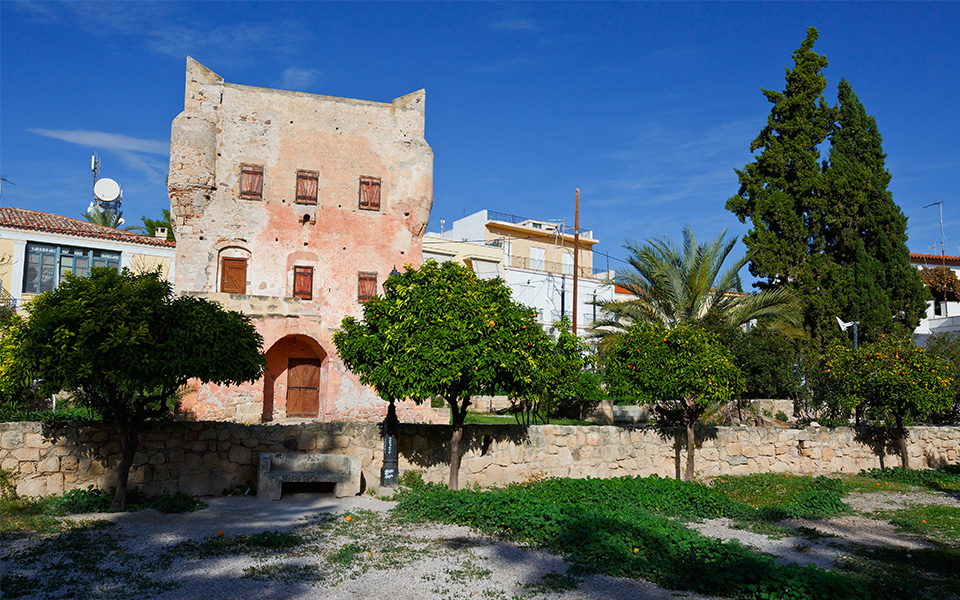
The pink-walled Tower of Markellos, a landmark of Venetian and revolutionary history.
© Shutterstock
Back in Aegina Town, a short stroll from the seafront brings you to the 17th-century Tower of Merkellos, its faded pink façade lending it a touch of theatrical charm. Originally a Venetian watchtower guarding the harbor, it was restored in 1802 by Aegina’s revolutionary leader Spiridon Markellos. During the War of Independence, it variously served as a headquarters for freedom-fighters, provisional governments, and ministers under Kapodistrias.
Today, the tower is owned by the municipality and houses the Kapodistrian Cultural Center and the Center for Social Reflection “Spiros Alexiou.” Occasional exhibitions and cultural events open its doors to visitors, offering a glimpse into the island’s modern history.

Mount Hellanion Oros, crowned by the chapel of the Ascension, one of Greece’s oldest mountain sanctuaries.
© Hellenic Ministry of Culture
If you’re staying on Aegina for more than just a quick day trip, and you’re in the mood for something more adventurous, head into the island’s rugged southern interior to Mount Hellanion Oros (532 m), home to one of the oldest mountain sanctuaries in Greece. Sacred to Zeus Hellanios – the weather god and “bringer of rain” – this wind-swept peak drew worshippers as early as the 8th century BC, with possible Mycenaean roots.
According to tradition, it was here that Aiakos prayed for rain during a devastating drought, building a shrine in thanks when the heavens finally opened. Little survives today of the ancient sanctuary beyond a Hellenistic wall, a broad stone staircase, and a small chapel dedicated to the Ascension/Prophet Elijah. But the landscape is dramatic, the air crisp, and the views over the Saronic Gulf are breathtaking.
From here, continue to the nearby village of Sfentouri, where a lovely stone-paved path descends to the ancient olive grove of Eleonas – a perfect spot for a late-afternoon picnic. Some trees are believed to be 1,500-2,000 years old, their twisted trunks and silvery canopies creating an atmosphere that feels almost mythical.
The charming port city of Volos...
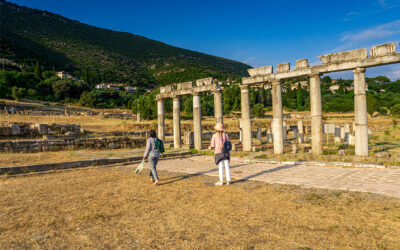
Step beyond Athens this autumn and...

Whether by foot, car, or the...

Locals share their memories of behind-the-scenes...