Margarites: The Potters’ Village of Rethymno
In Margarites, Crete’s historic pottery village,...

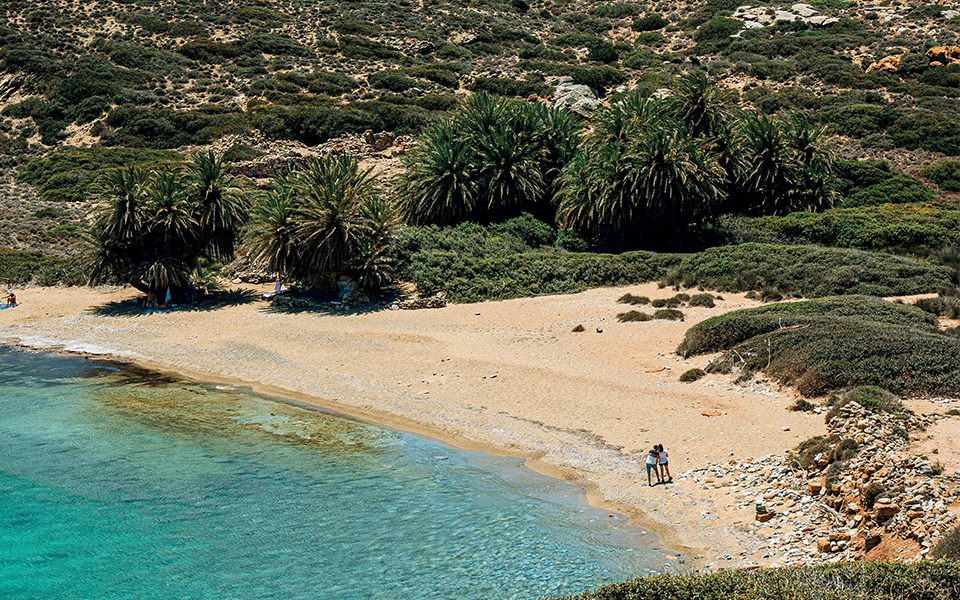
The beach of Itanos on the eastern side of Sitia.
© Georgia Kontodimou, Manolis Mathioudakis
The alleyways of Hamezi, a mountain village just outside Sitia, are full of architectural details reminiscent of the southern Mediterranean. “Elements like the arch above the windows are typical of Arab tradition,” explains Alexandros Garefalakis, our guide and a native of the village. Alexandros is the visionary behind Hamezi Festival, a cultural event that recently went viral on social media. For the past three years, it has been organized in collaboration with the village’s Cultural Foundation.
The festival features a week of music workshops, alongside sessions on traditional crafts like weaving and mosaic-making. Hamezi has long been known for its stonemasons, musicians, and dancers. As we stroll through its flower-lined alleyways, we arrive at a stone arch, once the entrance to the inner courtyard of a traditional home. Today, this charming corner, shaded by a mulberry tree and fragrant with jasmine, serves as the setting for some of the festival’s workshops.
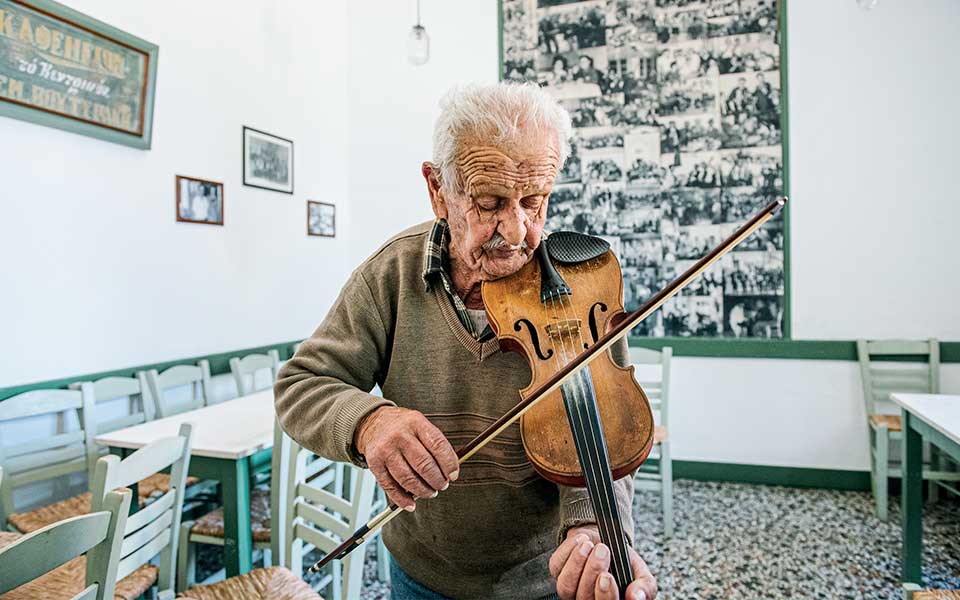
Yiannis Stavroulakis, one of the island’s most important violinists.
© Georgia Kontodimou, Manolis Mathioudakis
“The first time we discovered this spot, we ended up singing serenades for an hour just to enjoy its amazing acoustics,” recalls Alexandros. He adds that most classes are held in courtyards offered generously by local residents.
As we head down to the village’s traditional café, we meet two of the festival’s key musicians. Despite a 50-year age difference, they make an exceptional zygia – a Cretan term for a harmonious musical duo. Yiannis Stavroulakis, 92, one of the island’s most important violinists, is always up for a celebration and some good-natured teasing. I ask Yiannis Linardakis, a laouto player and music teacher, what makes the music of Eastern Crete so distinctive.
“When I think of Sitia’s music, the sound of Yiannis’s violin is the first thing that comes to mind,” he replies. “And that’s not something you can easily put into words. Some say our music is more lyrical, but that’s not enough to describe it. The musical idiom of our land is something you have to experience to understand. To learn it you must live it.”
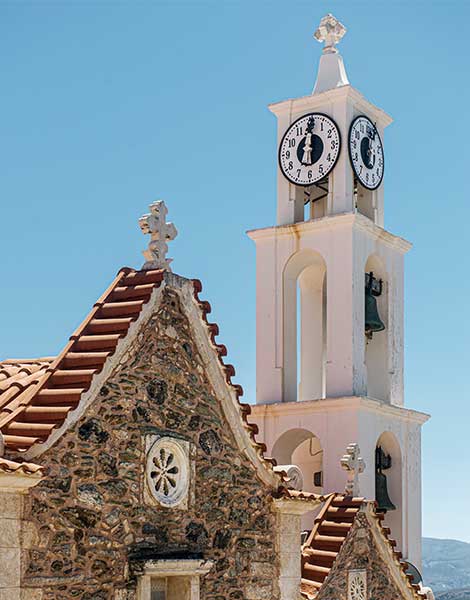
The bell tower of Aghios Panteleimon in Ηamezi.
© Georgia Kontodimou, Manolis Mathioudakis
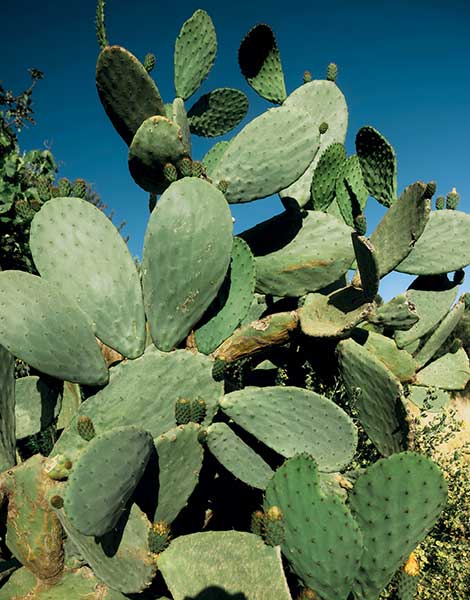
Prickly pear cacti are abundant in Lasithi.
© Georgia Kontodimou, Manolis Mathioudakis
The elder Yiannis offers a taste of the life behind the music, recounting scenes from grand celebrations he’s witnessed in towns and villages across the island: serenades beneath windows that roused entire neighborhoods, countless mantinades (as locals call the Cretan couplets), and music-filled nights at cafés that lasted until dawn.
The signature phrase at the end of every celebration was: “Ladies to the buffet, gentlemen to the lyra player,” a polite reminder for the men to leave a tip inside the musicians’ guitar.
The black-and-white photos on the walls of Roussos Cafe in Ηamezi capture the spirit of those times. Just around the corner, the village’s folklore museum – housed in a restored traditional home – offers another portal into Ηamezi’s cultural past.
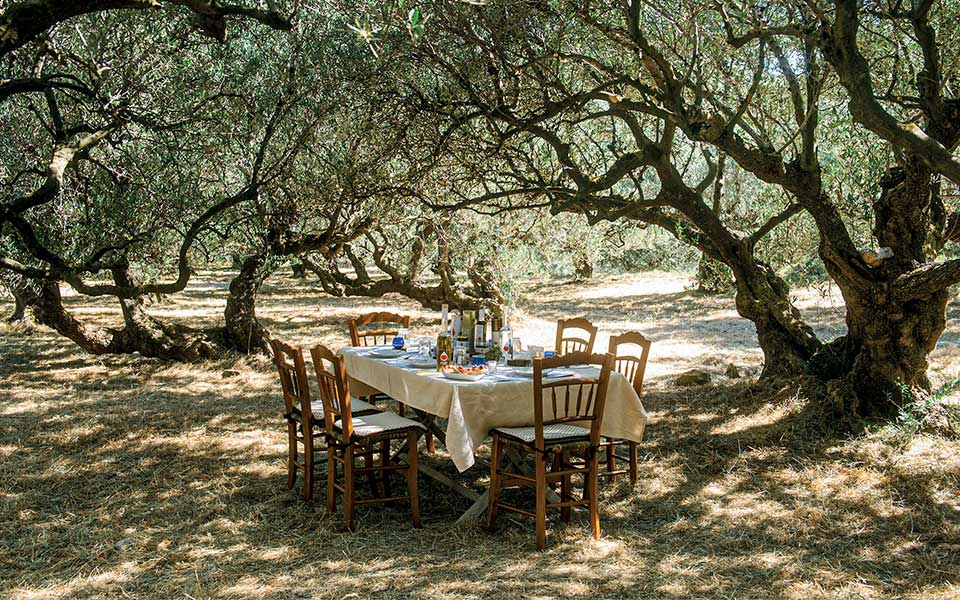
Tasting of Sitia products in the olive grove of Chrisopigi.
© Georgia Kontodimou, Manolis Mathioudakis
The most dominant feature of the landscape in Sitia is the olive trees, which blanket the hills of Lasithi. Olive oil is a cornerstone of the local economy. This summer, two producers of exceptional extra virgin olive oil – Vitsentzos Kornaros and Chryssovalantis Lasithiotakis – are welcoming visitors to their olive grove in Chrisopigi.
At the heart of the tasting is their own Koroneiki variety olive oil, pressed from the very olives growing just steps away. The offerings also include olive paste, barley rusks (paximadi), local honey, carob syrup, and a sweet spread made from carob.
“Depending on the season, we bring in fresh produce from our garden,” Vitsentzos explains, placing a dish of artichokes on the table, ready to be drizzled with olive oil. “Around here, we call them rakoloulouda – ‘raki flowers’,” he adds, pouring glasses of their own fragrant, smooth raki, distilled every autumn.
“Raki in eastern Crete is lighter,” he says with a smile, “so you can last through a whole feast without it going to your head.”
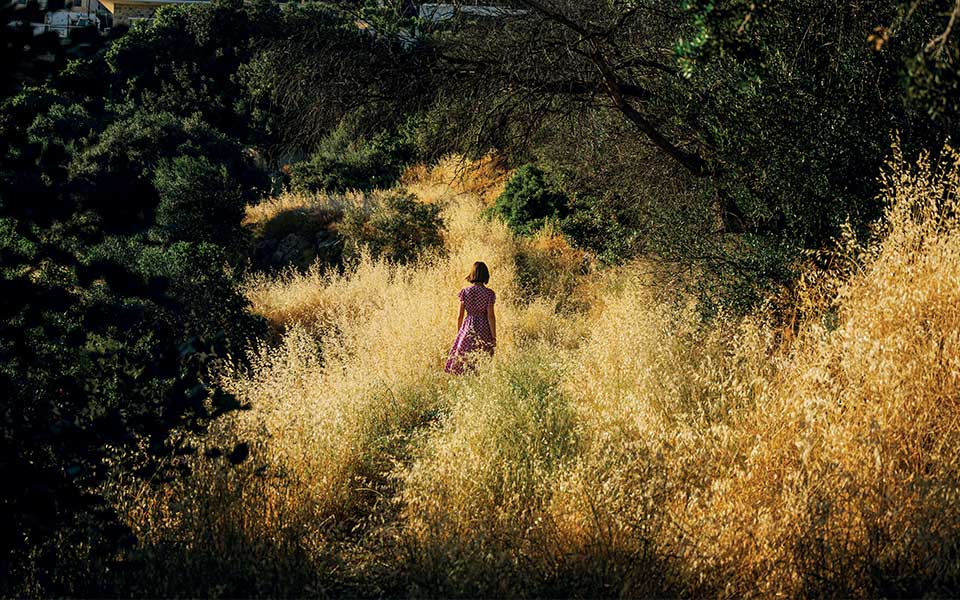
Path leading to Pefki.
© Georgia Kontodimou, Manolis Mathioudakis
Leaving the olive grove behind, we follow the two producers into the pine forest of Aghios Stefanos, where – depending on the season – they forage wild mushrooms and asparagus. As we near the village of Pefki, an old path leads us past ancient olive trees – some over a thousand years old – casting shade over a landscape far greener than Eastern Crete’s arid reputation would suggest.
Built amphitheatrically on the hillside, Pefki’s narrow alleys echo the architecture of the Cyclades, but the rhythm of village life is distinctly Cretan. On the main square, Piperia tavern serves as a local hub from morning to night. As we arrive, a group of villagers play cards under a tree, pausing to nod in welcome.
Fanis Eikosipentakis, owner of Piperia, brings goules (a type of turnip), wild cucumbers, and fresh artichokes with striking purple leaves. “Raw food is at the heart of our local cuisine,” he explains, and we quickly understand why – everything is grown in nearby gardens and bursting with flavor.
Next come chochlioi boubouristoi – snails, pan-fried with rosemary – and an omelet with wild asparagus freshly picked from the forest. By the time we finish our raki, the card players have set aside their game, and their table is covered in artichokes ready to be peeled. But the taste is so irresistible, they keep pausing the work to savor bites of rakoloulouda.
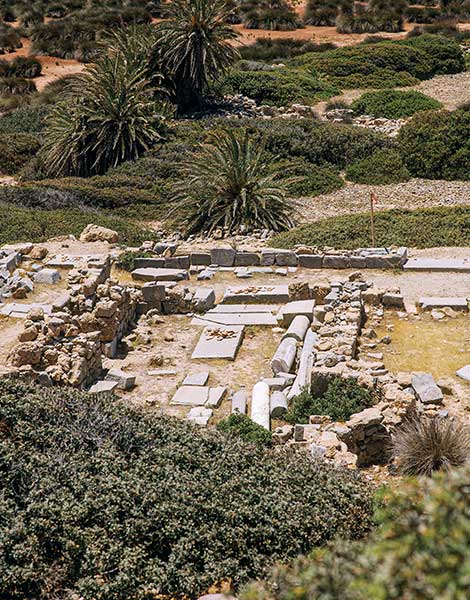
Archaeological site next to the beach in Itanos.
© Georgia Kontodimou, Manolis Mathioudakis
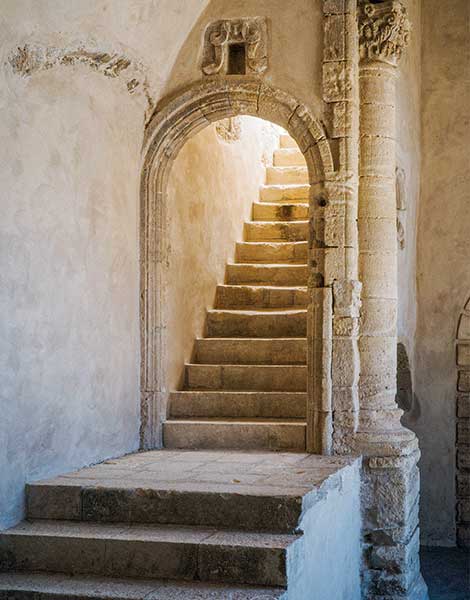
The interior staircase of the De Mezzo mansion in Etia.
© Georgia Kontodimou, Manolis Mathioudakis
Part of the unique charm of eastern Lasithi is its ruined settlements, perched in remote, awe-inspiring locations. In Etia, the Venetian feudal lord De Mezzo once built a grand manor, considered the largest rural private residence in Crete. Though now in ruins, its white stone staircase – still leading skyward – is a hauntingly elegant relic of the Renaissance. One inscription carved into the stone remains particularly striking:
“INTRA VOSTRA SIGNIORIA SENZA RISPETTO” – an invitation to enter without hesitation or shame.
Crossing the Armenochandrades plateau – where vineyards grow under the rhythmic whir of wind turbines – we reach the abandoned medieval village of Voila. Once a strategic stronghold, its fortress allowed Venetian lords to oversee their lands, while music echoed from the halls of their manor houses.
Two stone fountains with carved inscriptions echo the village’s Ottoman past, and inside the Church of Saint George lies a tomb believed to belong to the family of Dionysios Solomos, Greece’s national poet.
As we leave Voila behind, the terrain becomes more arid, covered in spiny aspalathos bushes. The winding road leads us to the turquoise waters of Xerokambos. One of the small villages along the way is Hametoulo, where we make a brief stop and chat with one of its few remaining residents. I ask him about the large ceramic jars placed on rooftops that seem to serve as chimneys. He explains that people in Lasithi were accustomed to poverty and often had to come up with clever ways to meet even their most basic needs.
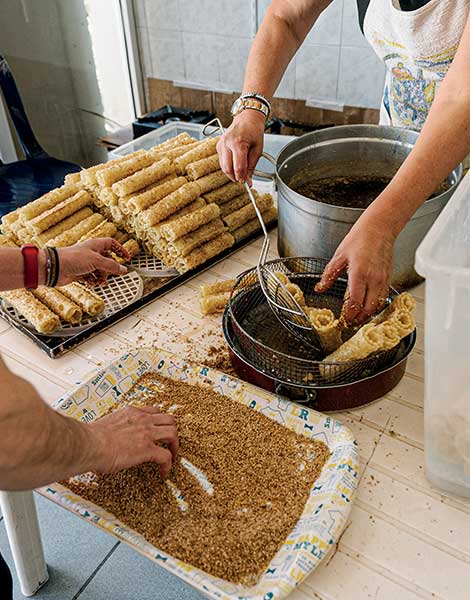
Xerotigana at the Women's Agricultural Cooperative of Zakros.
© Georgia Kontodimou, Manolis Mathioudakis
© Georgia Kontodimou, Manolis Mathioudakis
The word “piatsa,” still used by locals to describe the main square of Zakros, dates back to the Venetian era. It is home to O Pontios café and the Melion women’s agricultural cooperative. Five women prepare traditional Sitia sweets – xerotigana, stafidota, sourdough kalitsounia – all made with their own olive oil and honey. They work swiftly, but always find time to share the latest news or crack a joke.
One can easily imagine a similar atmosphere in the many workshops of the Minoan palace of Kato Zakros, thousands of years ago. Craftsmen working with clay or stone would have labored quickly to meet orders shipped out from this important southern Cretan port to cities across Africa and the East. According to archaeologist Stella Chrysoulaki, director of the Heraklion Archaeological Museum and long-time excavator at Zakros, water played a unique role in the palace’s design. Springs emerged from the rocky ground, and the Minoans built reservoirs where light and color would reflect and shift with the changing weather – a striking early example of bioclimatic architecture. Today, only fragments of this magnificent structure survive. Yet the lilac-tinted plaster that once adorned its outer walls invites us to imagine a space built with great attention to detail, inhabited by people with refined aesthetic sensibilities.
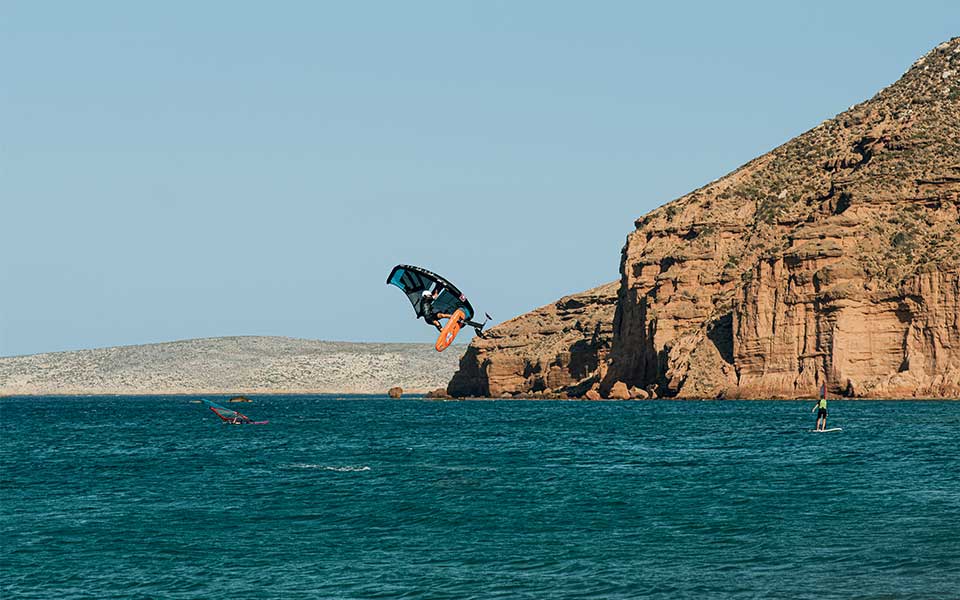
The sea of Kouremenos is a favorite destination for surfers.
© Georgia Kontodimou, Manolis Mathioudakis
Another major attraction in Zakros is the Gorge of the Dead, named after the natural caves the Minoans used as burial sites. As we pass through, a group of Italian hikers wearing brightly colored helmets sings a cheerful marching song. A Norwegian couple, who have returned to Crete every year for three decades, walk hand in hand. Nearby, on the deep red soil, a local farmer tends his olive grove. As our eyes meet, he surprises me with a question:
“Do you know what ‘Zakros’ means?”
Without waiting for a reply, he answers his own question:
“It means, ‘I live at the edge.’”
He draws out each syllable slowly, as if to underline the meaning behind his words.
As the Italians’ song fades into the distance, his words linger. Here, surrounded by sea, rock, and silence, Zakros truly feels like a place where the world tapers off; where history, nature, and humanity all meet at the edge.
Aspros Potamos (Makrys Gialos, Tel. (+30) 28430.516.94), a bold restoration project transformed the ruins of a 300-year-old rural settlement into an alternative eco-retreat. The ten stone-built houses of Aspros Potamos are minimal in decoration and amenities, allowing the raw architecture to harmonize with the natural surroundings. Lighting is provided by oil lamps and candles, with electric outlets available only in the reception area.
Porto Kaza (4 Varda, Sitia, Tel. (+30) 28430.288.00), refined, modern-style guesthouse offering panoramic views of Sitia Bay. Elegant and breezy aesthetics make this a great choice for a relaxing stay in town.
Lithos Houses – Traditional Guesthouses (Xerokambos, Tel. (+30) 28430.267.29), modern stone-built residences inspired by traditional architecture, featuring sea views from the upper floors of the apartments.
Terra Minoika Villas (Kato Zakros, Tel. (+30) 699.652.3714), stylish villas set against the backdrop of the Kato Zakros archaeological site and beach. Spacious outdoor areas with metal sculptures enhance the serene experience.
Esperides Stone Houses (Kouremenos Palekastro, Tel. (+30) 28430.614.33), stone-built houses overlooking the sea at Kouremenos beach. Perfect for travelers seeking a quiet escape with coastal views.
Chiona, (Chiona Beach, Palekastro, Tel. (+30) 28430.612.28), refined seafood dining with both traditional and creative touches, including several delicious seafood-pasta combinations. Tables are set right along the waterfront for a truly coastal experience.
Oinodeion (157 Venizelou, Sitia, Tel. (+30) 28430.261.66), delicious small plates served next to the sea in the Sitia harbor. Don’t miss the toasted bread with marinated anchovies and sea fennel, or the chochlioi boubouristoi (snails with rosemary). Ask about their live Cretan music nights.
Piperia (Pefki, Tel. (+30) 693.677.5069), one of the best tavernas in Lasithi, offering local produce and fresh fish from the surrounding area. Dine with a view of hillside houses and the sea beyond.
Roussos Café (Chamezi, Tel. (+30) 28430.717.10), traditional village café serving flavorful meze and steeped in a rich musical heritage. A great stop for an old-world atmosphere.
O Pontios (Zakros, Tel. (+30) 28430.934.38), run by Kyriakos and his father Apostolos – originally from northern Greece but locals at heart – the taverna offers grilled dishes and small plates in a warm, welcoming setting for both locals and visitors.
Olive Oil Tasting
Olive oil tasting: To participate in a tasting of local products in the olive grove of the company Chrisopigi, contact Vicentzos Kornaros at Tel. (+30) 694.471.4918.
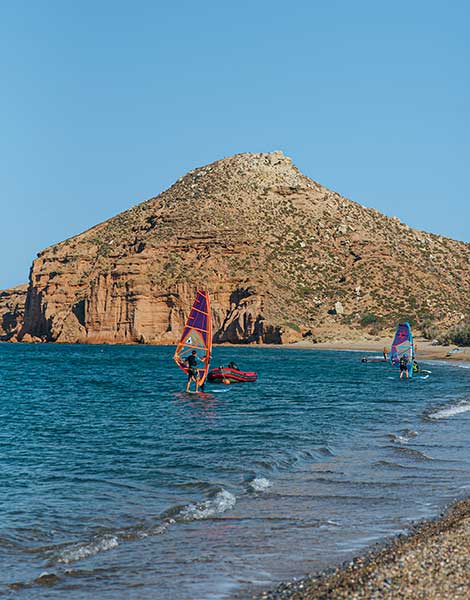
While Zakros lies at Crete’s easternmost tip, the road continues north toward a stretch of serene, lesser-known beaches. Discover the tranquil shores of Ancient Itanos, Erimoupoli, and Tentas. Kouremenos Beach is a favorite among windsurfers, thanks to its consistent breezes and open stretch of coastline.
On the southern side of Lasithi, you’ll find some of the region’s most unique beaches: the thick white sands of Mazida Ammos, the exotic landscape of Xerokambos, and the healing clay-rich shores of Argilos. For the adventurous, a boat ride or hike through a gorge leads to Karoumes, where traces of Minoan ruins are still visible in the surrounding terrain.
In Margarites, Crete’s historic pottery village,...

A forgotten world comes to life...
UNESCO has added six Minoan palaces...
The goddess Artemis, the Virgin Mary,...