How to Order Coffee Like a Greek
From sketos to varyglyko, discover the...

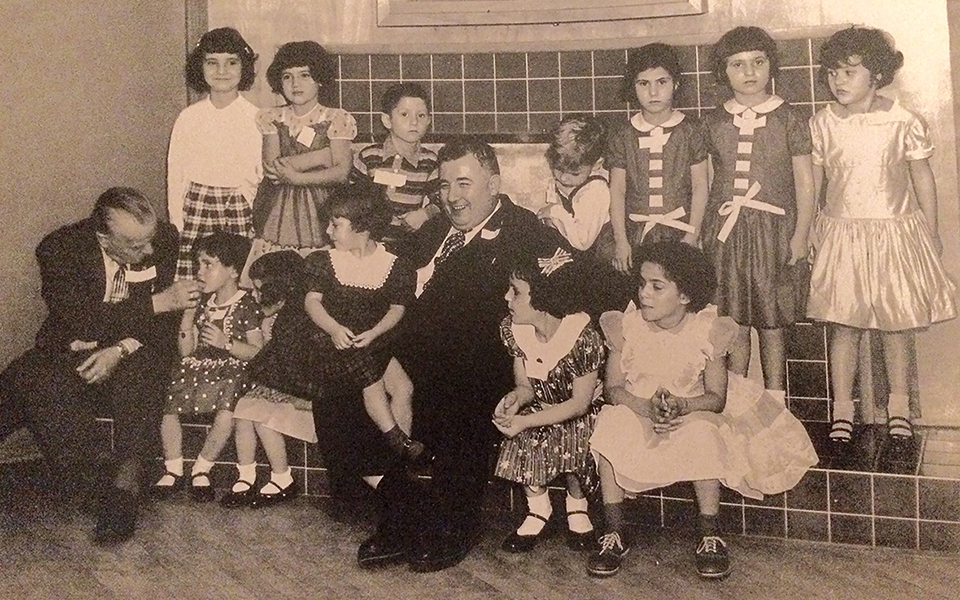
A publicity shot of some of the Greek adoptees.
In the aftermath of World War II and the Greek Civil War (1946–1949), Greece was struggling to rebuild. Children were among those most deeply affected. A wave of international adoptions sent thousands abroad in search of a better future, most of them to the United States, with others going to the Netherlands and Sweden. Some were indeed war orphans, but many were not. The story was far more complicated.
Professor Gonda Van Steen, the Koraes Chair of Modern Greek and Byzantine History, Language and Literature and the Director of the Centre for Hellenic Studies at King’s College, London has researched the story of the Greek adoptees extensively. Her work has helped bring this largely overlooked chapter of Greek history to light and, decades later, find meaningful ways to address its consequences. Together with Dr. Mary Cardaras and Stephanie Pazoles, both Greek adoptees, she has formed the action-research organization Nostos for Greek Adoptees. Nostos has been instrumental in addressing the concerns and rights of the adoptees, leading to growing awareness of their experiences and recognition for their plight.

Not always infants - young Greek children in transit for adoption, 1956.

Greek Adoptees in transit with a chaperone.
In the early 1950s, the placement of Greek adoptees – the vast majority in the United States – occurred largely in the larger context of post-war relief efforts. International adoption was often presented as a humanitarian mission: a way to rescue needy orphans and children who had been abandoned or relinquished by their parents. Some of the children were indeed orphans of World War II and of the Greek Civil War (1946-1949). The American Hellenic Educational Progressive Association (AHEPA) was the first Greek-American Organization involved in the rescue of these children and initially hoped to remain the sole organization involved. But as international adoptions increased, other players entered the picture, including lawyers, volunteers, and adoption agencies. The situation soon changed. Demand for healthy, white Greek infants and young children grew, and many of those being adopted were no longer war orphans. In fact, a significant number still had living parents.
With the opening of the “Kentro Vrefon ‘I Mitera’” (“Mitera” Infant Center) by Queen Frederica in 1955, still more infants became available for adoption. Decades later, both Sweden and the Netherlands launched investigations into past intercountry adoptions. Their findings identified I Mitera as the primary source of infants who had been classified as orphans and subsequently adopted by families in those countries.
Although some children had indeed lost both parents, the majority of the adoptees were unplanned children, born to unwed mothers. The pressure on these women to give up such children was considerable; the social stigma would affect not just the mother but her whole family and the fatherless child. In other cases, families struggling with poverty and already caring for several children made the difficult decision to give up a daughter, believing she would have better opportunities and a more secure future elsewhere.

A "Vrefodochos"- a baby box for leaving an infant at the orphanage anonymously - testifies to the social stigma of pregnancies outside of marriage.
Because of the stigma of having a child outside marriage, many women concealed their pregnancies. Leaving newborns anonymously at the orphanage door in the night was common enough that many institutions installed a vrefodochos (from the Greek words vrefos, meaning infant, and dochos, meaning receptacle) at their entrances. These boxes provided a safe place for babies to be left until they were discovered in the morning. The boxes often bore a dramatic biblical inscription, along with a final admonishment to the parents: “My father and mother have abandoned me, but the Lord welcomes me.” (Psalms 27:10).
In the early years of the Cold War, Greece was rebuilding with the help of the European Recovery Program, better known as the Marshall Plan. The country received some $700 million in US aid. Meanwhile, demand for healthy white Greek infants continued. Although there was no official agreement linking American financial assistance to international adoptions, an unofficial expectation of reciprocity has been suggested: as US funds flowed into Greece, so did the demand for its children. Private adoptions increasingly took place within a broader climate of neocolonial influence. In the Cold War context, Greece had limited room to assert its autonomy, while the rhetoric surrounding international adoption was often emotionally charged. Children were said to be leaving for “a better life in the United States.” As Van Steen has observed, Greece itself was almost being portrayed as an orphan in need of rescue. The flow of American aid also had an indirect effect on the number of children available for adoption. Improved medical care and access to infant formula meant that more babies in orphanages survived, increasing the number who could potentially be sent abroad.
Although no official link between US aid and the adoption of Greek children was ever established, the perceived connection did not go unnoticed. A 1959 cartoon in the newspaper Makedonia, for example, depicts then-Prime Minister Konstantinos Karamanlis seeking investment funds, while a box of Greek babies awaits export in the background. The title of Professor Van Steen’s 2019 book, Adoption, Memory, and Cold War Greece, carries an especially unsettling subtitle: Kid Pro Quo? As Van Steen puts it in an article on the subject: “The international adoption of any country’s children can hardly be equated with a post-crisis return to normalcy. In the case of Greece, it attests to America’s undue influence in the process of postwar state-(re)building. For a Greece committed to postwar economic reconstruction and to balancing transatlantic relations, the US-bound adoption traffic became one of the ideological but all-too-real battlefields of the emerging Cold War.”

Political cartoon from the newspaper Makedonia, 1956.
Demand for Greek infants and children outstripped supply Prospective parents wanted babies as young as possible, and they wanted them quickly. Some children were sent abroad when they were barely two weeks old.
How did the process work? Largely through correspondence. Children were typically selected through a lawyer and flown overseas in small groups, accompanied by volunteers or chaperones. In many cases, the adoptive parents met their new child for the first time at the airport. Families were generally limited to two adoptions. Members of certain religious communities, particularly Orthodox Jews and Mormons, were among those who sought to grow their families through adoption. The Greek Orthodox Church, meanwhile, opposed the departure of Greek children, fearing they would be lost to both their homeland and their faith. At the very least, the Church wanted them to be placed with families within the Greek diaspora.
Beyond religious motivations, other interests may also have been at play, including economic exploitation, particularly in the adoption of older children. Social work was still an emerging profession, and safeguards were limited. Prospective adoptive parents were not always properly screened, and there was little follow-up once an adoption had been finalized. Children, now adults, who did find a loving home call themselves “lucky,” because they are acutely aware of the fact that many did not.
More unsettling was the way in which prospective parents would specify what characteristics they were looking for in a child, “not unlike a shopping list,” as Van Steen has observed. In some instances, children were even rejected by prospective families. The process was less about finding homes for children than finding children who matched the wishes of prospective parents. A 1963 Dutch newspaper published an article titled “Greek Children for Sale” – not as an exposé intended to provoke outrage, but as information for families considering adoption.
Race was another factor. While racial prejudice undoubtedly played a role in some cases, there was also a practical consideration: for white families adopting white infants, the adoption was less likely to attract attention or raise questions. At a time when many adoptive parents preferred to keep an adoption private, a child’s appearance could help preserve that secrecy. Against the social attitudes of the era, an explicit preference for white children was also less likely to be challenged.

A reunion of some of the Greek adoptees in San Antonio, Texas, USA. Professor Van Steen is in the front, center.
Today, the Greek adoptees are older adults. Many of them have been in search of their origins, but, especially in the case of the earliest adoptions, records are scant. Many adoptees are also seeking to reclaim their Greek citizenship. They left the country as children, with no say in the matter, traveling on Greek passports. Yet some have since found themselves unable to prove their Greek ancestry. Reconnecting with their birth identity has often been a difficult, sometimes nearly impossible, journey. Thanks in large part to the attention brought to the subject by Van Steen’s research and the subsequent work of Nostos for Greek Adoptees, however, the situation is beginning to change.
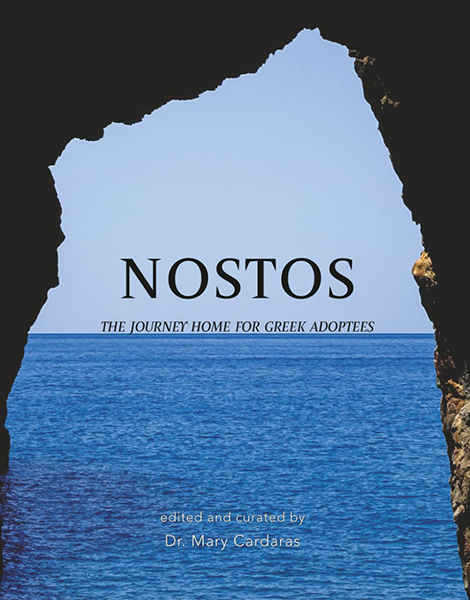
Founded by Van Steen, Mary Cardaras, DNA expert Stephanie Pazoles, and legal adviser Olympia K. Anastasopoulou, Nostos has become a leading advocate for Greek adoptees. Dr. Mary Cardaras, a professor and Emmy Award-winning journalist, is herself an adoptee. She is the author of Ripped at the Root: An Adoption Story (Spuyten Duyvil, 2021) and editor of The Voices of the Lost Children of Greece: Oral Histories (2023) and Nostos: The Journey Home for Greek Adoptees (2026). Anastasopoulou, who provided legal counsel to the initiative on a pro bono basis, has since been appointed Special Secretary for Alternative Dispute Resolution at the Greek Ministry of Justice.
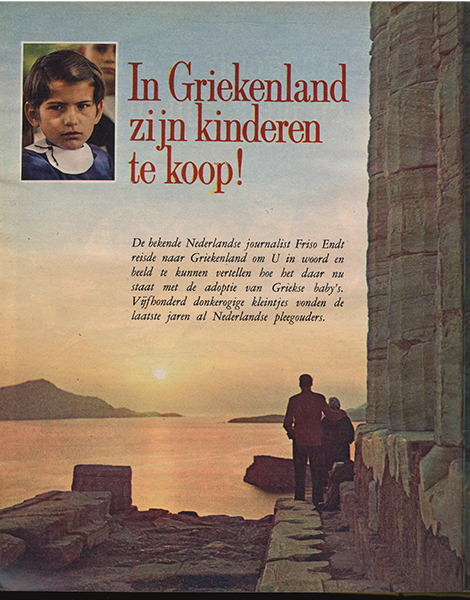
"Greek Children for Sale"- a Dutch Newspaper article from 1963.
A major step forward came on September 17, 2024, when Van Steen and Cardaras met with Prime Minister Kyriakos Mitsotakis, who agreed to accelerate the process of restoring the adoptees’ citizenship. Government support followed, and legislation passed on May 2, 2025, established a more accessible process for reclaiming Greek citizenship. Around 60 adoptees have already regained theirs. In another significant development, three institutions are now granting access to adoption records. This gives adoptees a chance not only to establish their Greek citizenship but also to search for their own lost stories, their families and villages.
Importantly, the impact extends beyond the adoptees themselves. As they reconnect with Greece, many are bringing their own families along. Under Greece’s jus sanguinis principle, citizenship is based on descent rather than birthplace, as is generally the case in the United States. This means that the children of Greek adoptees may also be eligible for Greek citizenship. Greek adoptees are returning to connect with their nation and culture, bringing their families to their villages, learning Greek, volunteering, traveling, investing in Greece, and potentially returning to Greece full-time. In a nation of declining birth rates, this renewed connection carries added significance.

A reunion of Greek adoptees in San Antonio, Texas, USA in 2024.Professor Van Steen greets the camera from the center, in the back.
The May 2, 2025, law also addressed the lasting consequences of this historic wave of adoptions. The story of the Greek adoptees is inseparable from the Civil War and its aftermath, one of the most painful chapters in the country’s modern history. By publicly acknowledging what happened and welcoming back the children who left during that era, Greece is taking a step toward confronting a difficult part of its past and addressing wounds that have remained open for generations. There is a sense of reconciliation in this process, along with the possibility of a new beginning, not just for the adoptees themselves, but for the generations that followed. The words of one adoptee’s daughter capture this beautifully: “I thought I was doing this roots search for my mom, but being a daughter of an adoptee still has affected me, too. To be so closely tied to a beautiful culture, but so far away and removed leaves a void.”
The years-long research of professor Van Steen and the personal accounts gathered by her and Professor Cardaras have been adapted into the play For Three Refrigerators and a Washing Machine by the actress, writer, and director Kyriaki Mitsou. It will be performed at the Municipal Musical Theatre “Maria Callas” (6-8 and 13-14 November), with an audience discussion to follow the performance on Sunday the 8th.
Van Steen, Gonda: Adoption, Memory, and Cold War Greece, University of Michigan Press, 2019
Van Steen, Gonda: “New Developments in “Old” Adoptions from Greece: When the Future Finally Catches up with the Past: To ανεπιθύμητο τάγμα is no more,” historyandpolicy.org.
From sketos to varyglyko, discover the...