Explore Vikos Gorge: Hiking, Rafting, and Food in...
One of the most impressive canyons...

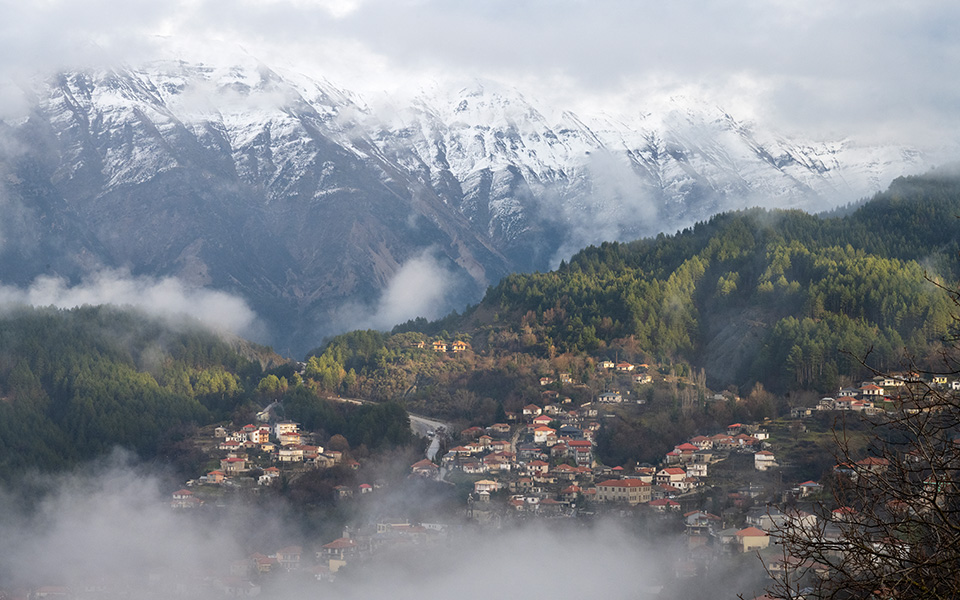
Pramanta, the area’s main village with around a thousand residents, is crowned by Mount Stroggoula.
© Julia Klimi
We arrive in Kalarrytes at dusk and begin walking along its cobbled paths. The stone paving feels so different than walking on dull asphalt, reflecting the care and skill of earlier builders, every stone laid with wisdom and skill. This same attention to detail is evident throughout the village – in the houses, churches, fountains, and cafés – forming a cohesive architectural ensemble. The central square, with its tiered seating reminiscent of an ancient theatre, underscores the continuity of communal life over time.
We meet Katerina Mousafiri-Gkolfinopoulou, who offers guided tours of an informal Folklore Museum she established with her husband. “My father lost his mother at a young age, and his uncles, the Nessis brothers (founders of the famous Nessi jewelry shop on Via Sistina in Rome), invited him to Italy to train as an apprentice,” she tells us. “Here you can see some examples of his work, including gold- and silver-bound gospel covers, as well as the tools he used, preserved on the lower floor.”
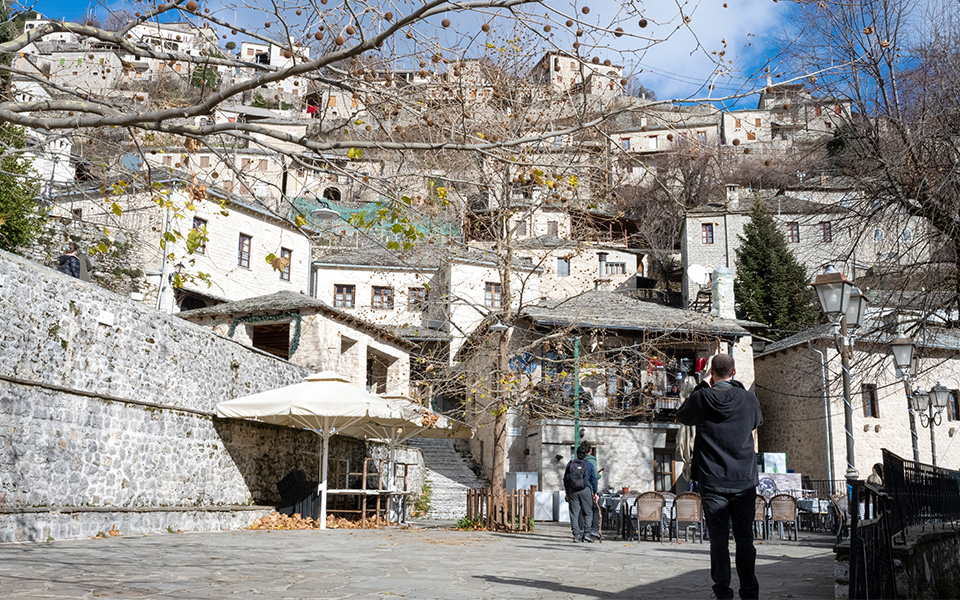
The architecture of Syrrako is remarkable, with its distinctive gray limestone stonework and urban layout that has withstood the test of centuries.
© Julia Klimi
The building itself is a typical Tzoumerka house, full of historical artifacts. A carved rosette on the ceiling of the main hall symbolizes the presence of God, while the walls are lined with photographs and traditional garments. Among them is an authentic fustanella with four hundred pleats, said to represent the years of Ottoman rule. The sigounia on display were woven on looms and embroidered by terzides, the traditional tailors of the region. “The silver belt, or kothros, was made by my grandfather using the savati technique,” continues Mrs. Mousafiri-Gkolfinopoulou. “It features seven images: the Hagia Sophia, a roe deer, a stag, a ship, an eagle, a lion, and King George with Queen Olga.”
Other exhibits include the mesantra, a cupboard incorporating a concealed escape hatch, and the famous woolen capes made from sheep and goat wool. Approximately 25,000 such capes were produced in Kalarrytes for Napoleon Bonaparte’s army. In the 18th century, the village was also a center for the production of skouti, a densely woven woolen fabric processed in fulling mills. This textile was manufactured both locally and by the Kalarrytes community in Ancona, Italy, and traded across Central Europe by merchants such as Georgios Douroutis. According to traveler W. M. Leake, increased commercial exchange with cities such as Arta, Trikala, and Ioannina during the 18th century – sources of raw materials – contributed to the expansion of livestock farming in the area. As a result, wool processing developed alongside silversmithing, reinforcing Kalarrytes’ economic significance.
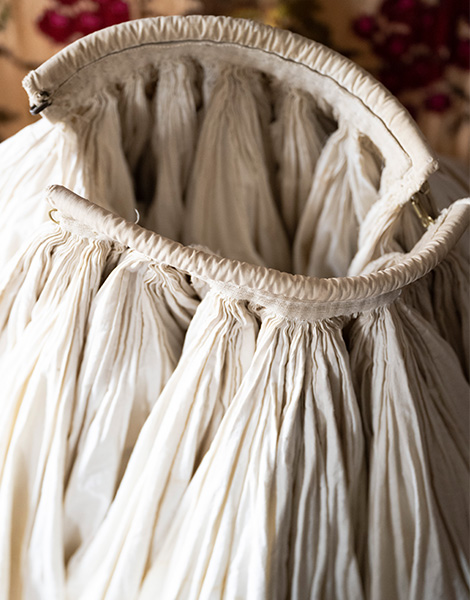
An age-old fustanella with four hundred pleats at the informal Folklore Museum created in Kalarrytes by Katerina Mousafiri Golfinópoulou, an outstanding educator.
© Julia Klimi
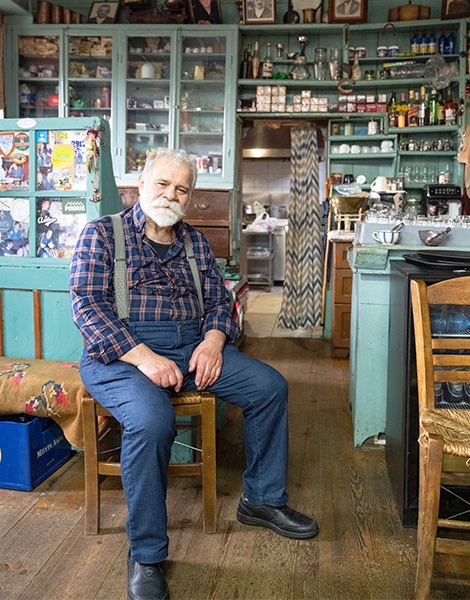
Napoleon Zagklis, the worthy successor of the café-grocery he inherited from his mother.
© Julia Klimi
Back in the village, we head to Akanthos, a café-grocery run by Napoleon Zaglis. The establishment functions as both a dining space and a social hub. Traditional dishes are prepared using familiar, home-style methods. Evenings often extend into informal gatherings, with shared plates of meze and tsipouro. In the mornings, the Vlach pie platsinta, made by his wife Lambrini, is a staple offering.
Local residents, including former muleteers, gather around the wood-burning stove, contributing to the café’s role as a meeting point for the community. As Zaglis observes, “A place is its people,” a sentiment reflected in the ease with which visitors are drawn into local conversations and plans, including a shared hiking excursion the following day.
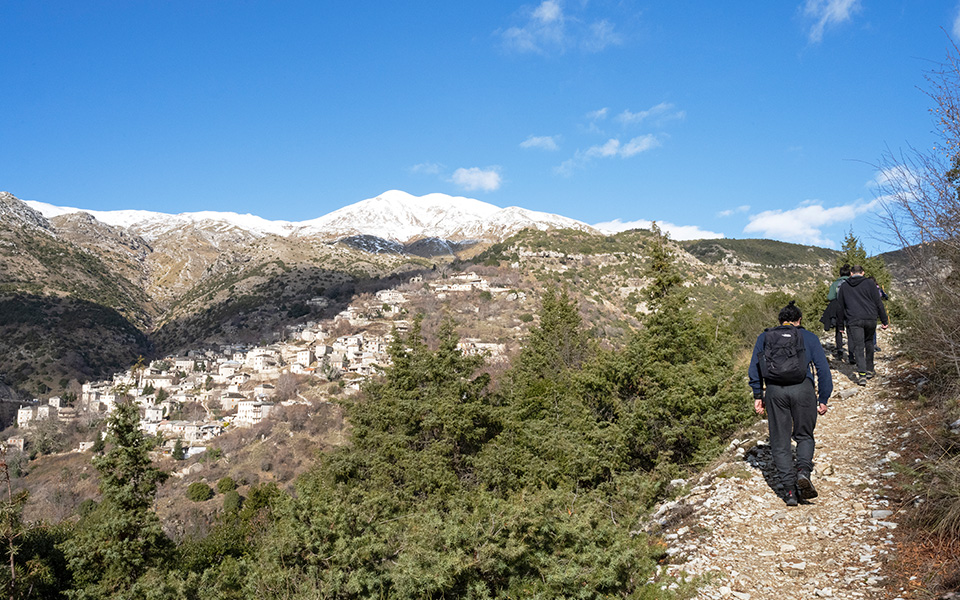
The hike linking Kalarrytes and Syrrako takes about an hour and a half, winding through a dreamlike landscape along the gorge of the Chrousia River.
© Julia Klimi
The day is bright and clear as we leave Kalarrytes, situated at an altitude of 1,170 meters, and begin our descent toward the gorge of the Chrousias River. The trail drops to 900 meters, crosses a small bridge, and then immediately climbs again along a cobbled path, ascending to 1,146 meters, where Syrrako is built into the mountainside. The walk takes approximately an hour and a half and passes through a striking landscape shaped by steep slopes and exposed rock. Syrrako’s setting, embedded in the folds of a dramatic mountain, is complemented by its architecture, constructed almost entirely of the region’s characteristic grey limestone. Despite repeated destruction by fire over the centuries, experts note that the village’s urban layout has remained largely unchanged since antiquity.
Among the key sites here are the house of poet Georgios Zalokostas (1805-1858) and that of prose writer and poet Kostas Krystallis (1868-1894), which today houses the Folklore Museum and the village library. The village square is dominated by the Church of Aghios Nikolaos, the village’s patron saint, with its intricately carved wooden iconostasis. Another notable landmark is the Gkoura Fountain, an impressive stone structure crowned by a dome supported on four arches.
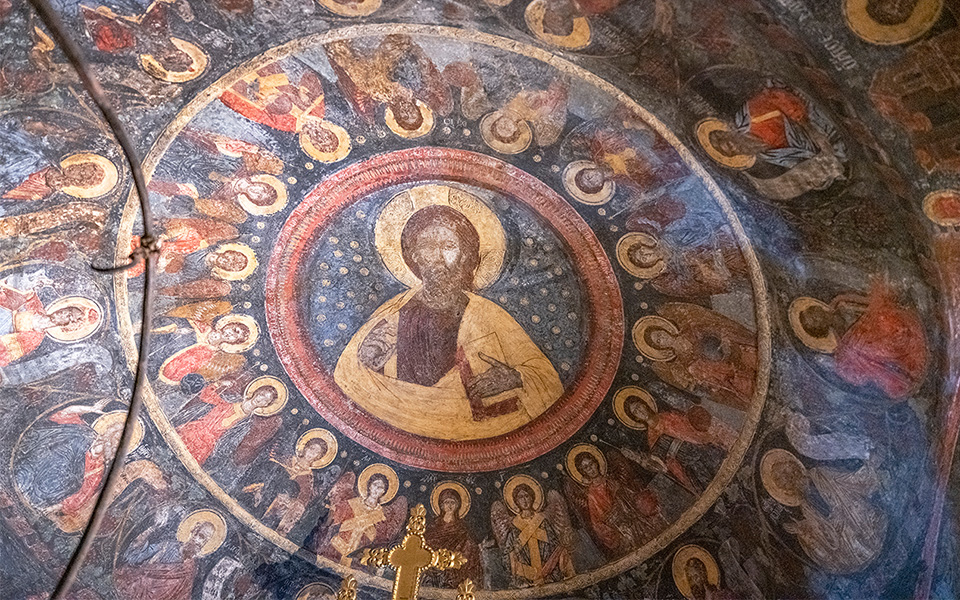
The katholikon of Kipina Monastery is roofed by the natural rock itself.
© Julia Klimi
For dining, the restaurant Mi me Lismonei is known for its local pies, while the meze café Sarika, run by Vasilis, offers tsipouro accompanied by meats, home-style dishes, pies, and desserts prepared by his mother.
Our next stop is Kipina Monastery, dedicated to the Dormition of the Virgin Mary and accessed via a narrow footpath. The monastery is carved directly into the rock face, with a wooden veranda projecting outward over the gorge. While the dramatic view toward the river is now partially obscured by a gift shop, the structure remains architecturally remarkable. The single-aisle basilica features a gilded wooden iconostasis and wall paintings dating to the early 18th century.
Leaving the monastery, the road descends to the first bend. Turning right, after approximately 300 meters one reaches the Kouiasa Bridge (1800). A further 250 meters away stands the old watermill of the same name, accompanied by a small waterfall. During the summer months, the mill operates as a café.
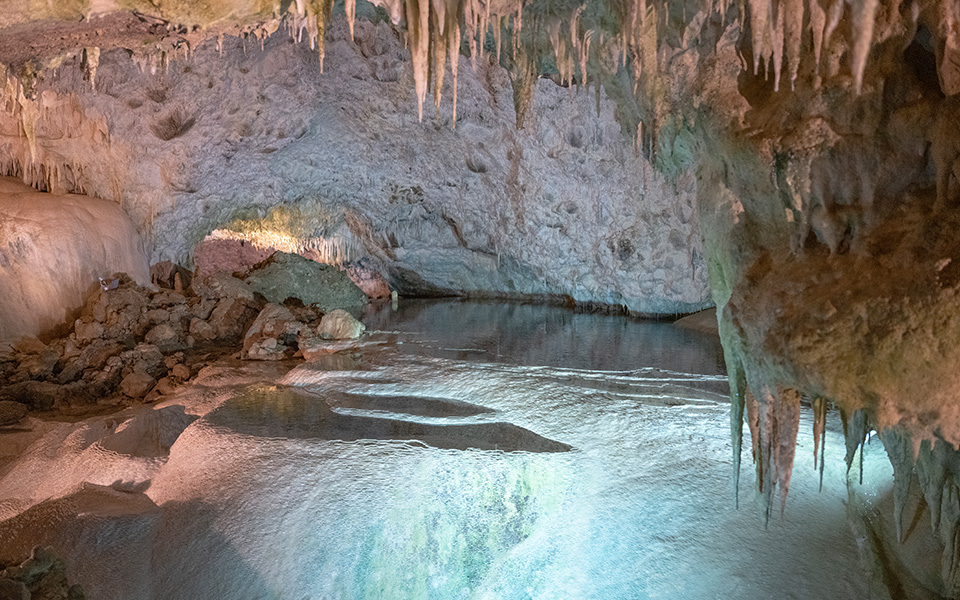
A view of the impressive Anemotrypa Cave.
© Julia Klimi
Pramanta is the main village of the area, with a population of around one thousand residents. It serves as a local center, with schools, a health center, an ATM, a petrol station, and a central square shaded by a centuries-old plane tree. The square is also home to the Arapis Fountain (1887), whose spout is carved in the form of a human head. Nearby is Anemotrypa Cave, known as Greece’s whitest cave due to the pure limestone found in the lake of its final chamber. Visitors move through corridors and chambers adorned with sculpted stalagmites, three small lakes, and the bed of an underground river.
Just outside the village is a mountain refuge run by Babis Triantafyllou and Pola Markozi. Recently renovated, it provides accommodation and hearty food to mountaineers and nature lovers alike. The café area offers stunning views of the rocky slopes of Stroggoula.
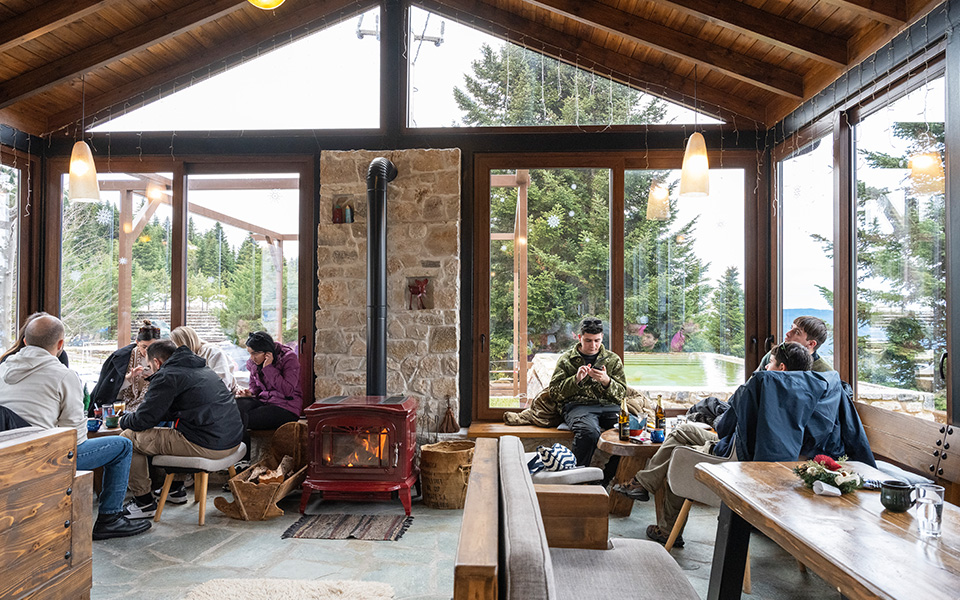
At the Pramanta Mountain Refuge, the café area offers a breathtaking view of the forest and the rugged rock formations of Stroggoula.
© Julia Klimi
“Our next goal is to complete the snow park. We believe it will be ready by spring. It will feature a special surface designed to simulate snow, allowing sledding and skiing throughout the year. It will be an ideal slope for beginners and children,” Babis tells us.
From Pramanta, a hiking trail leads through dense beech and fir forest to the Melissourgoi Mountain Refuge. The route is approximately eight kilometers long, of moderate difficulty, with an optional detour to the Kefalovryso waterfall, which descends from a height of 350 meters.
The Melissourgoi refuge is run by a group of young enthusiasts and maintains the character of a traditional mountain shelter. Inside, visitors gather around the fireplace, a sharp contrast to the cold outdoors. We are served a delicious pasta with minced meat, oven-baked chickpeas with vegetables, and an excellent chocolate tart with walnuts. Manager Fotis Delimitrou explains that meals are prepared using local ingredients, including vegetables from the refuge’s greenhouse and meats and cheeses sourced from the surrounding area. The refuge also functions as an Educational Center for Mountain Activities, organizing various outdoor experiences throughout the year.
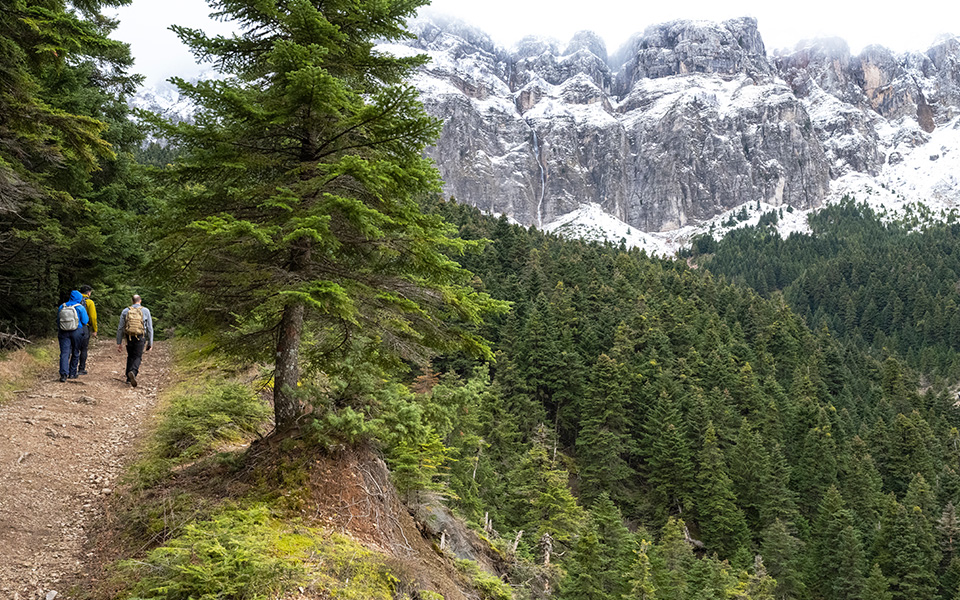
The hiking trail connecting the Pramanta refuge with the Melissourgoi refuge passes through dense forest of beech and fir trees.
© Julia Klimi
In the nearby village of Melissourgoi, a walk through the settlement is followed naturally by a visit to Pappas taverna, known for its local cuisine. From here, the landscape invites further exploration on foot, particularly toward the Arachthos Gorge.
One of the most direct ways to experience the gorge is by rafting along the river. Routes organised by Alpine Zone, operating since 1997, begin at the Charokopi Bridge (Tsimpovo) and end at the Plaka Bridge, offering a comprehensive view of one of Greece’s most impressive river passages.
Pramanta Mountain Refuge, Tel. (+30) 26593.006.45, (+30) 694.432.4156, babis30fillou@yahoo.gr
Melissourgoi Mountain Refuge, Tel. (+30) 697.437.4172, [email protected]
One of the most impressive canyons...
A journey through Hania’s Venetian past,...
Discover five mountain destinations where crisp...

Unexpected discoveries and timeless classics. Everything...