Walking Through Time in Hania’s Old Town
A journey through Hania’s Venetian past,...

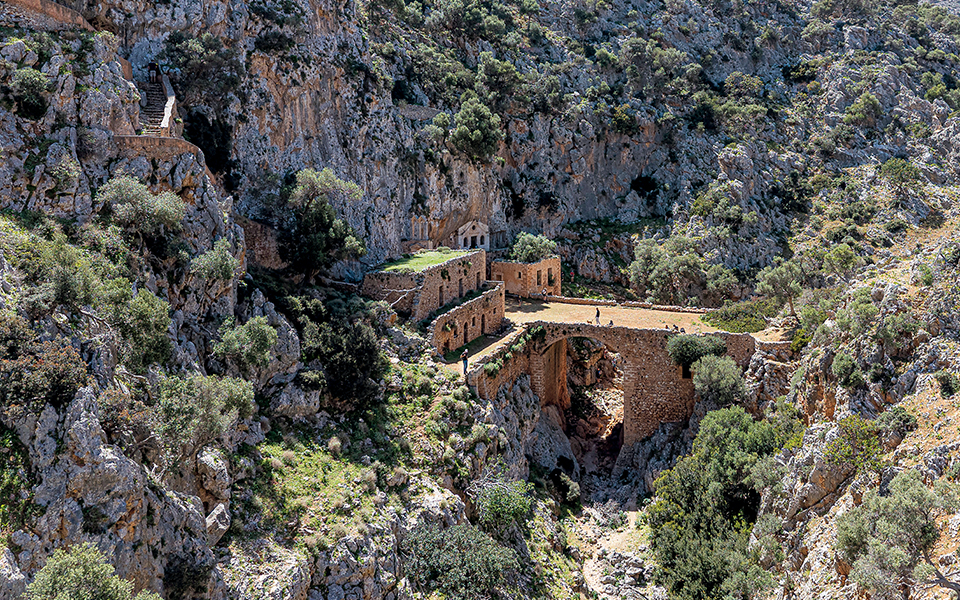
The Katholiko Monastery, at the bottom of the gorge
© Dimitris Tosidis
Father Akakios, speaking with a strong Cretan accent and unmistakable enthusiasm, is busy welcoming the faithful at the Aghia Triada Tsangarolon Monastery, in the northern part of the Akrotiri peninsula. Many foreign visitors who’ve traveled from Hania are already here, admiring the monastery’s architectural features and the backdrop of the still snow-capped White Mountains. The air is filled with the scent of jasmine and citrus trees. Purple wisteria hangs from pergolas outside the monks’ cells, flowerpots grace the walkways, and well-fed cats brush against dark cassocks. Today, seven monks live here, safeguarding the continuity of a centuries-old monastic life that, in truth, began long ago in the Avlaki Gorge, just a short distance away.
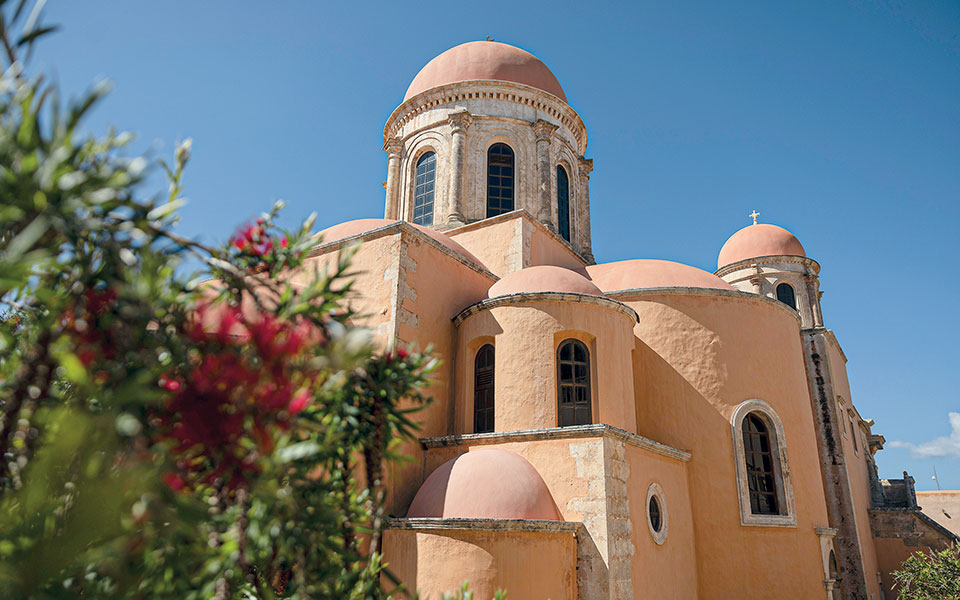
The Katholiko Monastery.
© Dimitris Tosidis
The gorge’s caves have always been places of refuge – from the elements or pirate raids – and of worship. From devotees of the goddess Artemis, once honored in the Bear Cave (“Arkoudospilios”), to the first hermits who found shelter in the rock-hewn hollows, to the earliest organized monastic community in Hania (perhaps in all of Crete) at the Katholiko Monastery, and right up to the present day with the still-active monasteries of Aghia Triada Tsangarolon and Gouverneto (“Our Lady of the Angels”), the thread of faith remains unbroken here.
Visitors can reach both the Aghia Triada and Gouverneto monasteries by car, but the true gem of this region might just be the trail through the Avlaki Gorge that lies beyond them. The hike itself, no more than five kilometers round-trip, offers not just nature in all its beauty but a sense of journeying back in time as well.
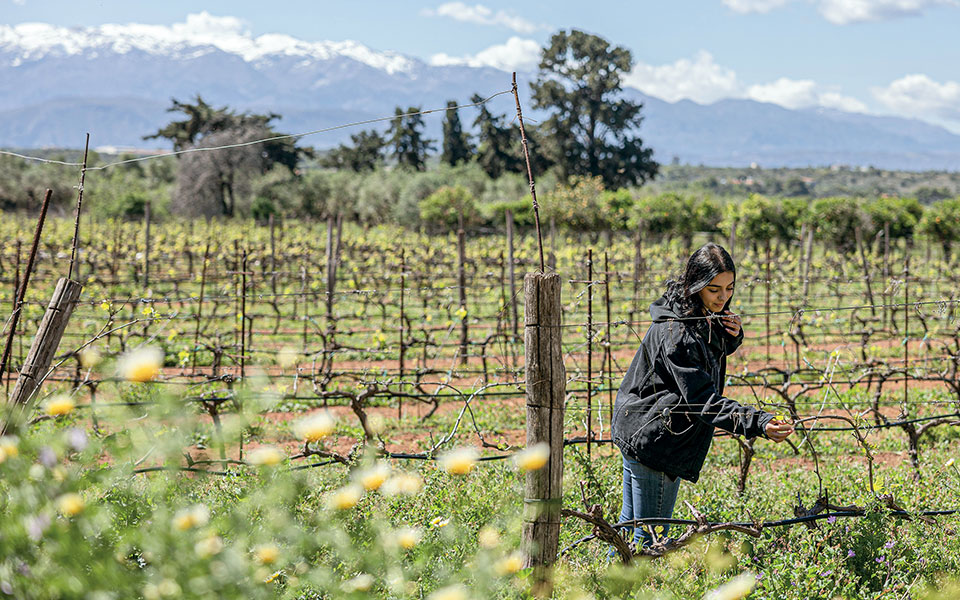
In the vineyards managed by the company Vinolio.
© Dimitris Tosidis
In 1700, the French traveler Joseph Pitton de Tournefort was hosted at the Aghia Triada Tsangarolon Monastery. He remarked that it was the finest monastery in Crete after Arkadi. At the time, he encountered 50 welcoming monks who produced olive oil, wine, wheat, oats, honey and wax, along with cheese and other dairy products. The fertile land surrounding the monastery is still being cultivated today – not by the monks themselves, but by the commercial enterprise Vinolio, which, under the monks’ guidance and on their behalf, produces and bottles both olive oil and wine. Eighteen hectares of vineyards yield up ten different grape varieties, including the Cretan Romeiko, Vidiano and Vilana. These are largely used in varietal wines, available at the monastery’s shop and tasting room, which is located in the old vaulted cellar beside the complex and which also hosts a small collection of folk objects. Some 7,000 organically grown olive trees produce around 40 tons of olive oil each year, and there are orange and lemon groves as well. The monks themselves still manage a small farm and a sheepfold that help cover their daily needs.
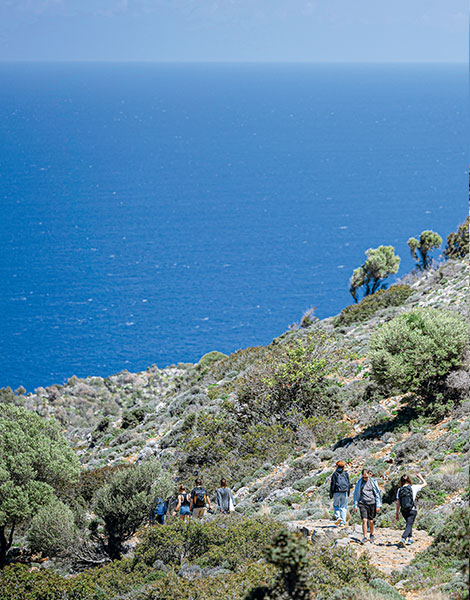
The stone-built path in the Avlaki Gorge.
© Dimitris Tosidis
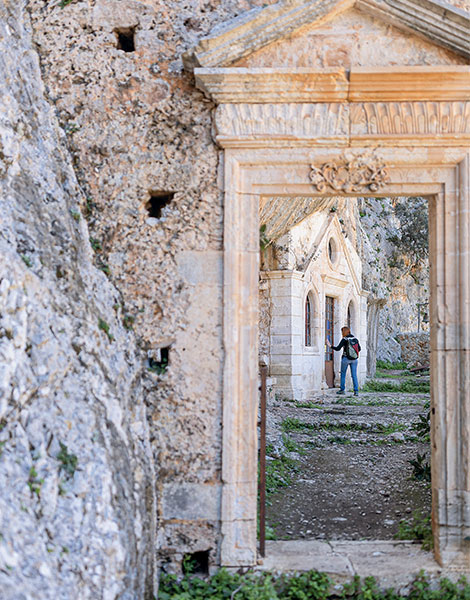
Architectural and decorative details at the Monastery of Tzagarolon.
© Dimitris Tosidis
Founded in the early 17th century by brothers Ieremias and Lavrentios of the Venetian Tsangarolon family, which had embraced Orthodoxy, the monastery, which served as an architectural model for others across the island, boasts a katholikon, or main church, of the Athonite type, an architectural layout first developed on Mt Athos; the rest of the complex represents a textbook example of Mannerism (the transitional style from Renaissance to Baroque), inspired by designs attributed to architect Sebastiano Serlio. Perfect symmetry, a structure that is two stories high inside but three outside (owing to the terrain), a monumental staircase, an ornate arched gateway, an elevated courtyard and many other details all evoke the Cretan Renaissance. Vaulted spaces house the ossuary, the old olive press, the cellar and a cistern, and there is an ecclesiastical museum, too, which features icons by the Hania painter Emmanouil Skordylis, as well as sacred relics, manuscripts and vestments. Yet the complex’s most striking feature of all is perhaps the bitter orange tree (Citrus aurantium) in the main courtyard, said to have been planted by the monastery’s founders themselves in 1606.
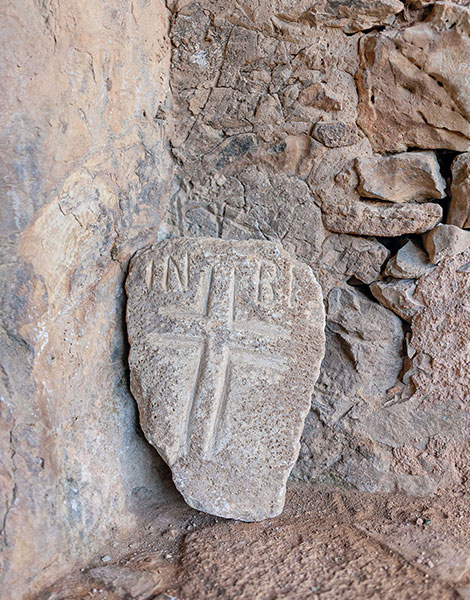
The sacred symbols of Christianity are scattered throughout the gorge and its caves.
© Dimitris Tosidis
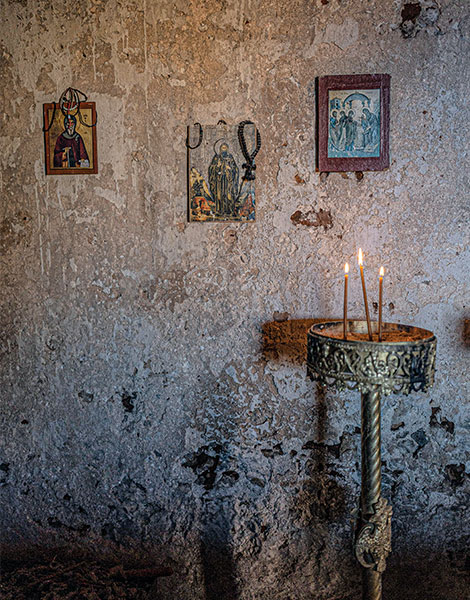
The Arkoudospilios, or Cave of the Presentation of Christ (also known as Panagia Arkoudiotissa).
© Dimitris Tosidis
Four kilometers further on, at the very end of the road, lies the Gouverneto Monastery, dedicated to Our Lady of the Angels, which marks the entrance – complete with a gate – to the Avlaki Gorge. The monastery was likely built in the early 16th century as a fortress (with towers and a machicolation) by the monks of the Katholiko Monastery within the gorge, who were seeking higher ground to escape pirate raids. The Gouvernato katholikon, dedicated to the Virgin Mary, took on its present form in the 17th century, during the time of Ieremias Tsangarolos, who undertook the rebuilding of the monastery even as he was founding Aghia Triada. Beyond its imposing gateway, the church façade itself is of particular interest; it is considered Mannerist in style, with carved anthropomorphic heads – described by archaeologists as grimacing masks – that some believe represent the god Pan, while others see them as Saracen pirates. The monastery is still inhabited by a brotherhood, although relations with the local community are tense at present.
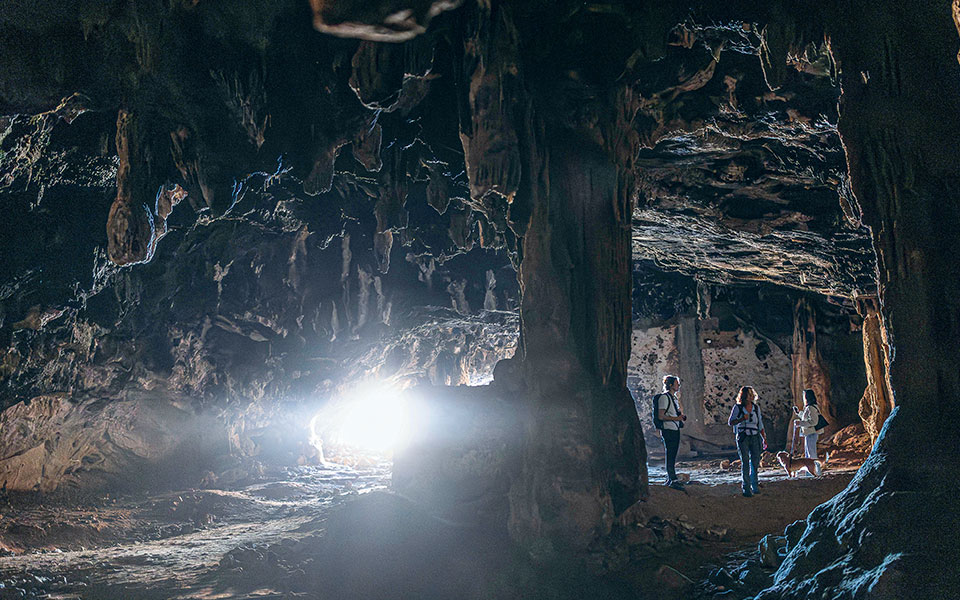
Inside the Bear Cave, with its fascinating geological formations.
© Dimitris Tosidis
A cobbled path, flanked by rocks, thorny shrubs, spiny bushes and the occasional solitary tree, winds through the gorge and descends toward the sea. Many visitors, Greek and foreigners alike, come here, drawn to a place that witnessed a succession of faith from pagan to Christian – locals come here, too, some for the same reason, and others merely to gather salt or wild greens.
The path runs past the 17th-century Chapel of Aghios Antonios; from here, it’s less than a 15-minute walk to the Arkoudospilios, or Cave of the Presentation of Christ (also known as Panagia Arkoudiotissa). Those entering should wear a helmet and carry a flashlight. At the cave’s center stands a stalagmite that resembles a bear bending to drink from a cistern. According to Christian legend, the Virgin Mary turned the animal to stone to protect the area’s water source. Archaeological finds, however, tell a different tale: fragments of Classical and Hellenistic-era pottery, tiles depicting Apollo as a lyre-player and Artemis as a huntress, and pieces of a marble statue of a child suggest that this was once a site dedicated to Artemis Kourotrophos. The bear was sacred to her; her young followers were called “Little Bears.” In time, Artemis was replaced by the Virgin Mary of the Bears, whose feast day is still celebrated inside the cave on the second of every February. (In antiquity, the festival of Artemis took place during the month of Gamelion, which corresponds to January.)
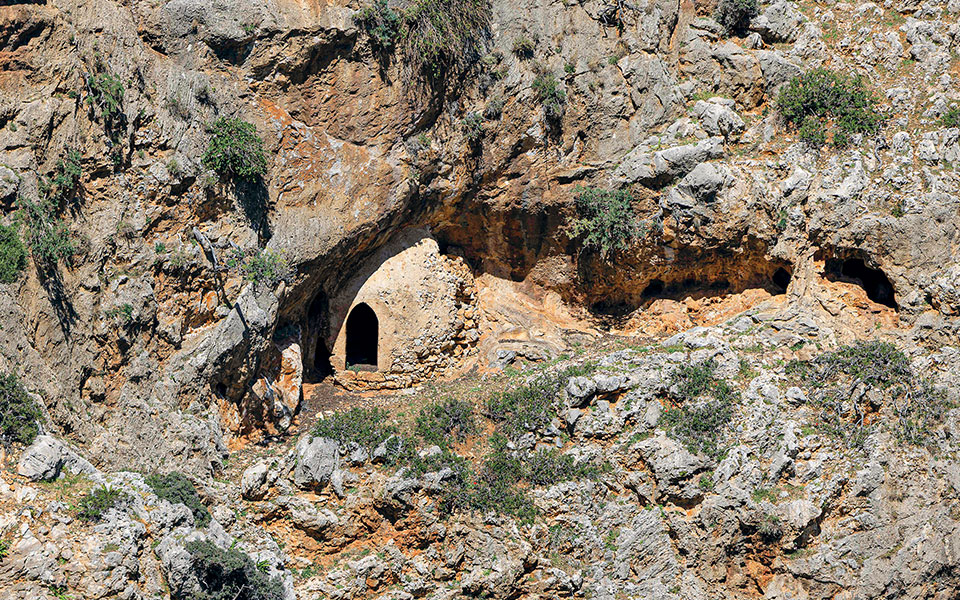
Visitors can reach both the Aghia Triada and Gouverneto monasteries by car, but the true gem of this region might just be the trail through the Avlaki Gorge that lies beyond them.
© Dimitris Tosidis
Another fifteen minutes’ walk puts you at the entrance to a small cave on your left. This is where Aghios Ioannis the Hermit once lived and died. By this point, you’ll be able to see the Katholiko Monastery, and what a sight it is! Built straight into the rock and perfectly adapted to the terrain are its vaulted buildings, while its impressive stone bridge once connected to hermits’ caves on the far side of the gorge. The entire complex is thought to have been constructed in the 16th century to accommodate pilgrims, though a rougher ascetic life likely began here for some as early as the 10th century.
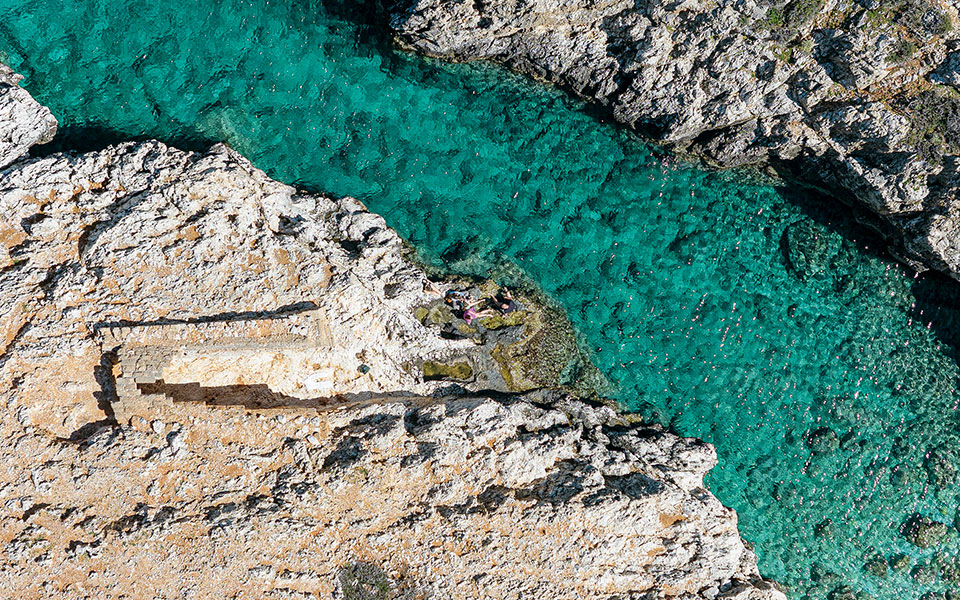
The fjord with crystal-clear waters where the gorge ends. On the left, the ruins can be seen of the structure where the monks used to hide their boat.
© Dimitris Tosidis
For the next fifteen minutes, as you walk the floor of the gorge, you might find yourself musing over nature, architecture and spirituality, but when you finally reach the rocky coastline and the stunning little fjord that awaits you there, it will undoubtedly be a swim in its crystal-clear waters that you’ll be thinking about. Nonetheless, history and legend are present even here; the ruined structure near the shore once sheltered the monks’ boat, while nearby lies a quarry from which building stone for the monasteries was extracted. A jagged rock formation facing you out at sea is said to have once been a pirate ship, turned to stone by Aghios Ioannis the Hermit himself when an abbot cursed it in that saint’s name.
Allow about 45 minutes for the descent, not counting stops, and a bit longer for the demanding uphill return. Beyond the Katholiko Monstery, the path requires care in places due to boulders and loose stones. Ideally, bring a helmet – rockfalls are common – and a flashlight, as both will serve you well when you’re exploring the caves. Keep in mind, too, that from Gouverneto Monastery onwards there is no mobile phone signal.
A journey through Hania’s Venetian past,...

A steep and curvy drive high...
Whether you’ve just stepped off a...
Experience Pilio’s scenic hikes, aromatic herbs,...