Abra Ovata: A Lakefront Restaurant Redefining Greek Hospitality
Abra Ovata is itself a rare...

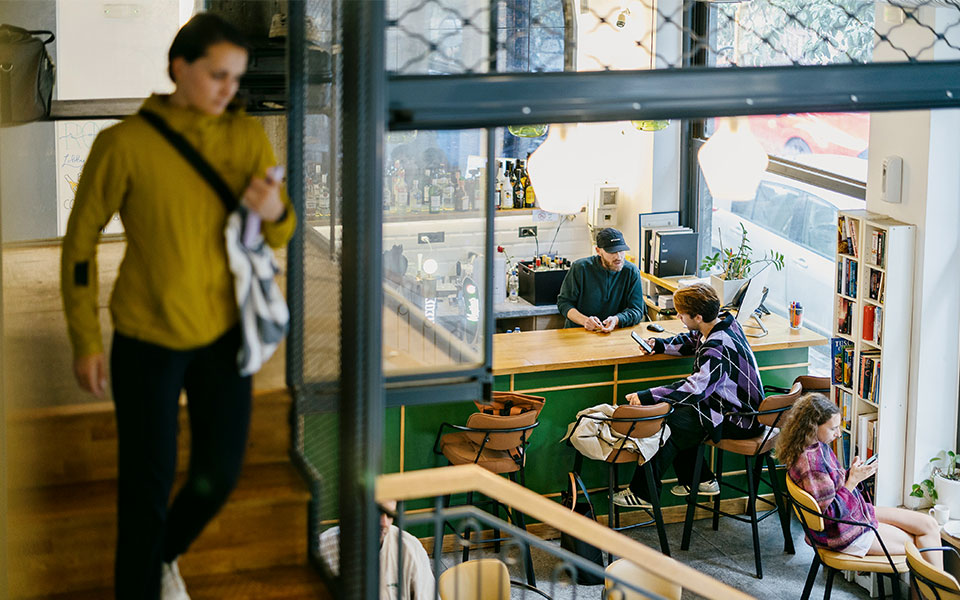
Eat, drink, work, play: communal spaces are whatever you need them to be.
© Angelos Giotopoulos
Two kids shout clues in heavily accented English from the back of the room. Laughter erupts, followed by applause. Someone orders shots; someone else calls out the next round of the game. It’s a Thursday night, winter has settled in for good, and I’m climbing up to the rooftop of a hostel off Plateia Theatrou. The Acropolis glows majestically in the distance, but no one seems to pay it much attention. Around the bar, groups of ten or fifteen are gathered around board games and decks of cards. From the speakers, Madonna remixes drift over a patchwork of languages, including English, French, Spanish, German and the occasional Greek, all tangled together.
At a side table sits a man in his early forties, alone but smiling as he watches the boisterous group still playing “Guess Who I Am.” I wonder if he feels lonely. But as the game unfolds, he starts slipping them clues about the mystery character. By the next round, he’s part of the team.
A staff member stops by to announce that karaoke night is about to begin. Everyone bolts down the stairs with their beers and cocktails in hand. As they rush past, I get a better look at their faces – they’re all over 30. I’d assumed from their voices they were students. Maybe it wasn’t their voices after all. Maybe it’s the stereotype we still carry about hostel culture and the people who choose it. Dorm-style living, shared bathrooms, the noise, the loosely organized chaos – these are the usual arguments against staying in one.
And yet, today’s hostels offer far more: private rooms, organized tours and activities, thorough cleaning practices, and above all, an accessible, easygoing kind of hospitality.
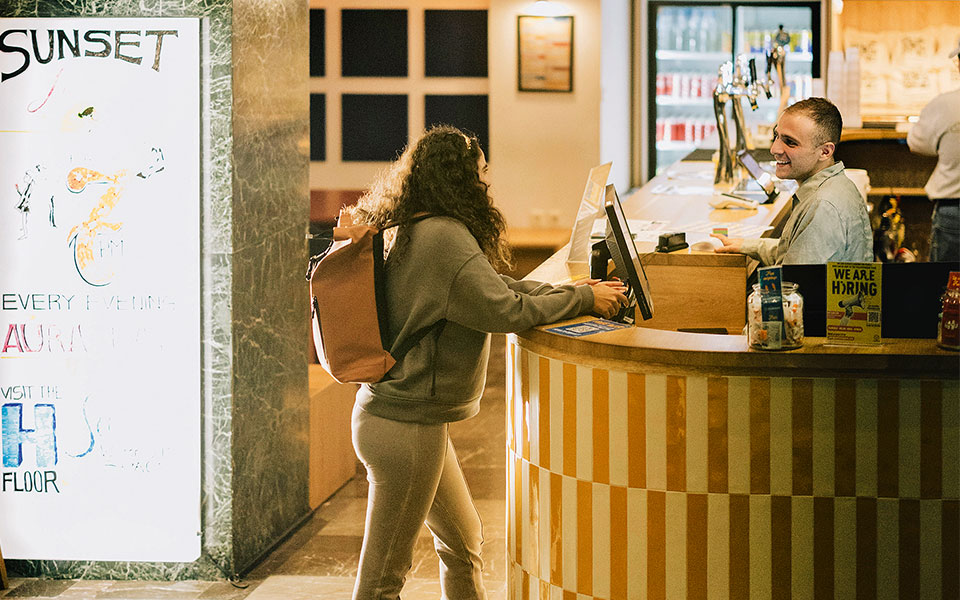
In hostels, you check in as a stranger and check out as a friend.
© Angelos Giotopoulos
“I think things are changing,” the receptionist tells me. “Even Greeks in the past few years – especially after COVID and with prices rising because of gentrification – have started to rethink the whole idea of hostels. Maybe for some it begins out of necessity, but to me it’s very similar to co-living. Ten years ago, if you said you were sharing a flat in Greece, people thought you were out of your mind. Now it’s part of everyday reality. That’s how we’re getting used to hostels, too, but we tend to forget the culture behind them,” he adds, all while helping the steady flow of guests coming through the door.
“Four years ago, I moved from Brazil to Rome and was desperately searching for a room,” Enrico, the activities manager, tells me. “That’s how I ended up in a hostel in the city center. As the days went by, I realized I didn’t want to leave. I felt like I belonged somewhere and so I became an activities volunteer. Luckily for me, that same week my supervisor resigned and I ended up taking his place. Later, I moved to Athens to do the same. I like the idea of organizing shared activities for guests, because at the end of the day, everyone in a hostel is just a stranger among strangers. If you want to get to know people and share an experience, it’s up to you,” he says, even as he prepares the stage for the karaoke night.

Keep calm and karaoke on.
© Angelos Giotopoulos
Around two in the morning, the party winds down. Everyone heads back to their rooms, agreeing to meet at the entrance for breakfast. Some float the idea of visiting the Acropolis; others are content just seeing it from afar. At about ten the next morning, a hostel guest named Ville is heading out on his own. His plan is to take to the alleys and explore the maze of small Middle Eastern and South Asian shops.
“I’m looking for Pakistani chicken. Then I want to go back to my room and get some work done.”
And what about seeing the city?
“Maybe tomorrow. I don’t know, I’ve already seen enough,” he shrugs.
Next out the door are Gabriela and Bob. They open the map on their phone and show me their destination: Stani. “Someone we met at a taverna last night recommended it,” Gabriela tells me as we head together toward Omonia. “He said that that’s where we should go for the best dessert in the city.
“It’s our first time in Athens. We arrived yesterday and decided to stay in the hostel that first night so we could meet other people. Today and tomorrow, we plan to explore the city, especially its nightlife. In two days, we’re leaving on a seven-day cruise from Mykonos, so this was a good chance to get to know Athens, too. Visiting this city has always been a dream of ours. As for the hostel, it’s our first time trying the experience. To be honest, it was the view of the Acropolis and the overall aesthetic that won us over, not the price,” she adds, holding a snack-on-the-go bag filled with sheep’s-milk yogurt and sweets.
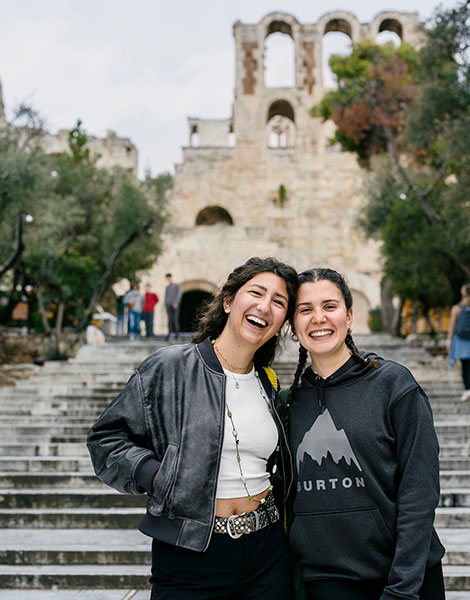
Sissilia and Eleonora hit the highlights.
© Angelos Giotopoulos

Magda, an enthusiastic patron, ready to explore Athens.
© Angelos Giotopoulos
A young woman in the lobby tells me that, for her, hostels are an extension of solo travel. “You want your comfort, but you also don’t want to feel completely alone. I mean, I like taking my walks, stopping wherever I want, looking at whatever I want without anyone interrupting me. Maybe I sound antisocial, but the truth is that sometimes you need your own space and, in hostels, you can actually find that balance,” she says, before slipping her headphones back on. In the doorway, an arrival called Magda is rolling a cigarette just before checking in. “I need a bit of quiet. I just spent almost a week with ten other people, so I want some time to myself. They decided to leave, but why miss a weekend in Athens? This is my third time in a hostel; I’ve also done five couch-surfing stays. I choose where to stay depending on how much privacy I need at each stage. I even have leftover food from the last few days, so I’m all set,” she adds, heading to her room.
Coming down the stairs is Songi. He stops at the reception desk to ask for sightseeing recommendations for the days he has left. “The first night was hard. I’ve never stayed in a hostel or traveled alone before. But I needed it. Let’s say the reason was that I wanted to meet people and improve my English. Do you have any advice on things worth seeing?” he asks, before heading out toward the market.
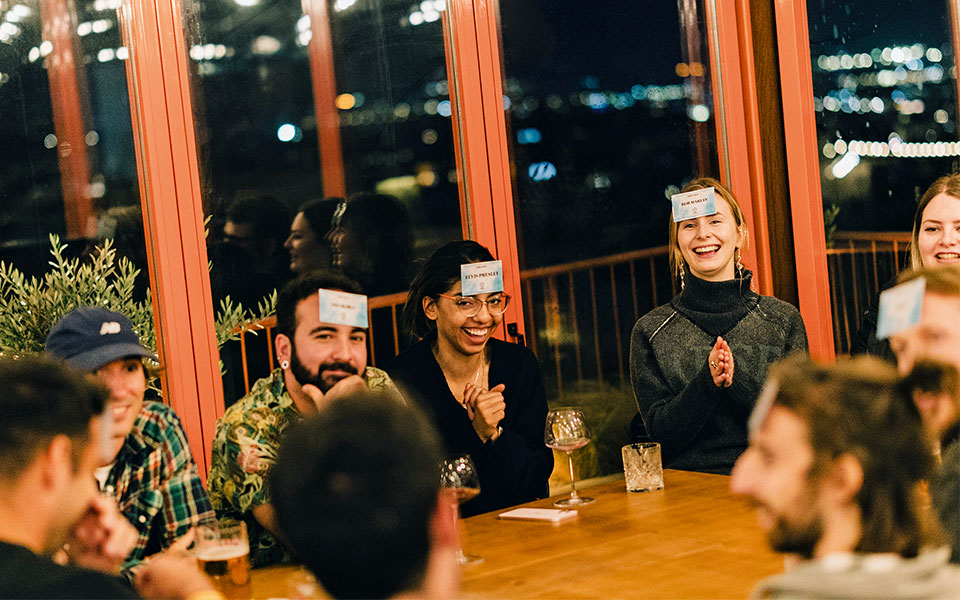
A game of “Guess Who I Am.”
© Angelos Giotopoulos
Around nine on Monday morning, I arrive at the hostel Athens Backpackers in Makrygianni. Breakfast has already been served. A few sleepy Italians are rushing to grab the last dishes before the buffet closes at 9:30. “It may sound strange, but in the past we often had people staying for two or even three months,” an employee tells me. “Rent in Athens has become insanely expensive and so have Airbnbs. All these people need somewhere to stay. There was, for example, a photographer who lived in Thessaloniki and often came down to Athens for work without having a place here. So, she started staying with us more and more. She met people here; eventually, we all became friends and she was able to do her job and enjoy it, too.
“As for foreign travelers, the idea of hostels is definitely more familiar to them, especially in recent years, with their own economic crises becoming more acute. And of course, the greed of other Greeks plays a part as well: people exploiting tourism for extra profit, pushing visitors toward alternative options,” he adds.
The conditions of modern hospitality are indeed shifting. Travelers today care about more than comfort or hotel stars. Connection and interaction have taken center stage – choosing a hostel is not just about keeping costs down.
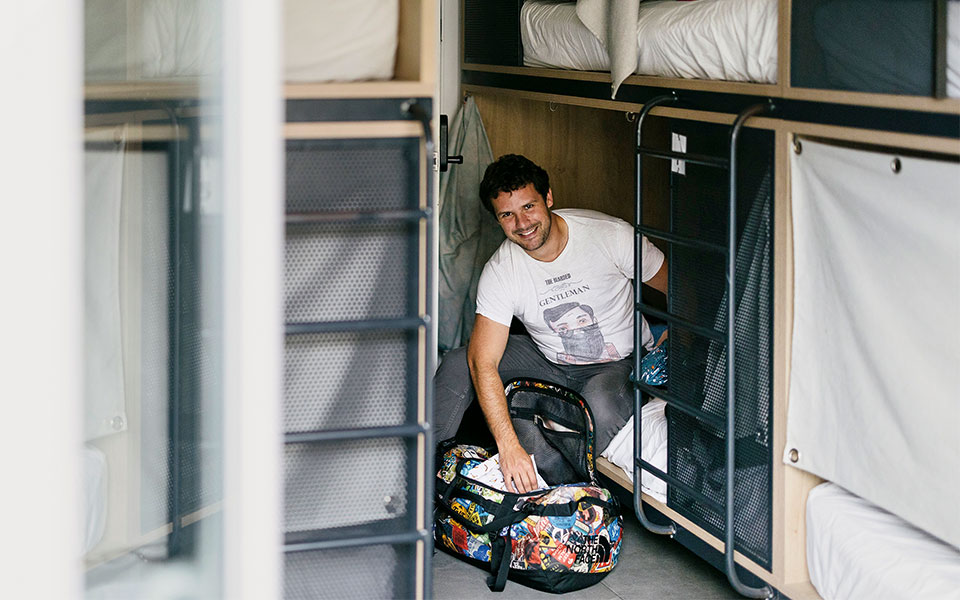
David getting ready to seize the day with his new friends.
© Angelos Giotopoulos
As the breakfast area empties, Sissilia adds the last mini croissant to her plate. “It always depends on the kind of trip you want to have,” she says, explaining her decision to stay here. “Often, when you book a trip last minute, you don’t want to blow your budget on accommodation, but you still want some sort of guarantee that you’ll have fun. And that’s usually true with hostels. Just imagine: last night Eleonora and I arrived knowing absolutely no one, and now, this morning, we’ve already made a new friend over breakfast,” she says, gesturing at David. We head up to their room, and once they’re ready, we set off for the Acropolis. “I love the contrasts in this city. I mean, on one side of the street you have the Acropolis and right across from it you have this incredibly modern building,” she says, pointing to the Acropolis Museum, before the two continue toward the ancient site.
Returning to the hostel, I run into Cremon and his bicycle, which he has named Giselle. “Do you know where I can sell her?” he asks, scrolling through bike shops near Koukaki on his phone. “It’s too expensive to fly back to Paris with her.” I ask him how he and Giselle ended up here, and he answers, “It’s a funny story. One night I was at a bar with a cyclist friend, and he told me he was thinking of taking a long bike trip all the way to Athens to visit his girlfriend. Somehow, he convinced me to join him. We traveled for over a month. We stayed in tents, in hostels, in motels, wherever you can imagine. The funny part is that before this trip, I hadn’t been on a bike in years,” he says, waving goodbye as he sets off for one last ride on Giselle.
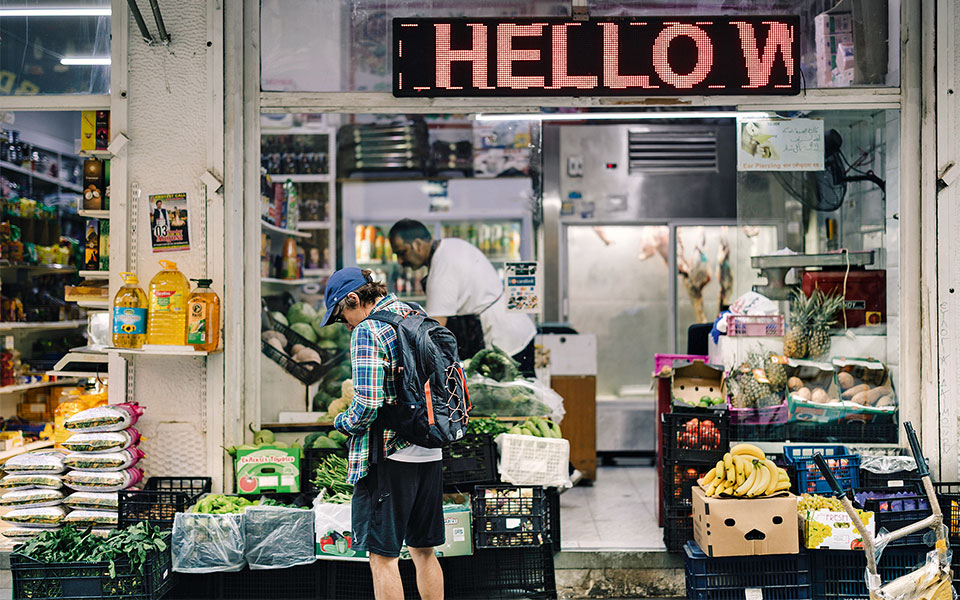
Ville goes ethnic food shopping.
© Angelos Giotopoulos
The reception area has almost emptied out, too. A few remaining digital nomads are sipping coffee while replying to emails or logging into video calls. Makrygianni and Dionysiou Areopagitou are already filling up, even though it’s only 10:30 on a Monday morning. People pop on their backpacks and set off for the archaeological sights that the neighborhood is known for. Others with no fixed destination in mind are ready to take in the city through entirely different eyes. They say their goodbyes to fellow guests, musing aloud that they might yet meet again somewhere else in the world.
After four days in the city’s hostels, I realize just how varied people’s needs are. There are always financial, aesthetic and geographical reasons behind the choices made for each stay, but the deeper desire to coexist with others seems to outweigh them all. It’s simple, really: you check in as just another stranger among strangers, and you check out sharing farewells with friends.
Abra Ovata is itself a rare...

From Alexandria to Hania and on...

Hiking lesser-known paths where history, nature...

The Goethe Institute's exhibition explores Athens'...