Jani Christou: A Greek Avant-Garde Composer of Metaphysical...
Jani Christou’s extraordinary compositions transcend disciplines...


The duo Tavernizer playing at Cachou.
© Dimitris Vlaikos
It’s late Friday, and like many nights over the past five years since I made Athens my home, I’m sitting in a dimly lit basement taverna surrounded by Greeks – most of whom are on the younger side. I see many familiar faces, as I sip the wine I’ve chosen instead of tsipouro, the standard drink for such situations – I, too, love the stuff, but I hate the hangover. A few mezedes, or small plates, sit on the table. The air is thick with smoke, something I will regret tomorrow. What I won’t regret is spending hours listening to the twang of the bouzouki, the heavy strum of the guitar, the voices in the room singing lyrics peppered with now-obsolete 1920s slang. This is a genre of urban folk music called rebetiko.
I’m not here as a journalist; this is a normal night out for me, ever since I began a deep dive into Greece’s folk music and scene, learning the fretless “guitar of the Middle East” – the oud – and following the music wherever it takes me.

Palia Athina is housed in a building from 1924.
© Dimitris Vlaikos
I’m fortunate as an eccentric foreigner to feel accepted into a community of people passionate about Greece’s traditional or folk music. And it’s not only the urban folk genre of rebetiko; the variety of local traditional music in Greece is incredibly diverse, varying from region to region, even village to village – from the wailing clarinet of Epirus to the fiery, lyra-driven tunes of Crete, or the lilting, danceable melodies of the Cycladic islands.
In Athens, you can hear all of this without even leaving the city center, and I’m not referring to the tourist restaurants in Plaka that blast clichéd syrtaki bouzouki melodies, probably Greece’s most widely recognized musical stereotype. Athens is full of high-quality venues, from small concert spaces to quirky tavernas, that showcase talented young musicians keeping Greece’s sometimes centuries-old musical traditions alive and bringing them into the present.

1002 Nychtes in Psyrri has a live music program of rebetiko and laiko.
© Dimitris Vlaikos
Fostering this boom are a growing number of institutions, from university programs to summer music seminars and even music high schools, teaching folk music. As part of their studies, students learn traditional instruments such as the oud and the lyra. The result is an abundance of musicians and eager audience members alike.
While I’m from the US, I lived in Berlin for many years, so to experience a “wild night out” in Athens dancing shoulder to shoulder in a circle while young people enthusiastically sing traditional lyrics such as “My little red apple, painted bright red” (“Milo mou, kokkino, roido vammeno”) has been a completely different and refreshing experience from the northern European bar/club electronic music vibe, to say the least.
Below you’ll find a few of my favorite spots for listening to live gigs, in case you, too, feel compelled to follow the music.
First, let’s head to Baumstrasse, a cultural center run by singer Martha Frintzila. This three-story, non-profit venue in industrial Votanikos has become a hub for the music community, hosting workshops and plenty of concerts. One of Frintzila’s goals is to showcase Greece’s folk music “masters,” highlighting the traditions they keep alive.
At a recent concert by one such master, Cretan lyra player Dimitris Sgouros, a large space had been left between the musicians and the seated audience, which can mean only one thing – there would be dancing. Sure enough, when the first notes sounded, people jumped up from their seats, joined hands in a circle and danced a delicate syrto from the Cretan city of Hania. People clapped and shouted, some throwing their hands up to emphasize familiar phrases. It felt as if we’d left Athens far behind and were now at a village festival, or panigyri.

You'll find music at Palia Athina most weeknights starting at 22:00.
© Dimitris Vlaikos
Another of my favorite concert venues is Makari, tucked away in Neapoli, just east of Exarchia. Christina Geraki has been running this establishment for 30 years. Her father’s shadow puppets decorate the walls; the vibe is candlelit and cozy. “They often say it’s an extension of my house,” Christina says, insisting that I have a shot of her homemade psimeni raki, a sweet cinnamon-flavored liquor from her windy Cycladic island of Amorgos. After 21:00 on most weeknights, you can find live folk music here.
I recently caught a concert of nisiotika, or music from the islands. Members of the audience sang along to traditional tunes from the Cycladic island of Naxos, perhaps having known them since childhood or maybe learning them recently at one of the many folk choirs, orchestras and dance groups that have sprung up throughout the city.
Prominent folk musician and educator Martha Mavroidi says this trend towards folk music is partly due to the yearning of many Greeks for a more local identity, one separate from the dominant cultures of the US and Europe. “There’s a growing need for communities, and folk music is based on that. It’s a community thing. It’s not one composer playing his piece to the audience – it’s a thing that’s shared,” she says. This communal aspect is what has kept me in Greece, too. In 2020, I attended a week-long music seminar on the Pilio peninsula. The topic of the course was early rebetiko (more on that below). Although I have a musical background as a trained opera singer, I was also born and raised in a small town in Michigan, so wrapping my ear around the Eastern ornamentation of this microtonal music was a difficult but exciting challenge.
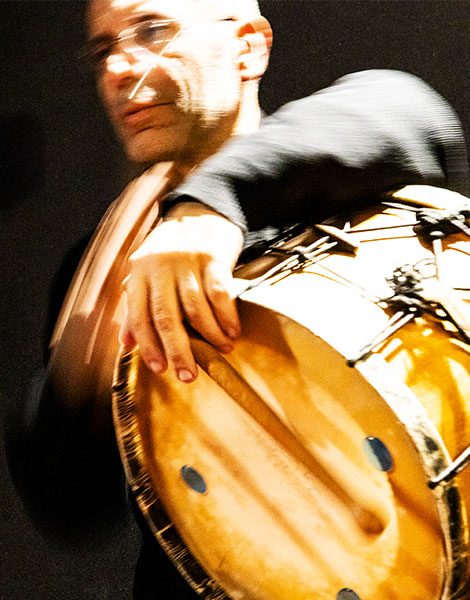
Percussionist Yiannis Papatzanis plays the Cretan davul at a recent concert at Baumstrasse.
© Dimitris Vlaikos
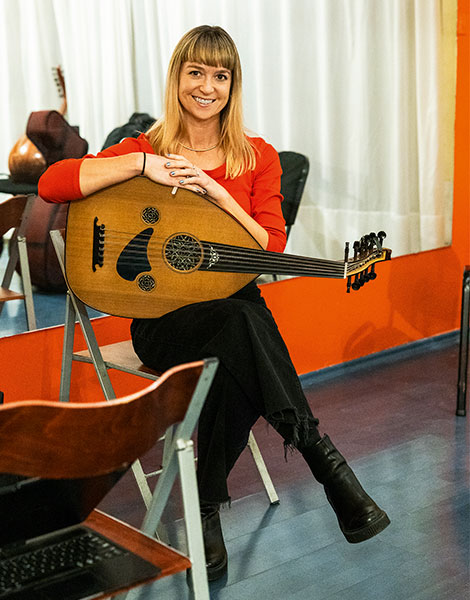
Author Sarah Hucal traded opera for oud.
© Dimitris Vlaikos
After a week of eating, drinking and playing music around a big table in the village square with my classmates, I was hooked. Inspired by our teacher, Evgenios Voulgaris, I started learning the oud, and several years later, I’m still here, still hooked.
No exploration of Greek folk music is complete without discussing rebetiko. The genre largely came into being after the 1922 forced population exchange between Greece and Turkey, when refugees from Asia Minor settled in shantytowns in Athens, Volos, Thessaloniki and Piraeus, bringing with them Ottoman-influenced music and instruments such as the oud and the kanun. This Eastern sound mixed with Western European music to give birth to rebetiko.
The early years captured the lives of rebetes, streetwise characters who lived on the margins of society. The songs paint vivid scenes of hash dens, brothels, prison life and the emotional terrain of poverty, exile and defiance. The subject matter was so controversial that it was suppressed and censored under various governments, including the 1967-1974 dictatorship. That anti-authoritarian aspect definitely still speaks to many, and especially younger, Greeks today.

Makari is a cozy concert venue in Neapoli.
© Dimitris Vlaikos
One place to hear and experience early rebetika is Palia Athina, a restaurant in a house dating back to the same period, 1924, located in the Profitis Ilias district. I suggest going mid-week on a Tuesday or Wednesday when you’ll find live music played by some of Athens’ most knowledgeable musicians. These include guitarist Giannis Niarchos, a specialist in the vocal improvisations of “amanes,” and singer and pianist-accordionist Haris Tsalpara, who performs with a talented cohort of female musicians.
Another prime spot is 1002 Nychtes. This Arabian Nights-themed venue is tucked into a small alley in the once-industrial zone of Psyrri and has been there for 25 years. Kurdish owner Memo serves fare you won’t find in other tavernas, such as fattoush salad and yoghurt kebab. There’s live music after 22:00 most nights of the week, and every other Tuesday you can hear the some of the city’s best rebetiko musicians – Vasilis Skoutas and Dimitris Mitarakis with singer Anatoli Margiola and lauded bouzouki player Nikos Tatasopoulos. This group plays a mixture of early rebetiko and old laika, a genre that emerged from the earlier rebetiko around the 1950s, smoothing out its rougher edges and making it a more polished, mainstream style with less controversial subject matter.
As Tatasopoulos told me prior to playing, he’s seen first-hand over the years how rebetiko speaks to young and older generations: “I can’t say it’s just a fashion, because it’s been popular again for a long time, since the 1980s.”
For many Greeks, rebetiko has been a connecting thread between generations. On the night I visit, a table of older gentlemen took turns dancing zeibekiko – a solo folk dance to a heavy 9/8 rhythm. Despite his large frame, a dancer moved in delicate circles, holding out his arms like a bird of prey as his friends clapped along to the beat.
Located a bit further west to the Metaxourgeio district, Cachou is quickly becoming a favorite, thanks in part to its delicious Cretan cuisine and the roaring fireplace. Housed in a large stone building on a pedestrianized street, it offers live folk music around four nights a week. While sipping on homemade rakomelo – warm raki blended with honey – I felt I’d been transported to a Cretan village for an intimate jam session with one of my new favorite duos, Tavernizer. Stelios Milonakis and Pavlos Mavromatakis (Pav Mav) offer listeners the rare chance to experience Cretan rebetiko, or tabachaniotika.
I should point out that the folk music boom in Greece isn’t only about historical recreation – there’s an increasing number of bands that take inspiration from folk tunes and rhythm, mashing them with punk, metal and rock, like Thrax Punks, Koyaman, Nu Balkan, Balothizer, Voukoliki Diataraxi and Gidiki (the latter plays every Sunday until mid-February at a venue called Pontiki). Popular larger venues for such bands include Ilion Plus, Exa Club and Kyttaro.
As for me, my Greek musical journey continues as I play oud in the +bAnda Orchestra, attend a seminar with my first teacher Evgenios once a month, and study a new instrument, the Cretan bulgari, a type of long-necked lute. But more often than not, you’ll find me in a cozy taverna, humming along to some of Greece’s folk classics.
Jani Christou’s extraordinary compositions transcend disciplines...
On an island known for creative...
Sometimes, the heart just knows what...
Explore the tavernas of Nikaia, Moschato,...