The Secrets of Amalias Avenue
Discoveries along Amalias Avenue, from the...

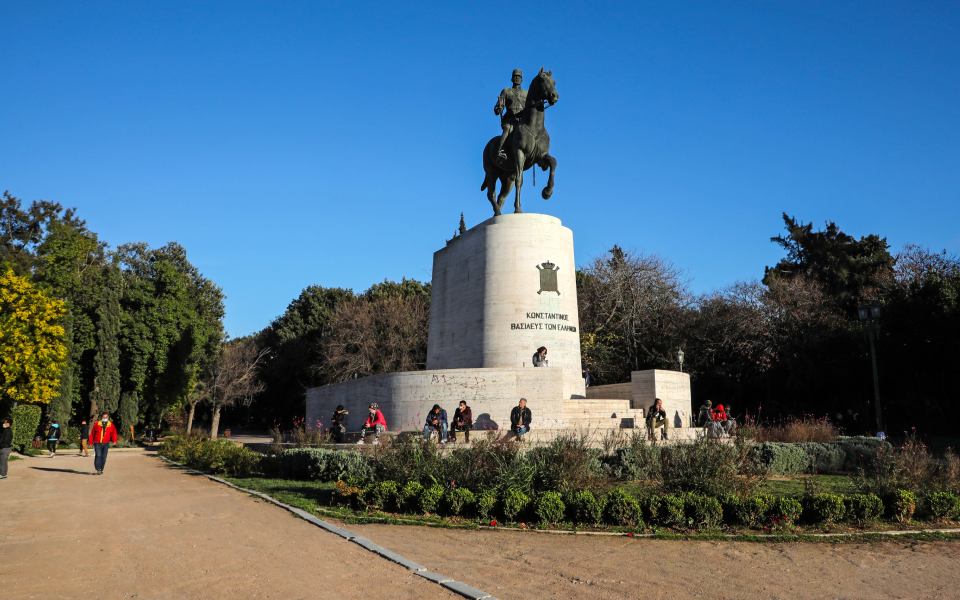
The statue of King Constantine the First.
© Nikos Kokkalias
This year marks the 200th anniversary of start of the Greek War of Independence, but how many people know that there’s an entire Athens park dedicated to its protagonists? These were the Greeks who envisioned a free Greece and fought passionately without abandoning their goal, even when everything seemed hopeless. The park Pedion tou Areos is the largest in the capital (although administratively it does not belong to the Municipality of Athens), covering an area of about 114 acres.
For those who live in Exarchia, Polygonο, Gyzi, Kypseli and the areas below Omonoia, this park is “their escape”, the closest place to “countryside” inside the city. Here they play, fall in love, and even get married and baptize their children – there are two churches in the park. The rest of us Athenians, especially those over forty, know it from pre-election political rallies, from the variety shows held at the Alsos Theater, and from the sports facilities of the Panellinios Gynastics Club, the oldest sports organization in the country.
© Nikos Kokkalias
Unfortunately, for a long time the park was left untended, and it ceased to be either attractive to or safe for visitors. Finally, in 2008, redevelopment began (which was completed in 2010 by the architectural firm Tobazis) with the aim of creating a promenade and a green space where people would be inspired by the glorious past of its heroes and would also be able to exercise, to walk, and to enjoy the park again. Let us not forget that the identity of a space is shaped by the people who use it.
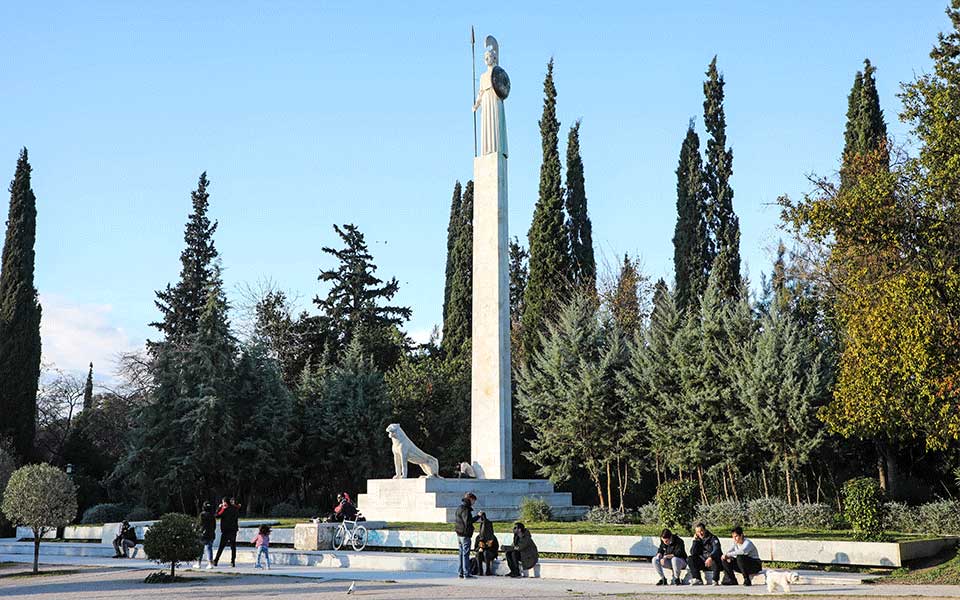
The statue of Athena at the entrance on Alexandra Avenue.
© Nikos Kokkalias
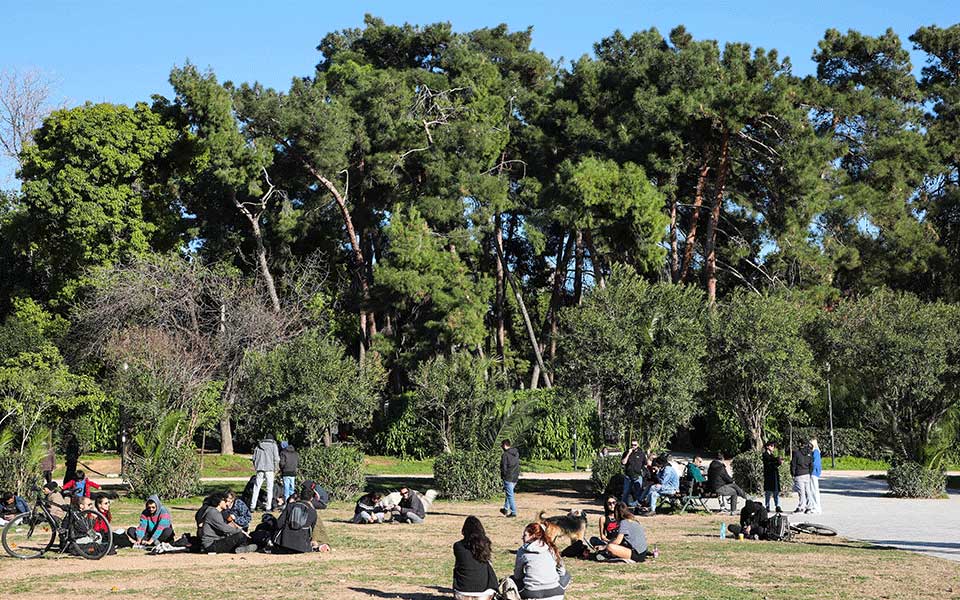
I visited it a weekday afternoon and thought that, due to teleworking and tele-education, it would not be crowded. I was wrong. From babies in strollers to old people in wheelchairs, everyone was there. People were playing chess on the benches, reading on the grass or just talking to one another and enjoying the midday sun.
Children were playing football, volleyball, cycling with their parents, or roller-blading and skateboarding. I walked through the entrance at the intersection of Alexandras Avenue and Mavromataion Street into a space dominated by the statue of King Constantine the First. This is the only monument to this monarch left in Greece; it recognizes his success as a strategist in the Balkan Wars.
Knowing that the urban identity of the surrounding areas has changed significantly over the last twenty years – Kypseli, Patissia, and Alexandras Avenue do not have the glamour they once did – I tried to understand the «human geography” of the park’s visitors.
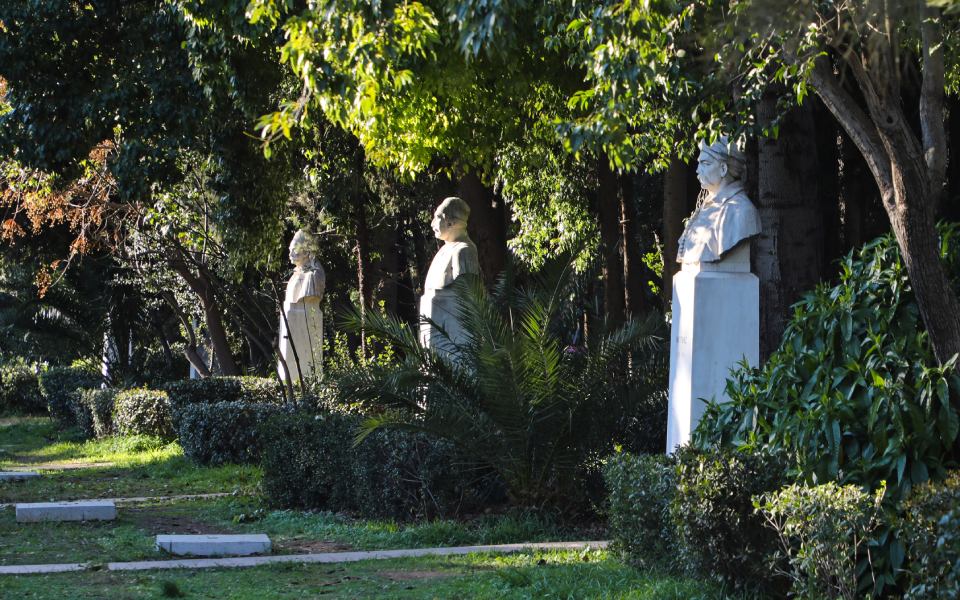
The Road of Heroes
© Nikos Kokkalias
After wandering an hour and a half down the paths and through the clearings in the park I found that, from the lower part up to the main square with its famed refreshment stand “Gardenia,” you come across more foreigners or immigrants than in the upper part where, in the wide space in front of the Theater Alsos, you’ll see a lot of dog owners playing with their pets on the grass. As the day lengthened, however, the number of athletes engaged in various activities increased in the park: there were abdominal workouts under the statue of Athena, TRX training with straps tied to trees, yoga exercises with mats on the lawn and, of course, running and walking – at all paces.
The park looks attractive again, and there is ample signage to help you find your way through the park. “During the redevelopment, all the different areas of the park – the rose garden, the corner with the holy oaks, the manmade stream under the plane trees, and the Road of the Heroes of 1821– were dealt with in a similar fashion,” explained agronomist and landscape architect Andreas Barboutsis, project manager of implementation and redevelopment of the park. “Sick trees were removed and mild structural interventions were made. For example, cement that had been used improperly was removed, and emphasis was placed on creating curves in the paths in order to enhance the element of surprise for the walker.”
Not everything was carried out according to the original redevelopment study. For example, the rose garden did not develop as one might expect, and the water channel that was created never reached the waterfalls or some of the other stream beds, but the maintenance of such a project is extremely demanding, so such shortfalls are to be expected. On the other hand, the work did successfully revive a park that is now in dialogue with the urban landscape and that connects us to a period in Greek history recognizable to all the nation’s citizens and many of its visitors, the revolutionary era of 1821.
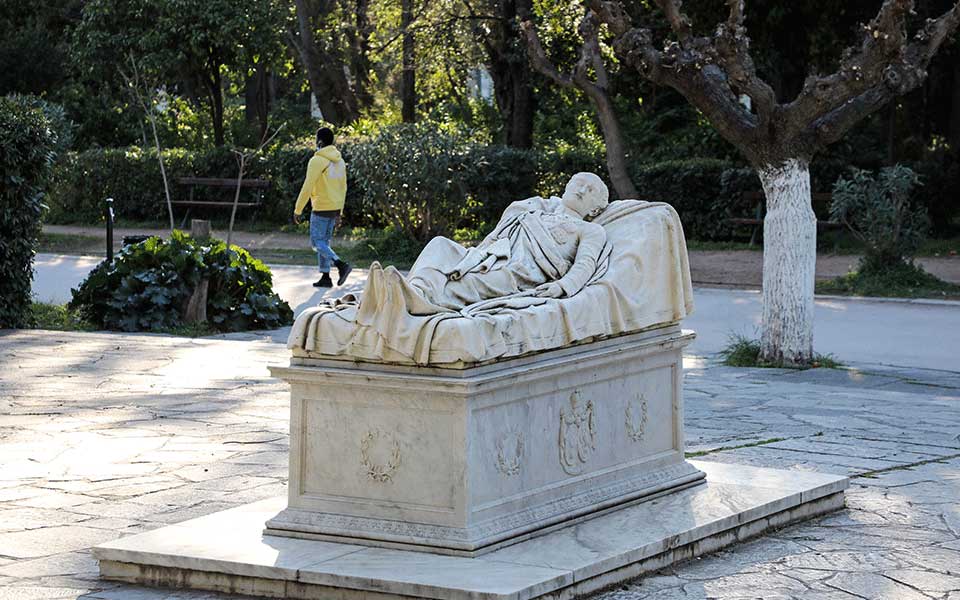
This monument, dedicated to the politician and soldier Alexander Ypsilantis, is in the courtyard of the Church of Taxiarches.
© Nikos Kokkalias
This article was first published in Greek on kathimerini.gr.
Discoveries along Amalias Avenue, from the...

A nexus of Hellenic research, the...

Trace St. Paul the Apostle’s journey...

Discover how Christos, Athens’ master souvlaki...