Your 3-Day Guide to Andros Island
Shady hiking trails, a vibrant cultural...


Hora, the capital of Ios, delivers the Cycladic aesthetic in full: whitewashed houses, narrow alleyways, and the unmistakable silhouette of Panagia Gremiotissa crowning the hilltop.
© Shutterstock
If you think of Ios and your first thought is non-stop partying, late nights, and crowds of young revelers hopping beach bars ‘til dawn – well, you’re not wrong. That version of the island did exist (and, in a few corners of Hora, still does). But in 2026, something different is emerging. What’s drawing attention now isn’t just nightlife but the quiet rebirth of Ios as a richer, more multi-dimensional Cycladic destination – one that balances culture, nature, heritage, and, most importantly of all, sustainability.
Euronews recently reported that Ios – long overshadowed by nearby heavyweights like Santorini and Mykonos – is appearing on must-visit destination lists for 2026 precisely because it’s striving to be more than a “party island.” Rather than overheating in the boiler room of mass tourism, straining infrastructure, and eroding local character, Ios is carving out a new narrative that emphasizes authenticity and quality of life, for both visitors and residents.
And international travel media seem to agree. A growing number of publications – from The Times of London to the French travel guide Petite Futé, alongside lifestyle and trend-focused sites across Europe – now recommend adding Ios to their 2026 travel wish lists.
So, what’s changed? And why should you be thinking about Ios now? To understand the island’s appeal, you need to look beyond its reputation – and spend a little time on the ground.
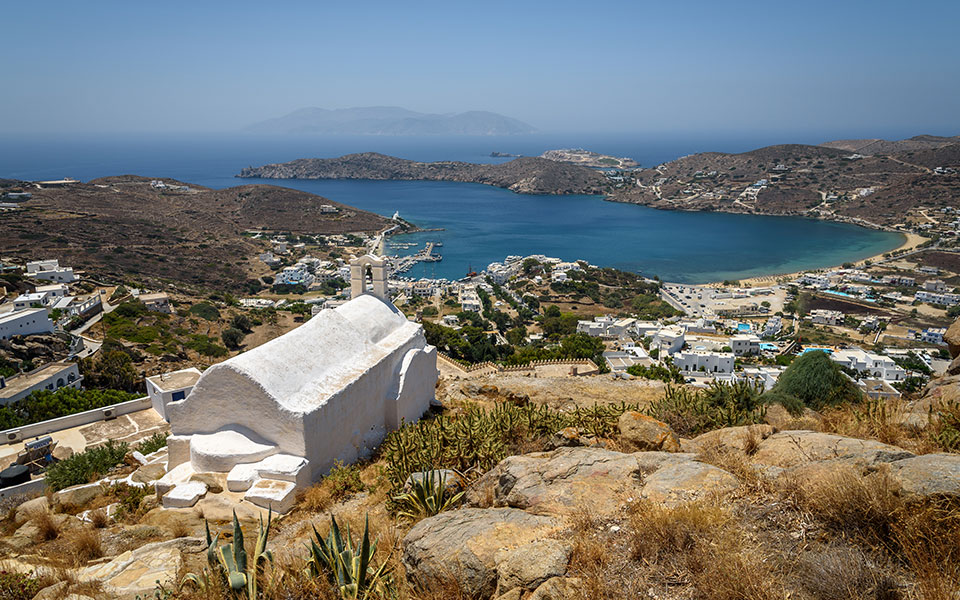
Rather than chasing ever-growing visitor numbers, Ios is focusing on authenticity and sustainable development.
© Shutterstock
Okay, let’s deal with it head-on. Ios has long been one of the Cyclades’ livelier islands, with bars and clubs – particularly in Hora – drawing generations of visitors in search of long nights and high energy. That scene hasn’t disappeared entirely, but it no longer defines the island as it once did.
Behind the fun façade, Ios is actively repositioning itself. As reported by Euronews, Mayor Gkikas Gkikas has stressed that the island’s strategy is “no longer limited to enriching tourist experiences but aims to create a destination with a high quality of life both for visitors and for the permanent local community.”
Restoration projects to the tune of €100,000, alongside targeted infrastructure improvements and new community facilities, underpin this shift – and help distinguish Ios from other Greek islands where tourism growth has sometimes felt hasty or unbalanced.
This isn’t just a marketing spin. It’s a tangible change that shows up in the way the island presents itself to visitors.

The Early Bronze Age settlement of Skarkos belonged to the Keros-Syros culture.
© Public domain
One of the clearest signs that Ios has found a new rhythm is its capital, Hora, stacked dramatically on a hillside above the port. Recently named by The Times among the 25 most beautiful villages in Greece, Hora delivers the Cycladic aesthetic in full: whitewashed houses, narrow alleys, blue shutters, and the unmistakable silhouette of Panagia Gremiotissa crowning the hilltop.
Wander its steep lanes and you’ll encounter boutique shops, artisan cafés, and quiet viewpoints that open onto sweeping Aegean panoramas – especially magical at sunset.
For an island of its size, Ios is also surprisingly rich in archaeology. Just a short distance from the port lies Skarkos, one of the most important prehistoric settlements in the Cyclades. Dating to the Early Bronze Age (3rd millennium BC), the site offers rare insight into early island life at the heart of ancient Aegean maritime routes. Covering 1.1 hectares, Skarkos is the largest and best-preserved settlement of the Keros–Syros culture, thought to have supported a community of 200 to 300 people at its height.
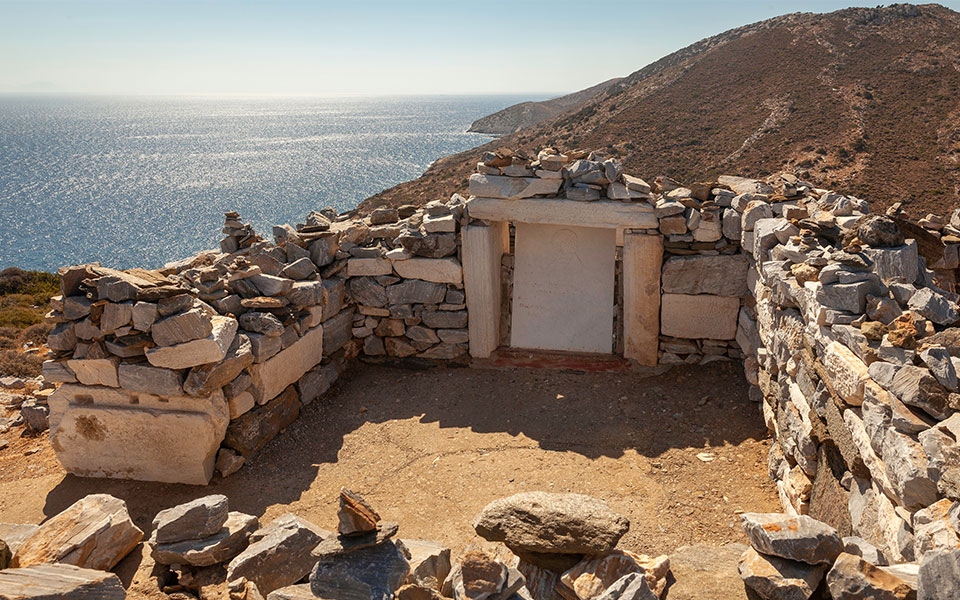
An ancient tomb, supposedly the final resting place of the epic poet Homer, is located on the north coast of the island.
© Shutterstock
Then there’s the island’s most evocative cultural landmark: the Tomb of Homer. Perched on a hill on Ios’ north coast, overlooking the sea, the site is tied to a tradition that the epic poet spent his final years here. According to the 2nd-century traveler Pausanias, Homer once consulted the Delphic oracle about his origins, receiving the enigmatic reply that his mother’s homeland was Ios – and that the island would receive him in death.
Today, the tomb is reached via a short walk up Plakoto hill, where a modest stone-and-marble structure bears an inscription reading: “Here the earth covers the sacred head of men and heroes, Homer the divine poet.”
Further east, Palaiokastro adds another layer to the island’s story. The remains of a Byzantine-era fortress – rebuilt in 1397 by Francesco I Crispo, Duke of Naxos, atop earlier fortifications – crown a hill 275 meters above sea level. Though only sections of the defensive walls and internal structures survive, the views over the Aegean are reason enough to make the climb. Within the ruins stands the small church of Panagia Paleokastritsa, still quietly watching over the sea.
It is also said that Ios is home to an astonishing 365 churches – one for every day of the year, but that’s probably an exaggeration! Either way, there are plenty of churches to explore. Don’t miss Panagia Gremiotissa and Aghia Ekaterini in Hora, and Aghia Eirini at the port.
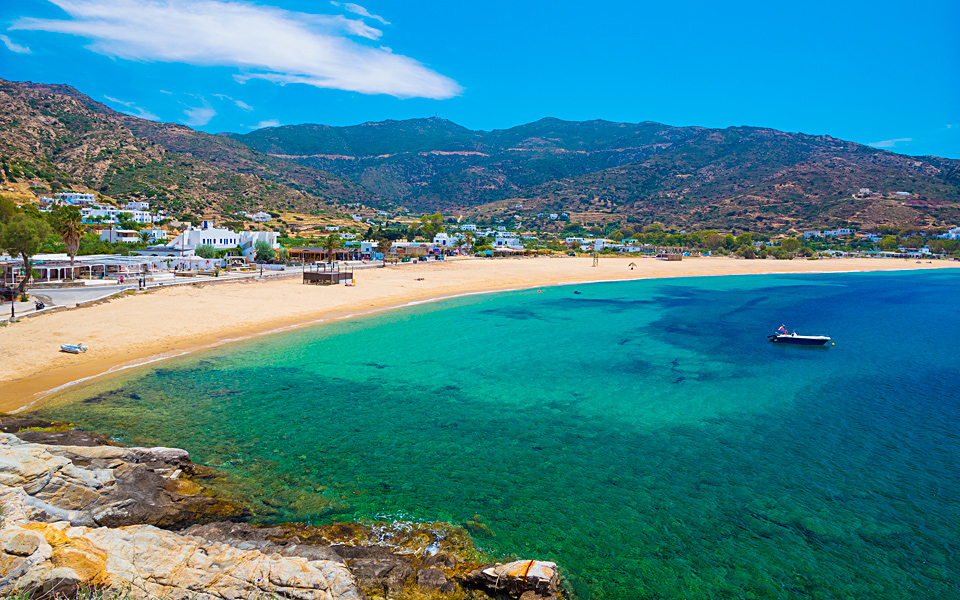
Mylopotas is the island’s most famous beach, a sweeping crescent of sand with amenities for watersports and beach bars.
© Shutterstock
Away from the cultural sites, one of Ios’ greatest pleasures is its coastline – a varied procession of beaches that suit just about every mood.
Mylopotas remains the island’s most famous stretch, a broad sweep of golden sand with facilities for watersports and several beach bars – especially popular among the younger visitors. Koumpara offers something calmer, with clear waters and views across to neighboring Sikinos, while Yialos, just steps from the port, is perfect for a quick dip straight off the ferry.
For something quieter still, Aghia Theodoti – around a 20-minute drive from Hora – rewards the effort with a beautiful, largely unspoiled beach where the crowds thin out. It’s the sort of place where a long swim and a simple picnic can easily fill an afternoon.
Ios’ food culture is also enjoying a quiet renaissance. Traditional family-run tavernas and more contemporary kitchens coexist, serving dishes rooted in the island’s agricultural past. Look out for “mosenta,” the local watermelon pie sweetened with thyme honey, alongside pumpkin pie, pasteli sesame bars, “melitinia” pancakes scented with mastic and “myzithra,” dried figs with sesame, stuffed zucchini flowers, snails, and the island’s much-loved “skotyri” – a spicy, herb-laced cheese. If you’re lucky enough to meet a local cheesemaker, ask for “gritsi,” a fresh cheese curd rarely found beyond the island.
So, what really sets Ios apart as 2026 approaches? In a word, it’s the balance.
Rather than chasing ever-growing visitor numbers, the island appears focused on cultivating quality over quantity. Investments in resilience and public facilities, alongside a conscious effort to protect natural landscapes and local character, are beginning to pay off.
And that’s the story travel editors and curators seem to have picked up on when they started spotlighting Ios as a destination to watch. It’s not simply that the island feels newly discovered; it’s that it feels newly considered.
Shady hiking trails, a vibrant cultural...

Discover festivals, beaches, food, and hidden...
On its own or paired with...
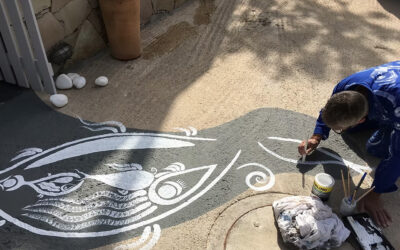
Igor Borisov turned Kimolos into his...