Lazarakia: The Little Buns That Welcome Holy Week
On Lazarus Saturday, a centuries-old Greek...


A street vendor cooks chestnuts over a charcoal brazier known as a “foufou.”
© Roberto Patti/Unsplash
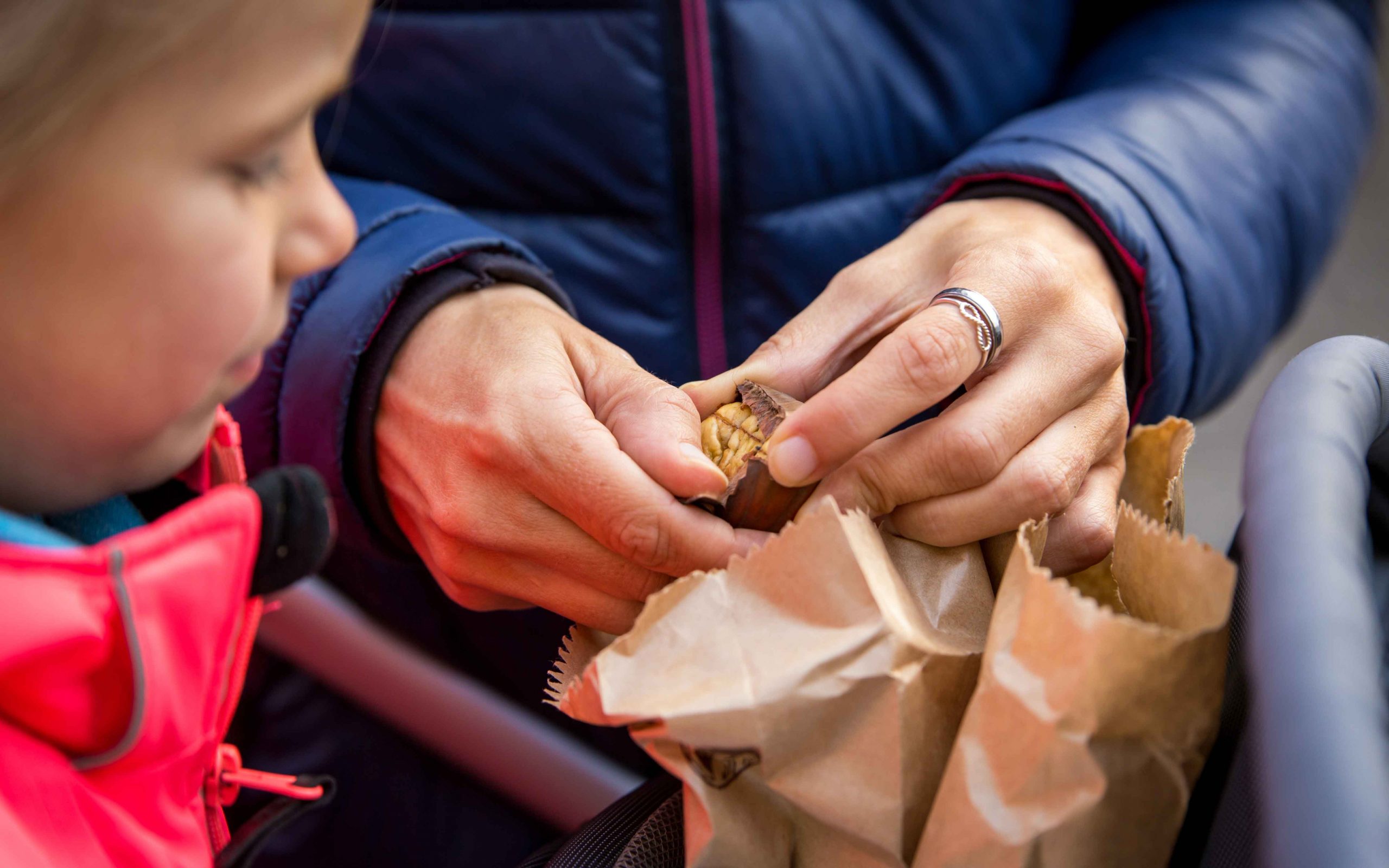
The first thing you notice is the smell. As the evenings grow colder and Christmas lights begin to twinkle above the streets of Athens, the sweet, smoky aroma of roasting chestnuts starts drifting from street corners and busy squares. There, beside a little charcoal brazier known as a “foufou,” a street vendor (or “kastanas”) patiently turns the glossy brown nuts over the heat, ready to scoop them into paper cones for passing pedestrians.
For a few euros, you have one of winter’s simplest pleasures: a handful of warm, freshly roasted chestnuts, their brittle shells giving way to soft, sweet flesh. Ιt’s an image as familiar to generations of Greeks as the first winter rain. But behind this humble seasonal snack lies a much longer story – one that reaches back to the ancient world and the mountain communities that once depended on the chestnut tree for their winter survival.
Tasty and nutritious, the humble chestnut has been a Greek staple for centuries, especially up in the mountains.
© Shutterstock
Τhe sweet chestnut (Castanea sativa) has a long history in the eastern Mediterranean. Native to a region stretching across southeastern Europe and Asia Minor, it has grown in Greece for thousands of years. Archaeological evidence, including ancient pollen deposits, suggests that chestnut trees were already part of the Greek landscape around 9,000 years ago, becoming more widespread by approximately 5,000 years ago.
One of the earliest literary glimpses of their importance comes from Xenophon. In his “Anabasis”, the fourth-century BC soldier-historian describes the Ten Thousand, a Greek mercenary army retreating through the mountainous lands south of the Black Sea in 401 BC. Among the communities they encountered were the Mossynoecians, inhabitants of what is now northeastern Turkey, whose diet included large quantities of nuts identified as chestnuts. These were stored and eaten boiled, providing an important source of nourishment. Centuries later, the physician and botanist Dioscorides also discussed chestnuts in his first-century AD work “De Materia Medica.” He referred to them as “kastana” – the word we still use today – as well as Sardian nuts, and recorded their medicinal properties.
Long before chestnuts became a seasonal treat, they were an essential food for communities living among Greece’s mountain forests. In places where steep slopes and poor soils made growing wheat and other cereals difficult, chestnut trees offered a dependable alternative. Their abundant harvest provided much-needed nourishment through the colder months.
Once gathered, the nuts could be boiled, roasted or dried and ground into flour, which was used to prepare bread and other filling dishes. They could also be stored for long periods, making them particularly valuable during winter. Indeed, before the introduction of the potato to Europe, chestnuts were a staple source of carbohydrates in many mountainous parts of Europe, earning them the nickname “bread of the poor.”
The trees themselves offered further benefits. Their durable timber was prized for construction and furniture-making. Chestnut wood has also long been valued by the monastic communities of Mount Athos, for example. Today, chestnut cultivation remains an important agricultural activity in several Greek regions, from Macedonia and Thessaly to the Peloponnese and Crete.
According to Husfarm’s FAOSTAT 2024 industry summary, Greece produced over 33,000 metric tons, placing it among Europe’s leading chestnut-growing countries after Spain and Italy, and seventh globally.

Warm and sweet and served with a sprinkle of salt, roasted chestnuts are synonymous with Greek Christmas.
© Perikles Merakos
Of course, you don’t need to venture into the mountains to enjoy chestnuts. In Greek kitchens, they’re just as welcome in sweet creations as they are in hearty winter and Christmas cooking.
They pair particularly well with pork and poultry, adding depth and sweetness to slow-cooked winter dishes. In some local recipes, they’re combined with pulses such as chickpeas to create hearty, nourishing meals that reflect their traditional role as a staple food. Our traditional chestnut soup from Arcadia makes an ideal starter for a winter meal.
They’re made into jams, spreads and the much-loved “glyko tou koutaliou” (spoon sweet), in which whole nuts are preserved in fragrant syrup and served as a little treat alongside Greek coffee. Chestnut cakes and pastries are other seasonal favorites. You’ll also find them making an appearance in modern variations of festive favorites such as “tsoureki” and “vasilopita.”
There’s even a charming Greek saying that celebrates the nut’s association with good company: “Τα κάστανα θέλουν κρασί και τα καρύδια μέλι, και το κορίτσι φίλημα πρωί και μεσημέρι.” Translated rather freely: “Chestnuts call for wine, walnuts for honey, and a girl for kisses morning and noon.” It’s a reminder that, in Greece, chestnuts have always been about more than food.

Kastanitsa is a picturesque and historic village in the region of Tsakonia in Arcadia; home to an annual Chestnut Festival.
© Perikles Merakos
Across Greece, the arrival of the autumn chestnut harvest is an excuse for a good village celebration. From the forests of Macedonia [add link – to the mountain slopes of the Peloponnese and the woodlands of Crete, communities welcome visitors with roasted chestnuts, local wine, music and traditional dishes.
One of the best-known gatherings takes place in Kastanitsa, a picturesque village on the eastern slopes of Mount Parnon in Arcadia. Its annual Chestnut Festival at the end of October brings the village to life with local delicacies, traditional music and dancing. Visitors can sample chestnuts prepared in different ways, enjoy hearty mountain dishes and follow woodland paths through the surrounding chestnut forest.
Further south, the village of Arna in Laconia celebrates its harvest with roasted and boiled chestnuts, homemade sweets and local tsipouro. An open-air market in the village square offers seasonal produce, including walnuts, quinces, pomegranates and aromatic herbs gathered from the surrounding countryside.
Chestnuts are not just a mainland affair, either. On Lesvos, the traditional village of Agiasos is famous for its beautiful chestnut grove. The festivities include walks through the woodland, musical and theatrical performances, and opportunities to sample regional delicacies. The village’s Women’s Agricultural Cooperative is also a good place to discover local sweets and other handmade products.
Over on Crete, the western villages of Elos and Prase, near Hania, have their own longstanding chestnut traditions. Here, the autumn harvest is celebrated with freshly roasted nuts, oven-baked chestnuts and spoon sweets.
Back in Athens, the chestnut vendor continues his work, turning the nuts over the glowing charcoal as passersby pause to warm their hands and pick up a paper cone. It’s a small ritual, repeated every winter, that connects the bustle of the modern city with the traditions of Greece’s mountain villages.
On Lazarus Saturday, a centuries-old Greek...

A classic, irresistible combination, deeply tied...

From old-town tavernas and seafood by...

Rustic and nutritious, discover how Greece’s...