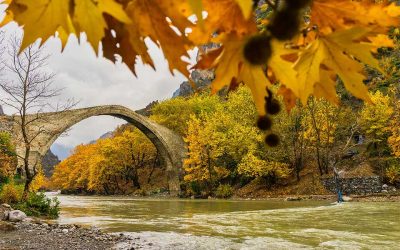
Exploring Pyrgi: The Chios Village with Painted Walls
Discover Pyrgi in Chios, a medieval...


“Mosaics – as an art form and because of their connection with the Greek world, from the Classical world through the Byzantine world in particular – were always fascinating to me.”
Peratsakis, whose family is originally from Crete, grew up in Astoria, Queens, at a time when the neighborhood was still a Greek stronghold. As anyone who grew up in the diaspora knows, identity exerts a strong pull. “It wasn’t the plaster Ionic columns on the porch kind of kitsch Greek identity though. For our household, and for me in particular, Greek culture was Tsarouchis, Moralis, Ghika, Hadjidakis and Theodorakis”
Drawing came naturally from an early age, earning her admission to New York City’s competitive High School of Art and Design. Greece found its way into her work: “Greekness and creativity were inseparable for me, but on an unconscious level. Others would point it out – an inspiration or mood even without any discernible Greek motif.


“Athens when I arrived in the early 1980s was so hot and loud and alive, especially Plateia Amerikis where I lived then. Wine and talk about art filled the warm nights in Exarchia Square or Dada Bar. We would also go see international art films at Studio Cinema, which was next to my apartment. I got a degree in Graphic Design at the “KATEE” (now TEI), and then found a job with Interior Designer Kostas Staikos, designing textiles, upholstery fabrics and tiles for his many stores. The Greek textile industry was producing such high-quality product from Greek cotton then. Textiles are such an important aspect of Greek cultural heritage, and it was nice to be a part of that legacy.
Part of my work at Staikos was interpreting fine artworks for textile production, finding a way to capture the impact of the work faithfully while working in the more constricted color palette that the medium dictated. The company commissioned works by Tsarouchis and Ghika; working from these pieces was absolutely thrilling for me, as these two artists personified Greece in every aspect. Mr. Tsarouchis was very interested in the process and he visited us at the studio.”

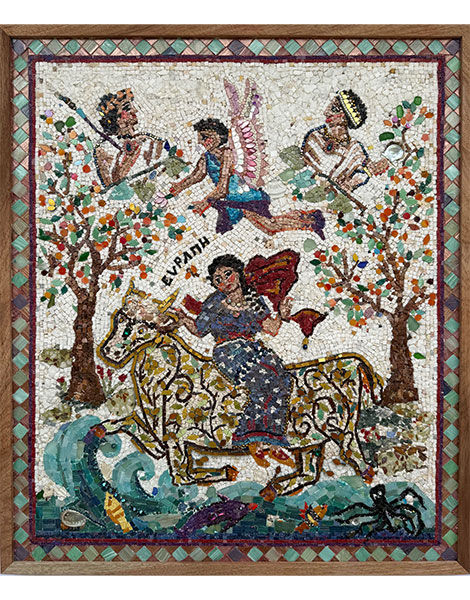
“There are different ways of making mosaics – direct and indirect methods – and a wide range of materials to work with: glass, composite stone and natural stone. You can use precut tesserae, the individual pieces that make up a mosaic, or cut them yourself, which gives you much greater control over the design. Cutting tesserae is one of the most labor-intensive and technically demanding parts of the process. Every material requires different tools and a different technique.
Then there’s the question of whether or not to use grout, a material that fills the gaps and forgives imperfections. Working without grout is a more exacting process, involving cutting the stones with absolute precision. It’s a little like a standard masonry wall made with cement as opposed to the dry-stone walls of the Greek islands, which are landmarks of structural and aesthetic integrity.”
“My experience with textiles proved very useful. Textile design and mosaics share a lot conceptually. Both require an understanding of surface pattern vs. texture. In textiles that are surface patterns, it’s all about the color and line and composition: a strictly two-dimensional experience. In mosaic, the indirect method is conceptually a surface pattern method, yielding a two-dimensional visual experience relying solely on line, color and composition. Tiles are placed upside down in the frame and you can work and rework the design as much as you like. I start from sketches, but I tend towards a maximalist aesthetic and inevitably, just like the botanical motifs themselves that I love so much, the designs tend to grow. You can remove sections or re-work them in the indirect method, but once you cement the mosaic from the back it’s set. You turn it over and see your work for the first time – a smooth surface that is a mirror image of what you’ve been looking at for months. That’s a thrilling moment. This is by far the more exacting method; an even more complex indirect method was used in the most famous mosaics of the Byzantine world, particularly in Ravenna.
In the direct method, what you see is what you get. The tesserae are placed face up in the frame and texture becomes integral to the work. In that sense, it’s more like working with a jacquard or other fabric where texture affects the appearance. It’s an easier method and a more playful one.
You could also compare the indirect method to print-making – etching, linocuts or lithography. The result is final when you pull the print, it’s a mirror image of what you created, and it’s also a strictly two-dimensional experience. Working in the direct method has more in common with painting in oils or acrylic – you can go back in and add layers to your work, integrate impasto, and so on.”
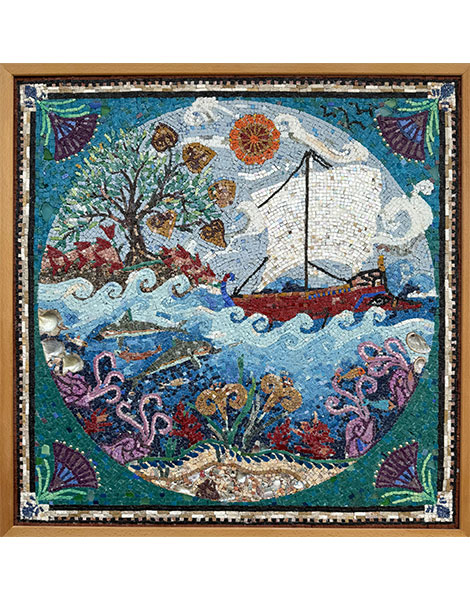

“My degree is actually in English literature. I have a high tolerance for tragedy – Dickens especially – but epic poetry and ancient Greek tragedy set the bar for emotional intensity. Besides resonating with my heritage, they also provide extraordinary visual material. The scene in the Odyssey where Odysseus is tied to the mast because he can’t resist the Sirens is such a powerful moment of self-knowledge, temptation and determination. That was my most challenging piece, an indirect mosaic I worked on for months – close to a full year actually. Mythology also captures the sheer wonder of the universe in remarkably beautiful ways, like the image of Selini with her chariot, the personification of the moon.”
“Crete was like a mythical place for us while we were growing up. My mother had lived there during WWII, but it was known to my siblings and me only through stories from the war about my family living in caves. This is why I see my mosaics as stories. When I saw that orange, iron-rich soil on the cliffs of Souda Bay when I was pulling into the harbor for the first time – I must have been 18 – it stirred something in me. Crete felt like home in a way no other place had before or since, and it has been my home now for a couple of decades.”
“While themes from Ancient Greek mythology inspire much of my work visually, the language is specifically Cretan – Minoan, not Classical.”
The imagery of Minoan and Cycladic art – dating from around 3000 BCE it flourished until the eruption of Thera around 1600 BCE – remains her greatest source of inspiration.
“Their botanical and natural motifs had so much vitality and motion. The swallows with their forked tails soaring through the skies like on the Thira frescoes, the flowers swaying in the breeze. Predating Minoan and Cycladic art, Greek Neolithic art is also a source of inspiration in its purity of geometric form, the bands of stripes, or the spiral – the cycle of life. These motifs still define the visual experience of Hania – the swallows of summer, the spirals of shells in the beach, the patterns of waves, the wild flowers and plants so abundant. They remain current and fresh.”
Over the past decade, Peratsakis has developed a substantial body of work, experimenting with different mosaic techniques and materials, including natural stone, composite stone and Orsoni glass smalti from Venice, where she held or attended a workshop [unclear], while occasionally incorporating meaningful found objects such as shells or pieces of jewelry.
From August 1-10, 18 works will be exhibited for the first time at Aghios Rokkos, a 17th-century Venetian church on the plateia of Splantzia, an ideal setting to get to know her pieces up close. The exhibition will feature both traditional and more experimental pieces, including free-standing wings of mirrored tesserae. Her work can also be seen on instagram @mediterranean.mosaics.
Discover Pyrgi in Chios, a medieval...
Events, exhibitions and new openings for...
How did the Greek National Opera...

Ten must-do experiences in Athens, from...