Mavros Gatos: A Genuine Neighborhood Taverna Operating in...
Among the many city eateries offering...

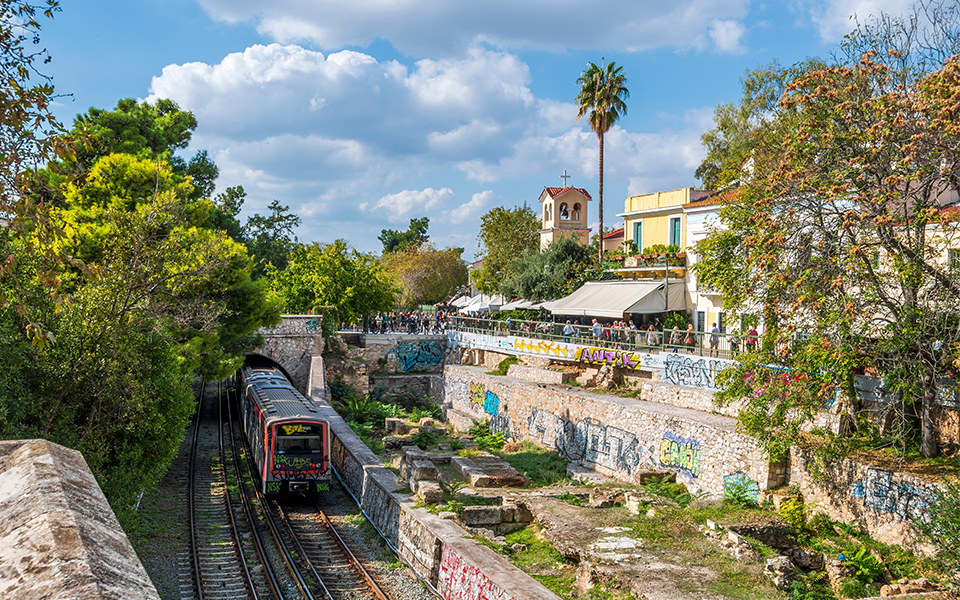
An Athens Metro train passes the ruins of the ancient agora.
© Shutterstock
It begins like any other busy morning in Athens: commuters spill out of trains, phones in hand, hurrying through tunnels and up escalators toward Syntagma Square. But look a little closer, and this is no ordinary metro station. Behind plexiglass walls, the ground beneath the city has been sliced open like the pages of a history book – foundations of ancient houses, workshops, graves, even the remains of a Roman bathhouse, all revealed by the tunneling machines that carved Athens’ Metro in the 1990s.
In a city famed for its museums and ancient monuments, it’s a pleasant surprise for first-time visitors to discover that some of the richest archaeology in the Greek capital is free to view, in the most unexpected of places: the metro.
For travelers seeking culture without the cost of an entry ticket, the Athens Metro is more than just transport – it’s a journey through 5,000 years of history, hidden beneath your feet.
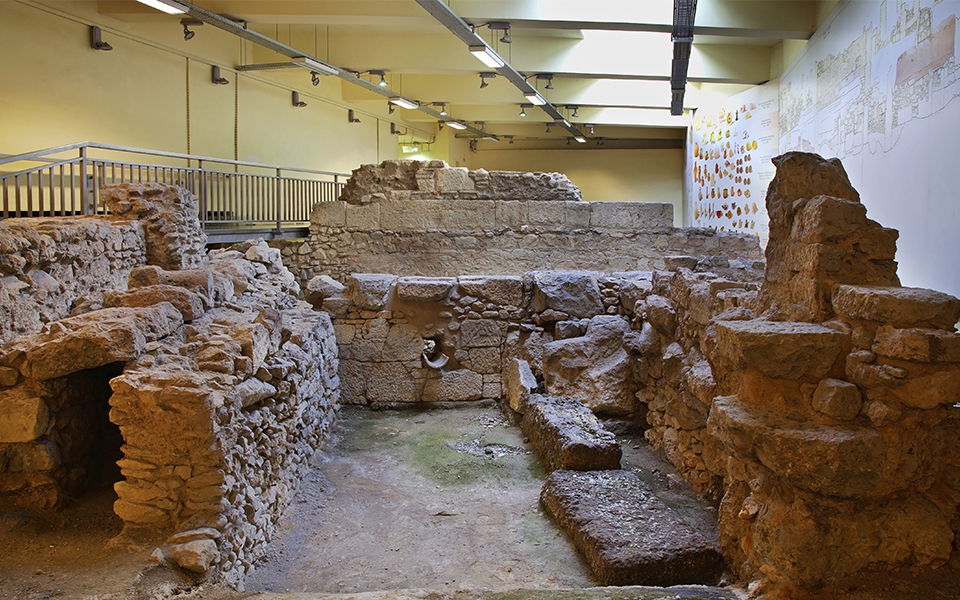
The vaulted bed of the Eridanos River and layers of ancient Athens are visible in Monastiraki station’s concourse.
© Shutterstock
When work began on the new Athens Metro in 1993, in preparation for the 2004 Olympic Games, no one doubted that digging beneath one of the world’s oldest cities would be complicated. What few anticipated was just how extraordinary the discoveries would be. Over seven years, until the system opened in 2000, an army of engineers and archaeologists undertook the largest urban excavation in Greek history. Covering nearly 79,000 square meters and reaching depths of up to 45m, the project unearthed more than 50,000 artifacts and dozens of ancient structures, from Neolithic wells to Byzantine workshops.
Builders had been warned from the outset: Athens’ subsoil is a palimpsest of antiquity. Instead of racing through, special measures were taken. Archaeologists worked side by side with tunneling crews, carefully recording and preserving layers of the city that stretched from the 3rd millennium BC to Ottoman times.
What set Athens apart was the decision not to send everything off to museums. In eight stations across the network, archaeology was woven into the architecture, transforming concourses and corridors into mini galleries. The result is a unique underground museum – hiding in plain sight, open daily, and, best of all, free.
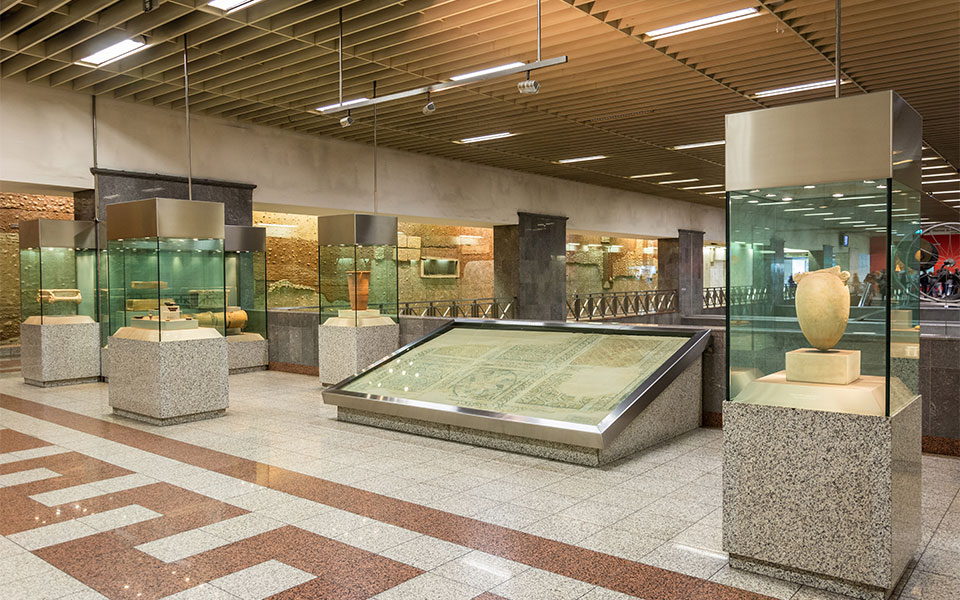
Interior of Syntagma station, featuring displays of archaeological finds.
© Shutterstock
The flagship of the Metro archaeology program, Syntagma Station (Red & Blue Lines) is a window into the deep history beneath modern Athens. A giant cross-section of soil layers – from the sub-Mycenaean period through Ottoman times – is mounted behind glass, a vertical timeline of the city. Displays include funerary objects from an ancient cemetery, a section of the Peisistratid aqueduct (6th century BC), the remains of a Roman bath complex, and part of a 5th-century AD mosaic floor. One highlight is the grave of a young woman from the 4th century BC, lying just a few meters below a 16th-century cistern.
If Syntagma shows Athens in layers, Monastiraki (Green & Blue Lines) captures it in flow. Excavations here revealed the vaulted bed of the Eridanos River, which once meandered from Lycabettus Hill across the Agora. In the early 2nd century AD, under Roman emperor Hadrian, it was covered over and converted into a sewer — and its arched stone channel is still visible in the station concourse. Around it lie remains of workshops, houses, and burials spanning from the Mycenaean era to the 19th century. According to myth, this river was where Phaethon, son of the sun god Helios, fell when struck down by Zeus’ thunderbolt.

Replicas of the Parthenon Sculptures on display at the entrance to Acropoli station.
© Shutterstock
As the gateway station for the Sacred Rock above, Acropoli (Red Line) offers both context and contrast. A gallery showcases artifacts uncovered during excavation, from children’s toys to amphorae once filled with olive oil and wine. Along the concourse, replicas of the Parthenon Sculptures accompany travelers on their way to the surface, a reminder of the treasures still contested at the British Museum in London. Don’t miss the striking photograph of a breeched Byzantine well discovered during tunneling, its pottery spilling into the modern shaft — a snapshot of history colliding with progress.
Heading west, Egaleo Station (Blue Line) brings you face to face with the Sacred Way, the ancient road that once carried processions from the Kerameikos in Athens to the sanctuary of Demeter and Kore at Eleusis. The stone-paved roadway lies exposed under protective cover, alongside a roadside cemetery with urns and sarcophagi. Display cases highlight ancient burial customs, with offerings placed beside the dead on their journey to the afterlife.
At Eleonas (Blue Line), the Metro cut across the Kifissos River, revealing the remains of a 2,500-year-old bridge – the oldest known in Attica. Three limestone piers survive from what was once a five-arched span, used for centuries to cross the river’s shifting course. Though weathered by floods, the stones now sit safely under cover near the station entrance.
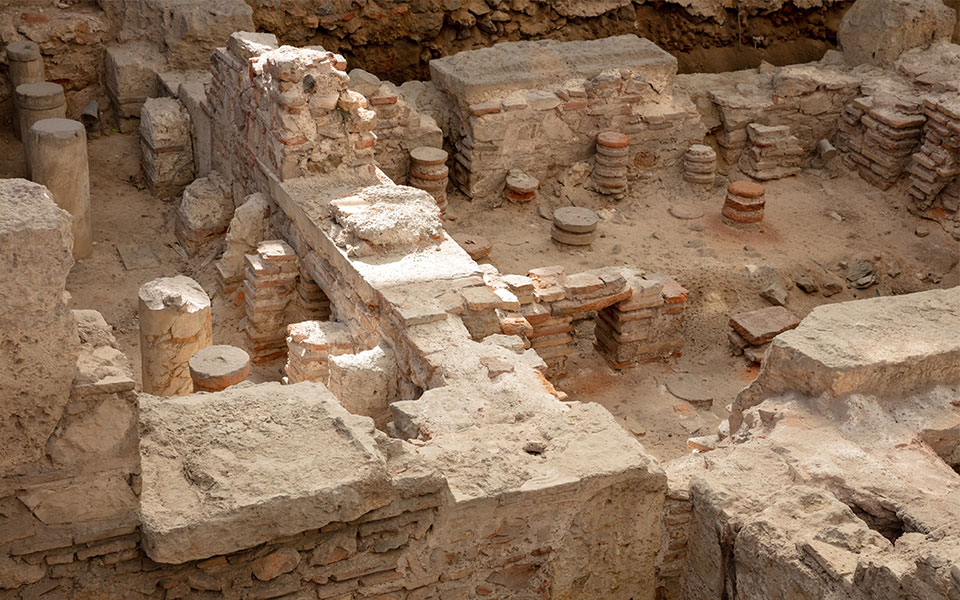
A section of an ancient Roman bath complex on display at Syntagma station.
© Shutterstock
Dafni (Red Line) offers a rare chance to see a reconstructed stratigraphic section, tracing human activity along the ancient road from Athens to Sounion. The excavation revealed a riverbed, covered over in the 1970s, with traces of domestic and agricultural life on its banks. Wells from the early periods, a Roman retaining wall, and layers of pottery all chart how this landscape was used from the 3rd millennium BC to modern times.
Smaller but no less fascinating are the displays at Evangelismos (Blue Line) and Panepistimio (Red Line). At Evangelismos, stratigraphic panels and artifacts reveal a cemetery, ancient roads, and a 6th-century BC water system built under Peisistratos, while Panepistimio (“university” in Greek) showcases grave goods from nearly 200 burials dating from the 5th century BC to the 4th century AD. The ceramics range from delicate perfume bottles to amphorae and clay lamps – poignant reminders of everyday life in the city’s quieter quarters.
For Athenians, these exhibitions fold the past into the daily commute. For visitors, they offer a chance to experience archaeology not as something taken out of its original context, but as part of the living fabric of the city. It is perhaps the most Athenian experience of all: stepping onto a train in the 21st century, surrounded by echoes of the ancient past.
The archaeological displays are free to view in the public areas of the eight Metro stations. Combine them into a day’s exploration or simply as an excuse to pause between museum visits. In Athens, even the subway doubles as a history lesson – no ticket required.
Among the many city eateries offering...

Amid neoclassical homes and narrow streets,...

Old and new hangouts, cafés, sandwich...

A monument of memory and music,...