At Lake Orestiada in northern Greece, an extraordinary Neolithic settlement offers a glimpse of everyday life some 7,500 years ago.
The morning is cool and still. A thin veil of mist hangs over the water as a dugout canoe slips quietly away from the settlement, its paddles dipping in and out of the lake. A black cormorant breaks the silence, crashing into the water with its wings folded tight against its body. Moments later, it surfaces with a tiny, silvery fish wriggling in its beak. Around the marshy shoreline, life stirs.
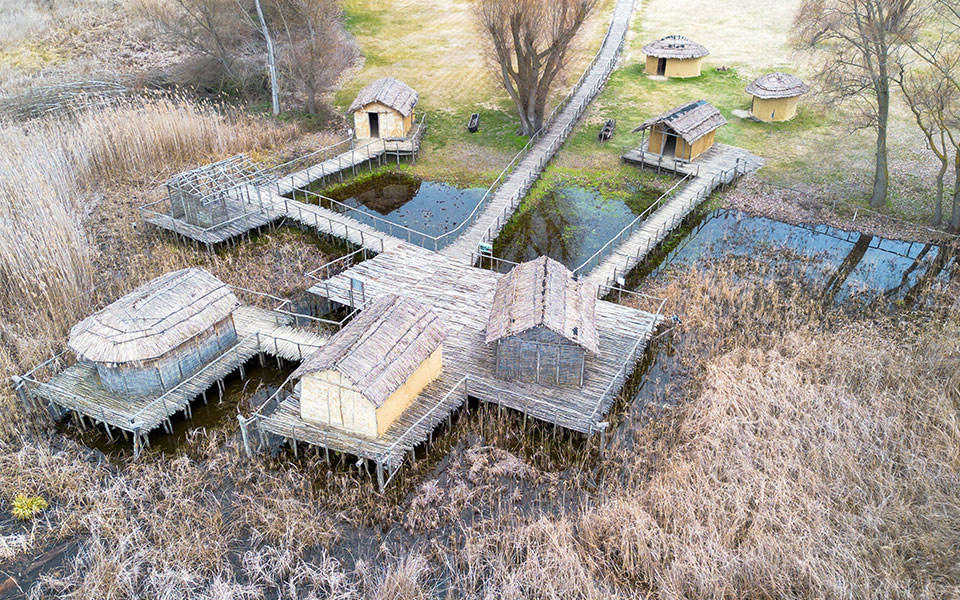
Their houses were built from wood, reeds and clay, raised on hundreds of vertical posts driven into the lakebed. They grew wheat, barley and legumes; kept domesticated cattle, sheep, goats and pigs; and fished, hunted and foraged in the surrounding wetlands. They made jewelry and figurines, fashioned tools from stone and bone, and even produced musical instruments – among them three flutes, considered the oldest in Europe.
Yet the people of Dispilio were already shaping a sophisticated settled life in northern Greece. And thanks to the exceptional preservation provided by the lake’s anaerobic, waterlogged sediments, they left behind an unusually intimate archaeological record of it.
An aerial view of the archaeological park on the southwestern shore of Lake Orestiada, showing the reconstructed dwellings and their setting beside the water.
© Shutterstock
The Neolithic Transition
Today, the archaeological site of Dispilio lies on the southwestern shore of Lake Orestiada, at a location known as Nisi (“island” in Greek), about 7 km from the city of Kastoria. To reach it is to leave behind the familiar postcard imagery of Bronze Age or Classical Greece – sprawling ruins, monumental architecture carved in stone – and enter a much older landscape.
The settlement was established during the Middle Neolithic, around 5600 BC, when farming communities were spreading and becoming increasingly established across southeastern Europe. By the Middle Neolithic (5800-5300 BC), farming communities were well established across mainland Greece. They lived in increasingly permanent settlements and developed mixed economies that combined agriculture and animal husbandry with hunting, fishing and the gathering of wild resources. Architecture also became more varied, with new house forms including the so-called “megaron-type” dwelling, while pottery, stone tools, decorative arts and other crafts became increasingly sophisticated.
Among the best-known Neolithic settlements are Sesklo and Dimini in Thessaly, where successive excavations have revealed substantial communities with complex architecture and rich material cultures. Dispilio belongs to this wider Neolithic world, but it stands apart because its inhabitants chose to settle in a very different environment: the marshy fringes of a lake.
It is this setting that makes Dispilio so important. It is one of the most significant Neolithic lacustrine settlements in the Balkans and provides an unusually detailed case study of how farming communities adapted to dynamic wetland environments and interacted with the landscapes around them.
Shallow waters and marshy fringes provided easy access to the lake’s freshwater resources. Dispilio was first identified in 1932, when unusually low water levels exposed wooden posts at the site.
© Shutterstock
A Time Capsule of Prehistoric Life
And then there is the preservation. At most archaeological sites, the materials of everyday life that were made from wood, plant fibers and other organic substances have long since disappeared. At Dispilio, the waterlogged, oxygen-deprived sediments created exceptional conditions for their survival. Construction elements, including over 900 waterlogged wooden piles, as well as botanical remains, animal and fish bones, and other fragile materials have been preserved alongside the more familiar pottery, stone tools and decorative objects.
The result is an unusually vivid “time capsule” of prehistoric life. Indeed, more than 1,700 complete or reconstructed ceramic vessels have been recorded, making the assemblage one of the largest complete Neolithic ceramic collections in Europe. More than 1,200 wooden construction elements have also been mapped in the site’s eastern sector.
The first archaeological clues emerged in 1932, when falling water levels exposed wooden posts at Nisi, the point where the former island became connected to the shore. Systematic excavation, however, began only in 1992, when Professor George Hourmouziadis (1932-2013) of the Aristotle University of Thessaloniki began large-scale investigations at the site. The excavations revealed hundreds of wooden posts, buildings and an extraordinary range of artefacts, providing the first systematic investigation of a Neolithic lakeside settlement in Greece.
Today, research continues under Professor Kostas Kotsakis, also of Aristotle University. Since 2014, an international team involving researchers from the universities of Bern and Oxford has been examining the settlement using techniques ranging from dendrochronology and micromorphology to environmental and climate reconstruction. The questions have consequently grown more ambitious: What was the landscape around the lake like? How did its inhabitants cultivate the land? What strategies did they use to manage their crops and animals? How did the climate change? And what impact did people themselves have on their environment?
The answers are helping archaeologists reconstruct not simply what the people of Dispilio left behind, but how they actually lived.
A snapshot of everyday life at Dispilio some 7,500 years ago, recreated using archaeological evidence.
© Shutterstock
Life by the Water
Recent research into the more than 74,000 bone fragments is shedding new light on how livestock was managed, including the use of cattle for both meat and milk. Fishing was another important part of daily life. The lake’s waters supported a variety of species, including carp and catfish, while abundant fish bones, bone hooks and other fishing equipment show that its resources were being systematically exploited. But the inhabitants were not confined to fishing from the shoreline. Several small boat-shaped models have been found at the site, while the surviving outlines of the gunwales of three larger craft indicate that dugout canoes once lay here too, their wooden hulls having long since disintegrated. Together, these finds offer tantalizing evidence of a community accustomed to traveling across the lake, whether to fish, hunt, gather resources or even visit neighboring settlements.
The houses themselves were built from materials available close at hand: timber, reeds and clay. Excavations have identified both circular and rectangular dwellings, together with extensive evidence for wooden platforms and other structural elements. Inside these homes, life revolved around food, craft and storage. Ceramic vessels were used for cooking and preparing food, while larger containers provided somewhere to store supplies. Stone tools included flint blades, grinding stones and implements associated with agriculture and other activities. Bone was fashioned into pins, needles and spatulas for working leather, as well as spoons and other everyday objects. A sickle blade tells us that someone harvested grain. A cooking vessel suggests a meal. A needle hints at clothing or leatherworking. A storage jar speaks of planning for a future day.
Taken together, these seemingly humble objects reveal a community whose daily routines were remarkably varied – and whose way of life proved remarkably resilient. Dispilio was not a short-lived experiment in lakeside living. The settlement was occupied from around 5600 BC through the Late Neolithic (5300-4500 BC) and Final Neolithic/Chalcolithic (4500-3200 BC) periods, with evidence of continued activity extending into the Bronze Age, perhaps as late as 2100 BC. For more than three millennia, generations of people returned to this watery landscape, rebuilding, adapting and making use of the lake and its surrounding wetlands. The settlement changed; the people changed; but the relationship with the water endured.
The Open-Air Museum, created in 1997-1999, offers a hands-on interpretation of Neolithic life based on archaeological research and evidence from the site.
© Shutterstock
Music, Memory, and a Highly Contentious Object
Perhaps the most intriguing discoveries at Dispilio are those that have nothing obvious to do with subsistence and survival.
Among the finds are jewelry, beads, and annulets made from marine shells, along with clay figurines depicting humans and animals. The figurines are difficult to interpret, but they may offer clues to how the inhabitants understood identity, age, gender and status, while their very existence suggests that symbolic expression was part of life at Dispilio. Such objects remind us that the people living beside the lake were concerned with more than food and shelter: they were also making things that represented, adorned, or perhaps helped them make sense of the world around them.
And then there was music. Three bone flutes have been found at Dispilio, possibly fashioned from the bones of large birds such as swans or eagles, alongside other sound-producing objects made from bone and clay. We cannot know what these instruments sounded like, or who played them, but their presence offers a wonderfully human connection across the millennia.
Then there is the object that has attracted perhaps the greatest attention: the so-called “Dispilio Tablet.” Made from a piece of cedar wood and radiocarbon dated to around 5200 BC, the object measures approximately 23 × 19.2 × 2 cm and bears a series of incised linear marks arranged across its surface. Similar markings have been identified on pottery and clay objects from Dispilio and on finds from other Neolithic sites in southeastern Europe, including the Vinča cultural sphere and the famous Tărtăria tablets.
The temptation to call these marks “writing” is irresistible. Some resemble familiar shapes – triangles, angles and lines that can look remarkably like letters to modern eyes. Professor Hourmouziadis went further, controversially proposing that the tablet represented an early form of “proto-writing.” At around 5200 BC, that would place it more than two thousand years before the earliest widely accepted writing systems of Mesopotamia. It is a remarkable idea but it’s one that remains unproven.
The apparent regularity of some of the incisions does not, by itself, demonstrate that they constitute a script. And while comparisons with later writing systems such as Linear A can be visually suggestive, resemblance alone cannot establish a relationship. There are other possibilities. The marks could have served some form of symbolic or practical purpose, perhaps to record quantities; alternatively, they may simply be the accumulated cuts and scratches produced by using a piece of wood as a working surface – a cutting board, for example.
That leaves the “tablet” in a fascinating archaeological limbo. For now, the most responsible description is also the most intriguing: we know when the wood dates from, but we do not know what its marks mean – or even whether they are writing at all. The object is now preserved in the archaeological collection of Dispilio, where it remains one of the settlement’s most enigmatic finds.
Open-Air Museum
The reconstructed lakeside settlement is now an open-air museum, with buildings based on archaeological evidence and furnished with reconstructions of objects and activities associated with Neolithic life in the wider region. Created in 1997-1999 as a complement to the excavations, the museum also includes a modern visitor center where three-dimensional reconstructions, virtual reality, augmented reality, and interactive displays draw on research by Aristotle University.
Just a short drive from Kastoria, Dispilio is easy to combine with a visit to the city and its lakeside setting. Autumn is an especially appealing time to make the trip, when cooler weather and changing colors around the lake offer a very different atmosphere from the high-season Greece of beaches and island ferries.
For more information, visit the Dispilio Lakeside Settlement website.

INFO
Opening hours: 09:00-17:00
Tickets: €5 general admission; €3 reduced; free for people with disabilities
Tel.: (+30) 2467.021910