The Capital’s Canopy: How Trees Shaped Athens
Athens has always been graced with...

© ILLUSTRATIONs: PHILIPPOS AVRAMIDES
Athens is not just a city. It’s a rhythm, an intensity, a lot of history, a lot of light – and yes, traffic jams. If you’re visiting for the first time and thinking about renting a car, the real question isn’t whether you can drive in Athens. You can. The question is: do you actually need to?
Let’s start from the beginning. Do you really need a car? The answer is: it depends.
A car becomes invaluable when Athens is your base and you plan to explore beyond the city limits: a sunset at the Temple of Poseidon, a day trip to Delphi, a weekend in Nafplio, beach-hopping along the Athens Riviera, or traveling out of town as a family with children.
If many of the above are on your must-see or must-do list, then, truth be told, a car gives you freedom.
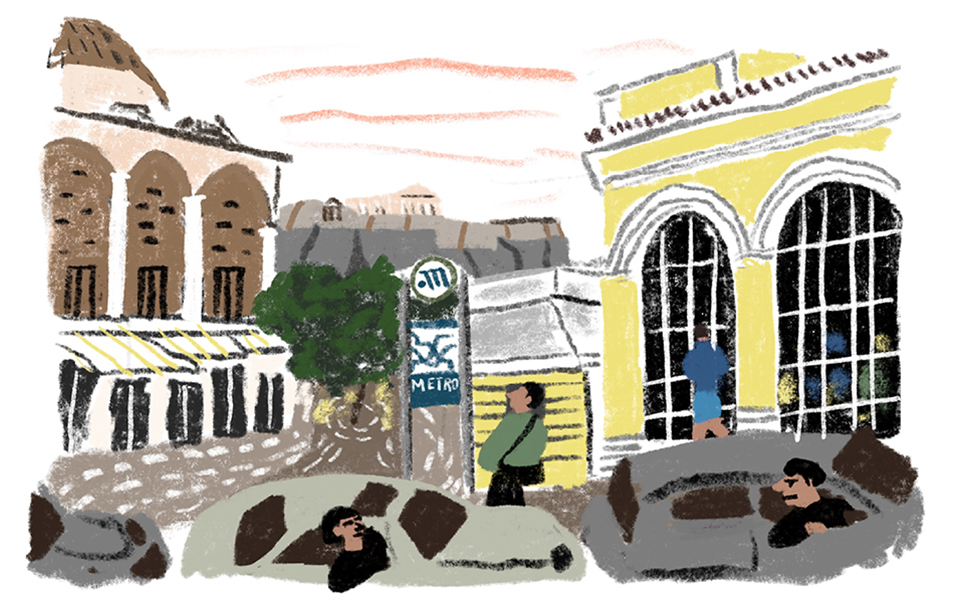
If you’re staying near a metro station and spending most of your time around Plaka, Monastiraki, Thiseio and Syntagma, a car will likely feel more like a burden than a convenience. Central Athens is walkable, although you’ll need to stay alert in places where sidewalks are narrow or sometimes even nonexistent (nothing like Barcelona, for example).
The metro, on the other hand, is fast, relatively clean, and reliable. Important note: we’re talking specifically about the metro – not the rest of the public transport network.
During rush hours (08:00-10:00 and 16:30-19:30), the city tightens up. If there isn’t a compelling reason to drive then, wait it out.

© ILLUSTRATIONs: PHILIPPOS AVRAMIDES
Airport
Renting from the airport is usually the easiest option. There’s greater availability, a smoother process, and it’s ideal if you’re heading straight out of Athens for a road trip.
The downside? Like at most airports around the world, prices can be slightly higher due to additional fees and surcharges.
City Center
Picking up a car in the city center makes sense if you’re spending a few days in Athens without one and only need it for one or two excursions. However, doing so requires good time management. You’ll also need to factor in the cost and logistics of getting from the airport to the city center – and back again – whether by taxi, private transfer or public transport. In many cases, when you add it all up, the total cost can end up being quite high.
Athens loves small cars. You don’t need an SUV to drive to Sounio, you need flexibility. If not a Category A (Economy) car, then a Category B (Compact) is usually more than sufficient. It keeps your budget in check and makes navigating the city much easier. Remember: Athens has narrow streets, limited parking, and steep inclines in many neighborhoods.
In general:
Bottom line: think practical, think compact, and you’ll thank yourself later.
When renting a car in Athens, the fine print matters. Make sure you understand:
In Greece, thanks to nationwide interoperability, all toll transponders work across the country’s highways. For example, e-Pass (used on Attiki Odos) can be used at toll stations nationwide, regardless of the motorway operator. That makes road trips much simpler.

© ILLUSTRATIONs: PHILIPPOS AVRAMIDES
Pay serious attention to peak hours. Traffic isn’t just heavier – it’s compressed. Travel time can become unpredictable, and even short distances may take far longer than expected.
They will pass you on the left, on the right and between lanes. This is normal. Maintain a steady line.
The same – or sometimes more chaotic – applies to cyclists and, increasingly, to electric scooter riders. Stay alert.
Don’t enter them. Fines are real and increasingly enforced through cameras. Over the past few months, enforcement has tightened and penalties have increased significantly.
And forget any idea of combining alcohol and driving. Even one drink can put you over the limit.
Yes, they may cross in the middle of the road. Yes, they’ll do it confidently – and possibly complain about you while doing so.
Drive defensively, not aggressively. Pay attention to crosswalks, even if local drivers don’t always do so (many seem to remember them only when traveling abroad).
Expect:
It’s not chaos on an Asian megacity level. It’s more like urban driving choreography with a distinct Balkan flair.
On main arteries, signage appears in both Greek and Latin characters. On smaller streets, that’s not always the case.
Priority is often given to vehicles entering the roundabout (or traffic circle) unless the signage states otherwise, but don’t assume; always check.
Athens applies a traffic restriction system (the “Ring”) during certain periods and hours to reduce congestion in the city center. Rental cars are usually exempt, but you should confirm this with the rental company.
Athens operates resident and visitor parking zones.
Read the signs carefully and check the hours. You cannot park in designated spaces marked “P – Resident Permit Holders Only.”
Tip: Download the very user-friendly myAthensPass app. It costs just €0.50 per half hour and allows you to park legally in spaces marked “P – Paid Parking.”
The paid parking schedule applies:
The app clearly indicates when parking is free, which takes away the anxiety of wondering whether you’ve done everything correctly.
In the city center, this is the least stressful option. It costs more, but it saves time and wear and tear on the nerves.
There are now municipal parking garages in Athens, including those at Klafthmonos Square and the Varvakios area, often with better pricing. Apps such as ParkAround allow you to compare locations and prices.
Parking tickets – and even license plate removal – are not urban legends.
Driving in Athens isn’t frightening, but it can come with surprises.
If you see it as part of the experience – like watching the light fall on the Acropolis or catching a sudden glimpse of the sea along Poseidonos Avenue – then a car becomes a tool of freedom. If, however, you came to wander through alleyways, walk without a plan, and stay within the downtown area, forget about the vehicle. Either way, Athens will show you its rhythm. The question is whether you want to drive to that beat, or walk to it.
If you’re arriving by road from a neighboring country, make sure your insurance covers Greece. If not, request that coverage. In Greece, this is called a Green Card – a simple and usually cost-free process.
Winter tires are not legally mandatory in Greece as they are in many Balkan countries and further north. However, you are required to have snow chains (or “snow socks”) during winter travel in certain conditions. In spring, summer, and autumn, these precautions generally don’t apply.
Athens has always been graced with...

Echoes from history meet everyday life...

New venues show how the city...

Exploring the eateries, stories, and shifting...