Five Greek Archaeological Sites Nobody Visits (But Should)
These sites may not make every...

© Angelos Giotopoulos
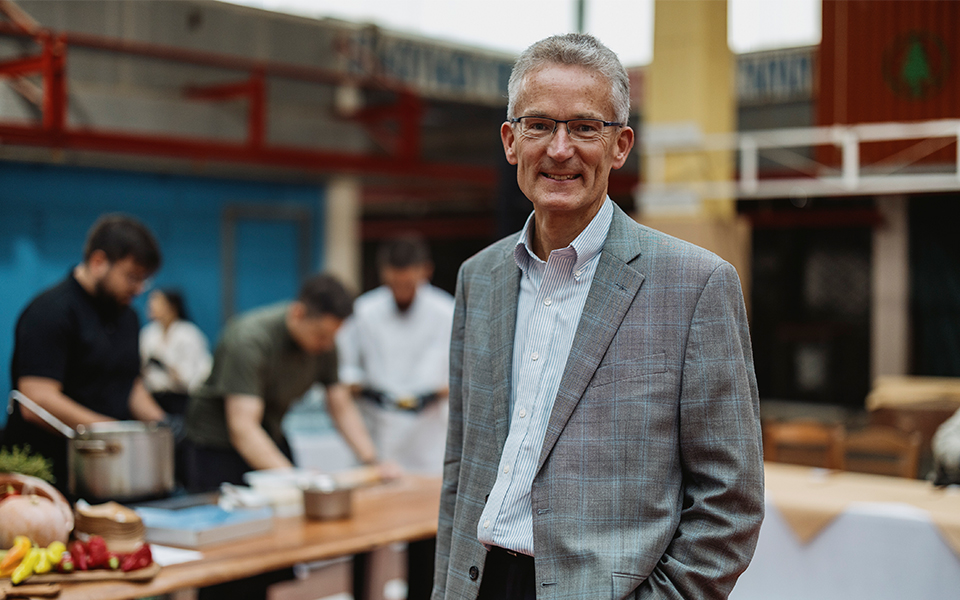
The Culinary Institute of America (CIA) is one of the world’s leading institutions for culinary education. Its main campus is in Hyde Park, New York, with additional locations in California, Texas and Singapore. Its more than 55,000 graduates, among them Anthony Bourdain, Jean-Michel Tusk, Grant Achatz and Roy Yamaguchi, have shaped the global culinary landscape. In recent years, the CIA has deepened its connection with the Mediterranean diet through its collaboration with the University of Barcelona to establish the Torribera Mediterranean Center, dedicated to Mediterranean food, culinary innovation and health.
Bakker’s vision focuses on sustainability, innovation and the integration of business thinking with gastronomy and global food systems. We met him at the bustling market of Kalamata. This was not his first encounter with the region, as the CIA frequently co-organizes educational programs with Costa Navarino, emphasizing experiential learning around Mediterranean cuisine, sustainability and agrifood in the earthly paradise that is Messinia.
Your career includes leadership roles in food and beverage at major organizations such as Starwood Hotels & Resorts and Google. Do you see more similarities or differences in the way people in hospitality and technology approach food?
There is certainly a wide range of views about the role and function of food. But whether you’re in hospitality, technology or education, you’ll always find people who understand both the joy food brings and the impact it has. If I focus on that, I would say I see more similarities than differences. What I’ve come to deeply appreciate is the power of food. It is incredibly personal and, at the same time, profoundly social. Food is an art form, but it is also a business. You need to understand both sides if you truly want to serve it well. And there is always room for change, even in environments where you might not expect it.
When I took over Google’s “Food at Work” program and suggested serving salads at breakfast, there were plenty of raised eyebrows. But we encouraged our chefs to create delicious combinations and positioned the salads strategically at the start of the buffet. As a result, employees not only accepted the idea of salad for breakfast, they were inspired to start their day with something both flavorful and healthy.
Why is the Mediterranean Diet so popular in the United States, and where does it stand among the so-called planetary diets?
The Mediterranean Diet is certainly among the diets that support both human health and the health of the planet. It is, in fact, the most extensively researched diet in the world, and it encompasses a remarkable range of regional variations. There really isn’t another dietary pattern that is both so diverse and so well studied. It’s an excellent starting point for anyone who wants to live a healthier life.
Beyond that, I think we human beings tend to romanticize what we don’t have or what we believe once existed. Americans, in particular, romanticize the Mediterranean and see it as a kind of magical place. Yet, as globalization accelerates, the reality is that people in the Mediterranean are gradually losing important elements of their traditional lifestyle. And that’s unfortunate, because the region continues to produce extraordinary ingredients.
When in Greece, I love eating salads and roasted vegetables. One of my favorite combinations is simply fresh bread with olive oil. And what I truly appreciate about Mediterranean cuisine is that you get to enjoy many different dishes in a single meal.
We’re fortunate to enjoy the richness of Mediterranean cuisine, but could planetary health become a reason to promote synthetic food?
I would find it dreadful if there were a single global diet for every person in every country. And I don’t think it would be practical either, because we will always enjoy local ingredients and local food traditions.
To me, the essence of the planetary diet is becoming more aware – whether you’re a cook, a nutritionist or simply a consumer – of the impact of what you choose to eat. It’s less about the specific foods you eat on any given day and more about the lifestyle you adopt over time.
Most people confuse the idea of a “diet” with a weekly menu. But a diet, in my view, is much broader: it includes both your good choices and your small indulgences. In that same spirit, a planetary diet must look different in every region, always with the aim of preserving the joy of eating.
How much do you think food will change in the next five or ten years?
It’s hard to quantify, because food is first and foremost local. What might change here in Kalamata could evolve very differently – and at a different pace from what happens in Rome, Athens, New York or London.
What does accelerate change is that younger generations are now more connected to people their own age across the world than to their local roots. Older generations tend to continue living and eating much as they always have, but that isn’t necessarily the case for Gen Z or Gen Alpha.
Whether these younger generations will eventually feel a pull back to their roots is something we simply don’t know yet.
We’re also seeing many young people on Instagram showcasing Mediterranean grandmothers’ recipes. Could we consider this a trend?
I think what we’re seeing is simply a different way of connecting with previous generations; one that fits the realities of social media. It’s also an opportunity for society to pass on cooking skills to the next generation in a way that resonates with younger people.
But beyond what a grandmother cooks, there’s an deeper cultural dimension. A grandmother cooks to offer her food and to bring her family together around the table. And we shouldn’t forget that family meals are no longer the norm for many people, who often eat alone.
How would you comment on the fact that recipes themselves change as they adapt to the needs of the platforms on which they are promoted? TikTok and Instagram now showcase a very different kind of recipe compared to television or cookbooks.
It’s certainly an interesting development. The world has always evolved, and what we’re experiencing now is simply the next wave of change. But before we even get to trends, the first step for anyone studying the culinary arts is to understand the techniques and the science of cooking. Once you have that foundation, you have the freedom to do whatever you want – and that’s how cuisine evolves.
From the guest’s perspective, things can be a bit trickier. A dish that looks spectacular on TikTok or Instagram isn’t necessarily pleasurable to eat. It can be fascinating to watch how quickly restaurant dishes change as a result of visual exposure on social media, but the essence always lies in the relationship between the cook and the people he or she is cooking for.
You emphasize the need for leadership development in the food and beverage world. Could you give us some practical examples of how the Culinary Institute of America interprets this idea?
Our industry absolutely needs leaders who can model a different way of thinking. At the CIA, we established the Centre for Food and Beverage Leadership, and through collaborations with American and European universities we’re working to change how professionals approach sustainability and the impact of food on human health and well-being.
The Menus of Change initiative is a powerful example. Together with Stanford University and roughly 80 universities across the United States – and a few around the world – we’re actively exploring ways to reduce our carbon footprint using food itself as the tool. One of the most successful outcomes is the “blended burger,” a burger made with 30% mushrooms and 70% meat. It’s incredibly delicious, and at the same time it significantly reduces carbon emissions.
This is exactly the type of work that shows how culinary leadership can have a tangible, measurable impact.
What is the role of chefs in initiatives like these?
We want the choices chefs make every day to have the greatest possible impact. My hope is that the next generation of chefs will become conscious culinary leaders who think critically and are aware of the significant influence they have on others.
When you go to a restaurant, the choices you make are shaped first and foremost by the chef, because he or she has created the menu. A chef should therefore think deliberately about the values that guide what goes onto that menu. Every choice has an impact locally and globally and it affects the health and well-being of the people who ultimately enjoy the food.
That awareness is at the heart of what we’re trying to cultivate.
The “planetary diet” is a dietary framework designed to answer a central question: how can we feed the global population by 2050 without exhausting the planet’s natural resources? It is based primarily on plant-forward eating – vegetables, fruits, legumes, nuts and whole grains – while sharply limiting the consumption of red meat, processed foods and added sugars. Its philosophy centers on balancing human health with environmental sustainability, aiming to reduce greenhouse-gas emissions, deforestation and water waste. The Mediterranean diet is considered highly compatible with the principles of the planetary diet, as it combines healthy eating with respect for the environment and local production.
These sites may not make every...
Exploring the eateries, stories, and shifting...

From postmodern bougatsa to wood-fired pizza...

Discover festivals, beaches, food, and hidden...