Your 3-Day Guide to Andros Island
Shady hiking trails, a vibrant cultural...

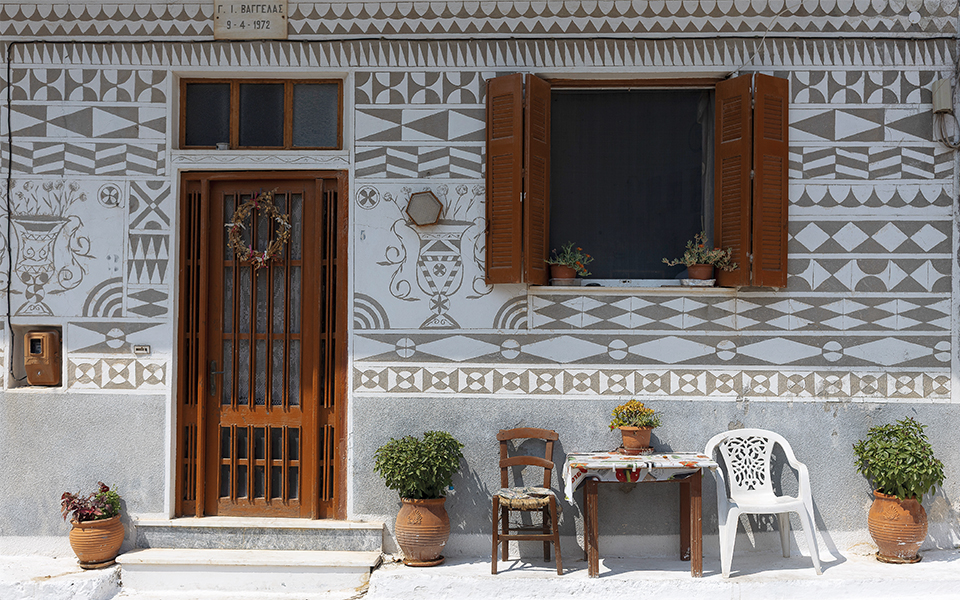
One of the many houses decorated with intricate xysta in the medieval settlement of Pyrgi.
© Dimitris Tosidis
At the heart of this medieval village in southwestern Chios, a young Chinese woman fans herself with rapid strokes, seeking relief from the island’s summer heat. She is dressed in a traditional local costume – heavy and ornate, despite the weather – as part of a travel campaign shoot designed to promote this North Aegean island to her compatriots back home.
Just a couple of tables away in the shaded main square, two brothers from Turkey gently help their elderly grandmother into a chair. Behind them, a group of ten Spanish-speaking visitors from South America stand captivated by their guide, who recounts the centuries-old history of the Church of the Holy Apostles, Pyrgi’s most iconic monument.
Pyrgi is one of the island’s most visited villages. Its appeal lies both in its size – it’s one of the largest of the so-called Mastihohoria, the mastic-producing villages of Chios – and in its designation as a preserved medieval settlement. Yet the village’s greatest draw is undoubtedly its xysta, the unique technique of decorating building façades with monochrome geometric patterns; it’s a phenomenon found nowhere else in Greece. The moment visitors step into the maze-like alleys of the old fortified heart of the village, cameras and smartphones are instantly raised.
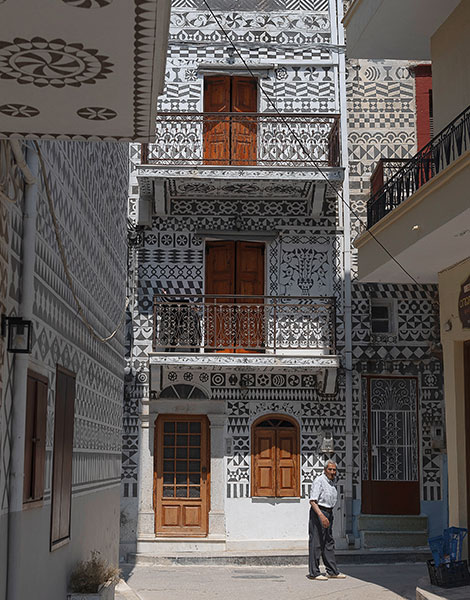
A spot in the medieval settlement where the walls are covered with xysta – the designs also appear beneath the balconies.
© Dimitris Tosidis

Chios-born architect Maria Xyda has extensively studied the origins and practices of this folk art.
© Dimitris Tosidis
For decades, scholars, filmmakers, journalists and even doctoral researchers have sought to unravel the how, the when and the why of this remarkable folk art, of which the locals are immensely proud. The village’s history stretches back centuries. The earliest written reference to Pyrgi dates from 1362, although some sources trace its existence to the 11th century. In the 14th century, when the Genoese took control of Chios – along with the island’s agricultural production and lucrative trade – they built Pyrgi in its present form, as a kastrochori, or “castle-village,” alongside other mastic-producing settlements such as Mesta, Olympi, Vessa and Kalamoti. (Fifteenth-century Italian maps made note of the fortifications.) These fortified outposts served to safeguard the island’s masticha, or “white gold,” from pirate raids.
The tall central tower dominated the settlement, from which houses spread outward in concentric fashion, forming a defensive perimeter. Thick outer walls enclosed the village, creating a stone-built stronghold. This medieval urban design, which remained intact during the Ottoman period and even after Chios’ liberation in 1912, survives to this day. There are no cars in the narrow vaulted alleyways, and the thick-walled stone houses, their flat façades pierced only by small windows, abut one another seamlessly – all features dictated by their defensive purpose.
During the 1960s and ’70s, renowned architect Aris Konstantinidis, serving as director and special advisor to the Greek National Tourism Organization (EOT), recognized the value of Chios’ medieval villages and oversaw studies for their restoration and conservation. The unique decorative façades of Pyrgi – its xysta – began to be formally appreciated as a vital element of the island’s cultural heritage. However, as the medieval settlements of Chios were only declared protected heritage sites in the 1960s, in a move that introduced strict preservation rules, some houses do display uncharacteristic small balconies or larger windows – architectural features added to the original structures before the enactment of these regulations.
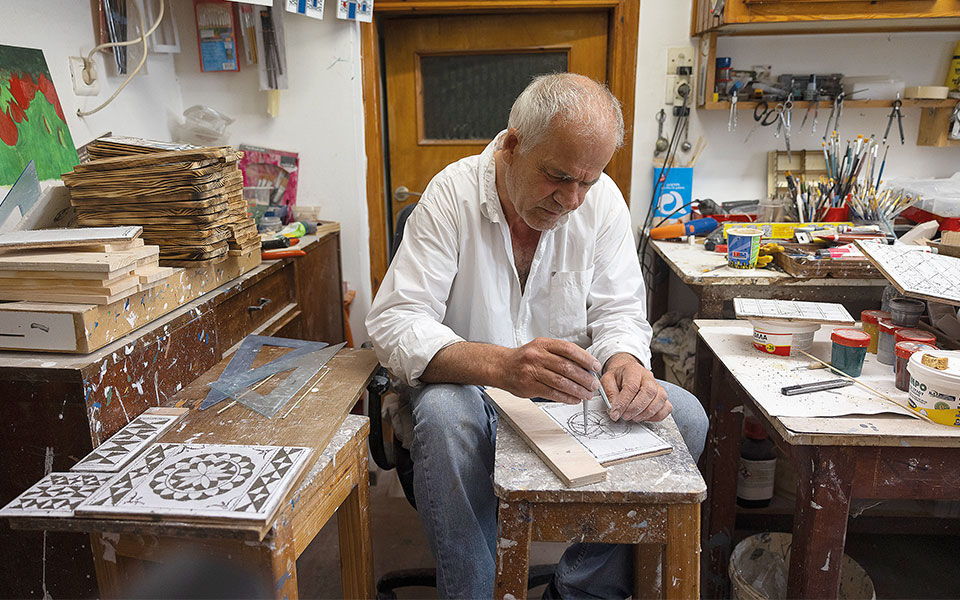
Giannis Benetos creates framed artworks and souvenirs in his workshop using the same technique that replicates the wall xysta.
© Dimitris Tosidis
One of the first architects to study the xysta, Chios-born Maria Xyda, offers a fascinating perspective on their origins. “We don’t know precisely when they first appeared in Chios,” she explains. “In Byzantine icons preserved in Cappadocia, we see depictions of houses adorned with similar motifs. We also know that, during festivals, it was customary to hang beautiful fabrics and carpets to decorate the homes. It is quite likely that people here did the same, until at some point they decided to paint the patterns directly on the walls. In fact, older examples of xysta feature small tassels at the base, resembling those found on traditional kilims.”
The technique itself, she adds, is not unique to Chios. “We find decorated façades in Switzerland, Italy and Spain, accomplished using the same process, although the themes differ.” In Pyrgi, this art form has reached a level of refinement and symbolism that makes the entire village a living canvas, where time, memory and craftsmanship are etched in stone.

Older xysta are dominated by geometric patterns. It is also said that ochre was originally used instead of white, which prevailed in the second half of the 20th century.
© Dimitris Tosidis
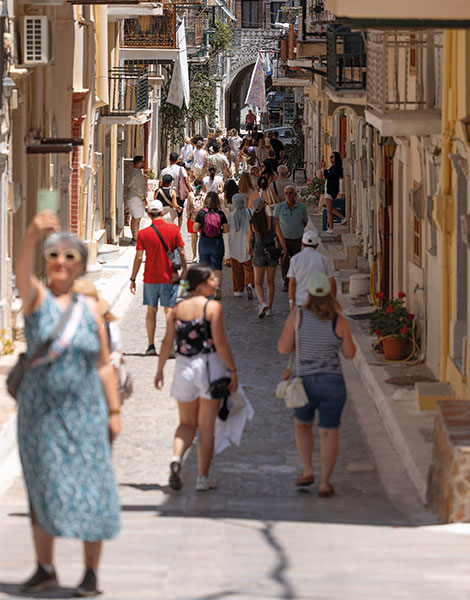
Almost everyone visiting Chios makes a stop in Pyrgi to admire the art of xysta up close.
© Dimitris Tosidis
Chios is poised between East and West, and influences on the island are many; no one can say with certainty exactly where the xysta began or who started the practice. In Italy, the word “graffiti“ comes from the verb “graffiare,” meaning “to scratch,” and the patterns there often mimic masonry rather than serving a purely decorative function. In Pyrgi, by contrast, the walls are covered with geometric designs – rectangles, half-moons and diamonds – alongside motifs drawn from nature, such as flowers, birds and ornamental flourishes with an unmistakable Eastern flavor. What is certain is that this form of folk art reaches back countless generations and survives today only thanks to knowledge handed down from master to apprentice.
Most of the xysta that one encounters while wandering Pyrgi’s narrow lanes date from the 19th and 20th centuries. In 1934, the façades of the buildings around the central square were decorated with xysta thanks to the initiative of Philippos Argenti, who financed the work of craftsmen Nikolaos and Konstantinos Kountouris. The village’s community hall was adorned in the mid-1980s by artisans Yiannis and Kostis Pantelakis, while the xysta on the façade of the Kolombos residence – one of Pyrgi’s oldest surviving houses – were restored in 2000 with funding from a European program. Today, the tradition continues in new forms; local artist Giannis Benetos, for example, brings the technique into his workshop, where he designs xysta on framed panels and canvases, keeping the art alive on a more intimate scale.
In Pyrgi, every wall tells a story. Each line and pattern is more than decoration; it’s an imprint of memory, a coded language of resilience and pride. Here, time is not merely recorded in books or archives; the village itself has become both canvas and chronicle, a place where history is carved into the very fabric of everyday life.
© Dimitris Tosidis
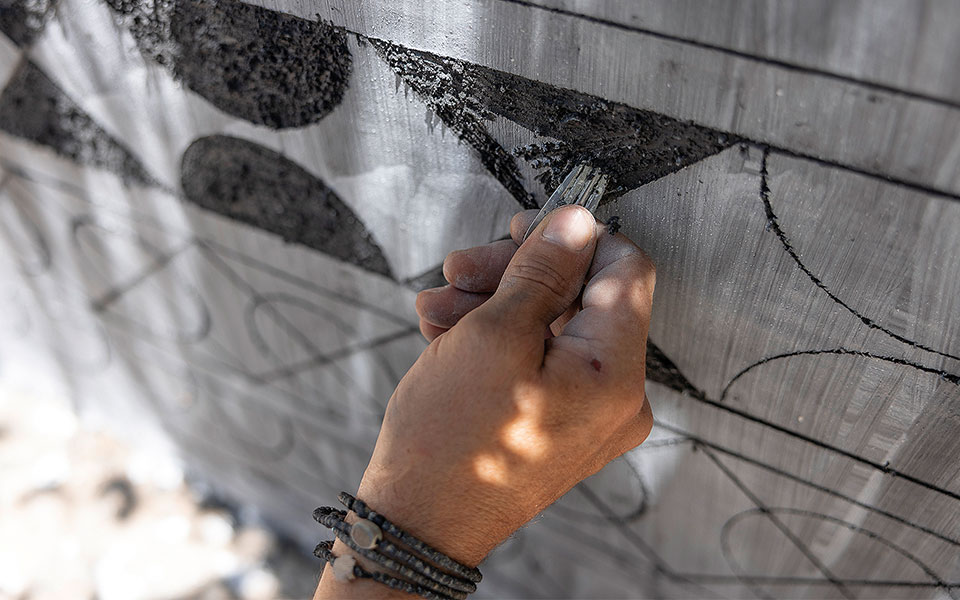
Following a family tradition is Michalis Pantelakis, among the few remaining craftsmen who still practice the art of xysta; as we watch, he demonstrates the technique. The process begins with a base layer of sand, black cement and lime, spread across the surface and left to dry. Humidity plays a decisive role here: without the right atmospheric conditions, the work can falter. Over this base, a thin coat of white lime is applied and, with nothing more than a straight edge and a compass, the geometric designs are laid out. The artisan, patiently working with a fork-like tool, decides which sections to leave white and which to scratch away to reveal the darker layer beneath. As the white lime dries in the sun, it grows brighter, and the contrast between light and dark becomes ever sharper.
Not all residents are pleased with the rules that govern this heritage. Pyrgi villagers often lament that the Archaeological Service does not permit new xysta on the façades of medieval houses. Parisianthi Valakou, head of the Byzantine and Post-Byzantine Antiquities and Museums Department of the Chios Ephorate of Antiquities, explains: “The aim is to preserve the integrity of the medieval settlement, so no alterations are allowed. Xysta can be added only to new buildings, or to those with evidence they once bore them.”
“Of course, the Archaeological Service decides based on historical and scientific criteria,” Xyda adds. “But in every village, folk art is also bound to people’s emotions. For the people of Pyrgi, xysta are not merely decoration – they are a form of expression, part of their identity.” She notes that Pyrgi’s xysta can be found far beyond the village itself – in Haidari, a suburb of Athens where Pyrgiots have settled; and even in America. Within the village, xysta decorate structures such as the village stadium, a church, and family tombs in the local cemetery. For many locals, these patterns are not just xysta; they are “Pyrgiot motifs” – symbols of identity and belonging.
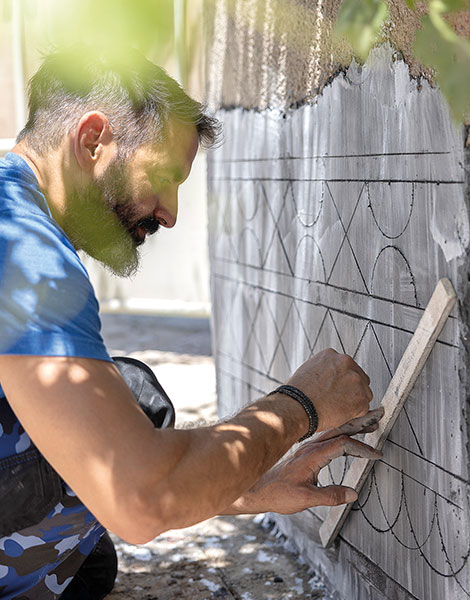
Michalis Pantelakis patiently scratches the white lime with a fork-like tool.
© Dimitris Tosidis
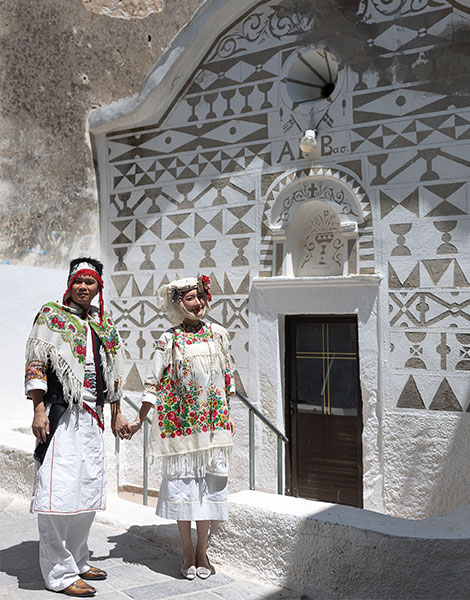
A young Chinese couple poses for the camera for a travel agency campaign from their home country.
© Dimitris Tosidis
Precision and speed are what impress most. “The craftsmen of Pyrgi possess an extraordinary command of geometry. They handle their material with ease, carving out intricate designs without a single miscalculation,” notes Xyda. This, in fact, is why mathematician and social anthropologist Haroula Stathopoulou chose to study xysta through the lens of ethnomathematics – the field that explores how the political, social, and cultural conditions of a community shape the mathematical knowledge it develops, and how tradition meets necessity.
“In earlier times, people created xysta simply to decorate their homes – and perhaps because in their fortified settlement with few windows, social life unfolded outdoors, in the narrow lanes,” Stathopoulou says. “Today, the desire to attract visitors, together with its role in supporting local identity, ensures that this folk art continues.”
She highlights what she calls “theorem in practice,” explaining that “the artisan employs essential mathematical concepts without formal knowledge. The skill comes from experience and apprenticeship. Most craftsmen cannot explain precisely why they do it, yet they do it correctly. The symmetry in xysta is absolute, both axial and central. We even see the golden ratio at work; in many of the rectangles, the proportion of the longer to the shorter side satisfies its condition. Perhaps this arises instinctively, but the harmony is there.”
Indeed, most of Pyrgi’s façades old and new radiate this sense of balance and mathematical order, a quiet compliance with timeless rules that are inscribed, often unconsciously, on the wall itself. And it is this harmony – born of skill, tradition and instinct – that draws visitors from across the world to marvel at a village where geometry and memory converge, and where striking designs from the past still shine forth.
Shady hiking trails, a vibrant cultural...

With its beautiful olive groves, emerald...
At any time of year –...
Just an hour from Athens, Kea...