Nefeli Nine Retreat: A Wonderful Week of Slowing...
We spent seven days at Nefeli...


Above the village of Drosato, on the slopes of Mount Karava, near the chapel of Profitis Ilias, stretches a rare forest of centuries-old prickly juniper trees.
© Olga Deikou
The Agrafa Mountains in Thessaly combine dramatic mountain landscapes with a rich history and a way of life that has changed considerably over the past century. The region is associated with figures such as Georgios Karaiskakis, who used the mountains as a base, as well as with the so-called “government of the mountains,” which operated there in the summer of 1944.
Local lore also tells of gold sovereigns hidden in the mountains by Civil War guerrillas. “In the old days, we didn’t come down to the river for enjoyment. We came to fetch water or wash the wool after shearing the sheep. We didn’t see the beauty of the landscape then; we saw how hard we had to work,” says Irini Bistitzanou, president of the Petrilo Cultural and Educational Association. Petrilo is the first village we reach in Argithea after a winding drive of about half an hour from Mouzaki, in the Karditsa region.
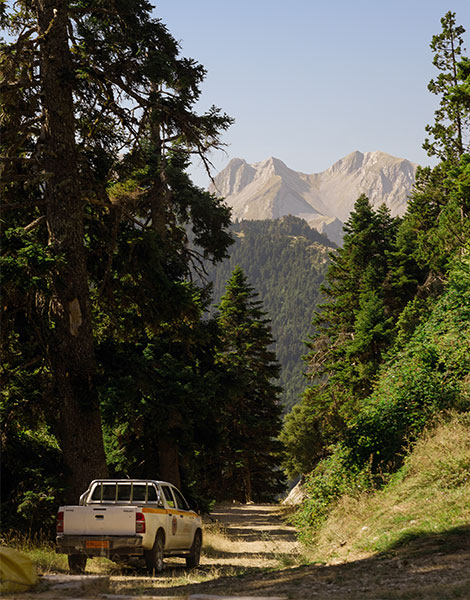
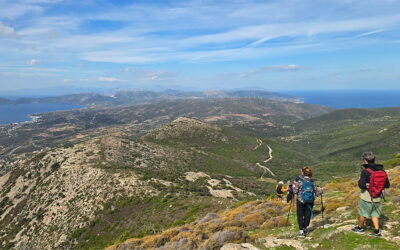
Forest trails with views of Delidimi Peak, the second-highest in the Agrafa Mountains, on the border between Karditsa and Evrytania.
© Olga Deikou

Restaurateur Vaios Pozios wearing the traditional cloak of the region’s shepherds.
© Olga Deikou
Petrilo, known locally as Petrilia, differs from the traditional Greek settlement organized around a central square or church. Instead, its eight main settlements and scattered houses extend across two mountains, forming a distinctive horseshoe shape. at an altitude of 1,150-1,200 meters. The wider Argithea area is equally sparsely populated. Evidence of its former population and activity can still be found in its hundreds of churches, old watermills and dozens of schools. Today, none of the region’s 20 remote villages has a functioning school, and many are largely deserted during the winter. The landscape, by contrast, remains remarkably rich. In fall, before temperatures drop and most residents head down to the lowlands, forests of fir, chestnut, walnut, beech and maple burst into a succession of colors, while rare junipers add to the diversity of the terrain. Monasteries, stone bridges, waterfalls, old cafés beneath centuries-old plane trees and Lake Stefaniada are among the attractions accessible by hiking trails and other outdoor activities.
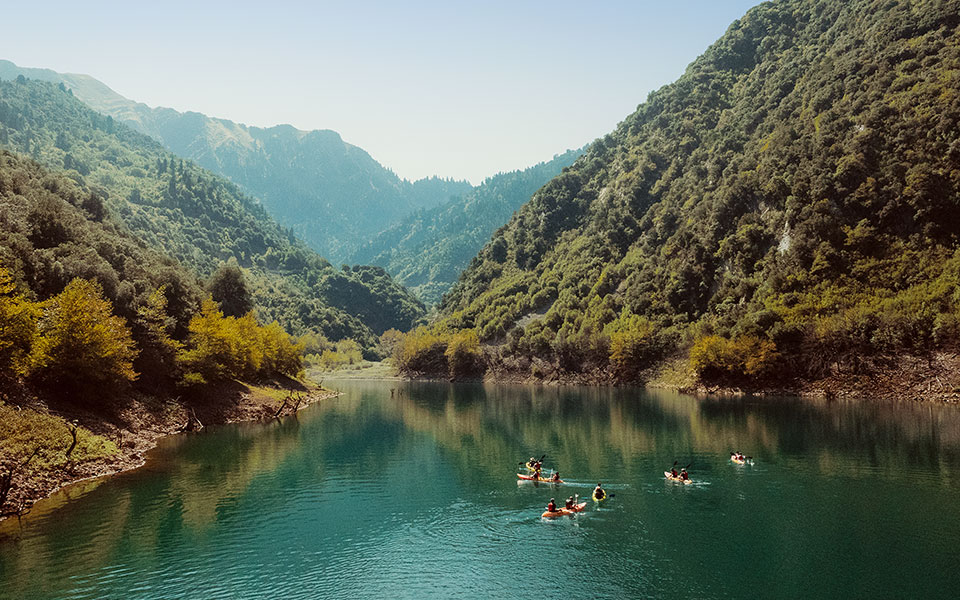
Paddling with Finix Adventures on Lake Stefan iada, Greece’s youngest natural lake, formed by a landslide in 1963.
© Olga Deikou
Lake Stefaniada is one of the region’s most unusual natural features. It was formed in the winter of 1963 after a month of torrential rainfall triggered landslides and caused tributaries of the Achelous River to overflow. Today, the lake is considered the youngest natural lake in Greece. Its turquoise waters, surrounded by steep, largely undeveloped slopes and partially submerged trees, have also made it a destination for outdoor activities including kayaking and swimming. Among those working to develop sustainable tourism in the area is mountain guide Vasiliki Koimtzidou. Originally from Xanthi, she has worked in alternative tourism since 2013 and has lived in Argithea since 2020. “The unspoiled nature won me over – the wildness and purity of a place where I could practice ecotourism as I envisioned it,” she says. Koimtzidou organizes kayaking tours on Lake Stefaniada and a range of other outdoor activities, from archery and horseback riding to gorge crossings and mountain climbs.
Together with her colleague Andreas Athanasiou, she is also involved in an initiative aimed at encouraging people to leave urban areas and settle in the region. Their vision is to establish an ecocommunity in which residents support one another, maintain a high quality of life and contribute to the revitalization of the area. “For me, what I do isn’t just a job; it’s a way of life and a philosophy,” Koimtzidou says. Her approach is centered on sustainability and on promoting Argithea without compromising its natural environment. “What matters is that nature regenerates faster than the rate at which people leave their mark,” she says.
© Olga Deikou
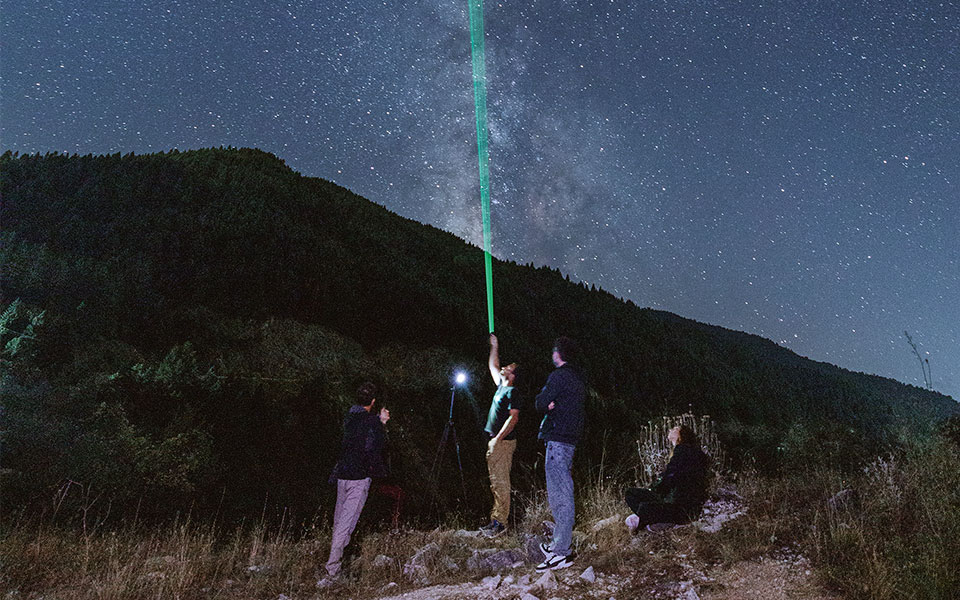
Vasiliki first came to know Argithea through mountaineer Konstantinos Vasilakakos, who comes from the Vasilades settlement of Petrilo. He was the first to decide to live year-round in his ancestral village and share what life in the mountains is like. “There are no difficulties; it’s all a matter of how you approach things,” he says as he sets up his equipment to guide us through the night sky beside the Tyrologos Gorge, where the Petriliotis and Vlasiotis streams meet. Konstantinos has been photographing the starry sky for 13 years and, though self-taught, now organizes stargazing and astrophotography sessions.
With almost no light pollution, we can see millions of stars overhead as he points out the constellations Aquila, Lyra and Cygnus. “Humans aren’t able to see light day and night. Our eyes have lost some of their sensitivity to light because of the intense light pollution and constant exposure to artificial light we experience in cities,” he explains. He asks us to put our phones away for a while to observe the sky without artificial distractions. In addition to his stargazing tours in Petrilo, Konstantinos organizes stargazing camping trips on Mount Tsmi, at an altitude of 1,911 meters, when weather permits – usually from May through October.
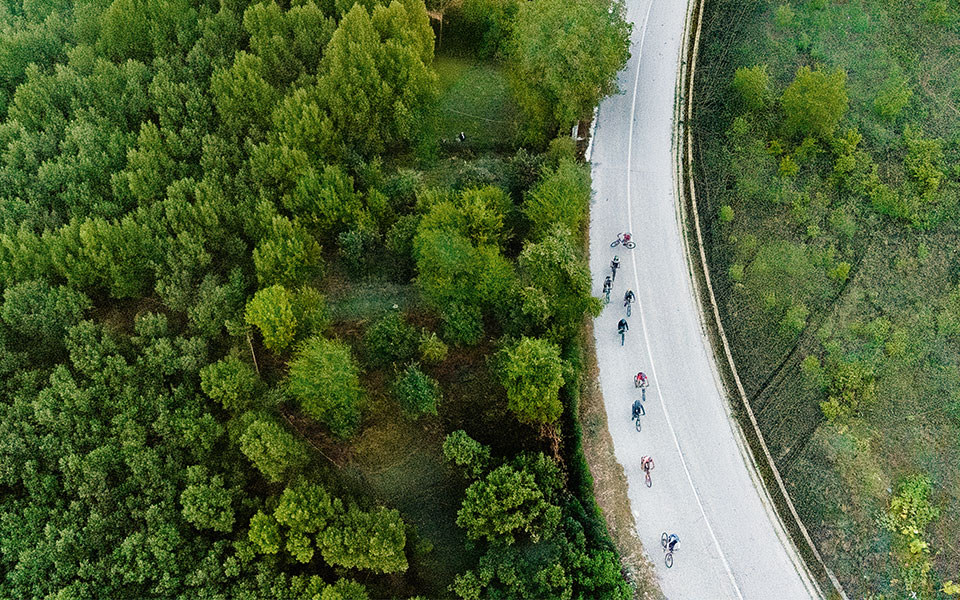
“The Agrafa are among Greece’s least explored mountains. They don’t draw the same crowds as the Tzoumerka, Smolikas or Olympus. You can cycle for miles without meeting anyone,” says Ioakeim Georgiou, who organizes cycling trips with the Hardtailers. The group began in Thessaloniki in 2017, when three friends decided to combine cycling and exploration. It has since grown into a large community whose members ride even in the most remote mountains. “We don’t climb just to race back down. We want to enjoy the route, visit a museum, hike down to a waterfall, try outdoor activities and discover everything the mountain has to offer.”
Despite the name, the group is no longer limited to riders of hardtail mountain bikes – bicycles without rear suspension. Electric mountain bikes are also welcome. “The only requirement is a positive attitude, so we can enjoy ourselves even in tough conditions, when we’re riding long distances through rain or mud.” The Agrafa cycling route begins at Lake Plastiras, crosses the historic Niala ridge and descends to the Agrafiotis River before completing a 120-kilometer loop. The three-day route combines paved and dirt roads with significant climbs and descents, passing through some of the region’s most remote landscapes.
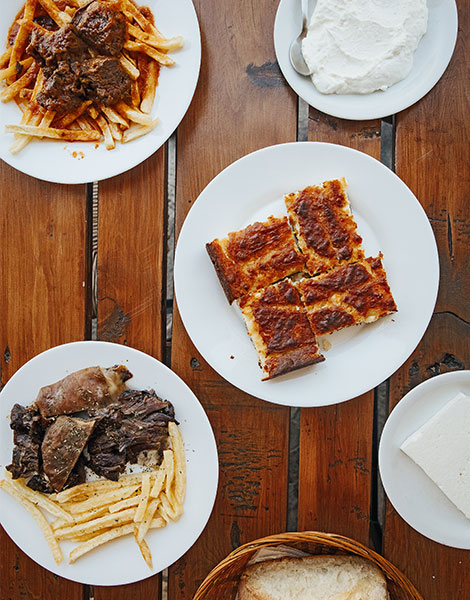
Melt-in-your-mouth veal and other delicious dishes at Ragazia.
© Olga Deikou

Eirini Bistitzanou with her homemade plastos (traditional cornmeal pie) at the café in the village of Rosi.
© Olga Deikou
The mountains surrounding the villages of Argithea offer a network of hiking routes for a range of abilities. Among the region’s highest peaks is Karava, which rises to 2,184 meters and is the highest point in the Agrafa Mountains. Trails pass through forests and ravines, with vegetation changing noticeably with altitude and season. Autumn brings particularly vivid colors, while clearings and higher sections offer views across the surrounding peaks.
One of the first marked trails in eastern Argithea starts at Livadia in Petrilo and leads to a waterfall known locally as Souda tou Mai. Beginning in a small hornbeam grove, the path descends beside streams for about 20 minutes, passing wild cherry trees, cornelian cherries, maples, firs and plane trees. The trail ends at a waterfall that drops some 25 meters in four stages, forming small natural pools where visitors can swim.

The Folklore Museum in Vasilades, Petrilo.
© Olga Deikou
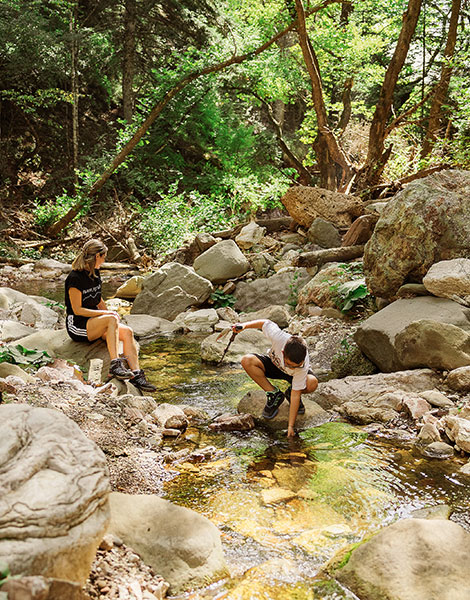
At the natural rock pools of Souda tou Mai, near the village of Petrilo.
© Olga Deikou

Father Christos in front of the centuries-old plane tree in Leontito.
© Olga Deikou
The walk is fairly easy: residents have installed small bridges and ropes where needed. It also holds a few surprises. Natalie Micallef, a painter from Malta who has made Petrilo her home in recent years, has added artworks along the trail, turning it into an unusual open-air gallery. “I’ve always loved Greece, ever since I read its myths as a child, and I was looking for a place where I could live close to nature. As soon as I arrived in Argithea, I knew I felt at home here,” says Natalie, who walks the trail every day with her little dog, Tortellina. Made from natural materials, her works blend discreetly into the landscape and add an unexpected artistic element to the hike. She believes, though, that the most important work is done by local people such as Thomas Souflakis and Sotiris Kissas, who keep the path clean and accessible. More trails requiring no special equipment can be found in nearby villages, including Drosato and Leontito.
In Drosato, formerly known as Mezilo, a moderately difficult trail begins at the Monastery of Aghios Athanasios. It passes through oaks, willows, holly and plane trees before reaching the old hydroelectric station in about 15 minutes. The station brought electricity to the village in the 1950s, earning it the nickname “Little Paris.” Today, visitors can also enjoy the cool waters of a small waterfall. A dirt road from the village, at the foot of Mount Koukourelo, leads to the chapel of Profitis Ilias and one of Greece’s few ancient forests of juniper trees.
Leontito, a historic village associated with Karaiskakis, was burned by Ottoman forces in 1823. Today, one of its most striking landmarks is an enormous plane tree believed to be around 1,000 years old. Its trunk has a circumference of almost 10 meters. The village sits at an altitude of 1,000 meters, at the foot of Mount Delidimi, overlooking the slope of Patlia. It is also the starting point of the “pilgrims’ trail” to Argithea’s most important landmark, the Monastery of Panagia Spilia. Perched on a rock, its smaller church dates to 1064 and houses an icon of the Virgin Mary of the Cave attributed to Luke the Evangelist. The views across the peaks of the Agrafa are also extraordinary.
Where to Stay and Eat
At Livadia, the former summer settlement of Petrilo’s residents, you’ll find Ta Livadia guesthouse (Tel. (+30) 24450.311.09) at an altitude of 1,200 meters, surrounded by firs and beeches. Its simply furnished rooms provide the essentials, but the main attraction is the view toward Karava or Voutsikaki. The Vasilou family’s restaurant, located on the same property, serves beef steaks, leek sausage and tsalafouti, a traditional local soft cheese. Ta Livadia operates year-round, apart from a short break between January and February.
On the road to the Monastery of Panagia Spilia, in Koumbouriana, you’ll find Ta Ragazia (Tel. (+30) 24450.320.20), a well-known taverna run by Vaios Pozos. The property also offers six rooms to rent. Here, Mrs Vaso and her daughter Spilioula make traditional pies, from batzina to milk pie. They also serve delicious home-style dishes made with their own vegetables, as well as freshly grilled meats. The taverna is open year-round, including during the winter, although calling ahead is recommended.
Another family-run taverna open throughout the year, Diaselo (Tel. (+30) 24450.322.13) is located in Mantzoureika. Its terrace has one of the finest views in eastern Argithea, overlooking the green slopes of the Agrafa. Come for its renowned lamb ribs, burgers, walnut skordalia and galotyri cheese, plus occasional home-style dishes that vary according to the season.
Traditional Cafés
On the square in Leontito, opposite the thousand-year-old plane tree and beside a recently reconstructed wooden, water-powered machine once used to wash woolen textiles, you’ll find O Platanos (tel. (+30) 693.270.6836), a café run by Father Christos’s family. Mrs Angeliki serves Greek coffee with spoon sweets, as well as tsipouro with small plates of food.
In the village of Rosi, near the 17th-century Church of the Nativity of Christ, Nikos Touralias’s café offers another glimpse of traditional village life. Its interior is decorated with old objects collected from villages throughout Argithea. Irini and Nikos serve grilled meats, omelets and sausages. When time allows, they also prepare plastos, a traditional greens pie made with cornmeal that is particularly associated with the region.
Activities
Finix Adventures (Tel. (+30) 697.766.3453) organizes hikes, off-road safaris in the Agrafa, kayaking on Lake Stefaniada, stargazing tours and other activities, as well as multiday trips and customized programs for nature and adventure lovers.
The Petrilo Cultural and Educational Association operates the Folklore Museum, housed in the old elementary school in Vasilades. Its collection features hundreds of traditional objects documenting everyday life in Argithea’s villages over the centuries. For an appointment, contact Irini Bistitzanou (Tel. (+30) 697.366.7411). The association also organizes mountain hikes in partnership with mountaineering clubs from across Greece (Stelios Karampas, Tel. (+30) 697.738.9874).
The Hardtailers (facebook.com/mtbhardtailers, Tel. (+30) 698.172.5734) organize cycling routes across the Agrafa and other multiday bike trips that include overnight stays outdoors.
We spent seven days at Nefeli...

Just two hours from Athens, Mt...
Greeks hope their highest mountain will...
Without noise or concrete, the Old...