Exploring Piraeus on Foot
Whether you’ve just stepped off a...

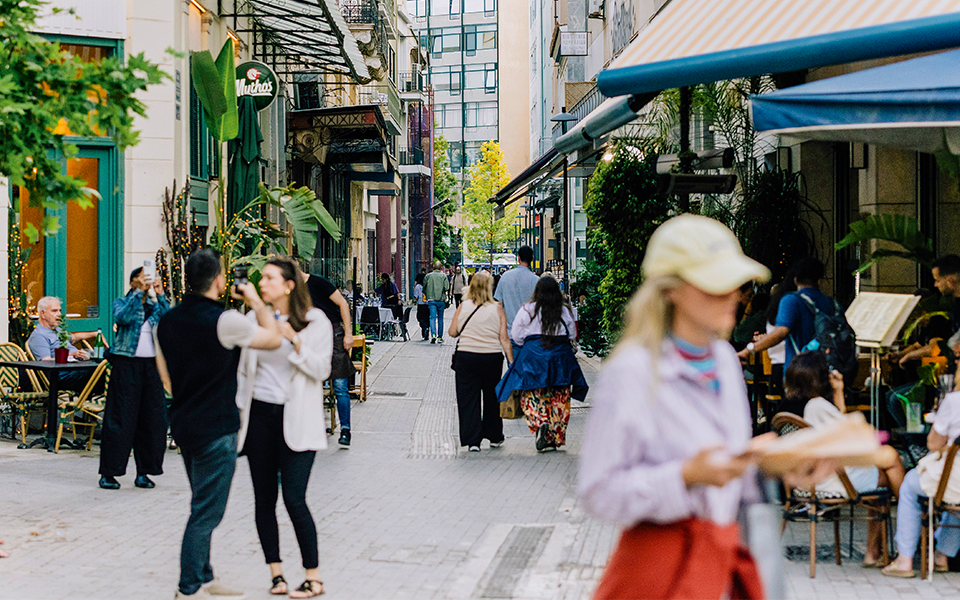
General view of Vyssis Street.
© Angelos Giotopoulos
Located at the heart of Athens’ historic Commercial Triangle, Vyssis Street has undergone a remarkable transformation. By day, it still belongs to the old merchants who have kept their family businesses alive for decades; by night, it fills with wine bars, restaurants, and cocktail spots. Today, Vyssis Street is one of downtown Athens’ liveliest nightlife destinations – and a characteristic example of the city’s changing urban landscape. I arrive in the neighborhood around nine in the morning. The cafés attached to the hotels on both corners of Aiolou Street are already full. Some visitors are enjoying breakfast or checking out before heading off to the Greek islands; others browse the nearby souvenir shop. Outside the old hardware stores, shopkeepers are already on their second coffee, chatting about politics and football. Between displays of bathroom fittings and curtain rods, shuttered storefronts hint at the next wave of change, many awaiting renovation and a new purpose.
Stretching from Aiolou Street to Karamanou Square and crossed by a network of narrow pedestrian lanes, Vyssis Street embodies the contradictions that make central Athens so fascinating. For generations, it was known for hardware stores, fabric merchants, and specialist suppliers serving the city’s tradespeople. Today, traces of that commercial identity remain, but they coexist with boutique hotels, contemporary restaurants, wine bars, and cafés that have gradually reshaped the neighborhood. The street’s transformation accelerated after its pedestrianization in 2017. Delivery vans gave way to outdoor tables, while visitors and locals began reclaiming the area as a place to linger rather than simply pass through. From nearby Agathonos and Kairi streets comes the sound of coffee cups, conversations, and the steady rhythm of a neighborhood discovering a new identity. That is Vyssis Street until late afternoon. Around five o’clock, the shutters begin to come down, the hardware stores close for the day, and the street undergoes its daily transformation. As evening approaches, the cafés, bars, and restaurants take over, and a different crowd begins to arrive.
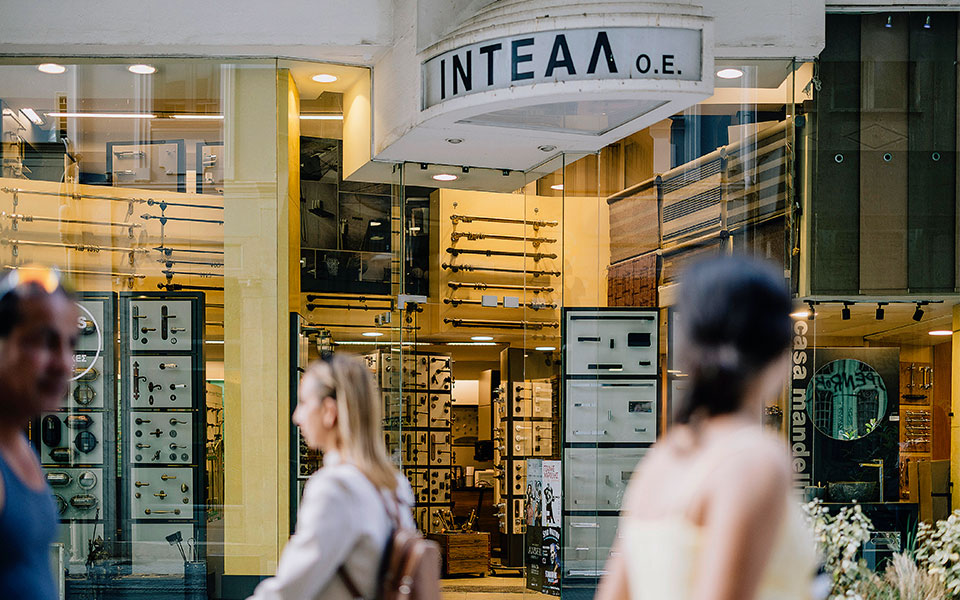
Passersby outside Casa Mandelli, one of the city's best-known hardware stores.
© Angelos Giotopoulos
“Pedestrianization, and all these hotels, destroyed the street,” says one of the area’s longest-serving shop owners. “Vyssis was part of the Commercial Triangle, not a triangle of hotels and cafés. We sell heavy products that need to be transported by vehicle. Once the street became pedestrian-only, that was no longer possible, and with it the commercial identity of the area disappeared.” For decades, Vyssis was known throughout Athens for its hardware stores, locksmiths, and specialist suppliers. Since the 1950s, tradespeople, contractors, and wholesale buyers came here for door handles, locks, fittings, and tools. But from the 1980s onward, the neighborhood gradually began to change, evolving from a business district into a destination increasingly shaped by tourism.
“Of course, far more people pass through here today,” he says. “But foot traffic doesn’t necessarily translate into business.” At the corner of Kairi Street, I meet Kleomenis of Casa Mandelli, whose family business has occupied number 18 Vyssis Street since 1996. “Years ago, this was essentially the city’s hardware district,” he says. “It was a purely commercial neighborhood. Shops opened early in the morning, business was constant until late afternoon, and after four o’clock the area emptied out completely. There was no tourism and virtually no nightlife.” He recalls he pedestrianization years as a difficult period, when many businesses struggled and the future of the street seemed uncertain. The turning point came after the pandemic, as tourism rebounded and a growing number of hotels and short-term rentals appeared in the area. “Old warehouses became commercial spaces, and gradually one change led to another,” he says. “The transformation isn’t necessarily a bad thing. Older business owners look back with nostalgia because they associate this street with an era of thriving trade and commercial activity – an era that is unlikely to return.”

On the corner of Vyssis and Polykleitou streets, Wine Is Fine, with its white tables and Parisian flair, has become a local favorite.
© Angelos Giotopoulos
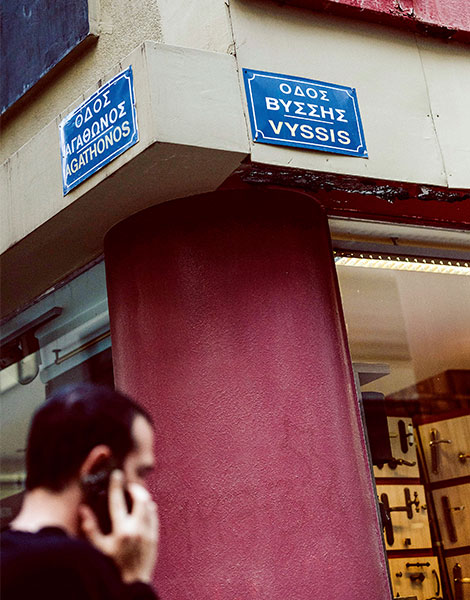
At the intersection of Vyssis and Agathonos streets, where the hardware shops give way to wine bars and restaurants.
© Angelos Giotopoulos

A table at Wine Is Fine, featuring steak tartare and a selection of cheeses.
© Angelos Giotopoulos
At the corner with Polykleitou Street, the tables of Wine is Fine spill out across the pedestrian lane. Colorful chairs line both sides of the street, glasses clink, and conversations drift between tables. By midnight, this corner will feel less like a street than a large open-air dining room. Since opening three years ago, the wine bar has become one of central Athens’ most popular evening addresses. Favored by creatives, hospitality professionals, and a younger local crowd, it combines a carefully curated wine list with a simple French bistro menu. Behind it are three friends: Frenchmen Rafael wallon-Brownstone and Thomas Brengou, together with Greek chef Stavros Chrysafidis. “Wine is Fine wasn’t born from a business plan,” Thomas tells me. “It came from three people who shared the same vision for food, wine, and hospitality, but having different sensibilities. We blended all of that into a space that feels as though it has always been here.” Finding the space, he says, was largely a matter of chance. “ We weren’t looking specifically in this neighborhood, but a friend’s grandmother owned the property. The moment we saw it, we knew. It was love at first sight. Athens is changing, and we’re happy that most of our customers are locals, even as tourism continues to grow every year.”
As Athens continues to evolve, Thomas is aware of the debates surrounding the gentrification of neighborhoods like this one. “That’s something we think about all the time,” he says. “Especially Rafael and me, as foreigners. Vyssis is undoubtedly part of a much broader transformation taking place in central Athens, and I don’t think anyone opening a business here should ignore that. I wish more investors and entrepreneurs reflected on it.” At the same time, he rejects the idea that every new venue should automatically be viewed as a negative force. “It depends on how you operate, who you welcome, how you price things, how you engage with the local community, and whether you’re contributing something to the neighborhood instead of simply replacing what was already here.”

One Burger
© Angelos Giotopoulos
A little further down, at Karamanou Square, the latest addition to the neighborhood has already begun drawing attention. Housed in the space once occupied by Dope, Sync opened only weeks ago, bringing together comfort food, inventive cocktails, and an airy glass-roofed atrium. Following a large group of German tourists, I continue toward Agathonos Street. Next to the ever-popular Feyrouz, now celebrating 12 years in business, sits the much-photographed One Athens, until recently better known as One Burger, an open-plan space that reflects many of the changes reshaping central Athens. “From the beginning, the idea wasn’t simply to create a burger spot,” explains Kolja Orzeszko, one of the owners. “One Athens was conceived as a modern-day public square – a meeting place where people from different backgrounds can gather, share a meal, get to know one another, and perhaps leave no longer as strangers. Both the name and the design draw heavily on Greek culture: stone, open spaces, references to old Athens and the city’s ancient heritage, combined with contemporary lines and industrial touches such as the exposed ceiling.”
The choice of location, he says, was entirely intentional. “We weren’t looking for a polished destination. We wanted a neighborhood that is still evolving, with long-time residents, newcomers, migrants, creatives, and small businesses. The space itself had essentially been abandoned; it was almost like a junkyard. We didn’t take anything away from anyone, and that was important to us. Instead, we tried to bring new life to something that had been left behind.” Like many new business owners in the area, they are mindful of the ongoing debate around gentrification. “Change doesn’t always have to carry negative connotations,” he says, “especially when it means revitalization.” By the time our conversation comes to an end, the restaurant is nearly full. Some tables are occupied by people enjoying coffee and brunch, while others are sharing burgers and fries. Voices mingle with the aromas coming from the kitchen. Gradually, the cocktails begin to replace the coffees, and another evening on Vyssis Street quietly gets underway.

© Angelos Giotopoulos
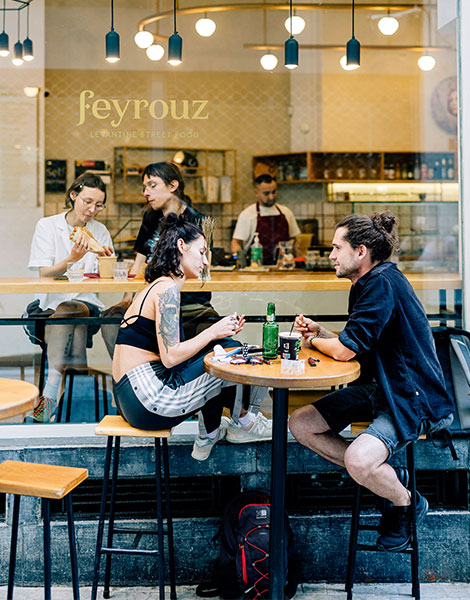
A stop at Feyrouz.
© Angelos Giotopoulos

September 18
© Angelos Giotopoulos
On tiny Kairi Street, which links Vyssis with Athinas Street, the eye is immediately drawn to a historic arcade. Built in 1934, the arcade at 6 Kairi Street was the first shopping arcade in Athens. Over the decades, it housed small retail shops, gunsmiths, tailors, and dyeing workshops, serving a city very different from the one that exists today. Little of that commercial world remains, but the building continues to adapt to changing times. Standing at its gated entrance is September 18, which opened just three months ago. With its brown-framed windows, expansive glass façades, industrial touches, and a large suspended sun that transforms into a moon after dark, the café-restaurant created by Nefeli-Ophelia Sachverdyan and Giannis Tsachlis became an Instagram favorite almost overnight. From through late-night dinner, its tables are rarely empty.
“Why here? Because we genuinely love this neighborhood,” says Nefeli. “This is where we’ve always spent our time. We’ve walked these streets for years and always felt closest to the city here. When we first started dreaming about opening a place of our own, we knew we wanted it to be in this neighborhood. Then one day we spotted a ‘For Rent’ sign on an old plumbing shop and immediately saw its potential.” When asked what makes the area special, she replies without hesitation. “Even though we’re right in the heart of Athens, it doesn’t feel like a purely tourist neighborhood. It still has the character of old Athens and a real sense of locality, expressed in a contemporary way.” That balance is reflected in the design of September 18 itself. Clean lines, understated interiors, and thoughtful details create a space that functions as a daytime workspace before effortlessly shifting into a lively restaurant and bar after sunset.
“The comment I hear most often is that the place doesn’t feel pretentious,” she says. “What people are looking for somewhere they can gather, feel that they belong, and believe they’re getting value for what they spend. Today it’s almost impossible to create something that doesn’t remind people of somewhere else, and keeping prices very low isn’t realistic either. The city’s real problems lie elsewher, like the endless wave of new hotels opening without any real purpose.” Just then, the owner of the hat shop across the street walks over to return his morning coffee glass. Outside, people stand shoulder to shoulder, drinks in hand. A chance toast sparks the first conversations between strangers. New arrivals are folded into existing groups. Watching, it’s hard not to see a reflection of Vyssis Street itself. Different generations, professions, backgrounds, and visitors pass through the same space, each bringing something of their own.
Whether you’ve just stepped off a...
In which a world-wearied scribe rediscovers...

New bakeries, restaurants and creative spaces...
Echoes from history meet everyday life...