Beyond Borders: Stories, Cinema, and Encounters on Kastellorizo
At the 10th International Documentary Festival,...

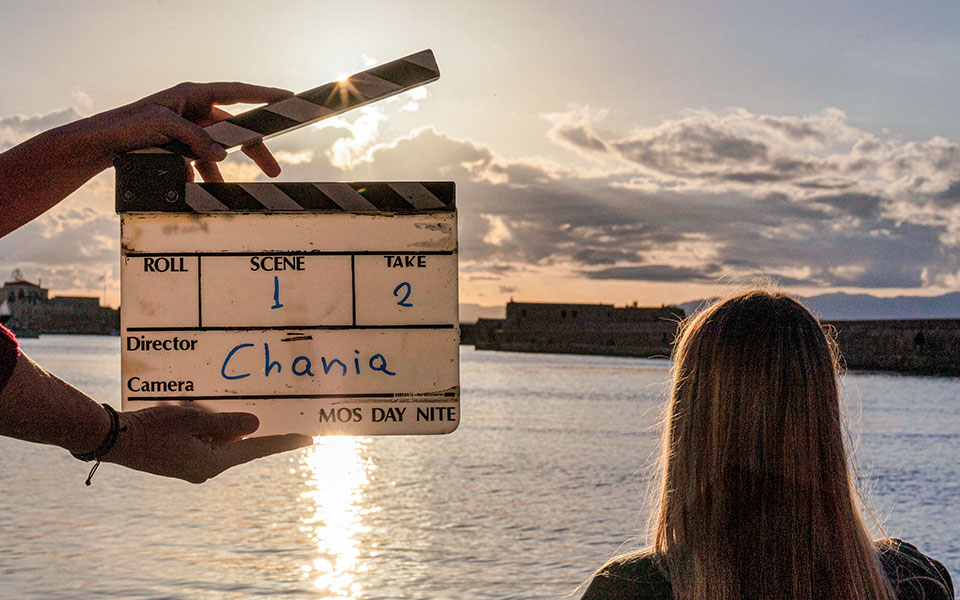
The Old Port of Hania is one of the most popular filming locations for Greek and international productions.
© Perikles Merakos
The Carpenter’s Son, starring Nicolas Cage and soon to premiere at international film festivals, includes scenes shot in Sfakia. The region of Hania has also been chosen as the filming location for Christ Recrucified, a major international co-production that begins shooting in October. The filmmaking momentum that has built up in Crete in recent years bears little resemblance to the situation two decades ago, notes Ioanna Davi, producer and co-founder of the audiovisual production company Indigo View.
Together with her team, Davi has created popular television hits such as The Island and Kommanta kai Drakoi (Commandos and Dragons), and has also worked on international co-productions, including the feature film The Two Faces of January and the TV series Moonflower Murders. “In 2005, the idea of establishing a production company in Hania seemed completely ‘exotic.’ There was nothing comparable anywhere else in provincial Greece. Today, however, demand is strong not only locally but also from countries such as Poland, Germany, Israel and the United States,” Davi says.
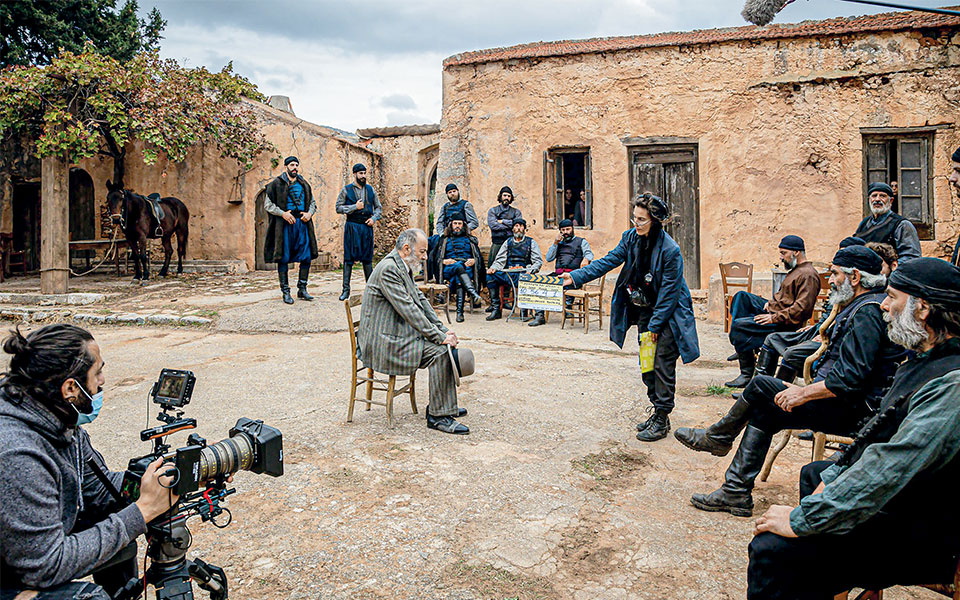
Filming of the series Komanda kai Drakoi in the village of Koumares.
© Perikles Merakos
A key factor is undoubtedly the incentive scheme launched five years ago by EKOME (the National Center of Audiovisual Media and Communication), which offers a cash rebate of up to 40% on qualifying production expenses in Greece. “But the incentives don’t end there. Crete offers extraordinary landscapes, many of them strikingly different from one another. Its gorges, trails and traditional villages effortlessly convey a timeless quality. The wider Elounda area also features distinctive sites ideal for period films. The Old Port of Hania, along with the Venetian alleyways of Rethymno and Heraklion, are favorites among many directors, not to mention the island’s beaches,” Davi adds.
Davi says that when she receives a script from an international production company interested in filming on the island, she looks for ways to highlight elements of local culture and to weave Crete organically into the film’s storyline.
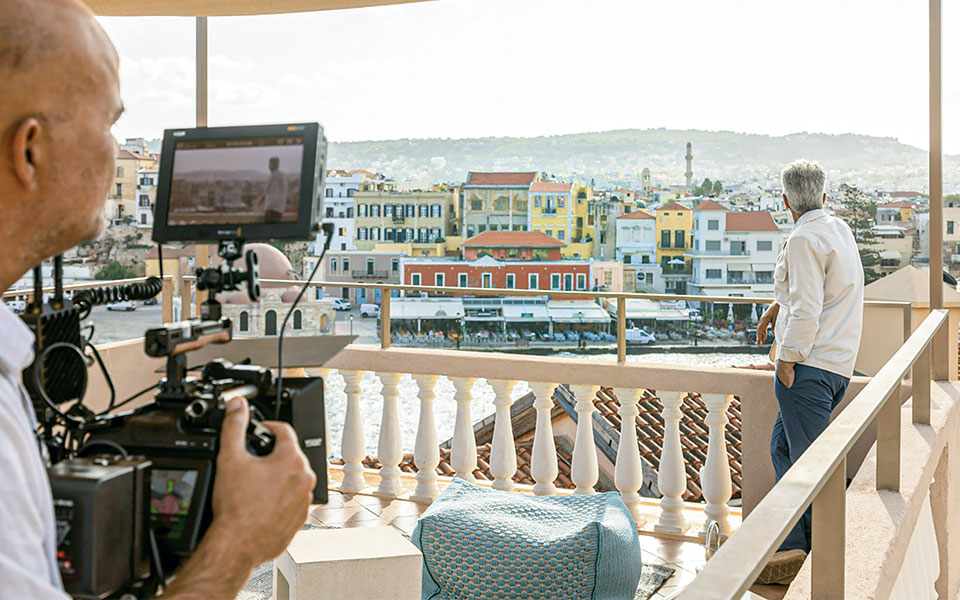
Thodoris Papadoulakis behind the camera during a shoot in the Old Town of Hania.
© Perikles Merakos
For foreign productions, a key requirement is the availability of skilled professionals on the island to cover all aspects of filming. Indigo View had to build, essentially from scratch, a talent pool encompassing every specialization necessary to deliver high-quality audiovisual productions. This effort was supported not only by local professionals but also by institutions such as the Region of Crete and the Municipality of Hania. It was also helped by a shift in career thinking; in recent years, an increasing number of young people have turned to film studies, envisioning employment in the broader industry.
As for the economic impact of film productions, Davi argues that it contributes to the much-desired extension of the tourist season. Producing a film requires accommodations and catering for hundreds of crew members over several days, or even months. These expenses, along with the daily personal spending of the teams, flow directly into the local economy.
What matters most, however, is that professionals leave the island so satisfied with their experience that they wish to return for future projects. Crete’s climate also works in its favor, especially the mild winters, which make filming easier. In addition to feature films, the island is also a favored location for northern European companies producing television commercials for sunscreen brands, while its spectacular roads – such as the route connecting the Askifou Plateau with Sfakia and Anopoli – appear frequently in car ads.
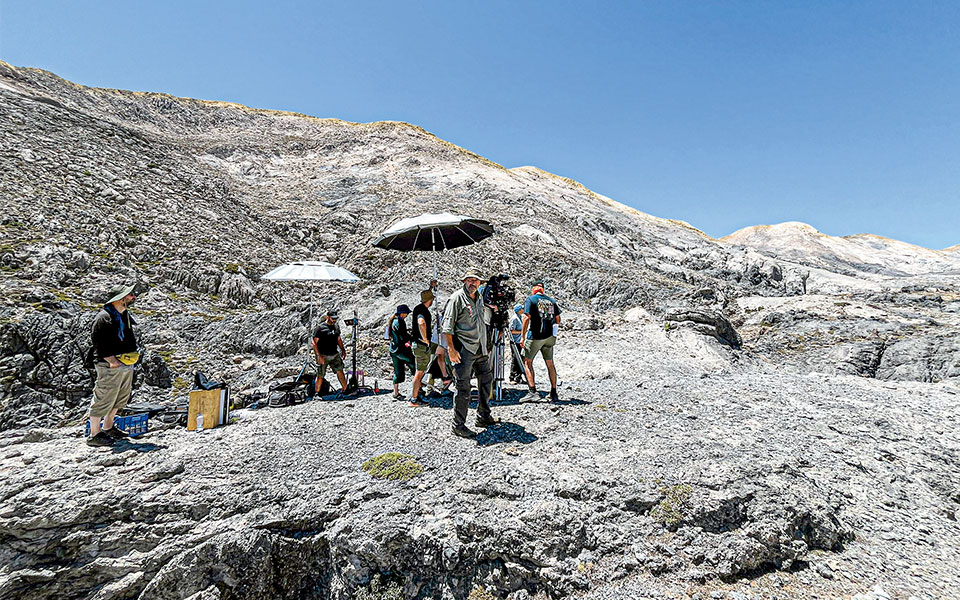
Filming of the movie The Carpenter’s Son in Sfakia.
© Perikles Merakos
Some of the new concepts shaping today’s film industry are highlighted by Dimitris Xenakis, producer and co-founder of Indigo View. The team’s next project is a film adaptation of Nikos Kazantzakis’ novel Christ Recrucified, a co-production between Greece, Italy, Luxembourg and Cyprus, directed by Thodoris Papadoulakis and featuring an international cast. Filming is scheduled to begin in Hania on October 21. The production will adhere to a Green Protocol, following strict guidelines to minimize its environmental impact. A production’s carbon footprint mainly stems from equipment and personnel transport, as well as the use of generators and vehicles. During filming, unannounced inspections will be carried out by qualified authorities tasked with this duty, and certification will be awarded based on the results.
“The parameters of film production are changing rapidly, and on multiple levels,” says Xenakis, pointing to shifts influenced by everything from climate change to geopolitics and artificial intelligence. “A major American production scheduled to shoot in Cyprus last summer suddenly changed plans, opting instead for Crete, fearing that extreme heat would hinder filming. In recent months, major producers from Israel have also visited, considering the possibility of setting up a studio here and relocating their entire business. But the most significant transformation seems to be coming from the field of technology.”
Xenakis explains that, in early test shoots for their new film, they needed to recreate sandstorms and conditions of extreme drought. Achieving the desired effect, he notes, is now far easier – and vastly more economical – through the use of artificial intelligence rather than traditional special effects. “Perhaps Christ Recrucified will be the last film that we have the luxury of shooting before the landscape changes dramatically and artificial intelligence fully takes over,” he says.
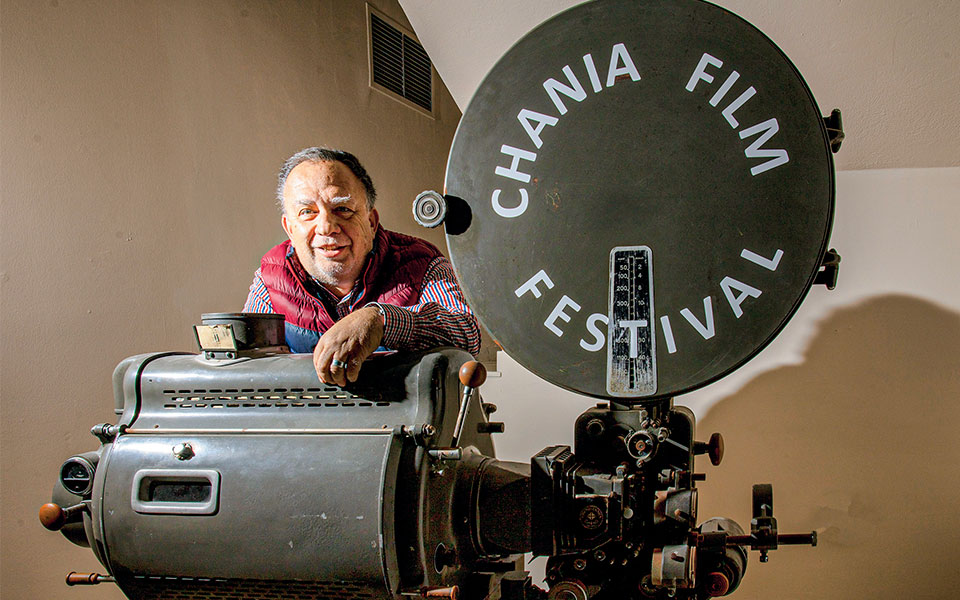
Matthaios Frantzeskakis, director of the Chania Film Festival.
© Perikles Merakos
Thodoris Thomadakis is Crete’s most renowned location scout and film fixer, specializing in identifying sites suitable for audiovisual productions and recommending them to companies in search of the perfect backdrop, such as the interior of the Izzedin Fortress in Souda, used for scenes in Pantelis Voulgaris’ film The Last Note. Thomadakis’ most recent success –achieved in collaboration with producers Alexandra Bousiou and Yiannis Iakovidis – was attracting the Hollywood production The Carpenter’s Son to Greece.
As Bousiou explains, the film was originally slated to be shot in the Canary Islands. She persuaded the filmmakers to choose Greece instead, and Thomadakis proposed a rugged landscape at 1,900 meters in the Sfakian Madares mountains. Seven days of filming required a full month of preparation and the mobilization of hundreds of local professionals and volunteers. A temporary “village,” complete with dressing rooms, toilets and catering facilities, was built from scratch, and all the equipment that the crew needed was hauled up the mountains using jeeps and farm vehicles.
“That we managed to complete the shoot under such conditions was thanks to the resilience of the Cretans,” Bousiou says. “People from Sfakia and Anopoli helped us to overcome natural obstacles and to film in an unimaginably otherworldly, lunar landscape, captured on camera for the very first time. The movie was shot on analog film, and I believe the final image fully justifies the effort that went into it.”
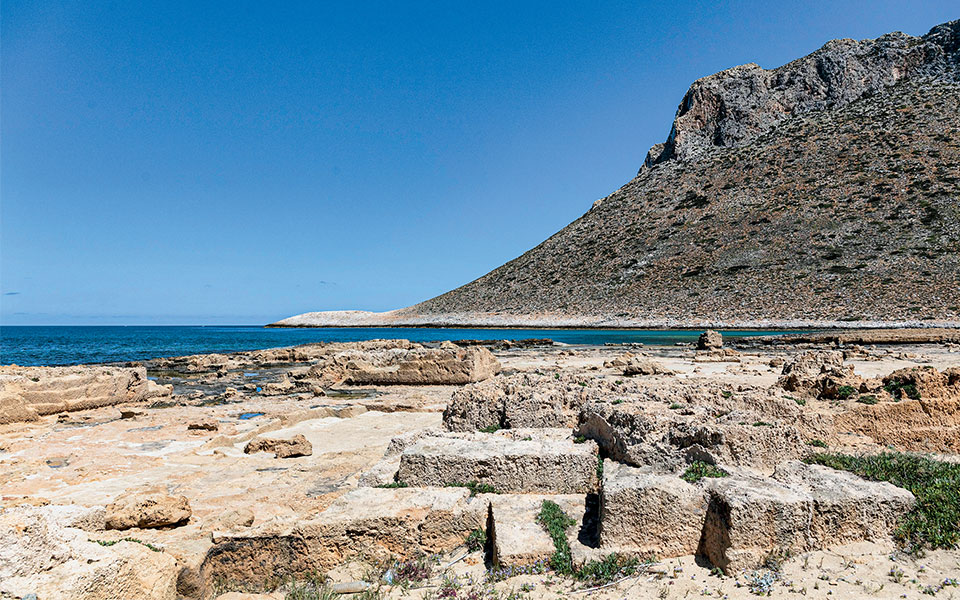
The beach of Stavros has been timelessly associated with the film Zorba the Greek.
© Perikles Merakos
Matthaios Frantzeskakis, director of the Hania Film Festival, agrees that there has been a surge in films being made in Crete. “In recent years, eight different documentaries filmed in Crete, with contributors from countries such as Germany, Italy, Australia and Iceland, have had their Greek premieres at the festival,” he notes. Many of these documentaries highlight landscapes and themes that inspire audiences to visit the island.
“Beyond the filming itself, which often takes place with the utmost discretion, it’s important that productions premiere here. This allows for a deeper connection with the place and its people. We’ve hosted premieres that drew huge crowds to Hania’s cinemas and brought locals closer to the art of cinema,” Frantzeskakis says.
The festival director believes that Crete now meets all the criteria for attracting international film productions. On the one hand, there’s a well-developed pool of experienced local professionals; on the other, the Region of Crete and other institutions recognize the importance of supporting the local Film Office, which provides assistance and guidance to foreign crews.
And, of course, one cannot overlook the cinematic allure of Crete’s natural landscapes. Many still associate Stavros Beach with Zorba the Greek, which was filmed there; Walter Lassally, the film’s Oscar-winning cinematographer, even moved here later in life, donating his Academy Award statuette to a taverna in Stavros. With this gesture, Lassally seemed to suggest that the award truly belonged to the place itself. That statuette was destroyed in a fire on New Year’s Day in 2012, but perhaps the time is approaching for Crete’s extraordinary landscapes to claim their next Oscar.
At the 10th International Documentary Festival,...

Cretan cuisine lives on from home...

When Herodou Attikou, a crossroads in...

A forgotten world comes to life...