The Panathenaic Way: Athens’ Historic Pathway Comes Alive...
A major restoration project is bringing...

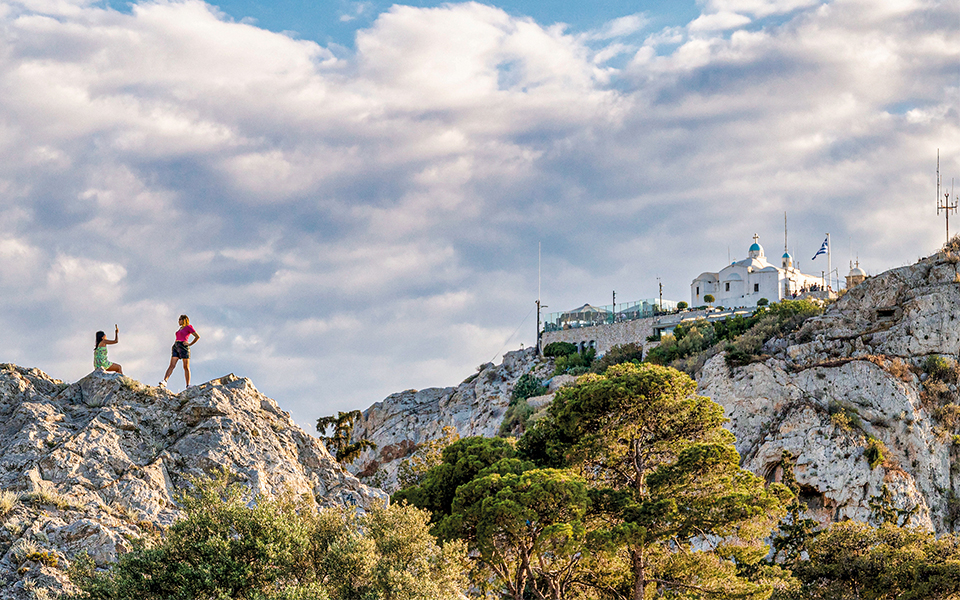
The Church of Saint George on Lycabettus Hill.
© Perikles Merakos
It may well be the most beautiful walk in all of Greece – and that’s no exaggeration. How else could one describe a four-hour trail that links the most storied hills of Athens? From Filopappou Hill, also known as the Hill of the Muses, to the Pnyx, the Hill of the Nymphs, the peaceful neighborhoods beneath the Acropolis, and finally to Lycabettus Hill, every stop along the Hills of Athens route feels in sync with the city’s eternal pulse.
After all, the secrets of Athens are hidden in these hills, tucked into green pockets of stillness, whispered from shaded footpaths, and revealed at each summit. To lear them is our goal as we gather at 12 Parthenonos Street in Koukaki, ready to set out on what felt less like a guided walk and more like a ceremonial initiation: a quest for the city’s inner essence.
We begin at the headquarters of Trekking Hellas, where we meet Yiannis Frydakis, the organization’s program coordinator and our guide for the day. “Beneath our feet runs the ancient wall of Athens, built some 2,500 years ago,” he tells us, before leading us toward Dionysiou Areopagitou Street, the pedestrianized promenade unveiled at the dawn of the new millennium and now one of the most beautiful thoroughfares in the city.
To the sounds of street musicians, we set off on a route that blends panoramic views, ancient monuments, and glimpses of authentic contemporary Athenian life. A quick right turn brings us onto the Hill of the Muses – also known as Filopappou Hill – the first stage of our journey.
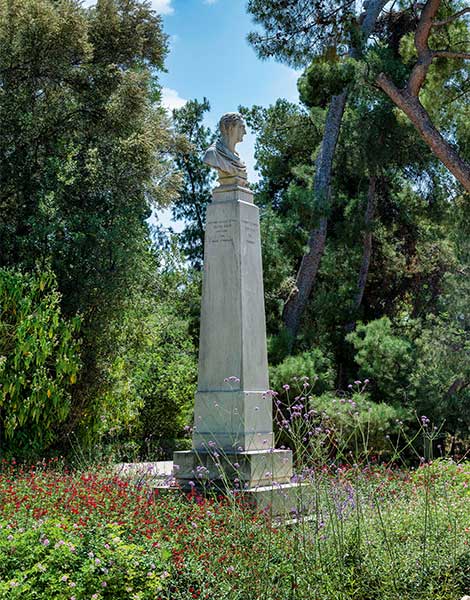
One of the many busts scattered throughout the National Gardens.
© Perikles Merakos
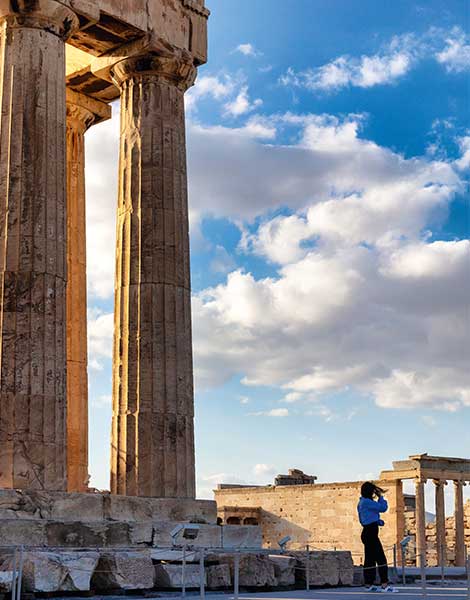
In the shadow of the Parthenon.
© Perikles Merakos
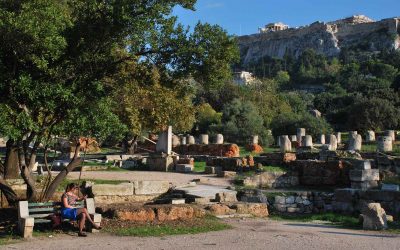
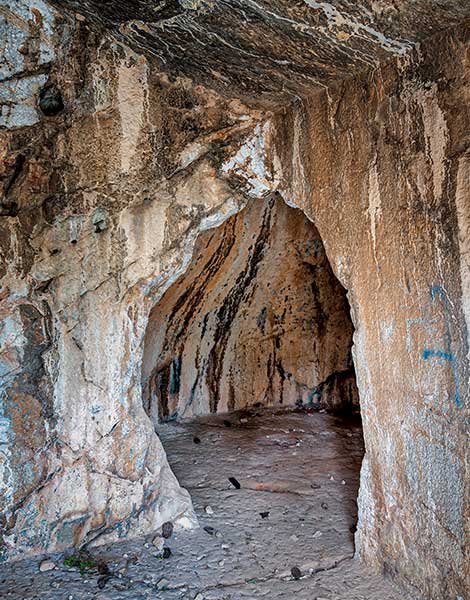
Perhaps overshadowed by the nearby Acropolis, Filopappou Hill is often underestimated. Yet here, in the most important green sanctuary of central Athens, is where – as Yiannis tells us – the first Athenians once lived. Today, you’ll see a few scattered picnickers, morning runners, and the occasional curious tourist. Pine trees and wild olive groves, planted in the 1950s during a postwar effort to breathe new life into the hill, now frame the path we follow toward our first stop: the so-called “Prison of Socrates.” Legend has it that the ancient philosopher drank hemlock in one of these stone-hewn cells. Millennia later, on the eve of the Nazi occupation during WWII, the Greek Archaeological Service chose this same site to conceal precious artifacts, walling them in with concrete to protect them from destruction or theft. The chamber remained sealed until the war ended.
As we climb, we notice a series of striking patterns underfoot, an artful collage of stones, marble fragments and ceramic shards. These were laid in the 1950s by the renowned architect Dimitris Pikionis, who reused salvaged materials from demolished neoclassical buildings in the area. Yiannis pauses beside a carob tree. He explains that these hardy plants, once used by Athenians in times of hardship to make carob flour, have been growing on this hill since antiquity.
It isn’t long before we reach the top, where the grand monument built between 114 and 119 AD comes into view – a tribute to Gaius Julius Antiochus Philopappos, from whom the hill takes its modern name. The structure is made from two types of marble: one brought here in ancient times from Mt Penteli, the other from Mt Hymettus, on the city’s eastern edge.
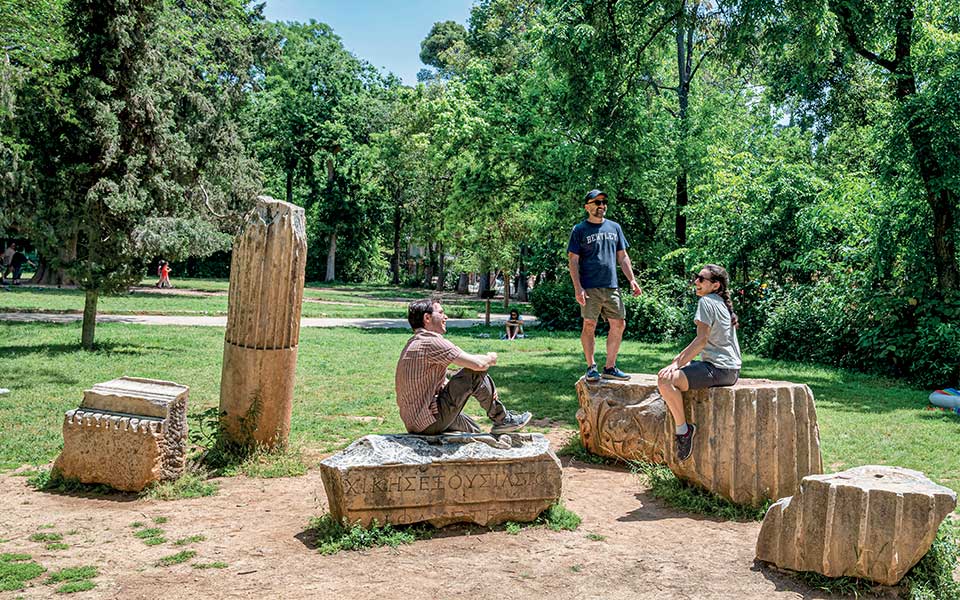
Stopping at the remnants of some columns in the National Gardens, Yiannis Frydakis (standing) of Trekking Hellas shares some local knowledge.
© Perikles Merakos
From here, Athens stretches out in every direction. To the south, the deep blue of the Saronic Gulf shimmers, with Aegina and Salamina on the horizon. It’s Saturday, and sailboats from local yacht clubs glide across the water. Behind us, Mt Hymettus, the longest of Athens’s surrounding ranges, rises in quiet grandeur. Nearby, two visitors call out in delight – they’ve just spotted a tortoise. With a bit of luck, you’re likely to see a number of them along the hill’s trails.
The next stop on our route leaves us momentarily speechless: seven stone-carved seats, known as the Heptathronon, arranged in a semicircle and shrouded in mystery. Their imposing form suggests a public function, perhaps a court, a council chamber, or a space for ritual gatherings. The prevailing view links the site to the great mother of the gods (Cybele/Rhea), whose sanctuary once stood nearby.
Across the way lies the site of ancient Melite, a historic district where some of classical Athens’s most prominent figures – Themistocles, Alcibiades, Miltiades and Epicurus – once had their homes. One can almost imagine them walking these very slopes.
After a brief pause, Yiannis gestures for us to continue. We come upon the ancient road of Koile, once the city’s main artery for supplies as it traversed the district of the same name and connected Athens with the port of Piraeus. Deep grooves carved into the stone by cartwheels – still visible after centuries – capture our attention.
Not far from the Hill of the Pnyx we reach the small Church of Saint Demetrios Loumbardiaris. This vaulted single-nave basilica, dating back to the Ottoman era (some say even to the 9th century), has long held its own spiritual gravitas. Visitors step in and out quietly, a few pausing to light a candle. The atmosphere is solemn, almost liturgical – a moment of stillness on this journey through layers of time.
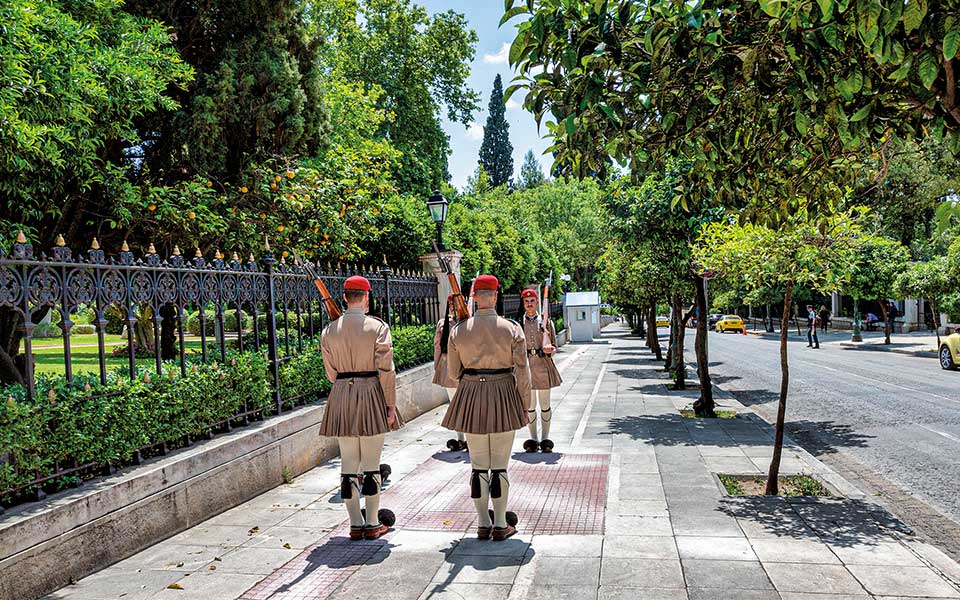
The Changing of the Guard in front of the Presidential Mansion.
© Perikles Merakos
We arrive at the Pnyx, the very ground on which the Ekklesia tou Dimou, the citizens’ assembly of ancient Athens, convened from the 6th to the 4th century BC. It’s impossible not to feel awe here, knowing that Pericles used to address the people from this sacred speaker’s platform. To stand at the heart of the world’s first democracy is to stand at the source of something still resonant today.
At the highest point of the hill, housed in a vaulted pavilion crafted from Aeginetan marble, stands the Doridis Telescope. Once part of the Athens Observatory, it was the largest telescope in Greece until 1959.
By the time we reach the Church of Saint Marina in Thiseio, a hush has settled over the scene. Only the voices of children echo through the courtyard as they play between trees and benches. The scent of home-cooked meals wafts through open windows, pulling us gently from the heavy weight of antiquity back into the intimate charm of everyday Athenian life.
Around us, neoclassical façades and postwar apartment buildings create a scene from earlier urban days. To many outsiders, the city’s ubiquitous apartment blocks may seem puzzling. Built rapidly between the 1950s and 1980s to address a pressing housing need, these concrete buildings often appear mismatched or sadly utilitarian. Yet their straightforward, functional design has proved both resilient and adaptable, securing their place in Athens’s urban identity.
“These buildings create a kind of social equilibrium,” Yiannis explains, describing how a typical Athenian apartment building brings together layers of city life: from the family-owned shop on the ground floor to the apartments housing multiple generations above.
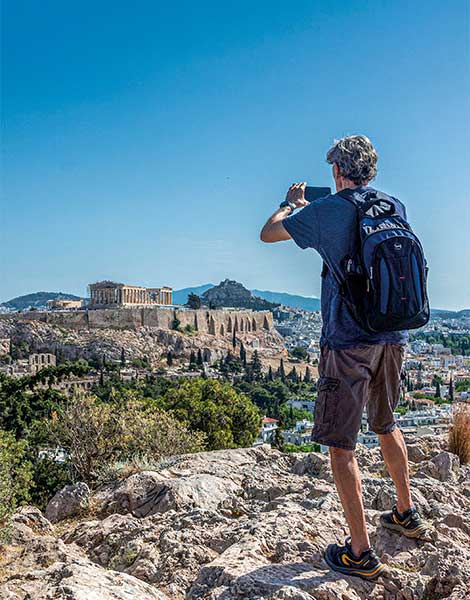
One of the many spots on Filopappou Hill offering a unique view of the Acropolis.
© Perikles Merakos
The reputed prison of Socrates.
© Perikles Merakos
A sudden shift in the landscape brings us to Anafiotika, a tiny, whitewashed neighborhood clinging to the slope of the Acropolis like a Cycladic mirage. Built in the mid-19th century by stonemasons from the island of Anafi, who had come to Athens to work on King Otto’s palace and other ambitious projects, the simple white houses offer a stark contrast to the imposing rock above.
Yiannis takes us through brightly colored doorways and tiny houses, explaining how a strong sense of community still binds the neighborhood together: “Here, neighbors cook for the less fortunate among them,” he tells us.
Balconies bursting with flowers, narrow stone alleys and modest windows that conceal a life of quiet simplicity – these images linger sweetly in the mind, a gentle imprint of a place where time moves differently.

© Perikles Merakos
To reach the National Gardens, we pass through Plaka – where restaurants and wine bars buzz with life – and stroll down Tripodon Street, the oldest thoroughfare in Athens. Before we know it, we find ourselves under a canopy of trees. It’s Saturday, and families fill the park, children darting off to explore the duck and turtle ponds with wide-eyed wonder. This lush refuge was once the passion project of Queen Amalia (1836-1867), who spent long hours tending to its design and plantings.
Time seems to slow here as we wander among the soaring palms, mosaic paths, ancient columns and marble busts of historical figures.
Exiting the garden, we pass the Presidential Mansion, where a small crowd has gathered. They’ve come for the changing of the guard, a solemn, captivating ritual performed by the Evzones at two locations: the other is at Syntagma Square, in front of the Tomb of the Unknown Soldier. The crisp, deliberate steps, the focused gazes and the traditional attire – the fustanella, a pleated skirt worn by the mountain fighters and heroes of the Greek War of Independence – leave an indelible impression.
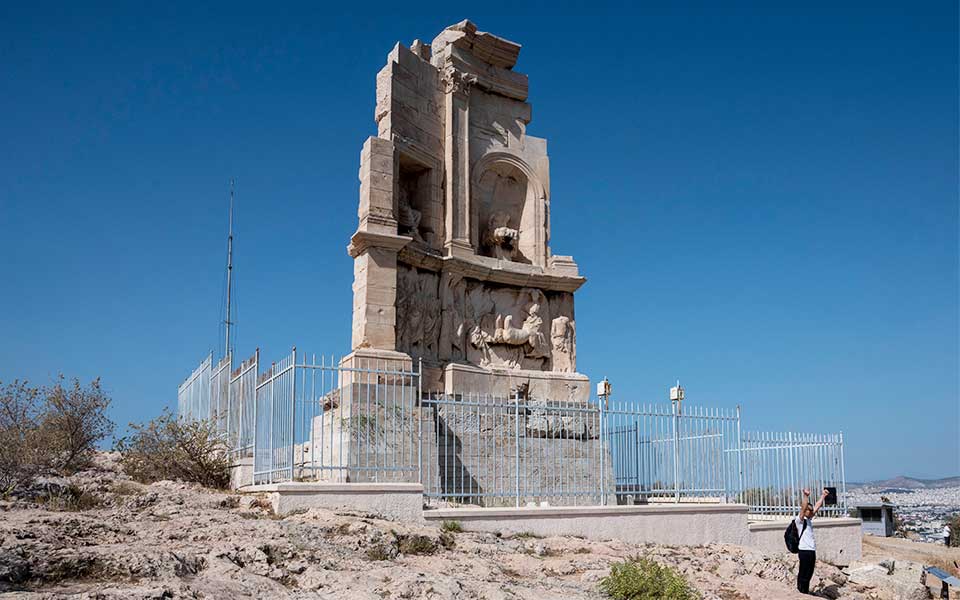
Filopappou Hill
© Perikles Merakos
The most breathtaking view of Athens awaits at Lycabettus Hill – the ever-present peak glimpsed throughout our journey, rising above the city like a silent sentinel. It’s the final stop on the Hills of Athens walk, and a fitting finale to a day steeped in history, legend and discovery. According to legend, the goddess Athena was carrying a massive limestone rock to fortify the Acropolis when, startled by some unexpected news, she dropped it, and thus Lycabettus was born.
To reach the summit, we make our way through the upscale neighborhood of Kolonaki and then walk up the footpath beginning near Dexameni Square, pausing at the café Prasini Tenta for a sweet reward.
By the time we reach the small white Chapel of Saint George at the top, the sun is beginning to set. Below us, Athens is bathed in golden light, and the hills that had guided our journey shimmer like relics of a dream – not merely topography, but sacred thresholds, timeless crossings between myth and memory.
A major restoration project is bringing...

We visit some of Athens’ classic...
From Michelin-starred tasting menus to sushi...

On her first ever holiday alone,...