Did the Ancient Greeks Really Play Football?
Ancient Greece had its own team...

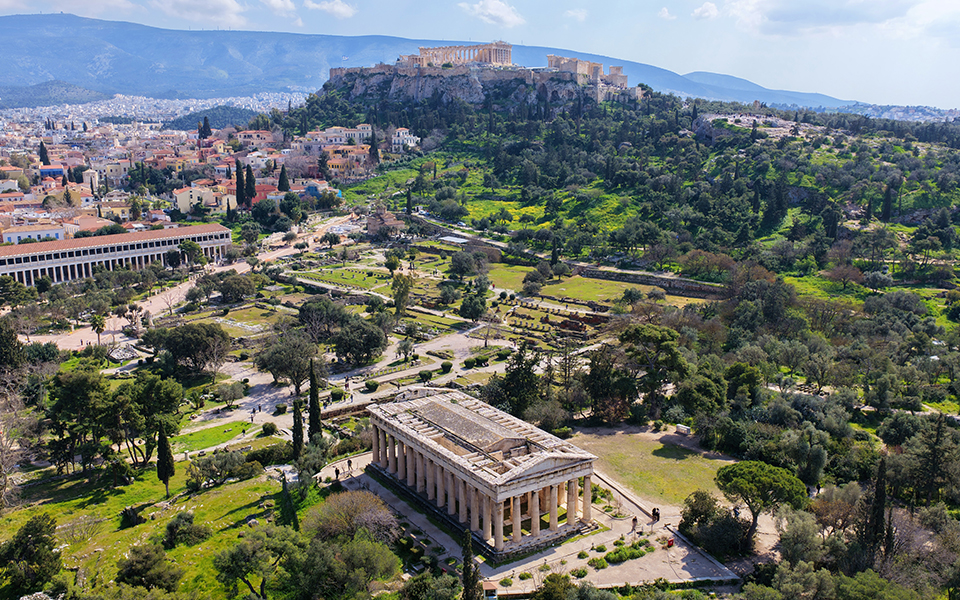
The Ancient Agora of Athens.
© Shutterstock
You arrive at an archaeological site and find yourself surrounded by a maze of broken columns, knee-high stone walls and foundations disappearing into the scrub. Perhaps there is a partially restored temple to admire, but beyond that, what exactly are you looking at?
The good news is that you don’t need an advanced degree in archaeology to make sense of it all. An ancient site is a bit like a giant jigsaw puzzle – Agatha Christie famously thought of archaeological excavations as crime scenes – once you know what clues to look for, the scattered pieces begin to reveal the bigger picture.
So, next time you find yourself among the ruins of an ancient Greek city, try looking at it in a slightly different way.
Here’s our step-by-step guide:
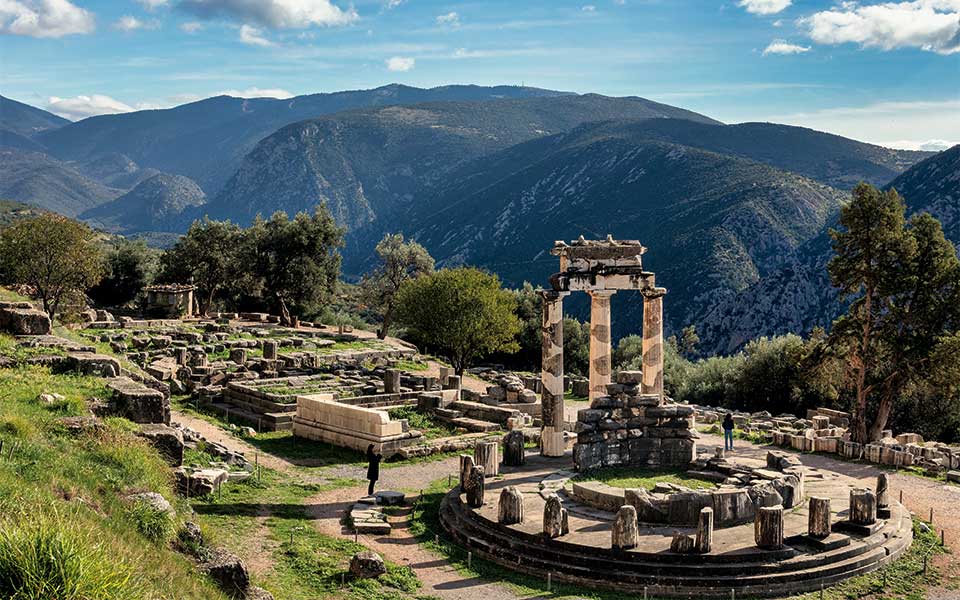
The Tholos (380 BC), in the Sanctuary of Athena Pronaea, is a masterpiece of the Classical period and perhaps the best-known monument at the archaeological site of Delphi.
© Perikles Merakos
Before looking at any of the scattered ruins in the forlorn hope of making sense of things, press pause and look around you. Why was this particular place chosen?
Ancient settlements were rarely located at random. Access to fresh water, fertile land and the sea mattered, as did natural defenses, routes for trade and communication, and places considered sacred.
At Delphi, for example, the spectacular mountain setting was inseparable from the site’s religious importance – the “navel of the world,” or “omphalos.” The sanctuary was built on the slopes of Mount Parnassus, overlooking the Gulf of Corinth, its monuments fitted into a dramatic natural landscape.
At other sites, the practical considerations are easier to spot. From the summit of Sounion, at south of Athens, it is immediately obvious why a sanctuary dedicated to Poseidon was placed beside one of the most important sea routes around Attica.
So, before you enter the ruins, stop to think. What does the landscape tell you about why people came here?

The Ancient Agora of Athens.
© Shutterstock
Now look for a large open space, usually rectilinear in shape, surrounded by the remains of substantial building. You may have found the “agora,” the beating heart of the ancient city.
The agora was much more than a marketplace. It could be a place for commerce, politics, religion and social interaction, with “stoas” – long, covered colonnades – providing shelter around its edges. Within stoas were often shops and spaces for public business, where merchants could sell their goods, or, in larger cities, the offices of various public officials, while the open area itself could host meetings, markets and other communal activities. In the Athenian Agora, philosophers, including the likes of Socrates and Plato, and their followers, would often meet here to discuss their big ideas on ethics, politics, and the meaning of life.
Ancient Messene, in the southwest Peloponnese, offers an especially good – and well-preserved – example. Its enormous agora, approximately 40,000 square meters, was surrounded by four stoas, with buildings serving financial, political and religious functions. Even surviving details such as measuring tables used by market inspectors give us glimpses of the everyday business conducted here.
Instead of simply admiring the columns, ask yourself: Who was using this space, and what were they doing here?
Temples are often the easiest – and most conspicuous – ancient buildings to spot, but even when only foundations remain, there are tell-tale clues.
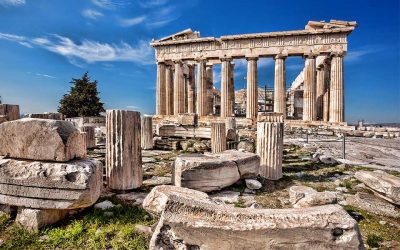
Look for a large rectangular building, often surrounded by columns. The main chamber was the “cella,” where the cult image of the deity was housed. In front might be a “pronaos,” or entrance porch, while the triangular “pediment” above the roof could once have carried elaborate sculpture. See our Anatomy of the Parthenon.
You may also encounter the three main architectural orders: Doric columns are generally sturdy and relatively plain; Ionic columns have distinctive “spiral volutes” on their capitals; Corinthian capitals are much more elaborate and “flowery,” decorated with acanthus leaves.
One of the best-preserved ancient temples in Greece lies in the heart of the Peloponnese, at Bassae. Dubbed the “Parthenon of the Peloponnese” and dedicated to Apollo, the temple was constructed in the late 5th century BC and attributed by the 2nd-century AD traveler Pausanias to the renowned Iktinos, architect of the Parthenon in Athens. One of its most remarkable features is its incorporation of all three classical orders of ancient Greek architecture: Doric, Ionic and Corinthian.
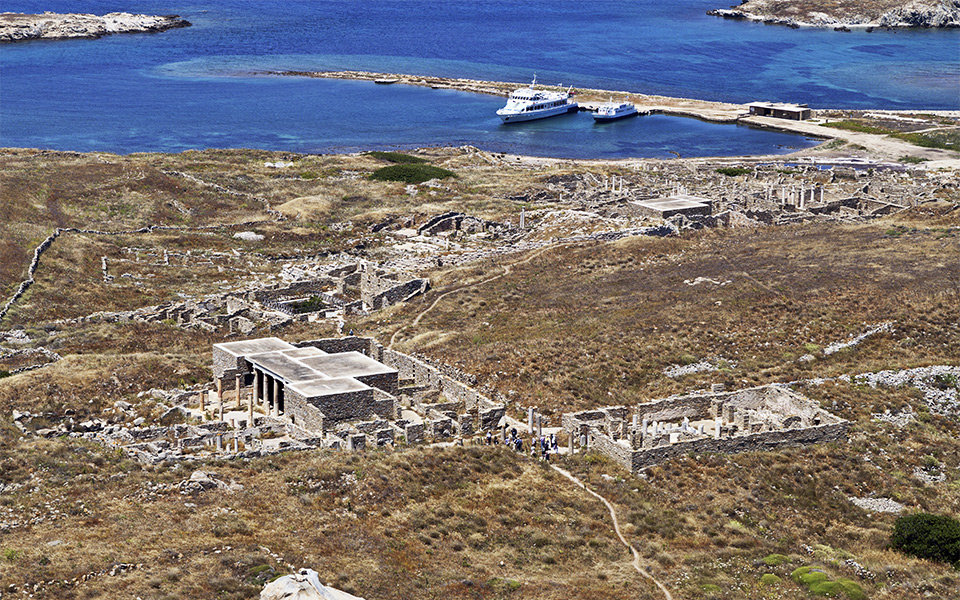
Delos – view of the area around Mount Kynthos.
© Shutterstock
Ancient cities weren’t made up entirely of temples and public buildings. Just like cities today, people had to eat, sleep, work, shop and argue somewhere!
This is where sites such as Delos, a sacred island in the heart of the Cyclades, become particularly fascinating. Among its grand sanctuaries and public monuments are streets lined with houses, courtyards and workshops. As you explore, look for doorways, thresholds, drains, and the remains of domestic rooms. A mosaic floor may tell you something about the wealth and status of its owner; fragments of pottery recovered from houses and workshops can offer even more intimate clues.
Large storage jars, or “pithoi,” for example, could reveal how food, wine or other goods were stored, while the arrangement of rooms and courtyards can tell us something about how people organized their homes and work.
These less glamorous remains can sometimes bring the ancient world closer than a monumental temple or public building. This is where people actually lived.
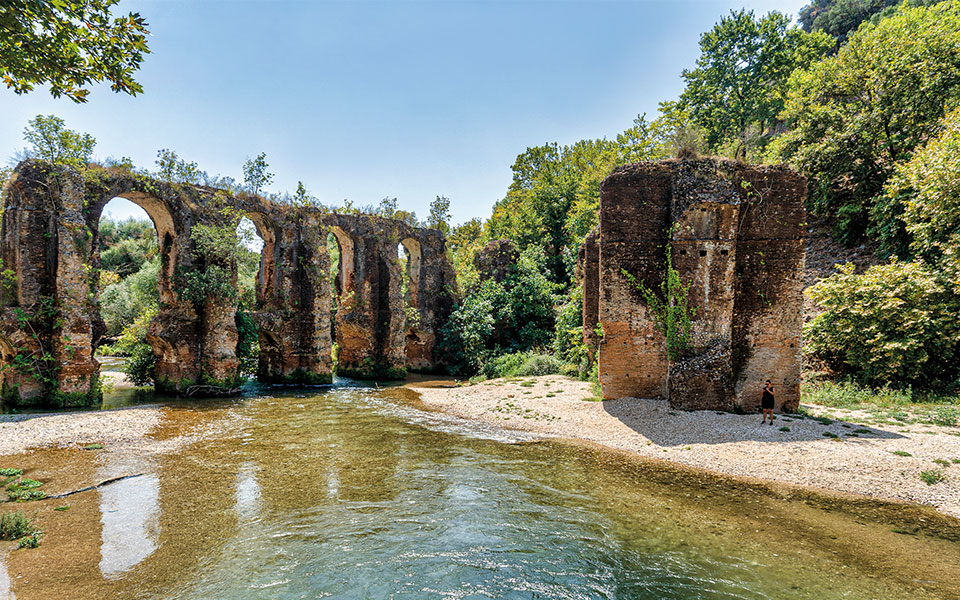
The aqueduct, which stretched 50 kilometers from ancient Nikopolis, supplied the city with fresh water.
© Perikles Merakos
Once you’ve found the buildings, look at the spaces between them.
Ancient streets reveal how a city was planned and how people moved through it. Look closely and you may spot paving stones worn by centuries of footsteps, wheel ruts left by carts, or steps designed to negotiate a slope. The width of a street, its paving and even the position of its entrances can tell archaeologists something about how busy it was and what kind of traffic it carried.
Then look down. Drains, wells, fountains, and cisterns may not be as photogenic as a fancy white marble column, but they tell us a lot about how an ancient city functioned. Aqueducts brought water from distant sources; drainage systems carried away wastewater; fountains provided places where people could collect fresh water.
At Nikopolis, for example, an impressive aqueduct carried water roughly 50km from springs in the Louros region to the city, where it was distributed through an urban water-supply system. At smaller settlements, wells and cisterns could be equally important, storing precious water for domestic use.
A fabulous example of urban life can also be found beneath the Acropolis Museum in Athens, the Makrigianni site. Today, visitors can walk along elevated walkways and enjoy a bird’s-eye view of an ancient Athenian neighborhood, an “urban honeycomb” at the foot of the Acropolis, featuring walls, streets, alleys, houses, baths and workshops.
In other words, the infrastructure is part of the story. A city needs more than impressive buildings to work.
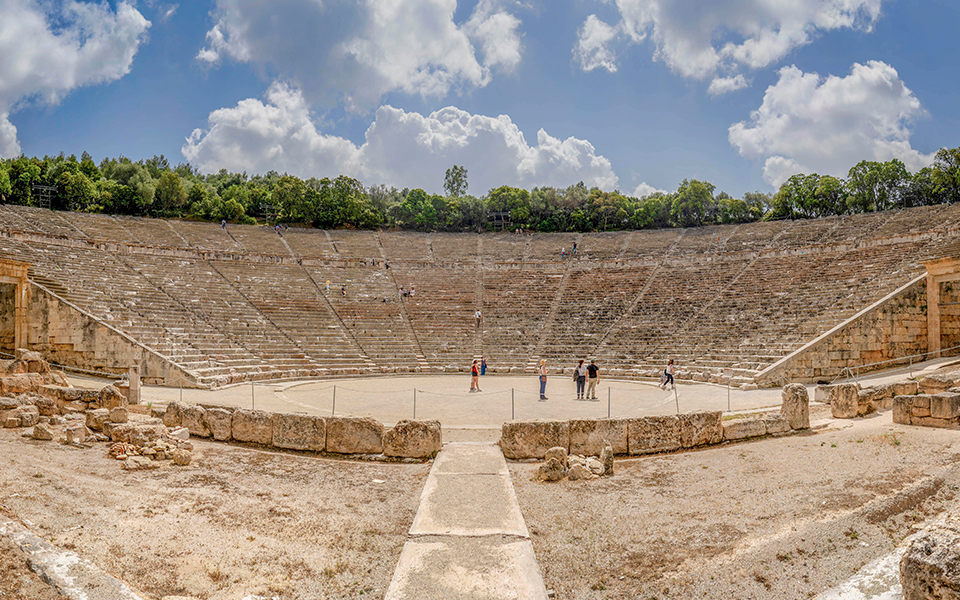
A view of the stage at the stunning Ancient Theater of Epidaurus.
© Perikles Merakos
If you encounter a large semicircular seating area built into a hillside, you’re probably looking at a theater.
The ancient Greeks were remarkably adept at using natural slopes to create seating, giving large audiences good views of the performance area and helping sound carry across the space. At the sanctuary of Epidaurus, in the northeast Peloponnese, the result is one of the most famous theaters in Greece. Built in the 4th century BC, it is renowned for its extraordinary acoustics: even the drop of a coin or a whisper from the stage (“orchestra”) can be heard from the back of the seating area (“theatron”).
But theaters weren’t simply places for entertainment. Returning to Ancient Messene, the theater was also used for political assemblies and remained in use for centuries, its architecture changing as the city itself evolved.
Other public spaces served different purposes. Stadia hosted athletic competitions, while gymnasia combined physical exercise with education and social activity. At Olympia, these facilities formed part of a much larger athletic complex within the sanctuary, alongside the “palaestra,” baths and other structures associated with the preparation and staging of the Olympic Games.
So, when you encounter a large public building, ask not only “What happened here?” but “Who came here – and why?”
Perhaps the biggest mistake we can make when looking at ancient Greek ruins is assuming that they originally looked like this: weather-beaten and bare. They didn’t. Obviously.
Temples and sculptures were often brightly painted. The polychromy of the Parthenon, for example – the practice of decorating architectural and sculptural elements in a variety of colors – is a well-known phenomenon. Buildings had roofs, doors, and colorful decorative details that have long since disappeared.
Streets were filled with people, animals, carts, and traders. Walls were daubed with graffiti – sometimes political, oftentimes obscene. There were voices, laughter, pungent smells, cooking fires, and the constant humdrum of daily life.
What we see today is, in many cases, essentially the skeleton of the ancient city.
So, when you look at a weathered marble statue or a bare temple, try to imagine the vibrant colors, the roof that has collapsed, and the people who once moved through the space. Seeing colorful reconstructions can be quite jarring at first, but the ruin itself is only the surviving fragment of a much richer environment.
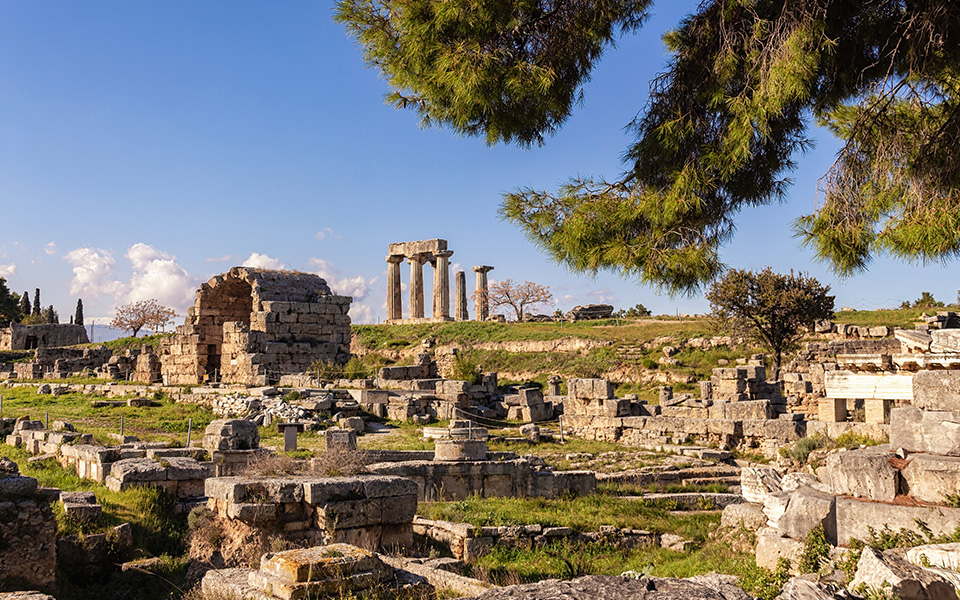
Ancient Corinth.
© Shutterstock
Finally, remember that an archaeological site rarely belongs to just one period.
A Greek city might later become Hellenistic, then Roman, Byzantine or medieval. Buildings were demolished, rebuilt and adapted; older stones were reused in newer walls; streets changed and sometimes disappeared altogether.
Ancient Corinth is a particularly good place to think about this. Founded in antiquity in a strategically important position between the Corinthian and Saronic Gulfs, the city was destroyed by the Romans in 146 BC and re-founded as a Roman colony a century later. Its urban landscape was subsequently transformed again in Late Antiquity, when earthquakes, political upheaval and the growth of Christianity altered the city.
What appears at first to be a single ancient city is therefore actually a palimpsest – a place where successive generations have written, erased and rewritten the landscape.
This means that archaeological sites should not always be read from oldest to newest. Look for the interruptions, additions and repairs. They are evidence of people adapting an existing place to meet new needs.
And that, perhaps, is the most useful thing to remember when visiting an archaeological site. Don’t just look at the monuments. Look around them. Find the landscape, follow the streets, look for the water, identify the public spaces and peer into the less spectacular corners.
Ask where people lived, where they worked, where they worshipped and where they gathered.
The next time you find yourself standing among a collection of broken columns and stone foundations, you may discover that you’re no longer looking at a pile of stones at all.
You’re looking at a once-vibrant city, filled with life.
Ancient Greece had its own team...

Everything you need to know about...
In which a world-wearied scribe rediscovers...

The ancient Greeks may not have...