Paros: 12 Culinary Stops on a Cycladic Favorite
From kafeneia serving souma and meze...

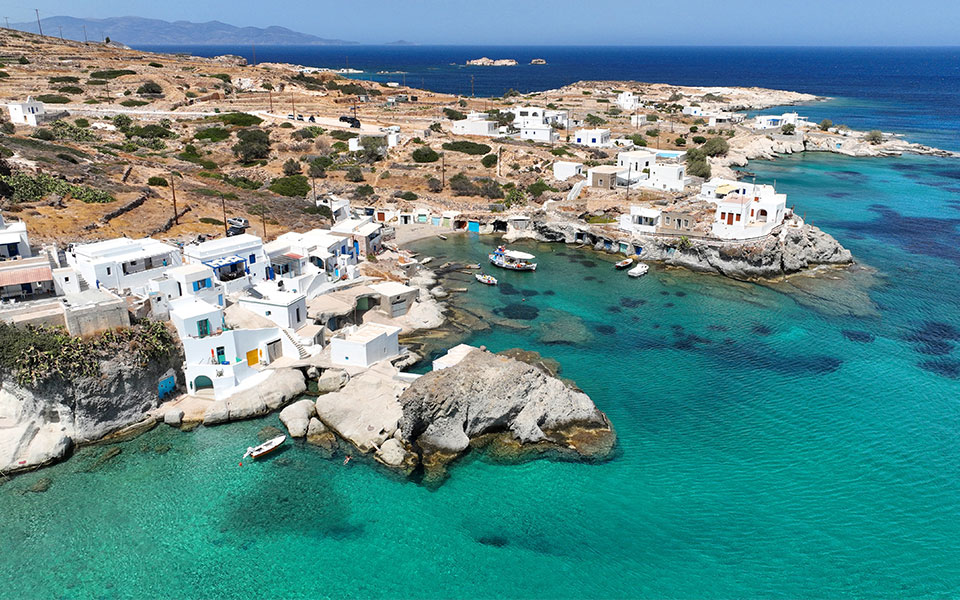
The picturesque fishing settlement of Sirmata Goupa on the southeast coast of Kimolos, with colorful boat houses and rock formation shaped like an elephant.
© Shutterstock
It’s true: Kimolos has been generating a fair amount of buzz of late, attracting praise across international media outlets and travel sites. Last summer, Dutch travel platform griekenland.net highlighted the island’s unspoiled beauty and “wonderfully quiet beaches” as a soothing alternative to the more headline-grabbing Cycladic hotspots nearby (yes, we’re looking at you, Mykonos). The UK’s Mirror, meanwhile, waxed-lyrical about Kimolos being a hidden gem blessed with “the world’s clearest waters.”
Yet there’s far more to this tranquil, laidback island than first meets the eye. For culture-minded travelers and those who enjoy exploring on foot, Kimolos – a stone’s throw from Milos in the western Cyclades – punches well above its weight. Beyond its luminous beaches lies a compact island shaped by centuries of human activity: a medieval castle crowning its hilltop capital, an engaging archaeological museum, a locally revered saint, submerged ruins, and a rugged landscape threaded with old walking paths.
With its strong sense of place, excellent local cuisine, and an unhurried rhythm of life, Kimolos reveals itself not only as somewhere to unwind, but as somewhere to explore with attention and curiosity.
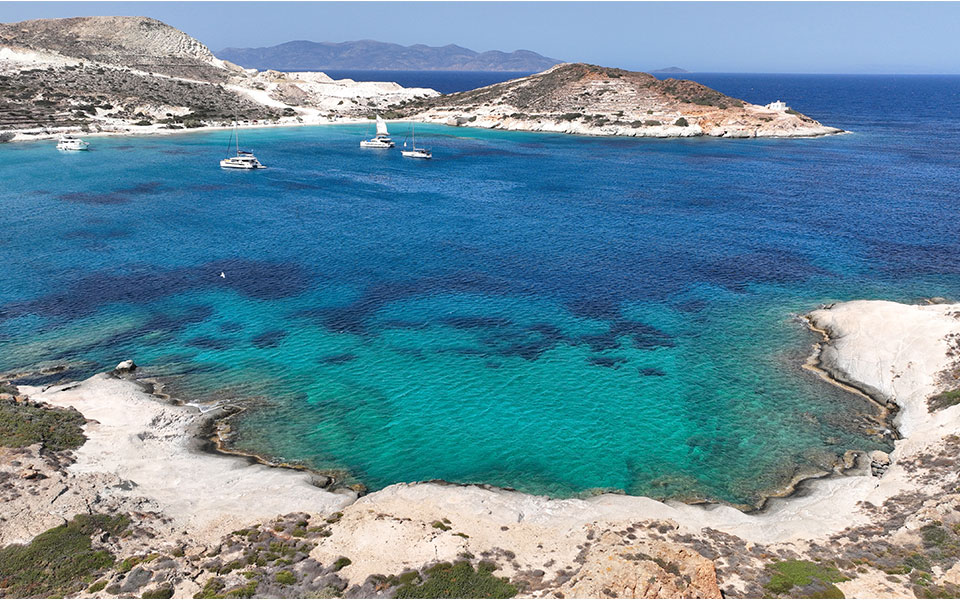
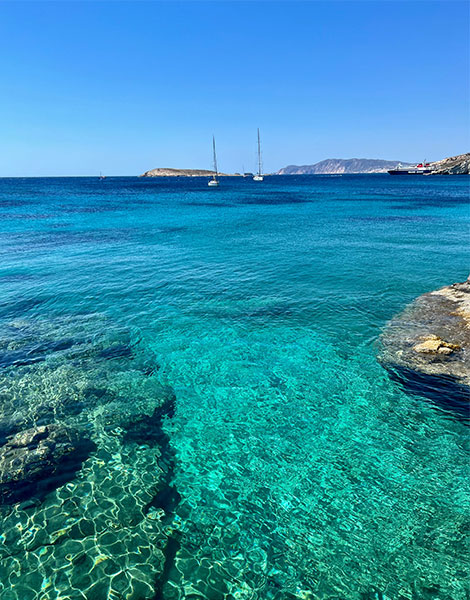
Prassa Beach, with its pale silver sands and translucent turquoise waters, is the island’s most photographed stretch of coast.
© Shutterstock
Kimolos has been inhabited since the Late Neolithic period (late 6th to mid-5th millennium BC), as evidenced by finds from the east-coast site of Provarma. The island’s name is thought to derive from “kimolia,” the fine white chalky clay known as “Kimolian Earth,” which was mined here for millennia and traded widely across the ancient Mediterranean. Prized for its cleansing, medicinal, and industrial qualities, kimolia was used in everything from cosmetics to textile production.
In Classical times, Kimolos found itself drawn into the orbit of larger regional powers. As a member of the Athenian-led Delian League, the island became a bone of contention between Athens and its main rival Sparta, whose influence extended from neighboring Milos. Its strategic position and economic resources made it more significant than its size might suggest.
An ancient city once stood on what is now the islet of Agios Andreas, opposite the beach and settlement of Ellinika. In antiquity, this landmass was joined to the main island before being severed by a violent earthquake. Today, traces of the city survive both on land and beneath the shallow waters of the bay, creating one of Kimolos’ most evocative archaeological sites.
Around the cobbled streets of Horio, the island’s main settlement and only town, scattered remains point to a familiar Cycladic pattern: communities gathered in defensible locations, shaped by shifting alliances and the uncertainties of life in the ancient Aegean.
Just offshore lies the tiny, uninhabited island of Polyaigos, declared an official archaeological site in 2025 to safeguard its prehistoric remains and a Classical-era shipwreck. Its protected status serves as a reminder that Kimolos and its immediate satellites once lay within a busy maritime world, not quietly on its margins.
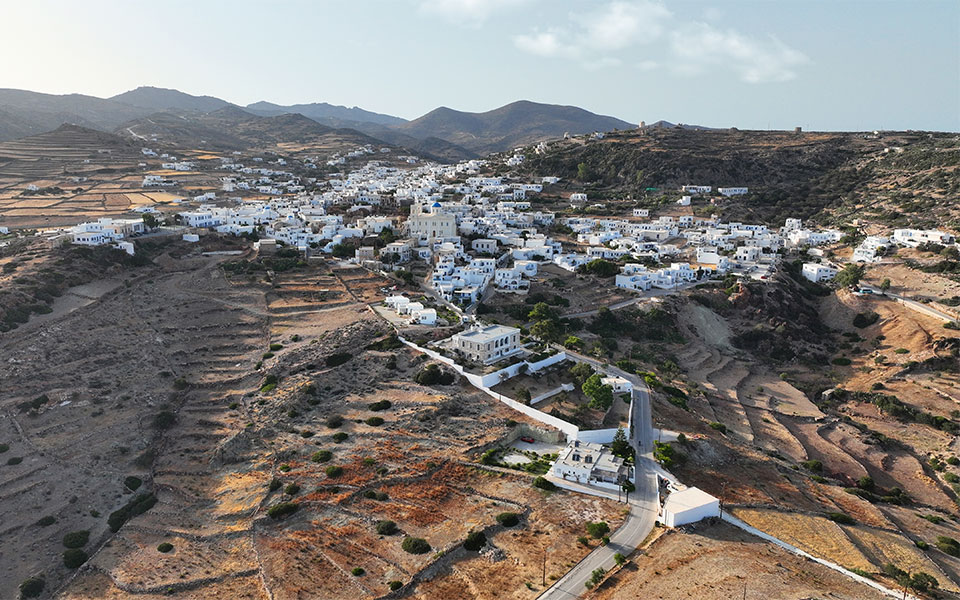
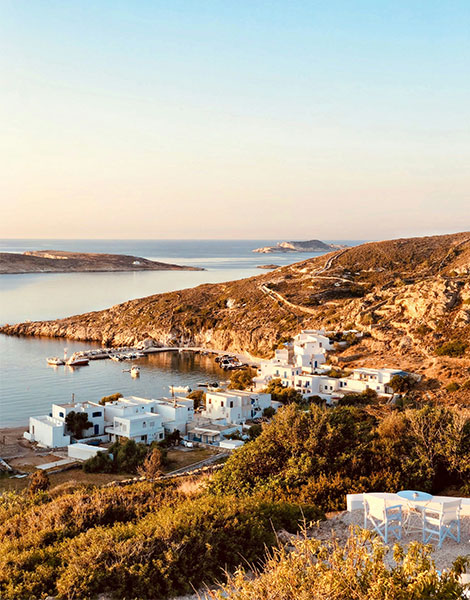
Horio, the island’s main settlement and only town, overlooks the port of Psathi.
© Shutterstock
To gain a clearer sense of the island’s past, a visit to the Archaeological Museum of Kimolos is a must. Located in Horio, opposite the Metropolitan Church of Panagia Odigitria, the museum is housed in one of the town’s oldest two-storey traditional buildings and opened to the public in 2008.
Its compact but carefully curated displays trace human activity on Kimolos from the Late Neolithic through the Mycenaean, Geometric, Archaic, Classical, and Hellenistic periods, continuing into Late Antiquity. One of the museum’s most evocative features is its transparent glass floor, revealing a reconstructed ancient burial beneath visitors’ feet.
Among the highlights – many recovered from the submerged ancient settlement and necropolis at Agios Andreas and Ellinika – are a carved gravestone of a headless woman dating to the 8th century BC, among the earliest known examples in Greece, a 1.3-meter-tall headless female statue from the 2nd century BC, and copies of civic decrees that shed light on Kimolos’ political life and disputes over ownership of nearby Polyaigos.
Archaeological Museum of Kimolos
Tel. (+30) 22870 51291
Opening hours: Tuesday-Sunday 08:30-15:00, Monday closed
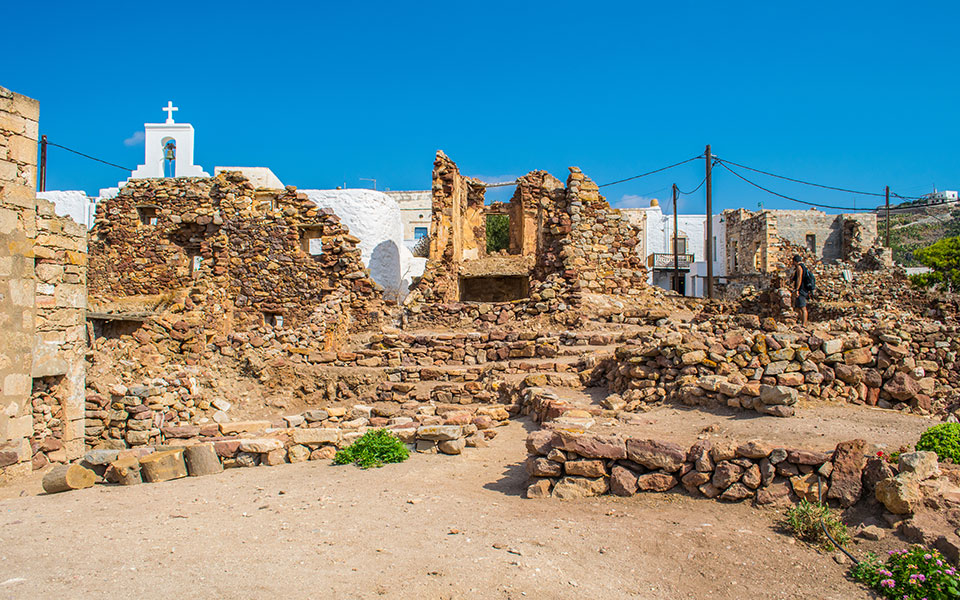
Ruins of the inner castle atop Horio, the island’s main settlement.
© Shutterstock
Rising above Horio, Kimolos’ medieval castle (Kastro) is less a single monument than a layered historical landscape. Built between the 14th and 16th centuries, the fortified settlement once contained around 123 houses arranged within concentric defensive walls. Today, fragments of fortification, stone façades, and dated door lintels still outline a closely knit community shaped by the ever-looming specter of attack.
Within the castle complex sits the small but engaging Folk and Maritime Museum, housed in a restored two-storey residence once associated with a local seafaring family. Its exhibits offer glimpses of everyday life on Kimolos, from hand-embroidered textiles and weaving tools to household ceramics and the implements of traditional trades such as farming, carpentry, and shoemaking.
Upstairs, 18th- and 19th-century furniture recreates the atmosphere of a traditional Kimolian home, while a modest nautical display honors the island’s maritime past through navigational instruments, photographs of sailing vessels, and memorials to local captains. Together with the nearby Church of the Birth of Christ, built in 1592, the castle area provides one of the island’s most atmospheric corners.
© Unsplash
© Unsplash
Kimolos is unusual in the Cyclades for venerating a modern local saint. Osia (Saint) Methodia remains a central figure in the island’s spiritual life. Born Irene on November 10, 1861, she felt a religious calling from an early age. After losing her husband at sea, she devoted herself fully to a life of prayer and service.
Tonsured as a nun by the Archbishop of Syros, she took the name Methodia and lived an ascetic life marked by compassion and spiritual counsel. Her small cell within the Inner Castle, beside the Church of the Birth of Christ, became a place of quiet pilgrimage, as islanders sought her guidance. Over time, her reputation spread well beyond Kimolos.
Recognized locally as a patron saint in 1946 and canonized by the Ecumenical Patriarchate in 1991, Osia Methodia’s relics are now housed in the Church of Panagia Odigitria. Her feast day on October 5 remains one of the most significant dates in the island’s religious calendar.
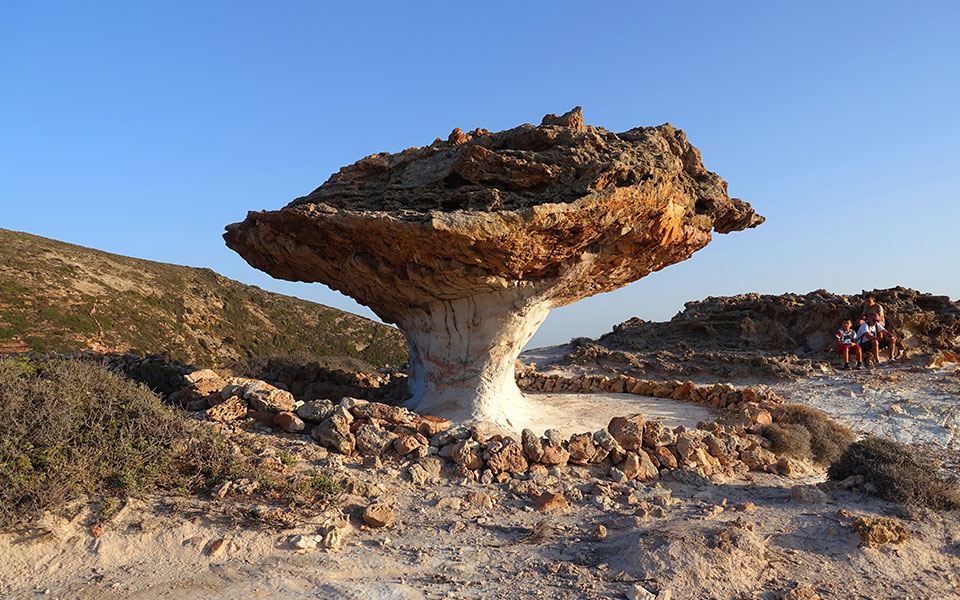
Skiadi, the geological formation that resembles a mushroom.
© Shutterstock
Kimolos is a walking island in the best possible sense. From Horio, a network of signposted trails extends across low hills and along the coast, many following centuries-old routes that once linked fields, chapels, terraces, and small rural settlements. Some walks are gentle, others more demanding, so be sure to wear sturdy shoes and bring plenty of water. Routes such as Horio–Ellinika Beach, Horio–Paliokastro, and Horio–Monastiria or Soufi combine historical and/or geological interest with expansive Aegean views, often ending at quiet coves.
One of the island’s most distinctive natural landmarks lies on a windswept plateau in the northwest: Skiadi, a vast mushroom-shaped rock formed by the relentless Meltemi winds. As softer stone at its base wore away while the harder cap endured, Skiadi acquired its bizarre silhouette. Listed in the Atlas of Geological Monuments of the Aegean, it feels both ancient and otherworldly.
At Ellinika, walking, archaeology, and seascape converge. With a mask and snorkel, visitors can float above the submerged remains of the ancient town, while on land, traces of tombs dating from the Mycenaean through the Hellenistic periods are still visible near the shore.
Taken together, Kimolos’ natural beauty and cultural depth invite travelers not just to unwind but to linger – and to look a little closer.
From kafeneia serving souma and meze...
Discover Greece’s islands in September with...
Charming architecture, unique beaches, rich history,...
A compact archaeological guide to the...