Kerameikos: An Oasis in the Ancient City
The Kerameikos archaeological site provides a...

“Travelers of the Levant.” That is how Thodoris Ktistakis describes his loukoumades.
© Christina Georgiadou
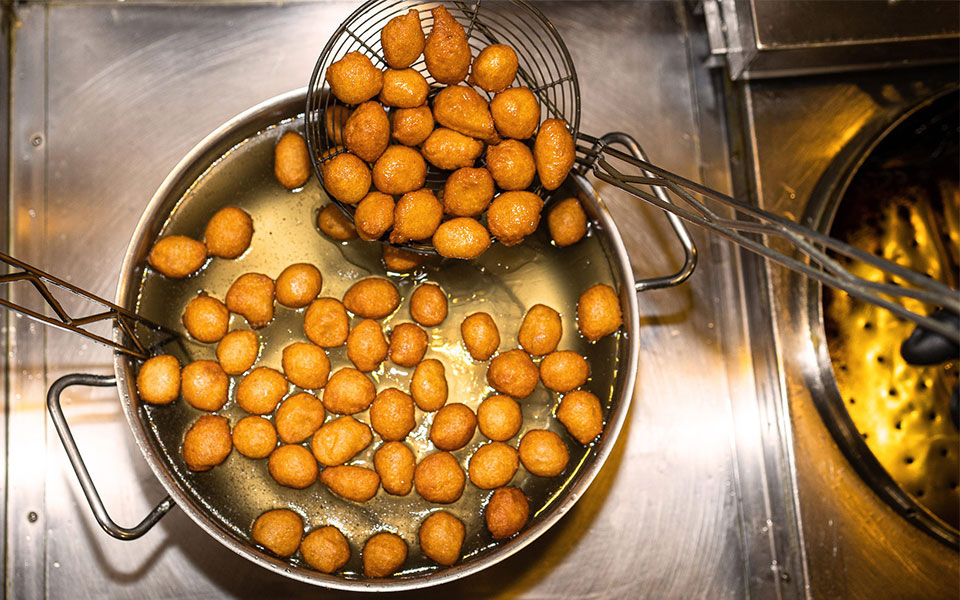
“Travelers of the Levant.” That is how Thodoris Ktistakis describes his loukoumades. These small, perfectly round bites of dough have a crisp exterior and, unlike your standard loukoumades, are not drizzled with honey. Instead, when they burst in the mouth with the first bite, they release the syrup trapped inside, like a small explosion of sweetness. The recipe, which Ktistakis inherited from his father, who in turn inherited it from his own, has followed a long journey: from Alexandria to Hania, and from there to Omonia.
For decades now, the small and unassuming Ktistakis shop on Sokratous Street has been a regular stop for downtown workers and passersby seeking a sweet break during the day. It’s one of the few constants in a city that, unfortunately, allows many of its best memories to fade, and this long history was one of the reasons Gastronomos awarded this year’s Athens Dessert Award to the shop.
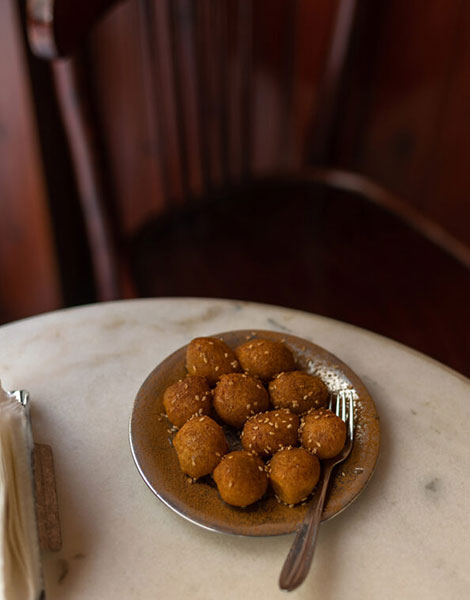
These small, perfectly round bites of dough have a crisp exterior and, unlike your standard loukoumades, are not drizzled with honey.
© Christina Georgiadou
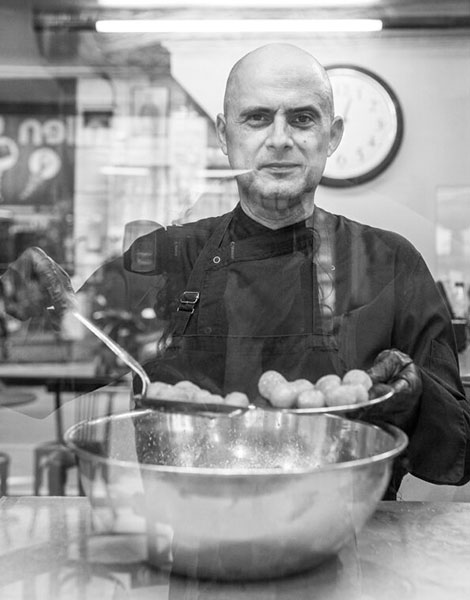
“The loukoumades maker is something between a laborer, a craftsman and an artist. It takes a bit of heart, a bit of hand and a bit of art,” says Thodoris Ktistakis.
© Christina Georgiadou
“In 1908, my grandfather left Crete and went to Alexandria, Egypt,” Thodoris recounts, “to work at the renowned pastry shop of one Tornazakis, who was also of Cretan origin. Tornazakis was famous for the triangular pastries he made, as well as for his loukoumades. Egyptians called them luqmat al-qadi, meaning ‘the judge’s bites,’ because, from what I’ve heard, they were offered to judges to soften them up.” There is yet more tit-for-tat in this story; in return for a personal favor, Tornazakis taught Thodoris’ grandfather the recipe, and it then traveled back with him to Hania on the island of Crete and later to Athens, where his three sons moved the shop following encouragement from the Cretan statesman and three-time Prime Minister Sofoklis Venizelos, who was perhaps pining for his favorite hometown treats.
The business faced difficulties at first, as syrup-filled loukoumades were an unfamiliar treat for Athenians. Gradually, however, the shop’s reputation spread, and the place filled with crowds from nearby theaters and cinemas. Couples arranged to meet there and, according to certain accounts, even the Royal Palace enjoyed their creations. There was, it is said, talk of the Ktistakis family becoming official suppliers to the palace, although that never came to fruition.
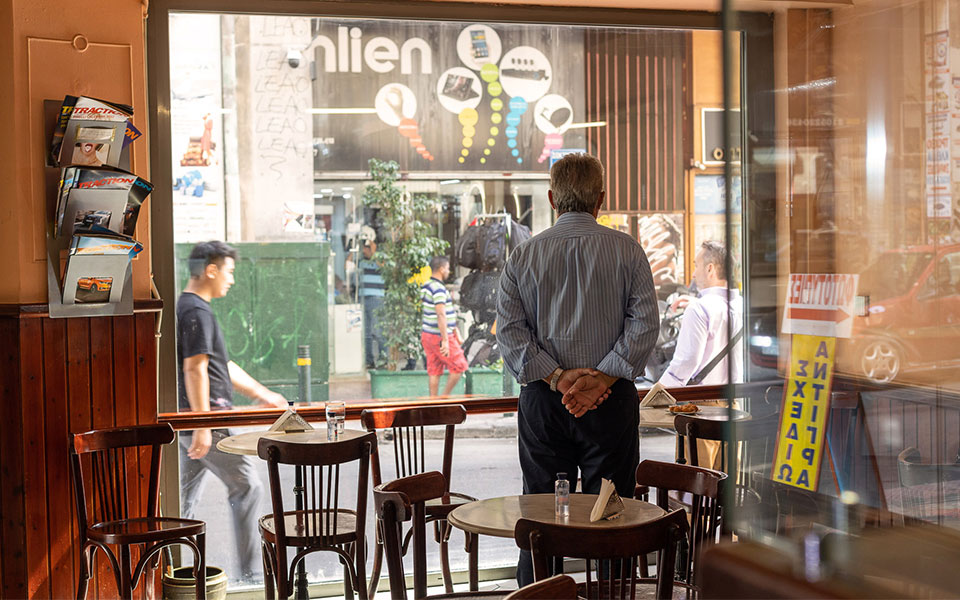
Ktistakis shop on Sokratous Street has been a regular stop for downtown workers and passersby seeking a sweet break during the day
© Christina Georgiadou
“The loukoumades maker is something between a laborer, a craftsman and an artist. It takes a bit of heart, a bit of hand and a bit of art,” says Thodoris who, every day and entirely on his own, kneads the dough, cuts it and then fries it in oil he changes with regularity before finally serving the loukoumades on the shop’s characteristic tin plates. He adds cinnamon and a little sesame “to break up the sweetness with a touch of something savory.”
Ktistakis’ clientele includes people of all ages and encompasses both loyal locals and tourists either trying loukoumades for the first time or chasing flavors they know from their own lands. Some enjoy them on the spot, accompanied only by a glass of cold water, since Thodoris deliberately serves nothing else in the shop; others leave carrying boxes as gifts (unlike ordinary loukoumades, these keep perfectly well until the next day). It’s not uncommon for customers to share stories of parents or grandparents who met at the shop or who used to arrange dates on the mezzanine of the original store. Just a few steps from Omonia Square, it’s a sweet postcard from Athens’ past.
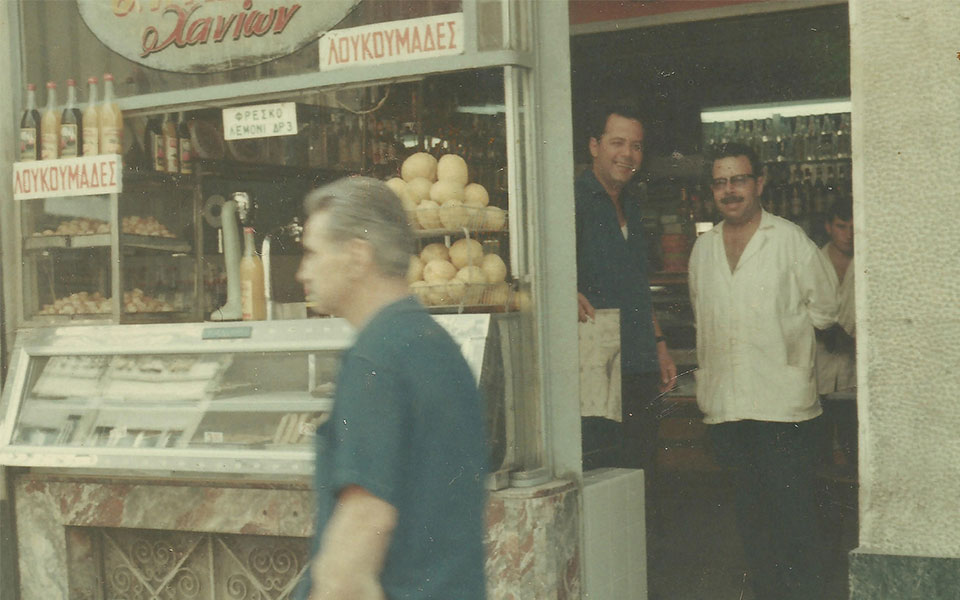
Evangelos (left) and Sophocles Ktistakis at the old shop.
“Omonia is the true mirror of Greece,” says Thodoris, a born-and-bred child of the city center. “It has just one flaw: it’s too honest. It lays everything out in the open, hides nothing from you,” he says.
As for the loukoumades recipe, he keeps it a closely guarded secret. There are all sorts of theories about how the syrup gets trapped inside the little bites: “We’ve even heard that we inject it with a syringe!” Ktistakis says, laughing, before divulging, but without going into too much detail, that it’s the type of dough that creates the signature effect.
“Even today, when I work alone, I remember sounds and images from the past. I see the hands that kneaded the dough back then, almost as if they’ve come to correct something for me. I remember the sounds that filled the space. Everything matters. A different sound can mean the dough has gone wrong. I can tell how the loukoumades will turn out from the noise they make when I knead the dough, or from the sound they makes when they drop, syrup-sweet, into the basin,” Thodoris adds.
His son is still young, but when the time comes, regardless of the profession he chooses, he will inherit the recipe. “For the right texture to become familiar to his hands … For him to learn the craft and keep it,” says Thodoris.
Originally published in Greek at gastronomos.gr.
Loukoumades Ηanion – Th. Ktistakis
59 Sokratous, Omonia
Τel. (+30) 210.524.0891
The Kerameikos archaeological site provides a...

On her first ever holiday alone,...

This recipe comes from Germanos Christianopoulos,...
From the salt-sprayed islands to the...