Kypseli: 18 Stops for Food, Coffee and More
Old and new hangouts, cafés, sandwich...


The dominant architectural style was influenced by European country houses.
© Perikles Merakos
Some Athens neighborhoods announce themselves immediately through their nightlife, restaurants, architecture or the constant flow of daily life. Others reveal themselves more quietly, beneath layers of dust and time, as if one were leafing through an old urban plan. Kypriadou, or Kypriadis Garden City as it was originally called, is one of them: a neighborhood that is unlikely to appear in a conventional Athens guide, yet one that reveals something rare about the city. It shows how Athens might have evolved had it had more room for gardens, squares, low-rise homes and a more human scale.
For most Athenians, and even more so for visitors, the area around the northern end of Patission Avenue is not an obvious place to wander. Ano Patissia, Rizoupoli and Galatsi usually sit outside the mental map of a short stay in Athens. But step away from the noisy, busy avenue, take your time under the trees and look past the apartment blocks, and Kypriadou begins to reveal itself.
It’s not a postcard-perfect neighborhood. It certainly hasn’t been polished into a destination, and that’s part of its appeal. Its charm is subtler; it’s in the two-story houses that do not hide the sky, in the broad pavements, in the front gardens that survived the postwar development system known as antiparochi through which so many landowners exchanged plots for apartments in the new buildings erected on them. Much of modern Athens developed this way, with many low houses and gardens disappearing in the process. Here, however, enough remains to show the scale of the original idea; this was once one of Greece’s most ambitious attempts to imagine another kind of city.
The story begins in 1919, when Epameinondas Kypriadis, a Greek engineer and agronomist from Egypt, decided to turn his family’s large estate in Patissia into a model garden city. The son of businessman Minoas Kypriadis, he imagined an “exemplary garden city” inspired by the European garden city movement and the ideas of British urban planner Ebenezer Howard, who’d proposed a new type of town in which residential, retail and public space could coexist on a human scale.

© Perikles Merakos

© Perikles Merakos
In Kypriadou, that ideal took physical form. The streets were laid out wide; the houses were designed as detached residences, set within their plots so that light, air and gardens could surround them; and the squares were positioned so that one’s gaze went from one to the next. This was a radical idea for interwar Athens, a fast-growing city still searching for its modern identity. (Kypriadou’s layout would later serve as a reference for Psychiko, the affluent leafy northern suburb also designed around low-rise housing and garden-city principles – although that’s not a helpful comparison for most foreign visitors.)
Fragments of that original vision still survive in Papadiamanti, Papalouka and Karkavitsa squares, named after major figures in Greek literature and art, and in Dimitris Pikionis Park, bordered by Schaubert, Karkavitsa and Alkyonis streets. The park is both a neighborhood pocket of green and one of the clearest surviving landmarks of the old garden city.
Dimitris Pikionis, one of Greece’s most important 20th-century architects, lived here and left a lasting imprint on the area. Best known internationally for his paths around the Acropolis and Filopappou Hill, he also designed, in 1949, the house and studio of his close friend Frosso Efthymiadi-Menegaki, a notable sculptor and ceramicist. The building still stands in the neighborhood today.
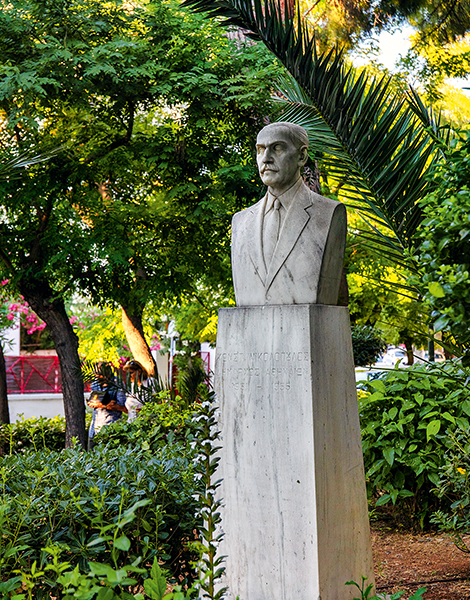
In 2023, the Municipality of Athens completed a major renovation of the park, adding hundreds of new plants and restoring its infrastructure. A bronze bust of Pikionis, created by Efthymiadi-Menegaki and donated by Agni Pikioni, the architect’s daughter, who has helped preserve his legacy, now graces the park.
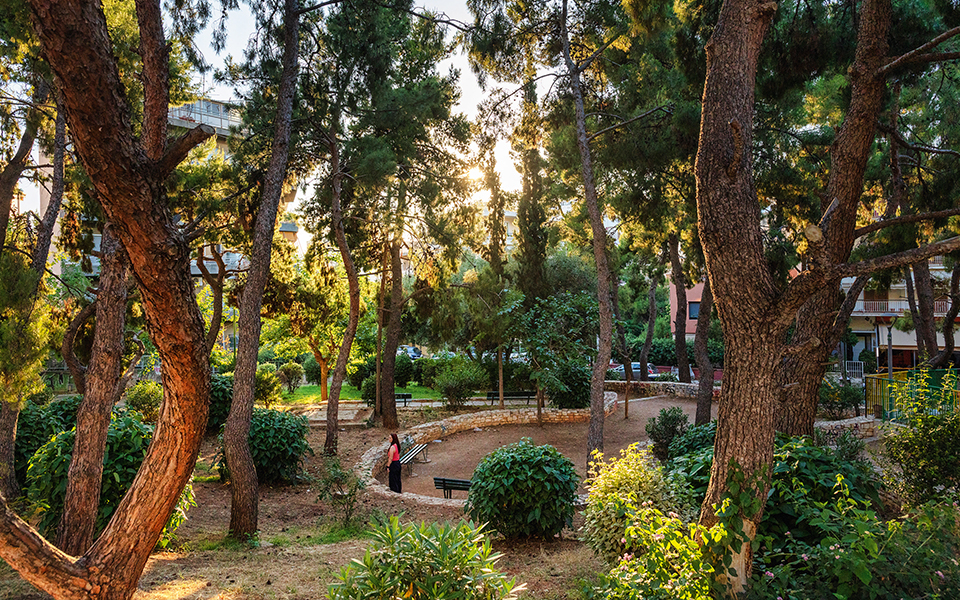
Karkavitsa Square is one of those corners of the neighborhood where you can still grasp the original concept: an Athens designed as a green city, with gardens, wider streets, and plenty of shady squares.
© Perikles Merakos
Kypriadou was one of Athens’ earliest attempts at urban planning on a human scale, and it soon drew artists, writers, architects and intellectuals. For decades, it had the feel of a quiet cultural enclave. The writer and painter Fotis Kontoglou, who helped reconnect modern Greek art with the Byzantine tradition, lived here. So did Spyros Papaloukas, a key figure of interwar Greek painting; Yannis Spyropoulos, one of the leading names in Greek abstraction; Oumbertos Argyros, a painter and professor at the Athens School of Fine Arts; and Spyros Vikatos, another influential painter and teacher of the early 20th century. Their homes and studios gave the neighborhood a cultural identity of its own.
Yannis Moralis, one of the great painters of postwar Greece and a teacher to generations of artists at the Athens School of Fine Arts, would later describe the neighborhood as the “Kypriadis School.”
The list did not stop there. Dimitris Glinos, the pioneering educator, political figure and champion of the demotic Greek language, lived here in a house that has since been designated a historic monument. So did Spyridon Marinatos, the archaeologist best known for his excavations at Akrotiri on Santorini; Antiochos Evangelatos, an important composer and conductor, and later his son, Spyros Evangelatos, one of the major figures of modern Greek theater. Even Thanasis Vengos, one of the most beloved actors in Greek cinema, once called this quiet, cultivated corner of Athens home.
In the interwar years, Kypriadou became a small hub for visual art. Its painters were not looking for ancient ruins or idealized landscapes. They painted what was around them: houses, quarries, quiet streets, the Attic light falling across walls. Spyros Papaloukas painted “Houses in Kypriadis,” while Yannis Tsarouchis, the painter and stage designer who was one of the defining figures of the Generation of the ’30s, painted “The Quarries of Kypriadis.”
© Perikles Merakos
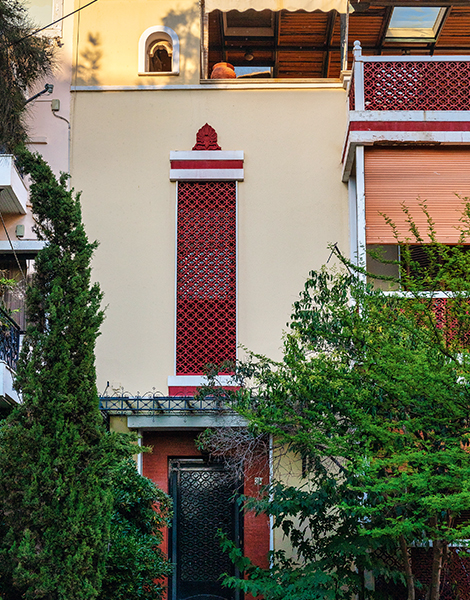
A number of the houses reveal fascinating blends of decorative elements; here, note the antique ceramic antefix atop the metal mesh above the doorway.
© Perikles Merakos
For decades, the area retained the feel of a quiet suburb, despite its proximity to the center. From the 1960s and 1970s onward, however, many of its villas were demolished and replaced by apartment buildings. Antiparochi changed the neighborhood, as it changed almost all of Athens. Yet Kypriadou kept traces of its original spirit: the squares, the greenery, the sense of community, the human scale. And somewhere among them, almost discreetly, Eve still stands.
The statue of Eve is one of those small Athenian secrets that seem to encapsulate the entire history of a place. It stands in Konstantinos Nikolopoulos/Rostand Square, the present-day name of the old Eve Square, in the heart of Kypriadou. Nikolopoulos was mayor of Athens in the early 1950s; Rostand refers to the French writer Edmond Rostand. Older residents, however, never really called it anything other than Eve Square. That alone says something about the place that the sculpture held in the neighborhood’s memory.
The work was created by Grigorios Zevgolis, a sculptor from Naxos and an important representative of modern Greek sculpture in the 20th century. Zevgolis had a particular affinity for female figures and a lyrical, human-centered approach. His Eve, nude and serene, suggests not provocation but an innocent, almost primal figure of nature. It belonged naturally to the idea of the garden city: the human body in sunlight, among the trees and open air.
At one point, the statue was moved. During the 1967-1974 dictatorship, when Greece’s military regime imposed a rigid and conservative public morality, Eve’s nude body was deemed offensive to public decency. The statue was removed from the square and transferred to Kypseli, a densely populated neighborhood north of the city center. In its place came a bust of Konstantinos Nikolopoulos. It was a telling substitution: official respectability replacing the freedom and sensuality of art.
More than 20 years would pass before Eve returned. In 1995, thanks in part to the persistence of local groups and residents, the statue was reinstalled in the square, where it remains today. Its return felt almost symbolic: a small restoration of the neighborhood’s own memory.
That, ultimately, is the reason to visit Kypriadou. Not because it is the most beautiful neighborhood in Athens – it is not – nor because it offers a perfectly preserved, postcard-perfect version of the old city. Kypriadou is more interesting because it is imperfect. It shows how Athens might have developed had it had more trees, pavements, squares and low-rise homes. It also shows how the city actually survives: in layers, through plans that were only partly realized, buildings that came later, and the everyday life of a neighborhood still very much in use.
For visitors who have already seen the Acropolis, Plaka, Koukaki and Pangrati, Kypriadou offers something else: a walk through a different Athens. It is lived-in, green in places, and historical without announcing that fact too stridently. It is a neighborhood that does not ask to be consumed quickly, but noticed.
Go on a quiet morning or in the late afternoon. Start from Ano Patissia, enter Kypriadou through its squares, pause at Pikionis Park, find Eve and take your time. You might not leave feeling that you’ve discovered another “must-see,” but you might depart with something better: the sense that Athens still has neighborhoods that cannot be explained in a single photograph.
How to get there
Take Metro Line 1, the green line linking Piraeus with Kifissia, to Ano Patissia Station. From Monastiraki or Omonia, the ride takes about 15 minutes. From there, walk toward Kypriadou rather than staying on Patission Avenue.
How long does it take?
Allow 45 minutes to an hour. This is not a checklist walk, but rather a troll through a neighborhood.
Why go?
To see a rare version of Athens: a neighborhood planned as a garden city, with interlinked squares, traces of interwar houses, greenery, public sculpture and a strong artistic legacy.
When to go
Morning or late afternoon, so that you can see the houses, gardens and squares in a softer light.
Old and new hangouts, cafés, sandwich...
In which a world-wearied scribe rediscovers...

New venues show how the city...
Exploring the eateries, stories, and shifting...