The British School at Athens: 140 Years of...
A nexus of Hellenic research, the...

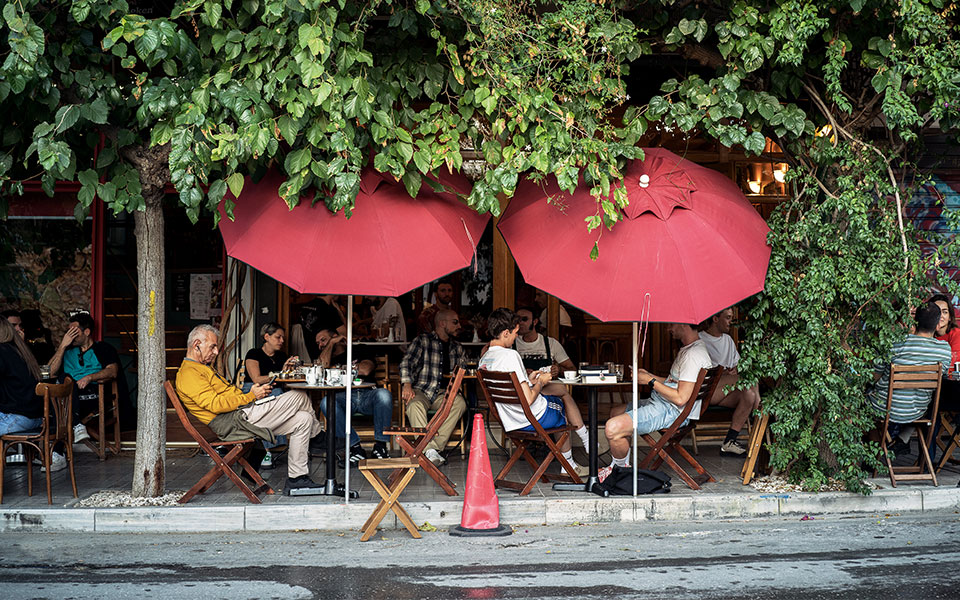
At Paraskinio for one last afternoon coffee.
© Stelios Papardelas
“On quiet nights, Athens will light up like a great ship, and you’ll be standing on its deck,” sings a young woman as she walks down Kallidromiou Street. A few meters away is the post-war apartment building on the corner of Deligianni Street where Arleta, the singer who performed that very song, once lived. Nearby, a group of teenagers descends the Strefi Hill steps carrying portable speakers, just as Yesterday’s Bread, the well-known second-hand clothing store, lifts its shutters as it opens for the afternoon. Despite this chorus of sounds, everything feels calm for this time of day in this corner of Athens.
The word “Kallidromiou” means “beautiful road,” but in fact this street was named in remembrance of the Battle of Mt Kallidromo (1821-22). Running northwest to southeast, this 750-meter strip of asphalt that stretches from Alexandras Avenue to the foothills of Lycabettus as it intersects the neighborhood’s main arteries, could well be considered a boundary line for Exarchia. Its route was laid out by Kleanthis and Schaubert, as part of the broader planning and building project involving the capital’s former suburbs, areas developed in the mid-19th century that hadn’t been included in the original urban plan. Chaotic and eclectic from the start, Kallidromiou still presents a lively collage of architectural styles – and lifestyles – today.
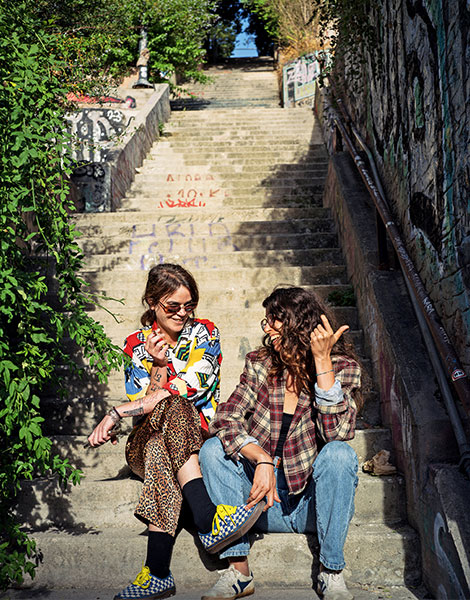
On the Strefi Hill steps, Sira and her friend pause, waiting for the sun to set.
© Stelios Papardelas
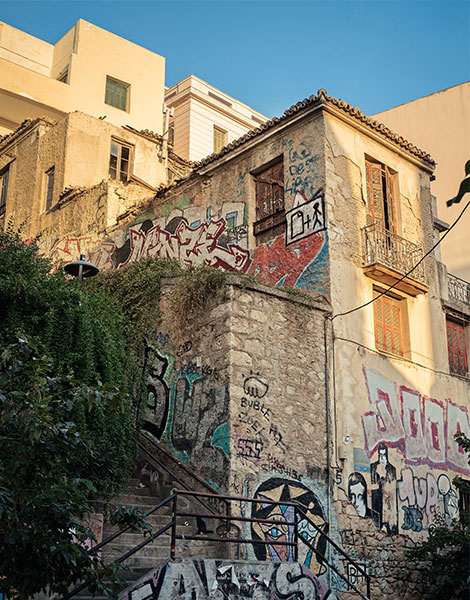
A mosaic of architecture and history.
© Stelios Papardelas
Among this street’s most important addresses are: the eclectic three-story residence on Plapouta Street, designed by architect Nikolaos Nikolaïdis, with its prominent bay windows and ornate decoration; the now-abandoned Aiolos Tower of the Iliopoulos brothers, which caught fire in 2018; its four famed cafés – Enoikos, Bourbon, Paraskinio, and Viola; the courtyard of Ama Lachi, the former school deemed unsafe after the 1981 earthquake; the laundromat at number 16; the site of the underground club Green Door at the corner of Benaki; the Astir steps; Nikolas Asimos’ shop at number 55; the historic café-bar Mouria on Harilaou Trikoupi, in operation since 1915; and both the crêperie and the fish-shop Paros across the street from that café. Notable, too, are the bookshops and the small publishing houses that dot the street. Of perhaps greatest significance , however, is the weekly farmers’ market; every Saturday since 1954, Kallidromio becomes a sea of orange awnings.
Kallidromiou Street is a free-flowing anthology of stories passed from person to person and from era to era, changing a little with every retelling, tales that, for each person, become personal.
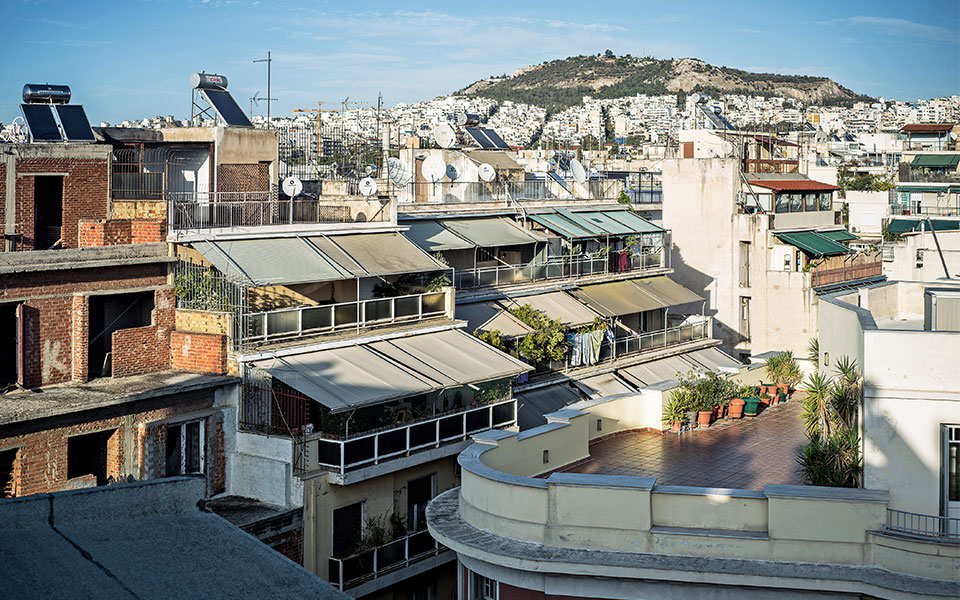
The sea of Athenian awnings and apartment buildings, as seen from a neighborhood rooftop.
© Stelios Papardelas
“Kallidromiou changes every six months, just like our wardrobes. Every season something new sprouts here. I won’t tell you whether that’s good or bad – just that it’s the reality,” a resident tells me. Across from us, two women in eccentric outfits are drinking margaritas at three in the afternoon. They’re already on their second drink, and their conversation flows in several languages.
“I’ll tell you where we’re from depending on what you want to hear,” Sira says, almost confrontationally. “I have roots in Portugal, so I could tell you I’m Portuguese. But the truth is I grew up and lived in Israel,” she continues, and behind her I notice the graffiti on the walls referencing the situation in Gaza. “I’ve been living in Pangrati for a year now. When I first came to Athens, I started volunteering at Skoros, just down the street, so Kallidromiou quickly became my hangout. From the start, it felt welcoming and friendly, while deeper into the neighborhood, things aren’t exactly like that. It has a certain quiet and a certain beauty. For instance, you can turn your head and see the Panathenaic Stadium in the distance,” she says, pointing at Lycabettus Hill. I don’t correct her.
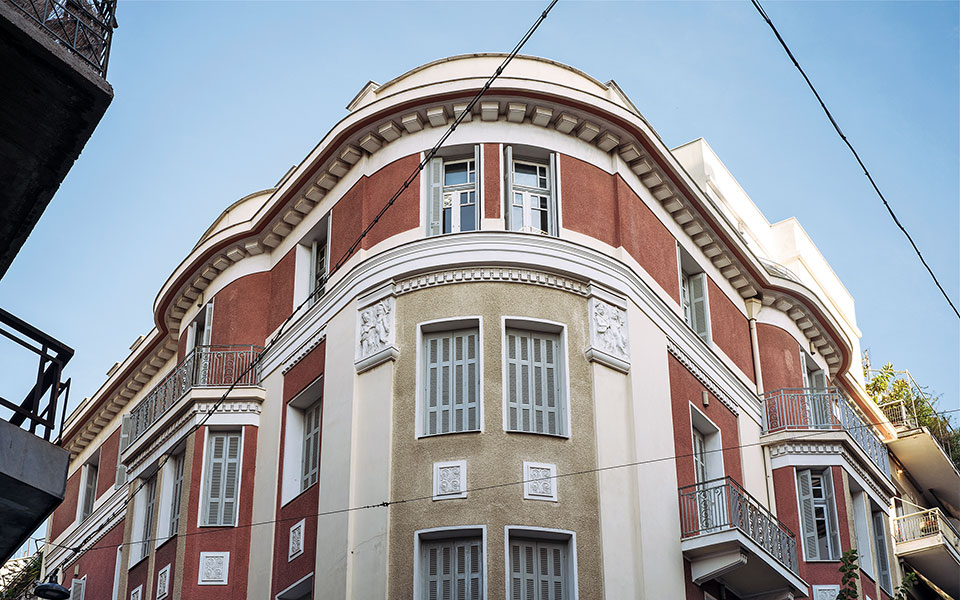
The eclectic residence on Plapouta Street, designed by architect Nikolaos Nikolaidis, stands at the end of Kallidromiou like an ornament left to time.
© Stelios Papardelas
“I like it because it gives me the feeling that this is the place where the people who actually live here come,” her friend adds, only a few hours after landing in Athens. “It’s my first time in the city, but something about this street has been pulling me in ever since we sat down. It has a kind of Western European charm, and I definitely like that it doesn’t feel like a tourist place.”
Before she can finish, Sira interrupts: “I wouldn’t say that the shops and the neighborhood here give me the sense of what we’d call ‘local.’ I’m not local in that way either. If anything, I choose to be a tourist in the city; that’s why I still haven’t learned the language,” she concludes, taking the last sips of her drink.
Further down at Paraskinio, I stop by one of the tables to greet a familiar face. “I’ve been living here seven years, but you know what? I wouldn’t leave. No matter how much it has changed, no matter how much it irritates me sometimes, this street has a beauty that can’t be matched,” a friend tells me, her face looking lovely under the midday light.
I reach Aiolos. I look for whatever remains, but instead am confronted by the scaffolding covering the neighboring buildings, which in the coming months will disappear to reveal new boutique hotels. I turn to go back and see a woman sitting on the windowsill of her apartment on Kountouriotou’s pedestrianized stretch who waves to me.
“Hello. I’m Emma,” she introduces herself in halting Greek. “Sorry I don’t speak well yet, I’ve only been here ten months. I work as a translator in migrant programs, and I’m trying to learn the language. Would you mind if we continue in English?” she asks, and then tells me her story. “I’ve lived in several cities, but here, on this street, I feel safer than anywhere else. It’s the people, the laughter, the good-mornings. It feels like a small village within the city, where we all know each other.”
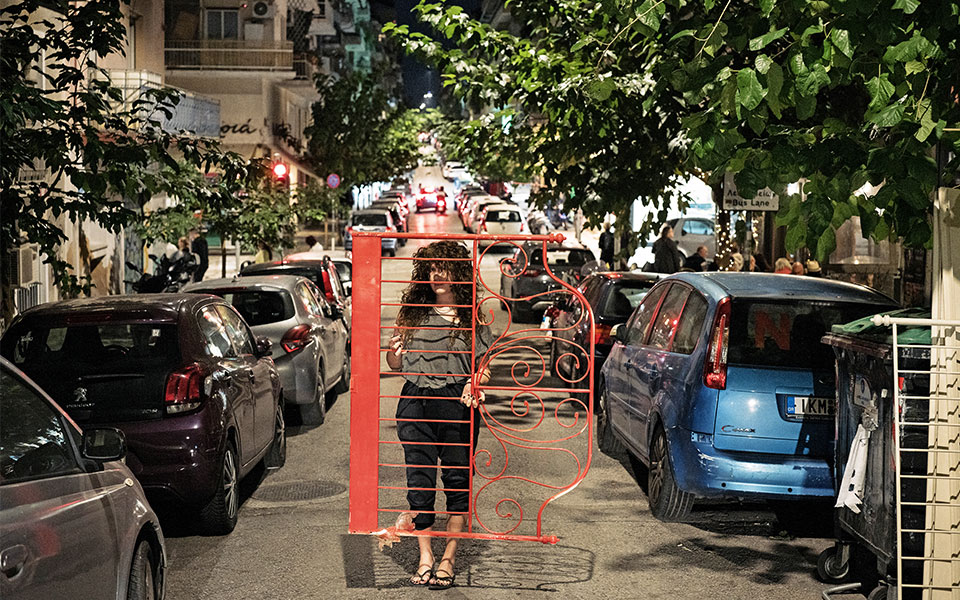
Erato takes a break from renovating her home.
© Stelios Papardelas
The building on the corner of Plapouta Street has always seemed strange to me; somehow, it can get lost within all the other sights of Kallidromiou, and yet the moment you truly notice it, all the other structures around it fade away and you’re focused on its bare brick, unfinished windows, scattered debris, and other traces of life interrupted.
“See that? Across the street at number 91 was the butcher shop, and right next to it the place that sold detergents and paper goods. There was also Motivo and the hair salon beside me, which is now a tailor’s workshop. We’ve been here since 1980. At first on the ground floor of the neoclassical on Plapouta, and since 2000 on the corner,” Panagiotis tells me; he has kept his father’s convenience store going for nearly thirty years.
“People left the neighborhood. The shops closed, and the families disappeared. And all of this started around 2019.” He blames the Airbnb platform.
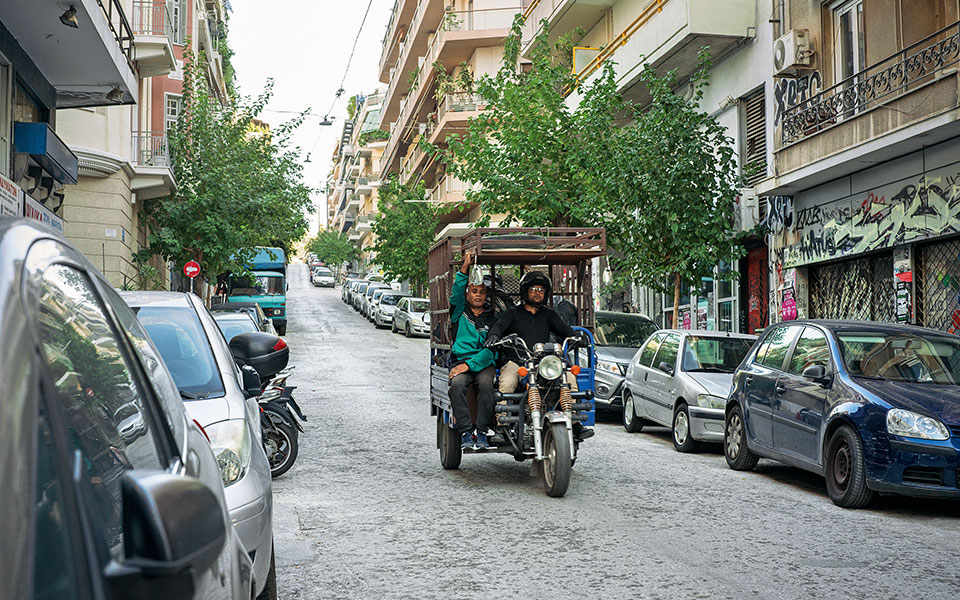
‘Junk dealers’ in search of treasures.
© Stelios Papardelas
“It’s a nice neighborhood. It’s still beautiful, and the young people bring it to life again. But maybe my shop won’t survive. Now there are supermarkets and 24-hour stores that have everything, so why would anyone come to me? I think about it and get frustrated. At least we still have good people,” he says, leading me to the tailor shop next door. “The kids are good people – and very good at what they do. I’m glad they’re here.” The “kids,” as he calls them, came to Greece in 2002 from Bangladesh, having learned to sew and repair clothes from the age of eight; since 2017, they’ve had their own shop in Exarchia. For six years now, they’ve been at number 94 on Kallidromiou and wouldn’t change neighborhoods because, in their words, the people here “are truly good. ”
At Moka Café at the end of the block, people of different cultures share a love of raki and rebetiko. From the speakers drifts the lyric, “What a strange girl you are; what longings torment you,” and I catch myself thinking that Kallidromiou really is a very strange girl.
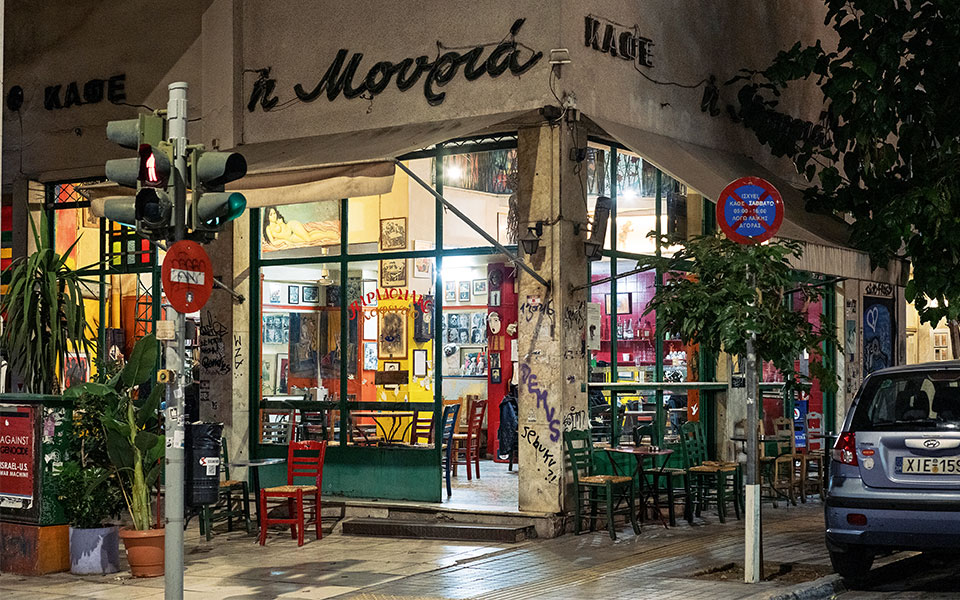
The evergreen Mouria on the corner of Harilaou Trikoupi, operating as a café-bar since 1915.
© Stelios Papardelas
Back at Café Viola, Eri is drinking her last coffee of the day. “Over there at Ama Lachi is where I went to school, until the February ’81 earthquake, after which it was deemed unsafe and demolished. My mother went to school here, too, and her mother before her. We lived our lives here. Until ’97, our nightlife was Green Door and Oktana. From the late ’90s, people began to leave. The neighborhood lost its charm, and the street became deserted. I don’t really see it as a neighborhood anymore. Back then I felt as if we were all part of here , even if we didn’t actually know each other. It’s not about passersby taking over, either, because other people were always around, too.
“There was Asimos’ shop, the Monastiri, the bakery on the corner, the homes of my friends, the models from abroad who stayed in the area’s hotels and walked down the street like exotic birds. If anything feels like home to me, it’s this neighborhood. Not because it gave birth to me, but because my relationships are here. I choose to stay, and I try not to complain about the changes. It’s just that there are things I no longer recognize – and things that no longer recognize me. Look at this light. Once upon a time, this sun hit the windows of our homes. Now it hits the solar water heaters,” she says, gazing out at the dusk.
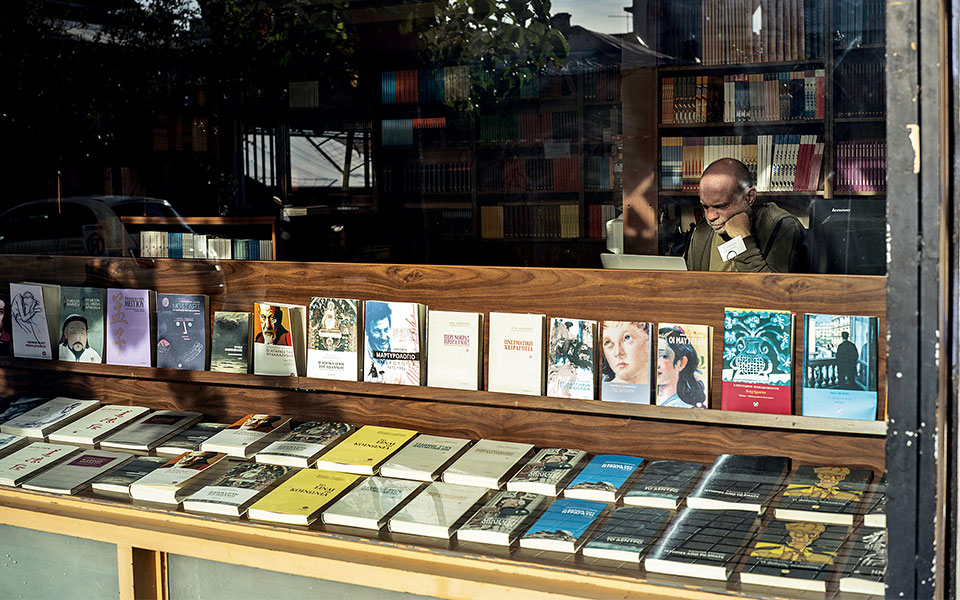
Detail from the window display of Indiktos Publications at 64 Kallidromiou Street.
© Stelios Papardelas
Night falls, and Sybil opens the door of her home across from the pedestrianized stretch of Themistokleous. I tell her the house suits her because it’s tall like she is. She laughs. “What do you want me to tell you about this street? It is the sum of its people, its bars, its Saturday market, its kiosk and all its noise. There are many people like me in Kallidromiou,” she says. Tall people, I ask? “Yes, let’s say tall people,” she replies with an accent, and waves goodbye.
Next to Au Grand Zinc, the crêperie with a French air, a young woman throws a red metal headboard into the bin. “It lived its little life,” Erato says, and then tells me about hers. “I’ve resided for twelve years in Exarchia, and about seven on Kallidromiou. To be honest, I don’t like the Saturday market – the whole ordeal of getting dressed up just to buy flowers and vegetables – just as I don’t like many other things around here. But look around. Look at the houses. My friends ask me how I can enjoy seeing all this graffiti and all these scribbles on the walls, but to me that’s the beauty; all the other houses look naked. I love this neighborhood. It’s the 24-hour shops where you’ll find whatever you need whenever you need it, and this feeling that if something happens to you and you shout out, everyone will run to help and they’ll be there,” she adds before climbing the stairs to her apartment to get back to tidying up.
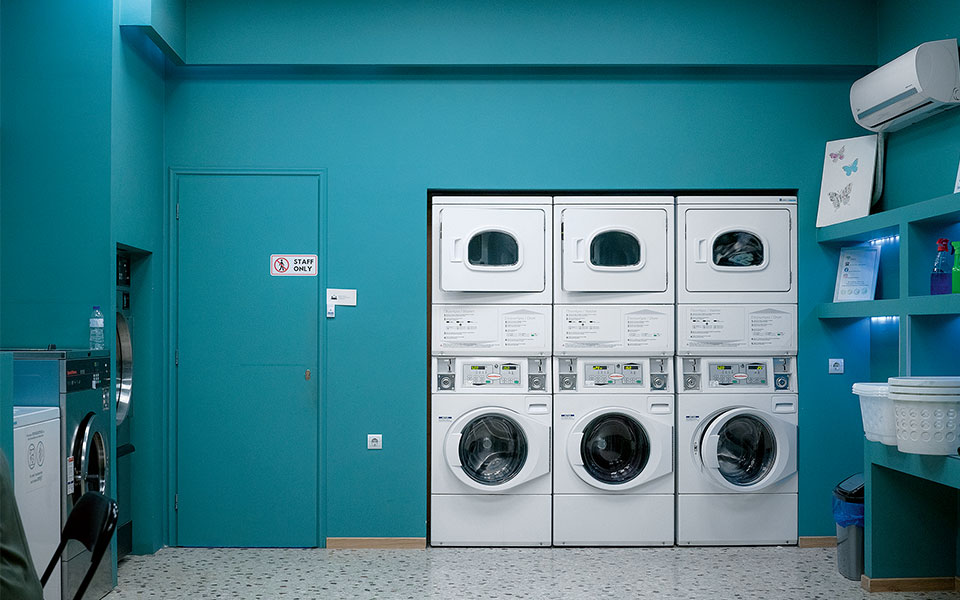
The self-service laundromat at number 16 is a meeting point.
© Stelios Papardelas
At number 16, locals and visitors to the neighborhood meet at the laundromat. Marina, Jenny and Dimitra sit at the large table by the entrance, dealing with the day’s dirty and freshly washed clothes. The shop belongs to Marina’s children, but she is there almost every afternoon. “I keep wondering why you young people don’t leave, why you stay here and torment yourselves. I’ve lived elsewhere – it doesn’t matter where, since now I’m here. I chose it, and I like it. Paris, for example, is like an open-air museum. What on earth do you like here?” she asks, and I tell her that Athens, too, is a museum – just a different kind.
The other two join the conversation, and topics shift over the next two hours. Danae, Jenny’s daughter, joins us as well – it’s her birthday today. They reassure me they celebrated, and apologize that there’s no cake left. The conversation returns for a bit to Kallidromiou but then ends with a piece of advice from Marina: “I have one rule: when there’s one good thing, a thousand more will follow. And that’s what you must remember, my children.”
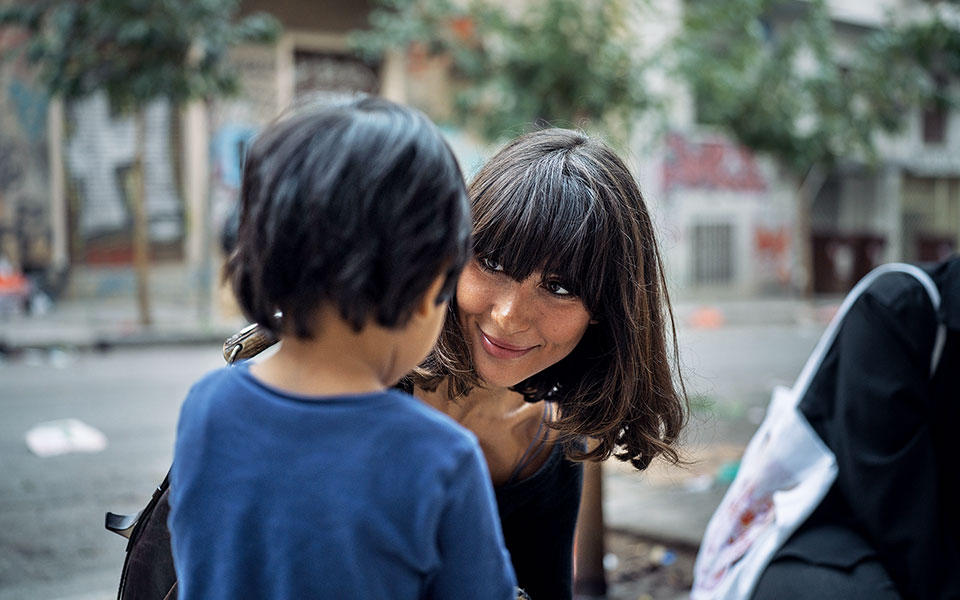
Shortly after the Saturday market, Chris meets a little girl playing in the empty street.
© Stelios Papardelas
The farmers’ market is almost over. At Lemonaki, friends and strangers stop for a shot of raki and some local products, all supplied cheerfully by Nikos. Complaints about the neighborhood mix with laughter and the week’s news.
“If this wasn’t a primary residential zone, Kallidromiou wouldn’t even have a pharmacy,” one of them tells me, while another adds: “Now a bunch of mint here costs €1.10 at the market, while in Kolonaki it’s 50 cents.”
The market stalls start disappearing at about five in the afternoon. The municipal workers wash down the streets, sweeping away the remnants of the morning, and Kallidromiou returns to its regular rhythm. Cars reclaim their spaces, and the bars fill up. Chris arrives at the table holding a bouquet. “I come to the market for the flowers,” she says. “I’m practically a local by now. But, strange as it sounds, I wouldn’t live here. I prefer more orderly conditions and neighborhoods.
“No, I wouldn’t call Kallidromiou chaotic – I’d simply say it’s more real. It has something inexplicably beautiful, as if time doesn’t concern it, as if it never rushes. It’s a gentle reminder that things don’t need to change to be beautiful. And while it doesn’t belong to any one group – it’s not like hipster Pangrati, for instance” she adds, laughing, “we all end up here and we feel like it belongs to us.”
As we leave, a little girl stops us. Behind her is the open door to a basement apartment, and we can see her mother, her brother, and a large children’s table covered in toys. She holds a plush tiger and imitates its sounds. Chris tells her that she also has a tiger and scrunches up her nose. I watch them – the young mother, the little girl, and Chris. On the street, a strange quiet reigns, unusual for this part of town. They continue their play undisturbed, and watching them, I decide that Chris is right. On Kallidromiou, time really does stop sometimes.
A nexus of Hellenic research, the...
Tourists share the highs and lows...

A major restoration project is bringing...

The Goethe Institute's exhibition explores Athens'...