Made in Greece: Six Stops for Souvenirs and…
From handcrafted ceramics to small works…

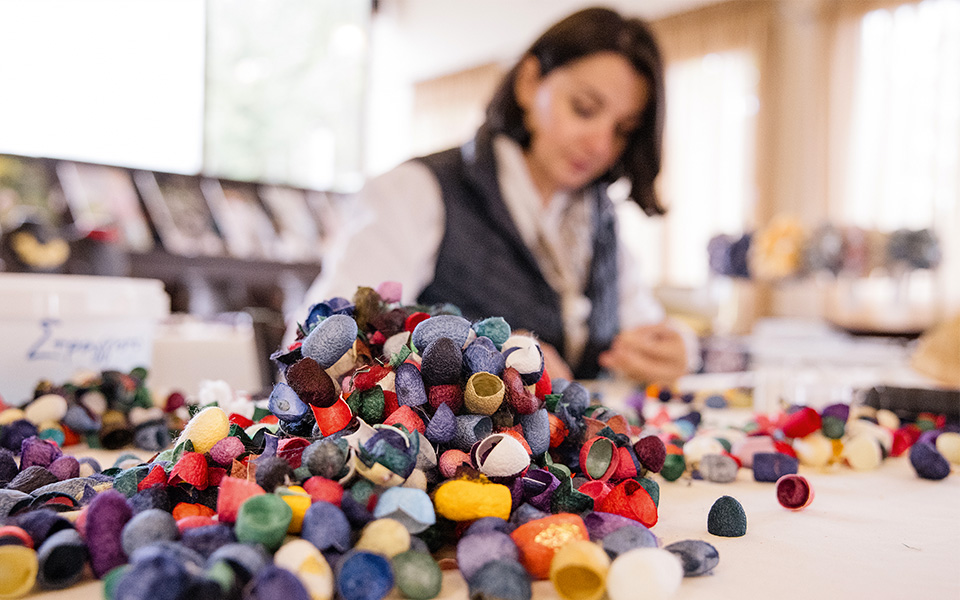
Kaltsidou dyes the cocoon shells with natural pigments and transforms them into jewelry items.
© Olga Deikou
They say that in the rare moments of absolute silence inside a silkworm house, you can hear a faint, rhythmic sound: the silkworms softly chewing on mulberry leaves. Even if you don’t, it’s impossible not to be captivated by their slow, deliberate movements over the green leaves just before they begin to secrete the fine silk thread that will form the cocoon in which they will transform into chrysalides.
Only a handful of people in Greece are familiar with the stages of a silkworm’s life. Most sericulturists work in Soufli, Thrace, but Anna Kaltsidou keeps her own sericulture farm in Makrynitsa, Serres, about an hour north of Thessaloniki. When she’s not tending to her silkworms, she creates natural skincare products using the protein they produce, designs jewelry from their cocoons, and prints patterns on handmade silk scarves.
North of Thessaloniki, the landscape opens into soft plains and endless fields that stretch toward the horizon. The autumn palette is gentle and earthy, dotted with great golden bales of hay. As you approach Kilkis, you see Lake Doirani to the west and the green slopes of Mount Belles rising in the north. On a rainy day, the white clouds hanging low over the hills make the scene look as though it were woven from silk itself.
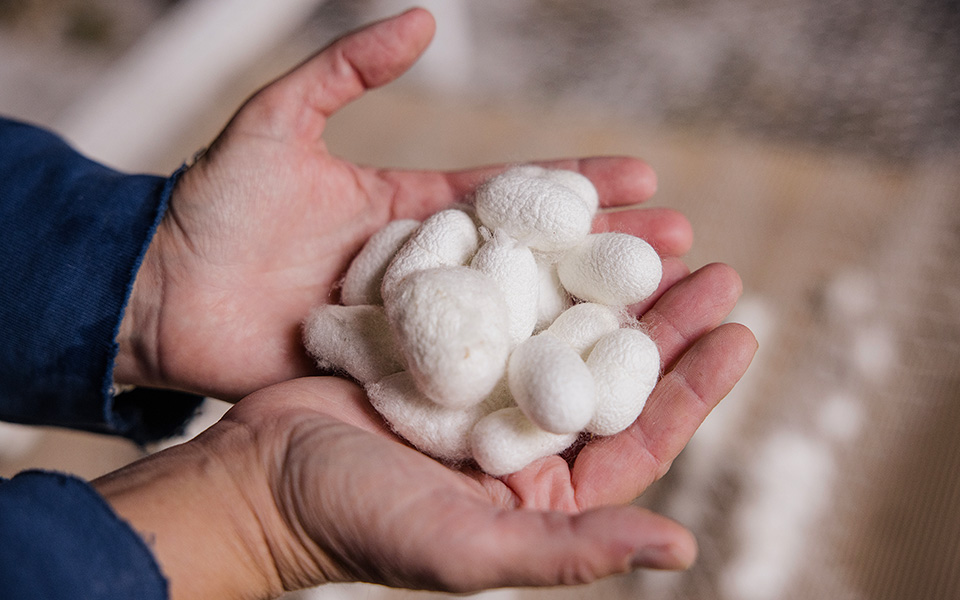
The cocoon shells that the silkworms form are processed to give us silk threads.
© Olga Deikou
Thick vegetation lines the road, and between the trunks of the trees you can see small houses with red-tiled roofs. The region abounds in mulberry trees; from the 1950s until the 1990s, many locals were engaged in silk farming, particularly families who’d arrived as refugees from Asia Minor and the Black Sea, bringing their sericulture tradition with them. Among them was Kaltsidou’s father, who built a 300-square-meter warehouse that still produces about one ton of silk cocoons each year.
“In June and July, I need fifteen people just to cut mulberry branches to feed the silkworms,” Kaltsidou says. “Especially during the last ten days of their rearing, when they eat constantly to build their cocoons. We call this period ‘the great feast,’ and everyone has to stay sharp to keep up with them.”
Only Kalsidou enters the silkworm house. The worms are extremely sensitive and can die easily from disease. “If even one gets sick, it’s vital that I find and remove it immediately,” she explains, “to protect the others.”
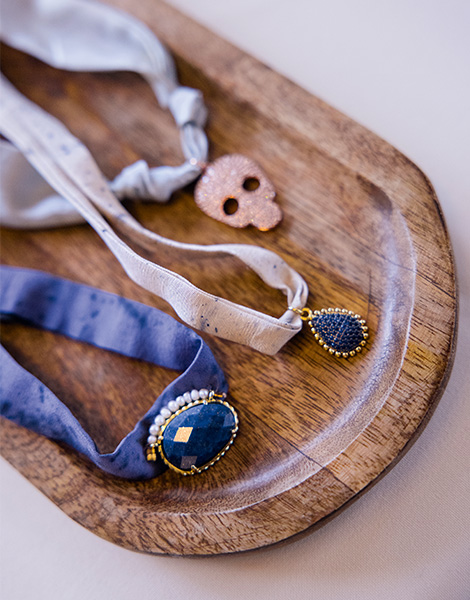
Silk ribbons.
© Olga Deikou
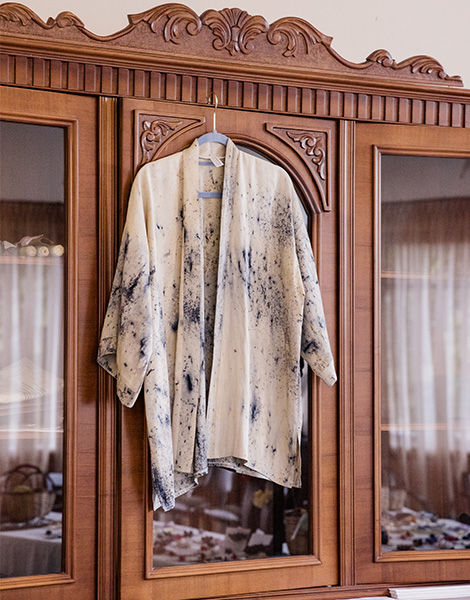
A silk tunic dyed with substances found in nature.
© Olga Deikou
To give visitors a closer look at this extraordinary creature, Kaltsidou brings small colonies of silkworms to the café she runs on the road to Promachonas. Spread across a large table covered not with a tablecloth but with layers of mulberry leaves, we see silkworms at three different stages of growth. The largest are as long as a human finger; the smallest resemble fine vermicelli noodles. On a white napkin nearby, tiny black eggs await hatching; the next generation is already on its way.
Their entire life cycle lasts just 50 days, and even within a few hours their size increases visibly. Kalsidou cuts mulberry leaves into smaller pieces for the youngest worms, who struggle to draw out the sap, and lights the fireplace to keep the room warm. “They survive only between 20 and 28 degrees Celsius,” she explains, pointing out yet another sign of their fragility. “And because they feed exclusively on fresh leaves, we raise them only from April to October.”
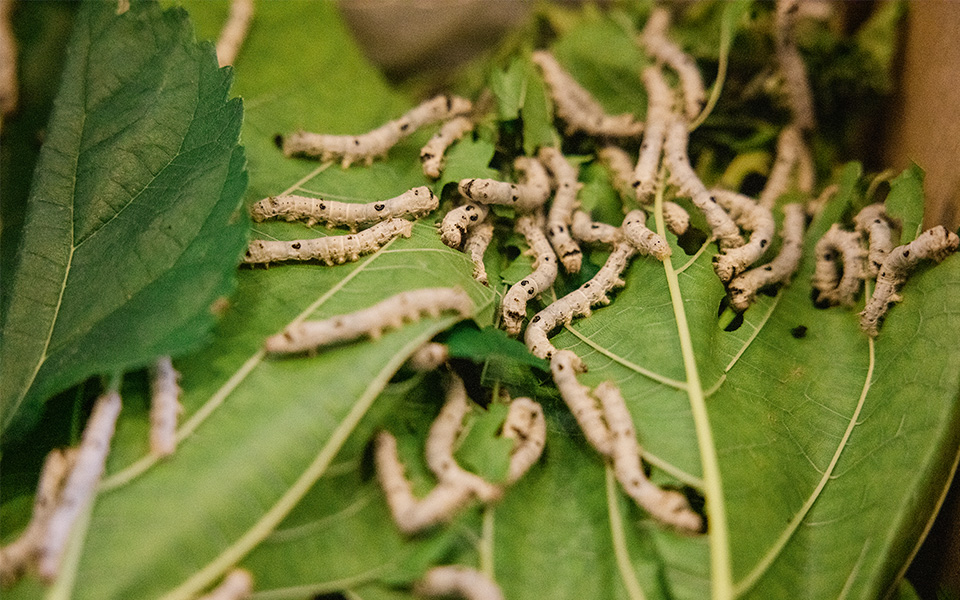
Silkworms feeding on mulberry leaves.
© Olga Deikou
Behind the display, the shelves are filled with silk creations Kaltsidou has made from the cocoons: scarves, shawls and delicate silk scrunchies, their patterns dyed with pigments extracted from flowers, tree bark, plant roots and insects. “I use only natural materials,” she says, “and I’ve learned to embrace the surprises this process can bring. One day, I had left my freshly dyed scarves outside to dry, and it started to rain. The raindrops, reacting with the tannins of the natural dye, created an entirely unexpected hue. The unpredictable element,” she says, “is part of the creation itself. I’ve never made two pieces that are exactly alike.”
Kaltsidou also dyes the silk cocoons, transforming them into elegant earrings and necklaces. Their texture is soft and pleasant, a quality owed to the protein secreted by the silkworms as they spin their cocoons. This protein, called sericin, promotes cell regeneration, and the organically produced cocoons are also used for natural facial care treatments. Kalsidou enriches her handmade olive oil soap with sericin and fresh carrot juice, blending traditional craftsmanship with gentle innovation.
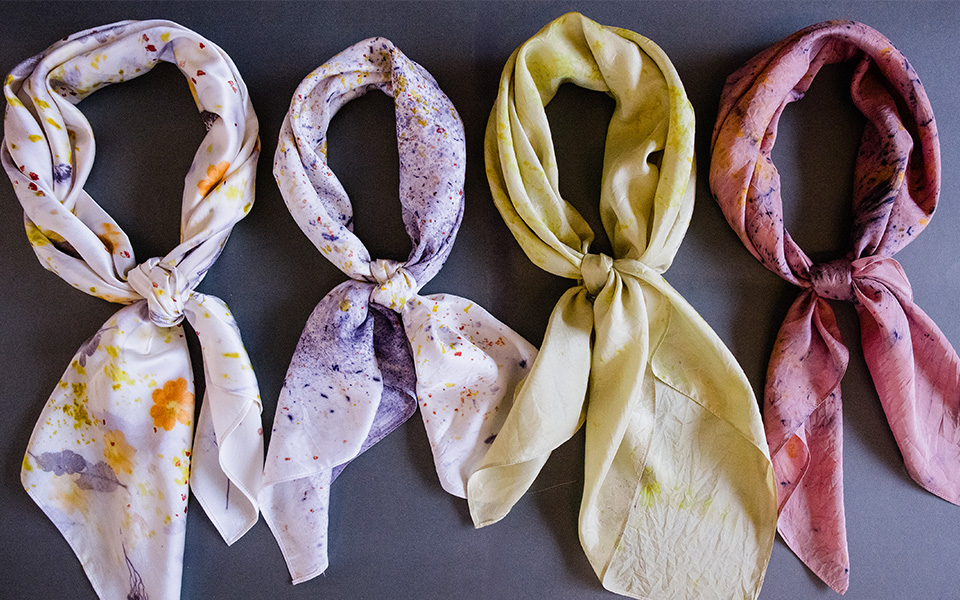
Silk scarves with floral motifs.
© Olga Deikou
The entire space carries the warmth of a true home enterprise. Visitors can enjoy homemade ekmek kataifi and galaktoboureko, or purchase honey produced by Anna’s brother Lazaros.
No matter the season, a visit to this place offers a glimpse into the beauty of silk and the quiet ritual of sericulture. I think of this as Kaltsidou, with precise, graceful movements, trims the edge of a cocoon and taps it gently on the table. From inside, a chrysalis emerges, a silkworm that hadn’t managed to pierce its silk shell. At the edge of the table rests a white moth, one that has completed its full transformation. I lift it carefully by the wingtips, tracing the delicate patterns on its silky wings, as I listen to the ancient Chinese legend of the princess who discovered silk:
“Long ago,”Kaltsidou begins, “a cocoon fell from a mulberry tree into her cup of hot tea and unraveled into a fine, shimmering thread. And so, the story goes, silk was born.” The legend makes our own tea taste all the sweeter as we sit by the fire, watching the rain fall softly over the slopes of Serres.
Koukouli, open on weekends and by appointment, is housed within Café Ioanna, located at the 42nd km of the Kilkis-Promachonas road, in Makrynitsa, Serres. Tel. (+30) 697.159.2242.
A visit here can easily be combined with an excursion to Lake Kerkini and the nearby village of Ano Poroia, a picturesque destination of unspoiled natural beauty.
Jewelry and silk creations by Anna Kaltsidou are available in select boutiques across Greece and can also be ordered online at annakaltsidou.gr
From handcrafted ceramics to small works…
Inside the historic, beautifully restored NEMA…
From holiday decor to pieces that…

The Papadopoulos family run a buffalo…