Mouriki Premium Greek Honey: From Elefsina to Paris
Their chestnut honey, harvested from the…

© Christina Georgiadou
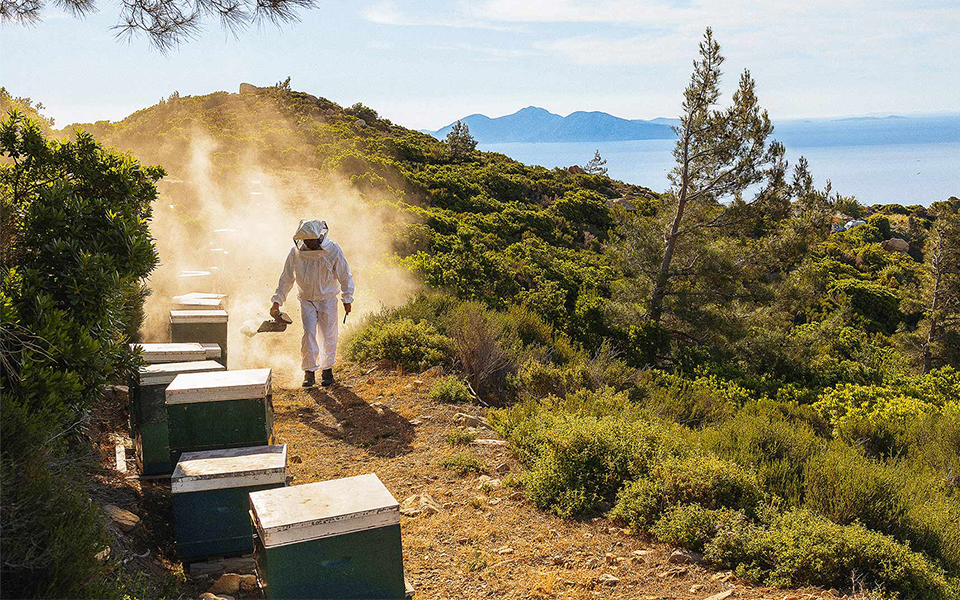
Late in the afternoon, we found ourselves on the Aghios Kirykos side of the island, in Patela, on a mountainside just above Aghios Panteleimonas, at an elevation of around 250 meters. The area has high atmospheric humidity, faces south and gets plenty of sunshine, while the surrounding mountains provide natural shelter from strong winds. At our feet lay a botanical garden generously planted by nature: thyme, strawberry trees, rockroses, wild lavender, Alexanders, spring heather and, above all, anamma, the autumn heather. The warm sun releases their fragrance into the air. In early summer, the heather was still green, not yet covered in clusters of pink, bell-shaped flowers. It reaches its peak in autumn, when it joins forces with the bees to produce Ikaria’s celebrated autumn heather honey. There is spring heather too, but its honey is left for the bees to feed on and build up their strength.
By December and January, the shrubs have dried out completely. Ikarians head into the mountains to gather the brittle branches, which make excellent kindling for fireplaces, wood-fired ovens and stoves. It is from this use that the plant gets its local name, anamma, meaning “kindling.”
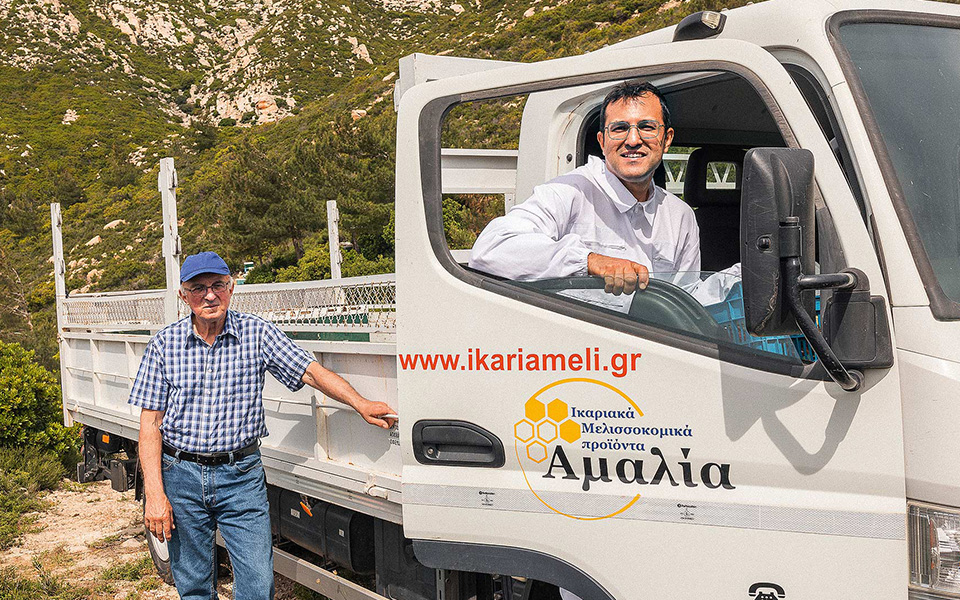
Vangelis with his father, Manolis.
© Christina Georgiadou
At a bend in the dirt road, Vangelis Christodoulou was waiting for us with his father, Manolis. They led us on foot along a path to their hives, warning us to be extremely careful. Ikarian bees are no joke. They are known for being particularly fierce, with a powerful and painful sting, and differ from other bee populations in Greece. Vangelis’ father first became involved with beekeeping in 1982. Manolis was a music teacher by profession, teaching at the Aghios Kirykos municipal band. He also played the keyboard in his own band, which performed at local festivals. But he was drawn to beekeeping. He loved nature and had a beekeeper friend who taught him the basics. He eventually began producing honey professionally with his wife, Amalia.
“I caught the bug from an early age. I literally grew up among the bees,” Vangelis says. “From my first years of secondary school, I knew I wanted to become a beekeeper. I started looking into how I could train and become a professional. I took the national university entrance exams and was admitted to the Department of Agricultural Technology in Kefalonia, specializing in Organic Farming. Although the program was four years long, I was in a hurry to finish, so I completed my coursework in three. I really wanted to create something of my own. I was longing to return to the island and work with bees.”
The university offered him a position as a member of its scientific staff, along with the opportunity to pursue a master’s degree at the same time and eventually become a lecturer. He also received a job offer from DIO, the organic certification organization, but he had a different kind of life in mind. He returned to Ikaria, and for the first few years the whole family worked together tending the hives. “As part of my undergraduate thesis, we also carried out an experiment on royal jelly production that was pioneering by Greek standards, and we still apply the findings in our production process today. We explored how to produce larger quantities of royal jelly over a longer period of time without harming the bee colony.”
© Christina Georgiadou
© Christina Georgiadou
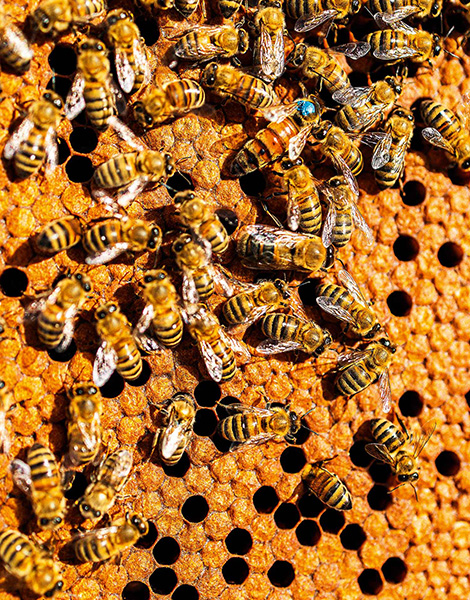
Even as a student, Vangelis had recognized the value of anamma honey. He had seen firsthand how colonies feeding on it grew more rapidly compared with those foraging on other plants. He also noticed that after the bees had foraged on autumn heather, their stings seemed to become more painful. “During the periods when bees are most active – spring, summer and autumn – they live for around 40-45 days. But the bees that have to survive through the winter, while the queen stops laying eggs, need something to strengthen them. Anamma, the last plant to flower each year, produces one of the most nourishing honeys there is. Along with chestnut pollen, it is considered by beekeepers one of the best sources of nourishment for helping colonies grow. Our grandparents would extract the honey from saskria, the traditional clay beehives, and tell us to eat anamma honey to make us strong.
The reason is that it contains a higher proportion of pollen, which is what makes it so beneficial – it is a natural remedy.” Indeed, chemical analyses show that the proportion of anamma pollen in Vangelis’ honey, and in Ikarian honey more generally, exceeds 90%, some seasons reaching as high as 99%. For a honey to be classified as monofloral anamma honey, the proportion must exceed 45%. This high proportion is possible because in autumn, when the honey is produced, relatively few other plants are available to provide nectar, allowing the heather to dominate.
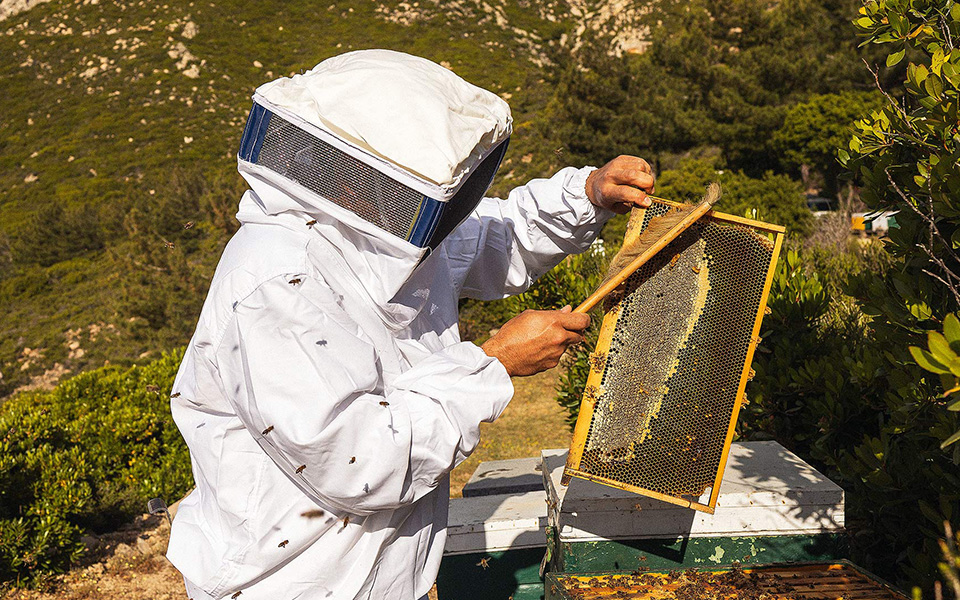
Who craves honey more: Vangelis or his bees? One thing is certain: they are equally hardworking and perfectionists to the core, a trait Vangelis inherited from his parents, Manolis and Amalia.
© Christina Georgiadou
In addition to contributing to the honey’s nutritional value, the pollen is also responsible for anammatomelo’s distinctive cloudy, opaque color. It is also naturally prone to crystallization. “When it is first extracted from the honeycombs, it is more fluid than other honeys because it contains more moisture. But it crystallizes very quickly. Several factors contribute to this, including the low temperatures during the harvest period and the types of sugars present in the honey.” Traditionally, anamma bloomed in October, and the bees would begin foraging on it around the beginning of November. “It needs two good rains first,” local beekeepers say, drawing on generations of experience. In recent years, however, climate change has altered this seasonal rhythm. Rain arrives later, which means the plant blooms later, and the entire process is pushed further into winter. “We often end up harvesting the honey after December and sometimes as late as early February. The later we harvest, the faster the honey crystallizes because of the cold temperatures at that time of year. Sometimes it happens within a week. When we harvested in the fall, it would take one to three months to crystallize.”
Since setting up his small workshop in Aghios Panteleimonas in 2017, Vangelis has grown his operation to more than 500 beehives. He transports them by truck to areas where they can forage on anamma and strawberry tree blossoms, across the wider Aghios Panteleimonas region, at elevations ranging from 250 to 800 meters, moving the bees to lower ground as the weather gets colder. For thyme honey, he takes them to the Faros area, while for pine honey he moves them to Aghios Polykarpos and Pezi. Anamma honey, however, stands out for its color, texture and intriguing flavor. Depending on the year and its pollen content, once crystallized it becomes opaque and pearlescent, ranging in color from beige to copper. Its aroma and flavor are reminiscent of butterscotch, with delicate notes of heather blossom. Its fine crystallization gives it a smooth, creamy texture. It melts effortlessly in the mouth, spreading across the palate with a gentle cooling sensation and subtle smoky notes. It is generally moderately sweet and can sometimes have a slight bitterness. “Toward the end of the anamma flowering season, the strawberry tree also comes into bloom, and its honey is very bitter. Depending on how much strawberry tree nectar the bees collect alongside the heather, the bitterness can become more pronounced,” Vangelis explains.
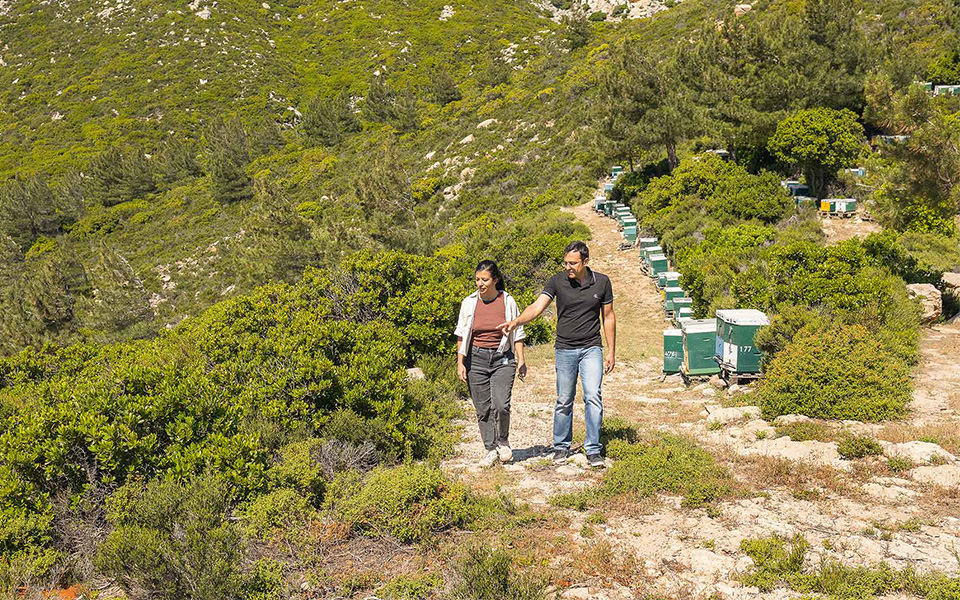
We walked through a rare, fragrant herb garden, where thyme, strawberry trees, rockroses, wild lavender, alexanders and spring heather bloom, along with, most notably, anamma, Ikaria’s autumn heather.
© Christina Georgiadou
“My grandfather is 93 and you can’t keep him at home. My other grandfather also lived past 90 and used to help us with the beekeeping, while my grandmother, who was a seamstress in her younger years, would sew and mend our mesh beekeeping veils. Honey was, and still is, part of our daily diet. If I don’t have anamma honey one morning, I feel like I don’t have the same energy. I’m used to eating it either on its own or on whole-grain bread. I eat about five spoonfuls a day. Ikarians generally spread it on rusks in the morning or dissolve it in lukewarm water, but mostly they eat it straight, and it keeps them going all day.” Now in his forties, Vangelis looks considerably younger. Some believe that this pure, unprocessed superfood may be one of the factors contributing to Ikaria’s famed longevity, although diet is only part of the story. “I don’t eat meat very often, and I follow the traditional Ikarian diet, based mainly on legumes and vegetables, as well as fish that I catch myself.” Next to the apiary, he also has his own greenhouse, where he organically grows whatever is in season.
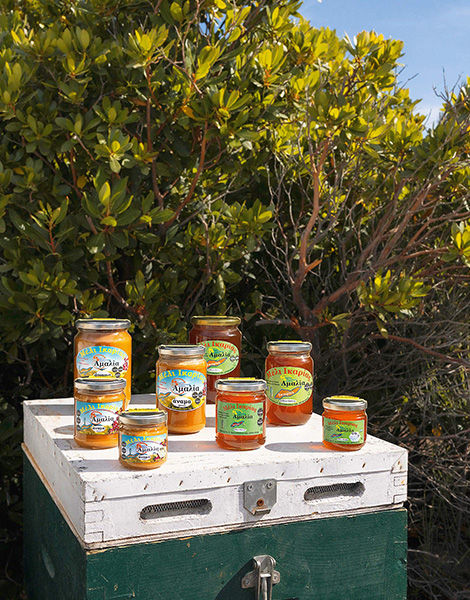
Vangelis recommends storing honey in a dark, dry and cool place, such as a cupboard away from the kitchen stove, although it can even be kept in the refrigerator. “In fact, it tastes even better straight from the fridge in summer. To me, it tastes like ice cream,” he says. At his workshop in Aghios Panteleimonas, just two kilometers from Patela, everything is neat and spotless: the hives, the automatic uncapping machine, the honey extractor and the settling tanks, where the honey rests for seven to 10 days, allowing air bubbles and any solid particles to rise to the surface. “It’s more difficult to handle than other honeys because, if it crystallizes inside the tanks, it becomes difficult to get it out.” Using a small filling machine, he transfers the honey into jars without subjecting it to any processing; even the labels are applied by hand. The carefully stacked jars bearing the brand name “Amalia,” after his mother, are ready to go to market.
He is now awaiting one more designation to appear on his label: PDO status. The application for Ikarian anamma honey has been submitted to and assessed by the Ministry of Rural Development and Food and is currently being forwarded to Brussels. In addition to anamma honey, he produces thyme honey, strawberry tree honey, which is intensely bitter with a caramel-like texture, and fragrant wildflower-and-forest honey made from spring blossoms such as savory and thyme, together with pine. Production is limited, ranging from three to five tons depending on the season. Vangelis handles everything himself, from production to sales. Hardworking and methodical, he has learned to follow the rhythm of the bees themselves, taking his only break only in February.
This article was previously published in Greek at gastronomos.gr.
Their chestnut honey, harvested from the…

The honey derived from the wild…

Dimitris Hasapis left Athens to return…
Crispy simits, zibilia (sweet pies with…