5 Epic Island Hikes in Greece for Spring...
This spring, five majestic peaks across...

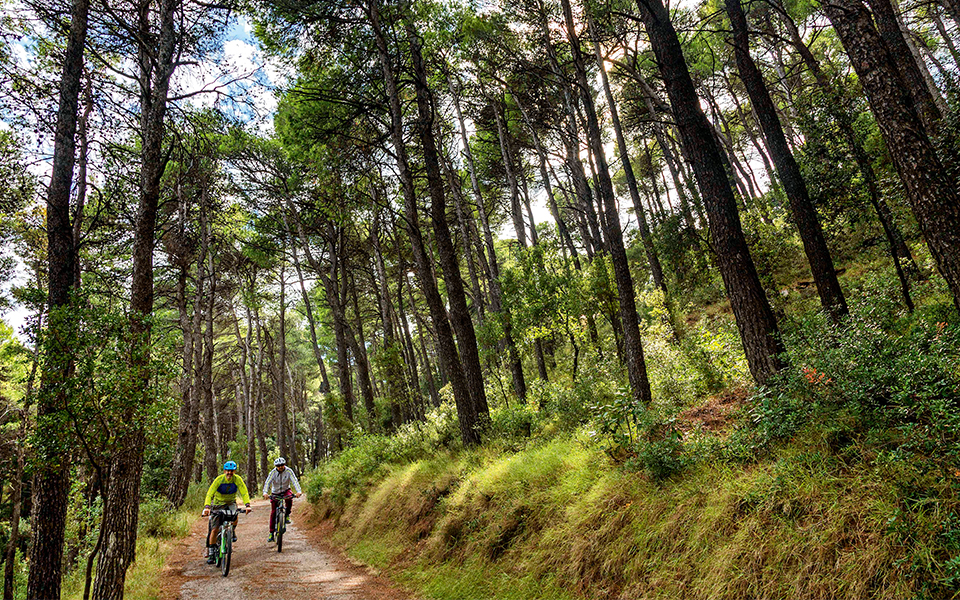
Those who choose to explore Parnitha by bike can follow a 16-kilometer circular route.
© Perikles Merakos
Classical monuments, culinary surprises, vibrant neighborhoods that never sleep – these are just some of the elements that make a visit to the Greek capital unique. But there’s another, lesser-known side to the Athenian summer that few think to explore. In case you didn’t know, just 40 minutes from Syntagma Square lies Mt Parnitha.
At over 1,000 meters above sea level, far from the traffic and buzz of the city center, a different kind of Greek summer awaits. Here, the air is crisp and pine-scented, the forest paths wind through lush greenery and sun-dappled clearings, and tiny chapels and freshwater springs seem to appear as if by magic. From the mountain’s many vantage points, you’ll take in sweeping views of the Attica basin and, if you’re lucky, you might even catch a glimpse of the mountain’s most famous resident, the majestic red deer, as it pauses just long enough to meet your gaze before disappearing into the woods, leaving behind the most unexpected memory of your trip.

he view from the Skipiza fire lookout.
© Perikles Merakos
According to myth, the goat-legged god Pan often came to Parnitha to play his flute and dance through the forest. You can almost picture him hiding behind the trees or prancing playfully along the trails. Now part of the EU’s Natura 2000 network, this landscape has suffered greatly in recent times. Three major wildfires (in 2007, 2021 and 2023) have each left their mark, still visible from the lower slopes.
In winter, a shroud of mist often covers the mountain slopes; rain runs into clear forest ponds and mushrooms pop up between rocks. But from spring onwards, the scene changes. The fresh green tips of fir branches glow in the sunlight, wildflowers and cyclamens blanket the ground, and the trails fill with sweet, earthy scents. In many shaded spots, where the firs form natural canopies, temperatures can be up to 10°C cooler than in the city.
Above 800 meters, the slopes are covered with Cephalonian fir trees (Abies cephalonica), a species native to Greece. You’ll also find pines lining the ravines, along with junipers, strawberry trees and more than 1,100 other plant species and subspecies out of the 6,000 found nationwide. Three of these are exclusively found on Mt Parnitha.
At elevations of 1,161 and 1,158 meters respectively, two mountain refuges – Bafi and Flabouri – welcome visitors year-round with home-cooked meals and overnight accommodation. Giannis Chelis, who runs both lodges and lives on the mountain with his family, also leads guided hikes and cycling tours with Trekking Hellas. A perfect guide, he might just know the secrets of the mountain better than anyone, its scars and wonders alike.

The Parnitha Casino, as seen from one of the many spots that offer breathtaking views.
© Perikles Merakos
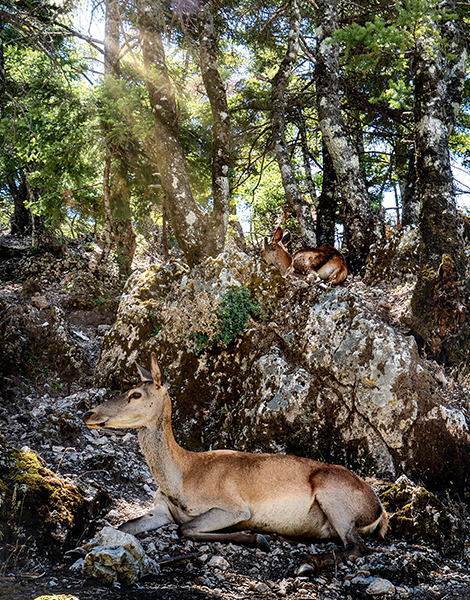
The deer of Mt Parnitha are permanent residents of the region.
© Perikles Merakos
Mt Parnitha offers a wide network of safe and well-marked trails, suitable for all levels of hikers and physical conditions. During the summer months, it’s important to check the website civilprotection.gov.gr a day before your excursion; when high winds and extreme heat increase the risk of wildfires, the mountain may be temporarily closed to visitors – a fairly common occurrence in July and August.
To reach the Bafi Refuge, where Giannis Chelis and his team await, you’ll first pass through the municipality of Acharnes. Here, traditional tavernas and modest buildings set a more rural tone for your adventure. Given the summer heat, early morning or late afternoon are the best times to head out.
There are two ways to ascend the mountain. One is the cable car that transports visitors to the Mont Parnes Casino; it’s free to use and operates regularly with only rare exceptions (which you can confirm by calling ahead). The ride offers spectacular views, but there’s an additional 40-minute hike from the upper station to the refuge. The other option is to drive a bit further and make a detour at the haunting Park of Souls, located opposite the abandoned Xenia Hotel. Built in the 1910s, this eerie structure originally served as a sanatorium for tuberculosis patients before becoming a hotel and a school for tourism professionals. After it closed in 1985, it remained empty, its crumbling frame reflecting the passage of time.
Across from the derelict building there once stood a collection of wooden sculptures, inspired by the stories of former patients and carved in 2012 from scorched tree trunks by the artist Spyridon Dasiotis; only one such sculpture remains today, along with a striking metal angel added later. It’s still an impressive scene, and serves as a ghostly yet poetic welcome to the mountain.
If you’re lucky, you might spot a deer descending to drink from a lower spring. In recent years, wolves have reappeared in Parnitha, pushing many deer to migrate elsewhere, but signs of their presence remain. Keep your eyes peeled for a “rubbing tree,” a trunk where male deer have scraped their antlers when shedding velvet to make way for new growth. (In the end, it may be the wolves that end up leaving. An official tasked with animal protection has called for their relocation.)

Mola Spring, one of many water sources in the park.
© Perikles Merakos
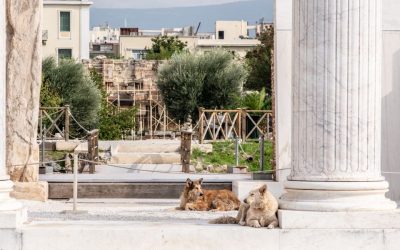
Some of the most accessible hiking routes on Mt Parnitha connect the Bafi and Flabouri refuges, which are just 3.5 kilometers apart. Right next to the Flabouri refuge, where you can enjoy a hearty homemade meal at a wooden picnic table, you’ll find Flambouraki Peak. Here, a Greek flag flutters in the wind above the Attica basin. The neighborhoods of Athens glimmer in the light, the sea shimmers in the distance and, if the sky is clear, you might even spot Marathon Lake and the island of Evia far beyond. You might also run into Gela, a stray dog who has become something of a local mascot.
Enjoy the crisp oxygen-rich air as you continue to your next stop: Mola, one of the few patches of forest to have survived recent fires wholly untouched. The small chapel of Aghios Petros – one of many in the area once built by shepherds – marks your arrival.
Carry on walking and you’ll find an idyllic setting: tall trees, sunlit clearings perfect for picnics and play, and wooden benches where you can rest. Mola is also a key junction for many trails. One of them takes you around the mountain to the Skipiza fire lookout, built in 1990, and its nearby spring. Note, however, that Skiriza and nearby Chouni are demanding destinations, suitable for more seasoned hikers.
If you do choose to come here from Bafi, you’ll be able to witness fir trees sprouting again in previously scorched areas. As you move deeper into the forest, you’ll note the richness of the flora and sweeping views that stretch all the way to the peaks of Mt Parnassus in Central Greece.
For cyclists, there’s a 16-kilometer circular route that begins at the Bafi refuge as well. It’s an easy ride that takes you through ever-changing scenery and showcases the mountain’s natural beauty from a different perspective. Regular or electric bikes and related equipment can be rented from Giannis Chelis.
Whichever route you choose, you’re sure to leave Parnitha with vivid memories of this wild and wildly beautiful place, scenes that will stay with you long after your return. From the morning sun streaming through the fir branches to the sight of Athens gleaming beneath you at dusk, these summer memories will be unlike any others. And as you make your way back down, you might even figure out what the god Pan was looking for on these ancient forest paths.
Trekking Hellas Parnitha
Tel. (+30) 697.476.9441
Giannis Chelis: Tel. (+30) 697.487.1203
This spring, five majestic peaks across...
At any time of year –...