How Christopher Nolan’s Epic Is Putting Greece Back...
Christopher Nolan's The Odyssey is already...


© “Odysseus and Polyphemus” by Arnold Böcklin (1896). In one of the most famous episodes in the “Odyssey,” Odysseus and his crew escape the Cyclops Polyphemus.
Homer’s “Odyssey” has always tempted readers to do something the poem itself resists: turn story into map. With Christopher Nolan’s “The Odyssey” due in theaters this summer, the old question returns with force: can Odysseus’ voyage home be plotted across the Mediterranean, or does Homer deliberately blur the line between remembered seaways and myth?
If we follow the poem, we trace a journey that unfolds across a decade – ten years of wandering after the fall of Troy. Along the way, Odysseus sails the “wine-dark sea” (I.183), skirts unknown shores, encounters strange monsters and enchantresses, and even descends into the depths of the Underworld, speaking, among others, with the shades of his mother and the fallen Achilles. It is a voyage both expansive and intimate, partially grounded in the rhythms of early trans-Mediterranean seafaring, yet constantly drifting into the realm of mythology.

Odysseus and the Sirens, eponymous vase of the Siren Painter, c. 475 BC
Throughout the poem, Homer offers tantalizing clues: directions by the stars, distances, days at sea, fleeting glimpses of land. Odysseus himself is no stranger to navigation. Leaving Calypso’s island, he sails keeping the “Pleiades, and late-setting Boötes, and the Bear … on the left hand” (V.270ff.), steering across open water like a seasoned mariner.
And yet, attempts to locate his landfalls are often contradictory. Some seem firmly rooted in the physical geography of the Mediterranean – the narrow Strait of Messina, for example, with its treacherous currents, is the most persistent and persuasive localization for Scylla and Charybdis (Book XII). Others hover just beyond it. In other words, the “Odyssey” exists in a liminal space between worlds: part travelogue, part “mythscape.”
Here, we attempt to retrace Odysseus’ route, anchoring his wanderings where possible in the Mediterranean – the Greek islands, southern Italy, Sicily, and the wider seascape known to early Greek sailors – while noting where myth begins to take hold.
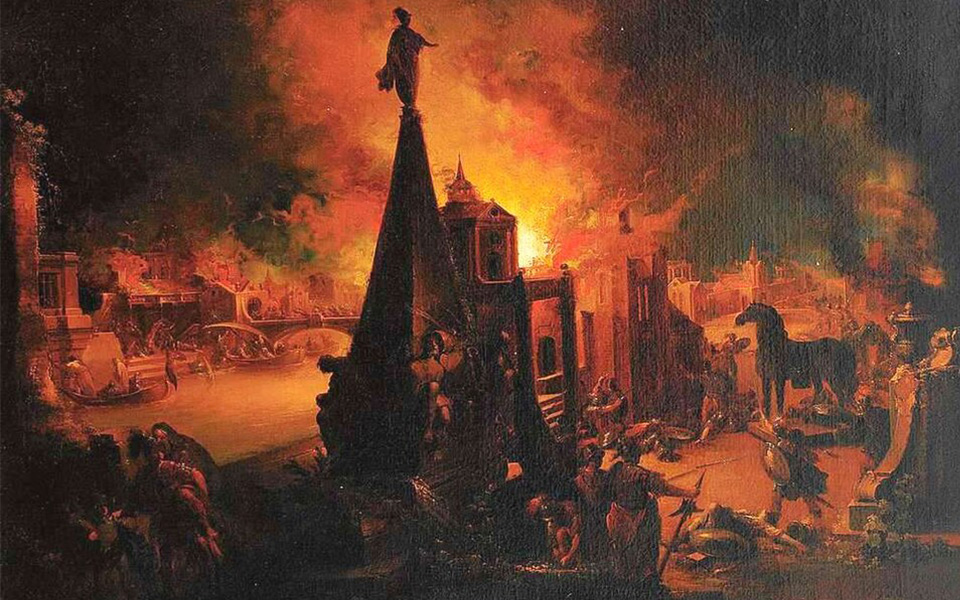
“The Burning of Troy,” by Johann Georg Trautmann (1759-1762).
The story begins, as all journeys must, with an ending. Troy has fallen. After ten years of bitter war, it is Odysseus’ cunning – the infamous wooden horse – that brings the city down. But victory comes at a cost. The Greeks’ violence, including the mass killing of innocents and acts of sacrilege against the gods, sows the seeds of the long journey to follow. War-weary Odysseus sets sail with his twelve ships for Ithaca, his island home in the Ionian Sea, unaware that his return will take as long as the war itself.
Sailing west from the Dardanelles and out into the northern Aegean, Odysseus first makes landfall among the Cicones in Thrace (IX.39ff.), allies of the defeated Trojans. He and his men raid the nearby city of Ismarus, often associated with the area around the modern village of Maroneia, plundering and killing – but they linger too long. Reinforcements arrive at dawn, “skilled at fighting with their foes from chariots” (IX.49ff.). Odysseus loses seventy-two men – six from each ship. The lesson is immediate and brutal: excess undoes success.

The treacherous Cape Meleas, the southernmost tip of the Laconian peninsula of the Peloponnese. On his return home to Ithaca from Troy, it’s likely that Odysseus was blown off course when attempting to navigate around the cape.
From here, the journey begins to slip its moorings. Blown off course for nine days, Odysseus and his men are carried “by direful winds” to the Land of the Lotus-Eaters (IX.82ff.). Ancient authors – and more recent scholars – have long suggested that the fleet was driven out of the Aegean, swept southwest of Cape Maleas at the tip of the Peloponnese, and carried south toward the coast of North Africa.
There, the “Lotophagi” offer a “flowery food” that erases memory and the desire for home: “whosoever of them ate of the honey-sweet fruit of the lotus had no longer any wish to bring back word or to return.” Odysseus drags his men back to the ships by force, binding them to the benches. Here, the danger is not death but forgetting.
Ancient authors Polybius and Strabo link the Lotus-Eaters to the island of Djerba (ancient Meninx), off modern-day Tunisia. British explorer and historian Tim Severin, known for his experimental voyages retracing ancient routes, likewise argues that Odysseus, driven by a strong northerly wind – the Meltemi – could plausibly have been carried south to the North African coast. Whilst highly speculative, the mysterious lotus plant may have produced fruit similar to the edible jujube (Ziziphus lotus), a date-like fruit native to the region.

Faraglioni dei Ciclopi (“The Rocks of the Cyclopes”) off eastern Sicily. Popular tradition links them to the huge rocks hurled by Polyphemus in an attempt to sink Odysseus’ escaping ships.
If the Lotus-Eaters threaten memory, the next landfall brings something far more visceral. On a rocky, rugged island – later associated with eastern Sicily near Mount Etna (although not explicitly so by Homer) – Odysseus and his companions take shelter in the cave of Polyphemus, a one-eyed giant and son of Poseidon (IX.165ff.). The Cyclops devours them two at a time, “as a mountain-nurtured lion,” until Odysseus turns to cunning. Getting the giant drunk on strong wine and naming himself “Noman” (or “Nobody” – “Outis” in Greek; IX.366), he blinds Polyphemus with a burning stake and escapes by clinging to the bellies of sheep.
It is a triumph of intelligence over brute force – but one that carries a fatal sting. As they sail away, Odysseus reveals his true name. Polyphemus hurls huge rocks at the departing ships – note the Faraglioni dei Ciclopi (“Rocks of the Cyclopes”) off Aci Trezza, near Catania – and calls upon his father: “grant that Odysseus, the sacker of cities, may never reach his home” (IX.530).
Soon they arrive at the “floating island” of Aeolus (Book X), latterly identified with the Aeolian Islands, a volcanic archipelago north of Sicily in the Tyrrhenian Sea – though Severin suggests the small island of Gramvousa off northwest Crete as a more plausible alternative. Here, Aeolus, keeper of the winds, gives Odysseus a magical leather bag containing every adverse wind, leaving only a gentle breeze to carry him home. For nine days, Ithaca draws near. On the tenth, it is within sight. And then – disaster. While Odysseus sleeps, his men, suspecting treasure, open the bag. The winds burst free, and the ships are hurled back across the sea.

The fourth panel of the so-called “Odyssey Landscapes” wall painting from the Vatican Museums in Rome, 60–40 BC, depicting the giant, man-eating Laestrygonians hurling rocks at Odysseus’ fleet.
What follows feels less like misfortune and more like unravelling. After a further six days at sea, Odysseus – now increasingly isolated from his men – arrives at the land of the Laestrygonians (X.80ff.), a fierce tribe of man-eating giants, sometimes said to be descended from Poseidon. Both Thucydides and Polybius hint at their location in southeast Sicily, while others point to the distinctive ring-like harbor of the southern Lazio coast. More speculative still is the resemblance of their name to the Lestriconi, a branch of the Corsi people of northeastern Sardinia (modern Gallura). Another candidate is the small, circular harbor of Mezapos on the western edge of the Gulf of Laconia, its narrow entrance just wide enough to admit a handful of ships.
Wherever it lay, the encounter is catastrophic. In a violent assault, the giants destroy all but Odysseus’ own ship. In a single moment, the expedition collapses. Of twelve ships, only one remains.
Reduced now to a handful of men, Odysseus arrives at Aeaea, the island of the enchantress Circe (X.135ff.), daughter of the sun god Helios. Here, the pattern shifts. Until now, each landfall has brought loss. With Circe, for the first time, Odysseus gains something in return: knowledge. Though she initially transforms his men into pigs – “they had the heads, and voice, and bristles, and shape of swine, but their minds remained unchanged even as before” (X.239–240) – with Hermes’ help, Odysseus is protected by the herb “moly” and withstands her magic. Circe restores his companions, becomes his ally and lover, and for a year they remain in an uneasy calm.
Historians, including Robin Lane Fox (2008, “Travelling Heroes: Greeks and their Myths in the Epic Age of Homer”), have observed that during the Greek colonization of the central and western Mediterranean, newly founded settlements in Sicily and Italy were often linked to mythical heroes, anchoring these distant places within a shared Greek past. From the later 6th century BC, Circe’s mysterious island came to be associated with Monte Circeo on the Tyrrhenian coast of Lazio – then effectively an island, surrounded by the Pontine Marshes, a region that was dangerously malarial (which could explain the hallucinations).
When at last Odysseus and his men prepare to depart, Circe offers crucial guidance. The road ahead leads not across the sea, but down into darkness – to the Underworld itself.

“Odysseus and the Sirens,” Ulixes mosaic at the Bardo National Museum in Tunis, Tunisia, 2nd century AD.
Following Circe’s instructions, Odysseus sails to the land of the Cimmerians (Book XI), a place “wrapped in mist and cloud. Never does the bright sun look down on them with his rays…” It is often linked to Lake Avernus, in the volcanic Phlegraean Fields near Naples – long associated with entrances to the Underworld – much as the river Acheron in Epirus, northwest Greece, has also been imagined as a gateway to the realm of the dead. Here, Odysseus performs the rites of the dead, and the shades gather.
What follows is among the most haunting passages in Greek literature. His mother, Anticlea, appears, along with the fallen heroes of Troy. Achilles delivers a line that cuts through the heroic ideal: he would rather “serve as the hireling of another, of some portionless man whose livelihood was but small, rather than to be lord over all the dead that have perished” (XI.489–491). Most crucially, the seer Tiresias offers a prophecy. Odysseus will return home – but only if his men resist temptation, above all the cattle of the sun god, Helios.
Armed now with knowledge – and with a warning he cannot afford to ignore – Odysseus returns to the world of the living. The sea, however, offers no reprieve. The first test comes swiftly.
The ship approaches the island of the Sirens (Book XII), strange hybrid creatures – human in face but winged and bird-like in form – often linked to the Li Galli islets off the Amalfi Coast of southern Italy. Known for their alluring voices and “clear-toned song,” the Sirens are nevertheless deadly, luring sailors to their deaths – later traditions – especially in medieval and modern Europe – reimagined them as mermaid-like figures: “about them is a great heap of bones of mouldering men” (XII.39ff). Following Circe’s advice, Odysseus plugs his crew’s ears with wax and has himself bound to the mast. He alone listens, straining against his bonds as the voices call. Survival here depends not on strength, but on foresight – and restraint.
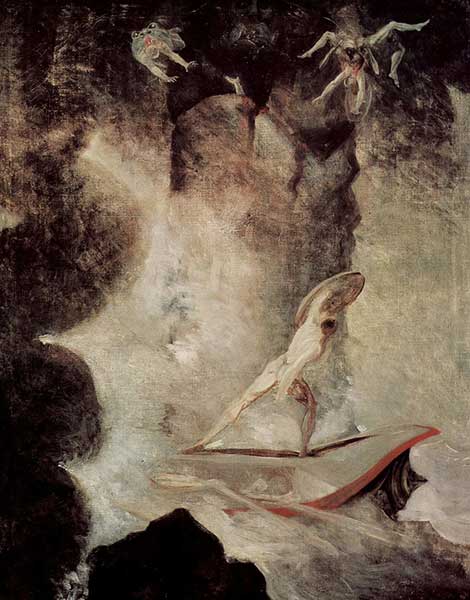
Henry Fuseli's painting of Odysseus facing the choice between Scylla and Charybdis, 1794-1796.
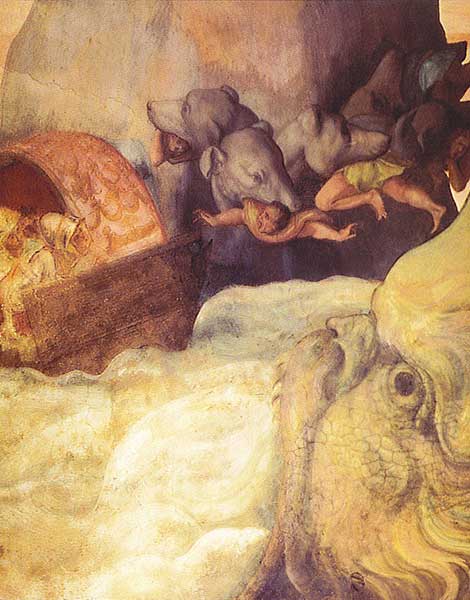
Top, each of Scylla's heads plucks a mariner from the deck; bottom right, Charybdis tries to swallow the whole vessel. Italian fresco.
If the Sirens test restraint, what follows tests something harder: the acceptance of loss. The narrow strait between Scylla and Charybdis (also Book XII) is most widely accepted as the Strait of Messina, between Sicily and the toe of mainland Italy. Here, Odysseus faces an impossible choice. On one side lurks Scylla, a six-headed monster hidden in the cliffs; on the other, Charybdis, a devouring whirlpool. Circe has already told him the truth: he cannot escape both. As they pass, Scylla snatches six men from the deck, “for with each head she carries off a man, snatching him from the dark-prowed ship” (XII.99–100). There is no clever solution here – only sacrifice; the lesser of two evils.
The final catastrophe comes swiftly. On the island of Thrinacia (Book XII), often identified with Sicily – known in antiquity as Trinacria, the “three-cornered” island – graze the sacred cattle of the sun god Helios. Odysseus remembers the warning. His men, starving and desperate, do not. Better to die at sea than to starve, Eurylochus argues (XII.340–352) – and the cattle are duly slaughtered. Zeus’ punishment is immediate. A thunderbolt strikes the ship, shattering it. All are lost.
All but one.
From this point on, the journey is no longer a voyage, but a desperate struggle for survival. Odysseus drifts alone across the sea for nine days before reaching Ogygia (Book V), the remote island of the nymph Calypso, daughter of the Titan Atlas. Its location is uncertain – although a Hellenistic tradition associated with Callimachus, and discussed by Strabo, identified Ogygia with “Gaulos,” modern-day Gozo in the Maltese archipelago. Others suggest locations in the Ionian Sea, northwest of Corfu (the island of Othonoi).
Calypso offers Odysseus immortality: to remain forever, ageless, untouched by suffering. And yet, each day he sits on the shore, weeping – “his eyes were never dry of tears” (V.151) – gazing out to sea and longing for home. When release finally comes, he firmly refuses her offer. Mortal life, with all its hardship, is preferable to eternal exile.
After seven years on Calypso’s island, his final passage brings him back into the human world – out of myth, and into society once more. “Woe is me, to the land of what mortals am I now come?” (XIII.200). Shipwrecked again, he is cast ashore in Phaeacia, often identified with Corfu. Here, among a people famed for their seafaring, Odysseus is received with ideal hospitality. In the court of the kindly King Alcinous, he recounts his journey – transforming experience into story. At last, the Phaeacians carry him home, asleep, across the final stretch of sea.
And so, in Book XIII, after twenty years, he arrives on the shores of Ithaca.
The island – modern Ithaki, in the Ionian Sea – is real, rugged, and unassuming, though its identification as the island of Odysseus is not without debate. But the homecoming is anything but simple. Disguised as a beggar, Odysseus must reclaim his place in a household overrun by suitors. Only after trials, recognition, and violence does order return. When he strings his bow and sends an arrow clean through twelve axe heads, the moment is unmistakable – the big reveal. “Here is a clear end to the contest. Now I’ll see if I can hit another target no man has as yet, and may Apollo grant my prayer!” (XXII.1-2).
After twenty years, the journey is complete.
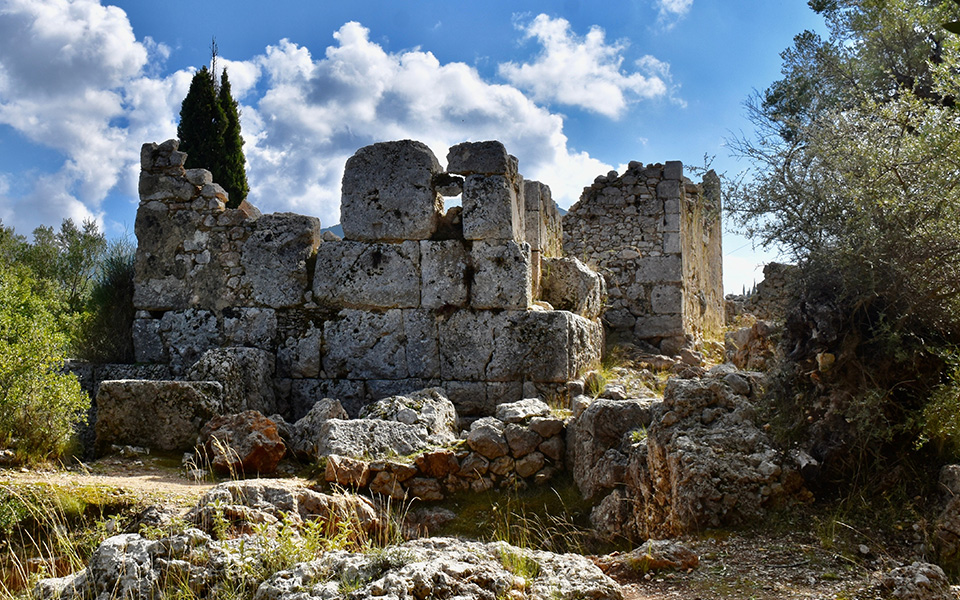
“The School of Homer” – a possible candidate for site of the Odysseus' palace.
© Shutterstock
So, can we map Odysseus’ journey? Yes – and no. We can trace plausible routes across the Aegean from Troy, down toward North Africa, up to southern Italy and Sicily, and through the straits and channels that challenge sailors even today. Stand above the Tyrrhenian Sea and imagine Circe’s palace, or listen to the wind along the Amalfi Coast and catch an echo of the Sirens’ song.
Modern historian and adventurer Tim Severin, ever the pragmatist, takes this a step further in “The Ulysses Voyage” (2000) – placing many of the “Odyssey’s” locations much closer to home, within the waters of Greece itself. He points in particular to the deeply indented coastline of the western mainland and its offshore islands. The Ambracian Gulf, with its maze of inlets and islets, has been proposed as a setting for episodes such as the Sirens, the Wandering Rocks, and even Scylla and Charybdis (perhaps echoed in Cape Skilla), while nearby Lefkada has been suggested as a candidate for the island of Helios’ cattle.
And yet, at some point, the effort to pin these places down to actual locations on the map begins to give way. The “Odyssey” is not simply a record of movement through space. It is a story about dislocation, temptation, endurance, and return. Geography stretches to serve those themes, blending real landscapes with imagined ones, memory with invention. Scholars have described this as a kind of territory without a map – a world composed of “imaginative renderings of actual places” (Blankenborg, 2020).
Perhaps that is why we keep retracing Odysseus’ steps – not to fix them once and for all, but to travel them again, each time tracing a slightly different line between myth and reality.
Christopher Nolan's The Odyssey is already...

In Homer’s “Odyssey,” the farther Odysseus...

From the pine-covered shores of Skopelos...

In Homer’s “Odyssey,” the journey is...